Page 294 of 448

CAUTION!
•The TPMS has been optimized for the original
equipment tires and wheels. TPMS pressures and
warning have been established for the tire size
equipped on your vehicle. Undesirable system
operation or sensor damage may result when us-
ing replacement equipment that is not of the same
size, type, and/or style. Aftermarket wheels can
cause sensor damage. Do not use aftermarket tire
sealants or balance beads if your vehicle is
equipped with a TPMS, as damage to the sensors
may result.
•After inspecting or adjusting the tire pressure,
always reinstall the valve stem cap. This will
prevent moisture and dirt from entering the valve
stem, which could damage the Tire Pressure Moni-
toring Sensor.NOTE:
•The TPMS is not intended to replace normal tire care
and maintenance, or to provide warning of a tire
failure or condition.
•The TPMS should not be used as a tire pressure gauge
while adjusting your tire pressure.
•Driving on a significantly under-inflated tire causes
the tire to overheat and can lead to tire failure.
Under-inflation also reduces fuel efficiency and tire
tread life, and may affect the vehicle’s handling and
stopping ability.
•The TPMS is not a substitute for proper tire mainte-
nance, and it is the driver ’s responsibility to maintain
correct tire pressure using an accurate tire pressure
gauge, even if under-inflation has not reached the
level to trigger illumination of the “Tire Pressure
Monitoring Telltale Light.”
5
STARTING AND OPERATING 293
Page 295 of 448

•Seasonal temperature changes will affect tire pressure,
and the TPMS will monitor the actual tire pressure in
the tire.
Base System
The Tire Pressure Monitor System (TPMS) uses wireless
technology with wheel rim mounted electronic sensors to
monitor tire pressure levels. Sensors, mounted to each
wheel as part of the valve stem, transmit tire pressure
readings to the Receiver Module.
NOTE:It is particularly important for you to check the
tire pressure in all of the tires on your vehicle monthly
and to maintain the proper pressure.
The TPMS consists of the following components:
•Receiver Module
•Four Tire Pressure Monitoring Sensors
•Tire Pressure Monitoring Telltale Light
Tire Pressure Monitoring Low Pressure Warnings
The “Tire Pressure Monitoring Telltale Light” will
illuminate in the instrument cluster and a chime
will sound when tire pressure is low in one or
more of the four active road tires. Should this occur, you
should stop as soon as possible, check the inflation
pressure of each tire on your vehicle, and inflate each tire
to the vehicle’s recommended cold placard pressure
value. Once the system receives the updated tire pres-
sures, the system will automatically update and the “Tire
Pressure Monitoring Telltale Light” will turn off. The
vehicle may need to be driven for up to 20 minutes above
15 mph (25 km/h) in order for the TPMS to receive this
information.
Check TPMS Warning
The “Tire Pressure Monitoring Telltale Light” will flash
on and off for 75 seconds and then remain on solid when
a system fault is detected. The system fault will also
sound a chime. If the ignition key is cycled, this sequence
294 STARTING AND OPERATING
Page 298 of 448
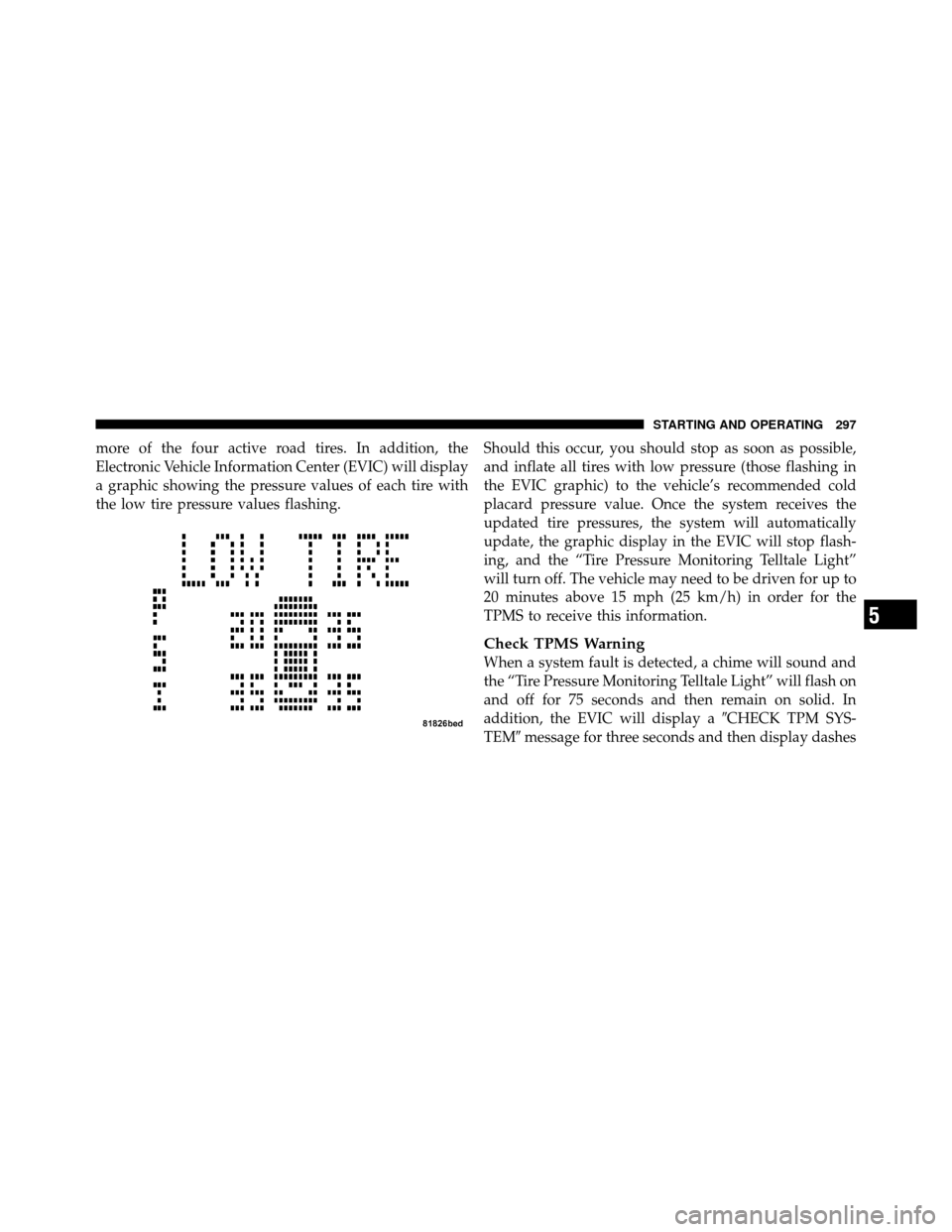
more of the four active road tires. In addition, the
Electronic Vehicle Information Center (EVIC) will display
a graphic showing the pressure values of each tire with
the low tire pressure values flashing.Should this occur, you should stop as soon as possible,
and inflate all tires with low pressure (those flashing in
the EVIC graphic) to the vehicle’s recommended cold
placard pressure value. Once the system receives the
updated tire pressures, the system will automatically
update, the graphic display in the EVIC will stop flash-
ing, and the “Tire Pressure Monitoring Telltale Light”
will turn off. The vehicle may need to be driven for up to
20 minutes above 15 mph (25 km/h) in order for the
TPMS to receive this information.
Check TPMS Warning
When a system fault is detected, a chime will sound and
the “Tire Pressure Monitoring Telltale Light” will flash on
and off for 75 seconds and then remain on solid. In
addition, the EVIC will display a
�CHECK TPM SYS-
TEM� message for three seconds and then display dashes
5
STARTING AND OPERATING 297
Page 322 of 448
WARNING! (Continued)
3. GAWR
4. Trailer tongue weight rating for the trailer hitch
utilized (This requirement may limit the ability to
always achieve 10% of trailer tongue weight as a
percentage of total trailer weight).
Towing Requirements – Tires
•
Do not attempt to tow a trailer while using a compact
spare tire.
•Proper tire inflation pressures are essential to the safe
and satisfactory operation of your vehicle. Refer to
“Tires – General Information” in “Starting and Oper-
ating” for proper tire inflation procedures.
•Check the trailer tires for proper tire inflation pres-
sures before trailer usage.
•Check for signs of tire wear or visible tire damage
before towing a trailer. Refer to “Tires – General
Information” in “Starting and Operating” for informa-
tion on tread wear indicators and for proper inspection
procedure.
•When replacing tires, refer to “Tires – General Infor-
mation” in “Starting and Operating” for information
on replacement tires and for proper tire replacement
procedures. Replacing tires with a higher load carry-
ing capacity will not increase the vehicle’s GVWR and
GAWR limits.
Towing Requirements – Trailer Brakes
•
Donot interconnect the hydraulic brake system or
vacuum system of your vehicle with that of the trailer.
This could cause inadequate braking and possible
personal injury.
5
STARTING AND OPERATING 321
Page 332 of 448
WARNING! (Continued)
•Always park on a firm, level surface as far from
the edge of the roadway as possible before raising
the vehicle.
•Block the wheel diagonally opposite the wheel to
be raised.
•Set the parking brake firmly and set an automatic
transmission in PARK; a manual transmission in
REVERSE.
•Never start or run the engine with the vehicle on a
jack.
•Do not let anyone sit in the vehicle when it is on a
jack.
•Do not get under the vehicle when it is on a jack.
•Only use the jack in the positions indicated and
for lifting this vehicle during a tire change.(Continued)
WARNING! (Continued)
•If working on or near a roadway, be extremely
careful of motor traffic.
•To assure that spare tires, flat or inflated, are
securely stowed, spares must be stowed with the
valve stem facing the ground.
•Turn on the Hazard Warning flasher.
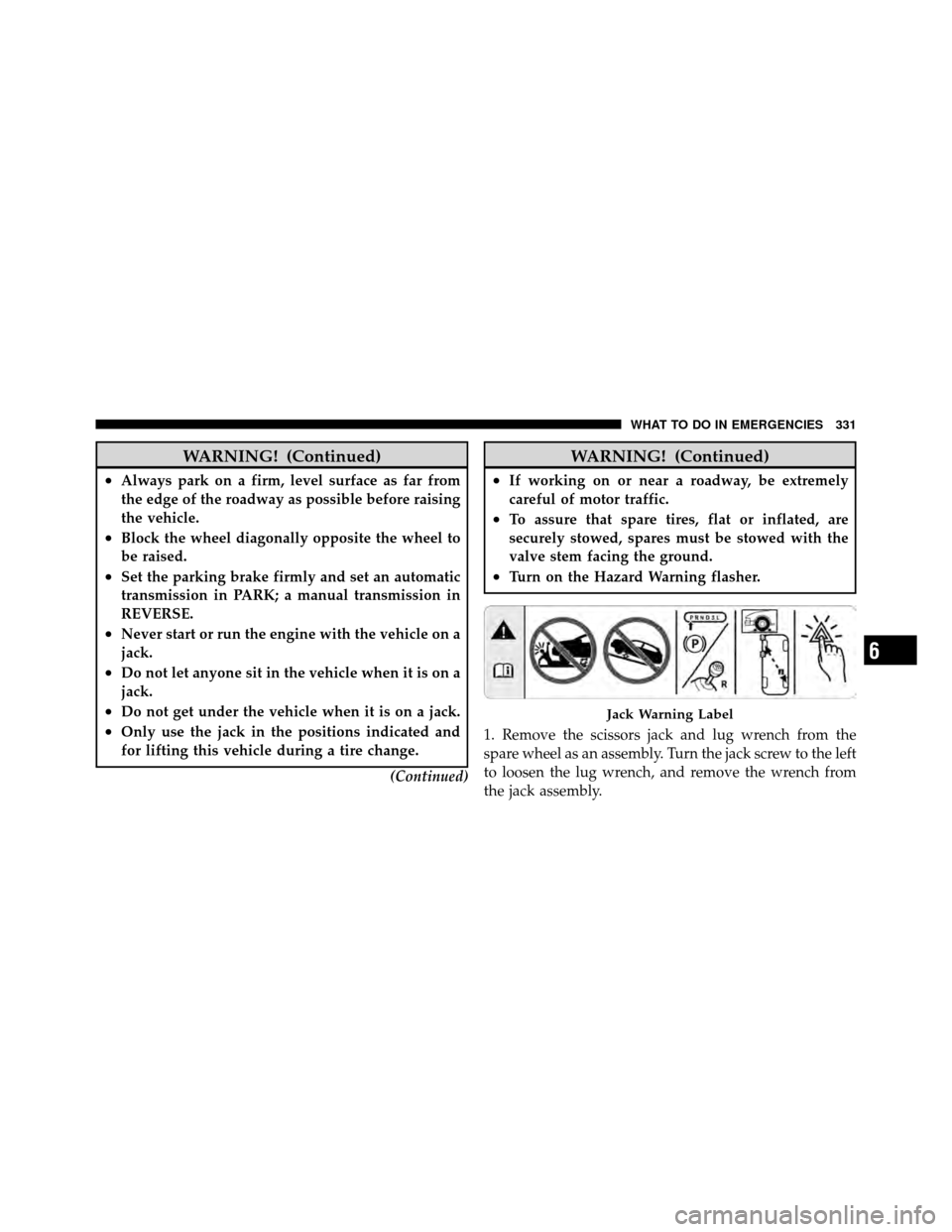
1. Remove the scissors jack and lug wrench from the
spare wheel as an assembly. Turn the jack screw to the left
to loosen the lug wrench, and remove the wrench from
the jack assembly.
Jack Warning Label
6
WHAT TO DO IN EMERGENCIES 331
Page 336 of 448

WARNING!
A loose tire or jack thrown forward in a collision or
hard stop could endanger the occupants of the ve-
hicle. Always stow the jack parts and the spare tire in
the places provided.
10. Place the deflated (flat) tire in the cargo area and have
the tire repaired or replaced as soon as possible.
WARNING!
A loose tire thrown forward in a collision or hard
stop could injure the occupants in the vehicle. Have
the deflated (flat) tire repaired or replaced immedi-
ately.
11. Check the tire pressure as soon as possible. Correct
the tire pressure as required.
JUMP-STARTING
If your vehicle has a discharged battery it can be jump-
started using a set of jumper cables and a battery in
another vehicle or by using a portable battery booster
pack. Jump-starting can be dangerous if done improperly
so please follow the procedures in this section carefully.
NOTE: When using a portable battery booster pack
follow the manufacturer’s operating instructions and
precautions.
CAUTION!
Do not use a portable battery booster pack or any
other booster source with a system voltage greater
than 12 Volts or damage to the battery, starter motor,
alternator or electrical system may occur.
6
WHAT TO DO IN EMERGENCIES 335
Page 427 of 448
Temperature Grades
The temperature grades are A (the highest), B, and C,
representing the tire’s resistance to the generation of heat
and its ability to dissipate heat, when tested under
controlled conditions on a specified indoor laboratory
test wheel. Sustained high temperature can cause the
material of the tire to degenerate and reduce tire life, and
excessive temperature can lead to sudden tire failure. The
grade C corresponds to a level of performance, which all
passenger car tires must meet under the Federal Motor
Vehicle Safety Standard No. 109. Grades B and A repre-
sent higher levels of performance on the laboratory test
wheel, than the minimum required by law.WARNING!
The temperature grade for this tire is established for
a tire that is properly inflated and not overloaded.
Excessive speed, under-inflation, or excessive load-
ing, either separately or in combination, can cause
heat buildup and possible tire failure.
426 IF YOU NEED CONSUMER ASSISTANCE
Page 431 of 448

Caps, FillerFuel ............................... 309
Oil (Engine) .................. 347,348,349,356
Power Steering ........................ 259
Radiator (Coolant Pressure) ............... 369
Car Washes ............................ 378
Carbon Monoxide Warning ...............81,304
Cargo Area Features ...................... 135
Cargo Compartment ...................... 135
Cargo Load Floor ........................ 135
Cargo (Vehicle Loading) ................... 135
Cellular Phone ........................ 93,224
Center High Mounted Stop Light ............ 394
Chains, Tire ............................ 289
Changing A Flat Tire ..................... 329
Chart, Tire Sizing ........................ 274
Check Engine Light
(Malfunction Indicator Light) ............... 351
Checking Your Vehicle For Safety ............. 80Checks, Safety
........................... 80
Child Restraint .................... 69,71,75,78
Child Restraint Tether Anchors .............73,75
Child Safety Locks ........................ 32
Cigar Lighter ........................... 132
Clean Air Gasoline ....................... 301
Cleaning Wheels ............................. 379
Windshield Wiper Blades ................ 363
Climate Control ......................... 224
Clock ..................... 176,190,192,195,204
Coin Holder ........................... 136
Compact Disc (CD) Maintenance ............. 224
Compact Spare Tire ...................... 285
Compass .............................. 169
Compass Calibration ..................... 169
Compass Variance ....................... 170
Computer, Trip/Travel .................. 19,167
Console ............................ 104,136
Console, Floor ....................... 104,136
430 INDEX