Page 74 of 444

CAUTION!
When your child restraint is not in use, secure it in
the vehicle with the seat belt or remove it from the
vehicle. Don’t leave it loose in the vehicle. In a
sudden stop or collision, it could strike the occupants
or seatbacks and cause serious personal injury.
NOTE: For additional information, refer to
www.seatcheck.org or call 1–866–SEATCHECK. Cana-
dian residents, should refer to Transport Canada’s web-
site for additional information. http://www.tc.gc.ca/
roadsafety/safedrivers/childsafety/index.htm
Lower Anchors and Tether for CHildren (LATCH)
Your vehicle is equipped with the child restraint anchor-
age system called LATCH, which stands for Lower
Anchors and Tether for CHildren. The LATCH system
provides for the installation of the child restraint without
using the vehicle seat belt. All rear seating positions have lower anchorages that are capable of accommodating
LATCH-compatible child seats having flexible, webbing-
mounted lower attachments. Child seats with fixed lower
attachments must be installed in the outboard positions
only. Regardless of the specific type of lower attachment,
NEVER
install LATCH-compatible child seats such that
two seats share a common lower anchorage. If you are
installing LATCH-compatible child restraints in adjacent
rear seating positions, you can use the LATCH anchors or
the vehicle’s seat belt for the outboard position, but you
must use the vehicle’s seat belt at the center position. If
your child restraints are not LATCH-compatible, you can
only install the child restraints using the vehicle’s seat
belts. For typical installation instructions, refer to “In-
stalling the LATCH-Compatible Child Restraint System”.
Rear Seat LATCH Anchors
Child restraints systems having attachments designed to
connect to the lower anchorages are now available. Child
restraints having tether straps and hooks for connection
2
THINGS TO KNOW BEFORE STARTING YOUR VEHICLE 73
Page 78 of 444
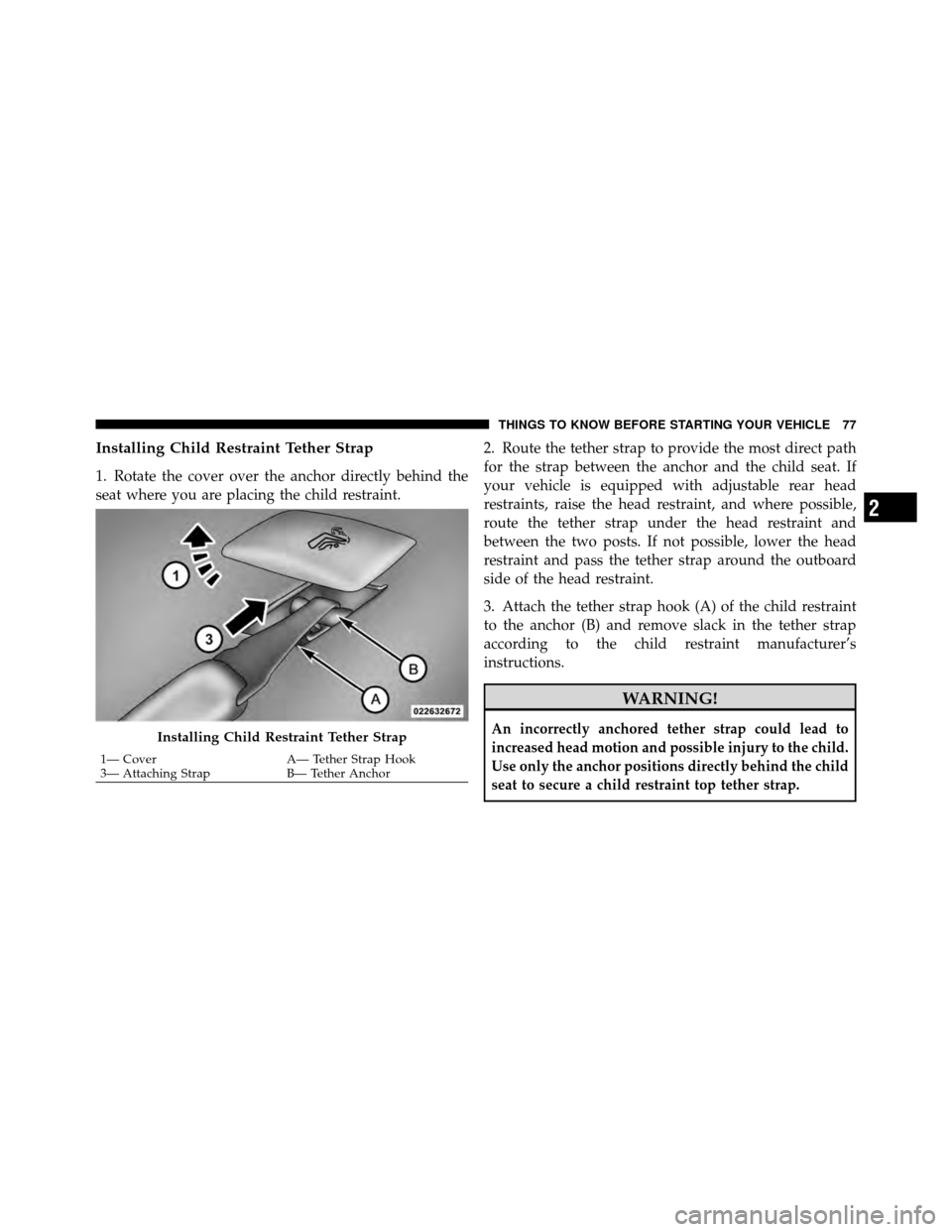
Installing Child Restraint Tether Strap
1. Rotate the cover over the anchor directly behind the
seat where you are placing the child restraint.2. Route the tether strap to provide the most direct path
for the strap between the anchor and the child seat. If
your vehicle is equipped with adjustable rear head
restraints, raise the head restraint, and where possible,
route the tether strap under the head restraint and
between the two posts. If not possible, lower the head
restraint and pass the tether strap around the outboard
side of the head restraint.
3. Attach the tether strap hook (A) of the child restraint
to the anchor (B) and remove slack in the tether strap
according to the child restraint manufacturer’s
instructions.
WARNING!
An incorrectly anchored tether strap could lead to
increased head motion and possible injury to the child.
Use only the anchor positions directly behind the child
seat to secure a child restraint top tether strap.Installing Child Restraint Tether Strap
1— Cover
A— Tether Strap Hook
3— Attaching Strap B— Tether Anchor
2
THINGS TO KNOW BEFORE STARTING YOUR VEHICLE 77
Page 79 of 444
Installing Child Restraints Using the Vehicle Seat
Belts
The passenger seat belts are equipped with Automatic
Locking Retractors (ALRs), which are designed to keep
the lap portion tight around the child restraint.
The seat belt must be in the Automatic Locking Mode in
order to enable a child restraint to be tightly installed.
Refer to “Automatic Locking Mode” for further informa-
tion. A locking clip should not be necessary once the
automatic locking feature is enabled. Position the shoul-
der and lap belt on the child restraint. The Automatic
Locking Retractor (ALR) is activated by first attaching
the child seat, then pulling all of the webbing out of the
retractor, then allowing the webbing to retract. As the
webbing retracts, you will hear a clicking sound. This
indicates the safety belt is now in the Automatic Locking
Mode. To release, simply unbuckle the seat belt by
depressing the button, and allow the webbing to retract
into the retractor.In the rear seat, you may have trouble tightening the
lap/shoulder belt on the child restraint because the
buckle or latch plate is too close to the belt path opening
on the restraint. Disconnect the latch plate from the
buckle and twist the short buckle-end belt several times
to shorten it. Insert the latch plate into the buckle with the
release button facing out.
If the belt still can’t be tightened, or if pulling and
pushing on the restraint loosens the belt, you may need
to do something more. Disconnect the latch plate from
the buckle, turn the buckle around, and insert the latch
plate into the buckle again. If you still can’t make the
child restraint secure, try a different seating position.
78 THINGS TO KNOW BEFORE STARTING YOUR VEHICLE
Page 80 of 444

Children Too Large for Booster Seats
Children who are large enough to wear the shoulder belt
comfortably, and whose legs are long enough to bend
over the front of the seat when their back is against the
seatback, should use the lap/shoulder belt in a rear seat.
Make sure that:
•The child is upright in the seat.
•The lap portion should be low on the hips and as snug
as possible.
•Check belt fit periodically. A child’s squirming or
slouching can move the belt out of position.
•If the shoulder belt contacts the face or neck, move the
child closer to the center of the vehicle. Never allow a
child to put the shoulder belt under an arm or behind
their back.
Transporting Pets
Airbags deploying in the front seat could harm your pet.
An unrestrained pet will be thrown about and possibly
injured, or injure a passenger during panic braking or in
a collision.
Pets should be restrained in the rear seat in pet harnesses
or pet carriers that are secured by seat belts.
ENGINE BREAK-IN RECOMMENDATIONS
A long break-in period is not required for the engine and
drivetrain (transmission and axle) in your vehicle.
Drive moderately during the first 300 miles (500 km).
After the initial 60 miles (100 km), speeds up to 50 or
55 mph (80 or 90 km/h) are desirable.
While cruising, brief full-throttle acceleration within the
limits of local traffic laws, contributes to a good break-in.
Wide-open throttle acceleration in low gear can be detri-
mental and should be avoided.
2
THINGS TO KNOW BEFORE STARTING YOUR VEHICLE 79
Page 83 of 444
Safety Checks You Should Make Inside the
Vehicle
Seat Belts
Inspect the belt system periodically, checking for cuts,
frays, and loose parts. Damaged parts must be replaced
immediately. Do not disassemble or modify the system.
Front seat belt assemblies must be replaced after a
collision. Rear seat belt assemblies must be replaced after
a collision if they have been damaged (i.e., bent retractor,
torn webbing, etc.). If there is any question regarding belt
or retractor condition, replace the belt.
Airbag Warning Light
The light should come on and remain on for four to eight
seconds as a bulb check when the ignition switch is first
turned ON. If the light is not lit during starting, see your
authorized dealer. If the light stays on, flickers, or comes
on while driving, have the system checked by an autho-
rized dealer.
Defroster
Check operation by selecting the defrost mode and place
the blower control on high speed. You should be able to
feel the air directed against the windshield. See your
authorized dealer for service if your defroster is
inoperable.
Floor Mat Safety Information
Always use floor mats designed to fit the foot well of
your vehicle. Use only floor mats that leave the pedal
area unobstructed and that are firmly secured so that
they cannot slip out of position and interfere with the
pedals or impair safe operation of your vehicle in other
ways.
82 THINGS TO KNOW BEFORE STARTING YOUR VEHICLE
Page 84 of 444
WARNING!
Pedals that cannot move freely can cause loss of
vehicle control and increase the risk of serious per-
sonal injury.
•Always make sure that floor mats are properly
attached to the floor mat fasteners.
•Never place or install floor mats or other floor
coverings in the vehicle that cannot be properly
secured to prevent them from moving and inter-
fering with the pedals or the ability to control the
vehicle.
•Never put floor mats or other floor coverings on
top of already installed floor mats. Additional
floor mats and other coverings will reduce the size
of the pedal area and interfere with the pedals.(Continued)
WARNING! (Continued)
•Check mounting of mats on a regular basis. Al-
ways properly reinstall and secure floor mats that
have been removed for cleaning.
•Always make sure that objects cannot fall into the
driver foot well while the vehicle is moving.
Objects can become trapped under the brake pedal
and accelerator pedal causing a loss of vehicle
control.
•If required, mounting posts must be properly
installed, if not equipped from the factory.
Failure to properly follow floor mat installation or
mounting can cause interference with the brake
pedal and accelerator pedal operation causing loss
of control of the vehicle.
2
THINGS TO KNOW BEFORE STARTING YOUR VEHICLE 83
Page 88 of 444
�Electronic Speed Control ................ 117
▫ To Activate ......................... 117
▫ To Set a Desired Speed ................ 118
▫ To Deactivate ....................... 118
▫ To Resume Speed .................... 118
▫ To Vary The Speed Setting .............. 118
▫ To Accelerate For Passing .............. 119
� Garage Door Opener — If Equipped ........ 120
▫ Programming HomeLink� .............. 121
▫ Gate Operator/Canadian Programming .... 124
▫ Security ........................... 125
▫ Troubleshooting Tips .................. 125
▫ General Information .................. 126 �
Power Sunroof — If Equipped ............ 126
▫ Sunroof Operation ................... 127
▫ Auto Sunroof Express With Anti-Pinch
Protection — If Equipped .............. 128
▫ Sunshade Operation .................. 128
▫ Wind Buffeting ...................... 128
▫ Sunroof Maintenance ................. 128
▫ Ignition Off Operation ................. 129
� Electrical Power Outlets ................. 129
� Cigar Lighter And Ash Receiver —
If Equipped .......................... 131
� Cupholders .......................... 132
▫ Front Seat Cupholders ................. 132
3
UNDERSTANDING THE FEATURES OF YOUR VEHICLE 87
Page 105 of 444
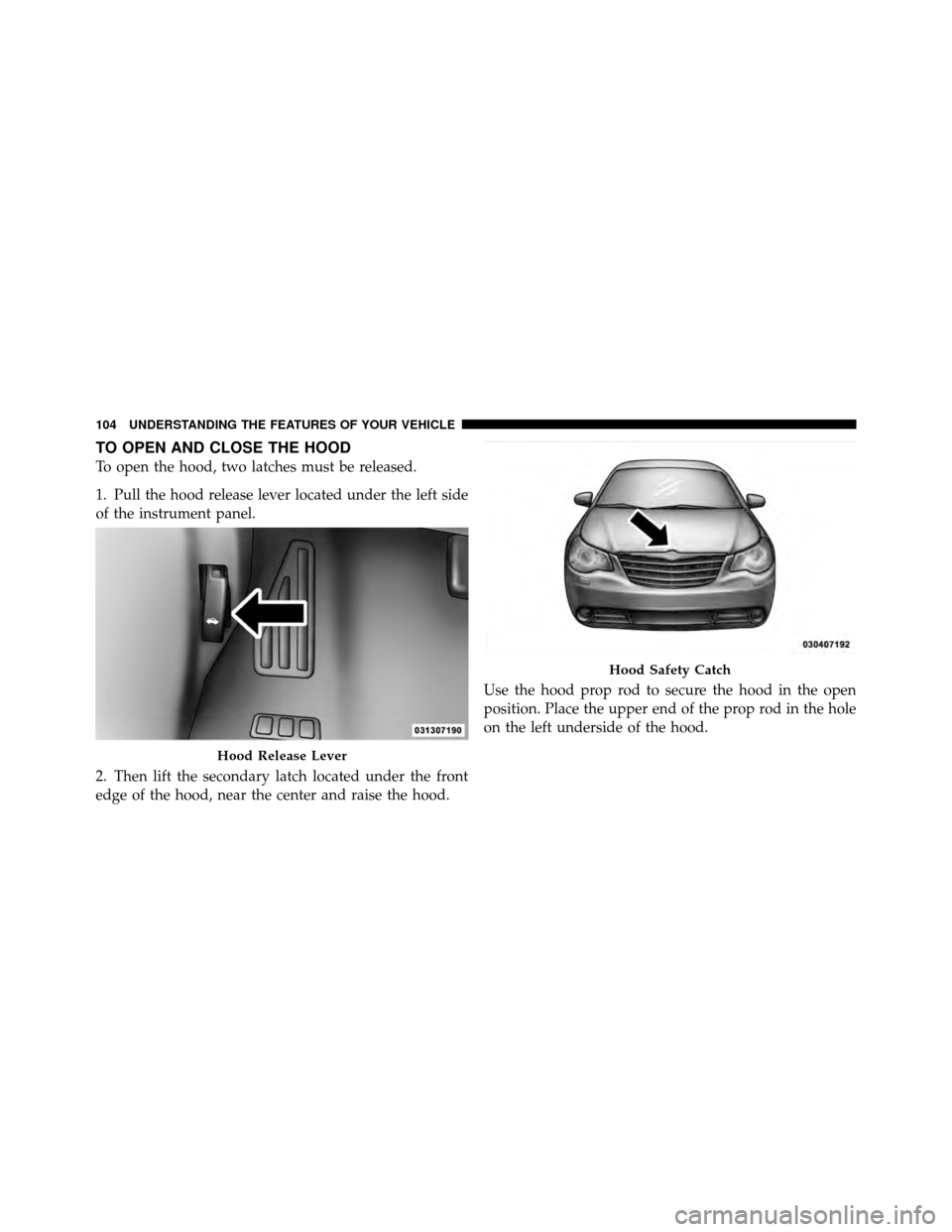
TO OPEN AND CLOSE THE HOOD
To open the hood, two latches must be released.
1. Pull the hood release lever located under the left side
of the instrument panel.
2. Then lift the secondary latch located under the front
edge of the hood, near the center and raise the hood.Use the hood prop rod to secure the hood in the open
position. Place the upper end of the prop rod in the hole
on the left underside of the hood.
Hood Release Lever
Hood Safety Catch
104 UNDERSTANDING THE FEATURES OF YOUR VEHICLE