Page 353 of 457

ONBOARD DIAGNOSTIC SYSTEM — OBD II
Your vehicle is equipped with a sophisticated Onboard
Diagnostic system called OBD II. This system monitors
the performance of the emissions, engine, and automatic
transmission control systems. When these systems are
operating properly, your vehicle will provide excellent
performance and fuel economy, as well as maintaining
engine emissions well within current government regu-
lations.
If any of these systems require service, the OBD II system
will turn on the Malfunction Indicator Light (MIL). It will
also store diagnostic codes and other information to
assist an authorized service technician in making repairs.
Although your vehicle will usually be drivable and not
need towing, see your authorized dealer for service as
soon as possible.CAUTION!
•Prolonged driving with the “Malfunction Indica-
tor Light” on could cause further damage to the
emission control system. It could also affect fuel
economy and driveability. The vehicle must be
serviced before any emissions tests can be per-
formed.
•If the “Malfunction Indicator Light” is flashing
while the engine is running, severe catalytic con-
verter damage and power loss will soon occur.
Immediate service is required.
Loose Fuel Filler Cap Message
After fuel is added, the vehicle diagnostic system can
determine if the fuel filler cap is possibly loose or
improperly installed. A “GASCAP” message will be
displayed in the instrument cluster. Tighten the gas cap
until a\bclicking\b sound is heard. This is an indication that
352 MAINTAINING YOUR VEHICLE
Page 377 of 457
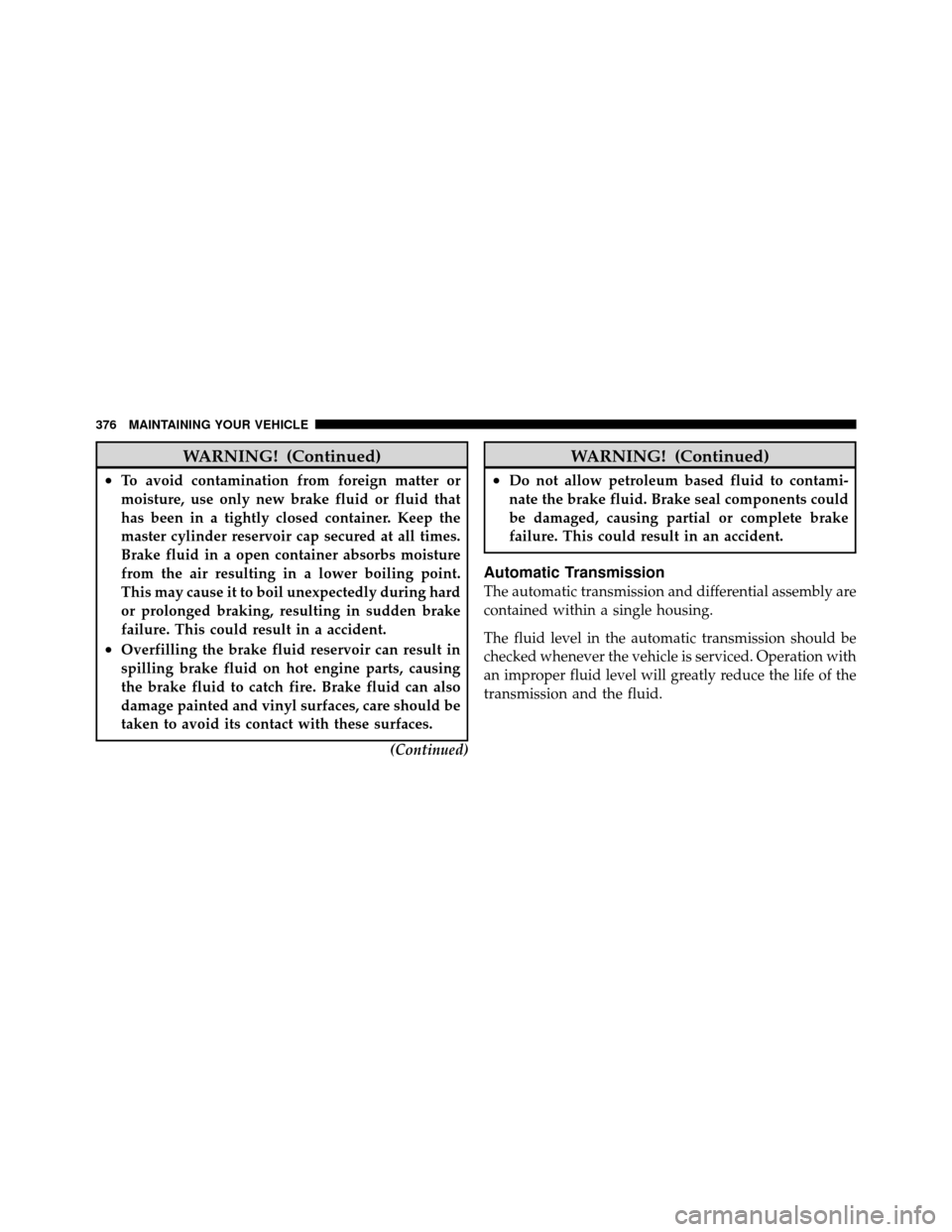
WARNING! (Continued)
•To avoid contamination from foreign matter or
moisture, use only new brake fluid or fluid that
has been in a tightly closed container. Keep the
master cylinder reservoir cap secured at all times.
Brake fluid in a open container absorbs moisture
from the air resulting in a lower boiling point.
This may cause it to boil unexpectedly during hard
or prolonged braking, resulting in sudden brake
failure. This could result in a accident.
•Overfilling the brake fluid reservoir can result in
spilling brake fluid on hot engine parts, causing
the brake fluid to catch fire. Brake fluid can also
damage painted and vinyl surfaces, care should be
taken to avoid its contact with these surfaces.(Continued)
WARNING! (Continued)
•Do not allow petroleum based fluid to contami-
nate the brake fluid. Brake seal components could
be damaged, causing partial or complete brake
failure. This could result in an accident.
Automatic Transmission
The automatic transmission and differential assembly are
contained within a single housing.
The fluid level in the automatic transmission should be
checked whenever the vehicle is serviced. Operation with
an improper fluid level will greatly reduce the life of the
transmission and the fluid.
376 MAINTAINING YOUR VEHICLE
Page 378 of 457

Fluid Level Check – 2.4L and 2.7L Engines
Use the following procedure to check the automatic
transmission fluid level properly:
1. Park the vehicle on level ground.
2. Run the engine at curb idle speed for a minimum of
60 seconds.
3. Apply the parking brake fully.
4. Place the shift lever momentarily into each gear posi-
tion ending with the lever in PARK.
5. Wipe the area around the dipstick clean to eliminate
the possibility of dirt entering the transmission.
6. Remove the dipstick and determine if the fluid is hot
or cold. Hot fluid is approximately 180°F (82° C), which
is the normal operating temperature after the vehicle isdriven at least 15 miles (24 km). Hot fluid cannot be held
comfortably between the fingertips. Cold fluid is at a
temperature below 80°F (27° C).
7. Wipe the dipstick clean and reinsert until seated. Then,
remove dipstick and note the reading.
a. If the fluid is hot, the reading should be in the
crosshatched area marked “HOT” (between the upper
two holes in the dipstick).
b. If the fluid is cold, the fluid level should be between
the lower two holes in the area marked “COLD.”
If the fluid level is low, add sufficient fluid through the
filler (dipstick) tube to bring it to the proper level. Do not
overfill.
7
MAINTAINING YOUR VEHICLE 377
Page 379 of 457

CAUTION!
•Using a transmission fluid other than the manu-
facturer’s recommended fluid may cause deterio-
ration in transmission shift quality and/or torque
converter shudder. Using a transmission fluid
other than that recommended by the manufacturer
will result in more frequent fluid and filter
changes. Refer to “Fluids, Lubricants, and Genu-
ine Parts” in “Maintaining Your Vehicle” for fur-
ther information.
•Dirt and water in the transmission can cause
serious damage. To prevent dirt and water from
entering the transmission after checking or replen-
ishing fluid, make certain that the dipstick cap is
re-seated properly.
Fluid Level Check – 3.5L Engine
The automatic transmission has no dipstick and is dealer
serviced only.
Transmission Fluid and Filter Changes
Refer to “Maintenance Schedule” for further information.
In addition, change the fluid and filter if the transmission
is disassembled for any reason.
Special Additives
Automatic Transmission Fluid (ATF) is an engineered
product and its performance may be impaired by supple-
mental additives. Therefore, do not add any fluid addi-
tives to the transmission. The only exception to this
policy is the use of special dyes to aid in detecting fluid
leaks. In addition, avoid using transmission sealers as
they may adversely affect seals.
378 MAINTAINING YOUR VEHICLE
Page 406 of 457
Chassis
ComponentFluid, Lubricant, or Genuine Part
Automatic Transmission MOPAR�
ATF+4�Automatic Transmission Fluid or equivalent licensed
ATF+4� product.
Brake Master Cylinder MOPAR�
DOT 3 and SAE J1703 should be used. If DOT 3 brake fluid is
not available, then DOT 4 is acceptable. Use only recommended brake
fluids.
Power Steering Reservoir MOPAR�
Power Steering Fluid +4, MOPAR� ATF+4�Automatic Trans-
mission Fluid or equivalent licensed ATF+4� product.
7
MAINTAINING YOUR VEHICLE 405
Page 416 of 457

54,000 Miles (90,000 km) or
54 Months Maintenance
Service Schedule
❏Change the engine oil and engine oil
filter.
❏ Rotate tires.
Odometer Reading Date
Repair Order #Dealer Code
Signature Authorized Chrysler Dealer
60,000 Miles (100,000 km) or 60 Months Maintenance Service
Schedule
❏Change the engine oil and engine oil filter.
❏ Rotate tires.
❏ Replace the engine air cleaner filter.
❏ Replace the spark plugs (2.4L Engine except PZEV*).
❏ Inspect the brake linings, and replace as necessary.
❏ Replace the air conditioning filter (if equipped).
❏ Change the automatic transmission fluid & filter if using your vehicle for any of the
following: police, taxi, fleet, or frequent trailer towing.
❏ Inspect the front suspension, tie rod ends and boot seals for cracks or leaks and all parts for
damage, wear, improper looseness or end play; replace if necessary.
❏ Adjust parking brake on vehicles equipped with four wheel disc brakes.
Odometer Reading Date
Repair Order #Dealer Code
Signature Authorized Chrysler Dealer
8
M
A I
N T
E
N A
N CE
S
C
H E
D
U L
E
SMAINTENANCE SCHEDULES 415
Page 421 of 457

114,000 Miles (190,000 km) or
114 Months Maintenance
Service Schedule
❏Change the engine oil and engine oil
filter.
❏ Rotate tires.
Odometer Reading Date
Repair Order #Dealer Code
Signature Authorized Chrysler Dealer
120,000 Miles (200,000 km) or 120 Months Maintenance Service
Schedule
❏Change the engine oil and engine oil filter.
❏ Rotate tires.
❏ Replace the engine air cleaner filter.
❏ Replace the spark plugs (2.4L Engine except PZEV*).
❏ Inspect the brake linings, and replace as necessary.
❏ Replace the air conditioning filter (if equipped).
❏ Inspect the CV joints.
❏ Inspect the exhaust system.
❏ Inspect the front suspension, tie rod ends and boot seals for cracks or leaks and all parts for
damage, wear, improper looseness or end play; replace if necessary.
❏ Change the automatic transmission fluid & filter.
❏ Adjust parking brake on vehicles equipped with four wheel disc brakes.
Odometer Reading Date
Repair Order #Dealer Code
Signature Authorized Chrysler Dealer
8
M
A I
N T
E
N A
N CE
S
C
H E
D
U L
E
S420 MAINTENANCE SCHEDULES
Page 454 of 457

Towing............................... 318
Disabled Vehicle ....................... 344
Guide .............................. 321
Recreational .......................... 328
Weight .............................. 321
Traction .............................. 260
Trailer Towing .......................... 318
Cooling System Tips .................... 328
Hitches ............................. 319
Minimum Requirements ................. 323
Trailer and Tongue Weight ............... 322
Trailer Towing Guide ..................... 321
Trailer Weight .......................... 321
Transaxle Additives ............................ 378
Automatic ...................... 247,250,376
Autostick ............................ 258
Filter ............................... 378
Maintenance ......................... 376 Operation
........................... 250
Overdrive ........................... 255
Selection of Lubricant ................... 405
Transmission ..................... See Transaxle
Transmitter Battery Service
(Remote Keyless Entry) .................... 26
Transmitter, Garage Door Opener
(HomeLink�) ........................... 138
Transmitter Programming
(Remote Keyless Entry) .................... 21
Transmitter, Remote Keyless Entry (RKE) ........ 21
Transporting Pets ........................ 76
Tread Wear Indicators .................... 291
Trip Odometer .......................... 162
Trip Odometer Reset Button ................ 165
Trunk Lid (Deck Lid) .................... 35,37
Trunk Release, Emergency .................. 37
Trunk Release Remote Control ............... 35
Turn Signals ................... 123,128,166,398
10
INDEX 453
Page:
< prev 1-8 9-16 17-24
