Page 11 of 368

�Remote Keyless Entry (RKE) .............. 20
▫ To Unlock The Doors And Liftgate ......... 20
▫ To Lock The Doors And Liftgate .......... 21
▫ To Turn Off “Flash Lights With Lock” ....... 22
▫ Panic Alarm ......................... 22
▫ To Program Additional Transmitters ........ 23
▫ General Information ................... 25
▫ Transmitter Battery Replacement .......... 25
� Door Locks ........................... 26
▫ Manual Door Locks ................... 26
▫ Power Door Locks .................... 28
▫ Child Protection Door Lock System — If
Equipped ........................... 30 �
Power Windows ....................... 31
▫ Auto-Down Feature ................... 32
▫ Rear Window Switches ................. 32
▫ Wind Buffeting ....................... 33
� Liftgate ............................. 33
� Occupant Restraints ..................... 34
▫ Lap/Shoulder Belts .................... 36
▫ Lap/Shoulder Seat Belt Untwisting
Procedure ........................... 42
▫ Adjustable Upper Shoulder Seat Belt
Anchorage .......................... 43
▫ Automatic Locking Retractors (ALR) Mode
— If Equipped ....................... 43
▫ Seat Belt Pretensioners — If Equipped ...... 44
10 THINGS TO KNOW BEFORE STARTING YOUR VEHICLE
Page 12 of 368
▫Enhanced Seat Belt Use Reminder System
(BeltAlert�) ......................... 44
▫ Seat Belts And Pregnant Women .......... 45
▫ Seat Belt Extender ..................... 46
▫ Driver And Front Passenger Supplemental
Restraint System (SRS) - Airbag ........... 46
▫ Event Data Recorder (EDR) .............. 62
▫ Child Restraints ...................... 64
▫ Transporting Pets ..................... 72 �
Engine Break-In Recommendations .......... 72
� Safety Tips ........................... 73
▫ Transporting Passengers ................ 73
▫ Exhaust Gas ......................... 74
▫ Safety Checks You Should Make Inside The
Vehicle ............................. 75
▫ Periodic Safety Checks You Should Make
Outside The Vehicle ................... 77
2
THINGS TO KNOW BEFORE STARTING YOUR VEHICLE 11
Page 25 of 368

2. Enter your vehicle and close all doors.
3. Fasten your seatbelt. (Fastening the seatbelt will cancel
any chimes that may confuse you during this program-
ming procedure.)
4. Place the key into the ignition.
5. Turn the ignition to the ON position.Do not start the
engine.
6. Press and hold the UNLOCK button on the RKE
transmitter.
7. After holding the UNLOCK button for four seconds,
also press the PANIC button within six seconds.
8. When a single chime is heard, release both buttons.
The chime is an indication that you have successfully
entered program mode. All RKE transmitters that are to
be programmed must be done so within 60 seconds of
when the chime was heard. 9. Using the RKE transmitter to be programmed, press
and release both the LOCK and UNLOCK buttons,
simultaneously.
10. A single chime will be heard.
11. Within four seconds of hearing the chime, press and
release the UNLOCK button on the RKE transmitter.
12. A single chime will be heard.
13. Repeat steps 8 through 10 to program up to six
additional RKE transmitters.
14. Turn the ignition to the OFF position.
15. Your vehicle will remain in program mode up to
60 seconds from when the original chime was heard.
After 60 seconds, all programmed RKE transmitters
function normally.
NOTE:
If you do not have a programmed RKE trans-
mitter, contact your authorized dealer for details.
24 THINGS TO KNOW BEFORE STARTING YOUR VEHICLE
Page 35 of 368
WARNING!
•Driving with the liftgate open can allow poison-
ous exhaust gases into your vehicle. You and your
passengers could be injured by these fumes. Keep
the liftgate closed when you are operating the
vehicle.
•If you are required to drive with the liftgate open,
make sure that all windows are closed, and the
climate control blower switch is set at HIGH
speed. DO NOT use the RECIRCULATION mode.
Gas props support the liftgate in the open position.
However, because the gas pressure drops with tempera-
ture, it may be necessary to assist the props when
opening the liftgate in cold weather.
OCCUPANT RESTRAINTS
Some of the most important safety features in your
vehicle are the restraint systems. These include:
•Three-point lap and shoulder belts for all seating
positions
•Advanced Front Airbags for driver and front passen-
ger
•Supplemental Seat-Mounted Side Airbags (SAB) — if
equipped
•An energy-absorbing steering column and steering
wheel
•Knee bolsters/blockers for front seat occupants
•Front seat belts incorporate pretensioners to enhance
occupant protection by managing occupant energy
during an impact event — if equipped
34 THINGS TO KNOW BEFORE STARTING YOUR VEHICLE
Page 36 of 368

•All seat belt systems (except the driver ’s) include
Automatic Locking Retractors (ALRs), which lock the
seat belt webbing into position by extending the belt
all the way out and then adjusting the belt to the
desired length to restrain a child seat or secure a large
item in a seat — if equipped
If you will be carrying children too small for adult-sized
seat belts, the seat belts or the Lower Anchors and Tether
for CHildren (LATCH) feature also can be used to hold
infant and child restraint systems. For more information
on LATCH, see Lower Anchors and Tether for CHildren
(LATCH).
NOTE: The Advanced Front Airbags have a multistage
inflator design. This allows the airbag to have different
rates of inflation based on the severity and type of
collision. Please pay close attention to the information in this
section. It tells you how to use your restraint system
properly, to keep you and your passengers as safe as
possible.
WARNING!
In a collision, you and your passengers can suffer
much greater injuries if you are not properly buckled
up. You can strike the interior of your vehicle or other
passengers, or you can be thrown out of the vehicle.
Always be sure you and others in your vehicle are
buckled up properly.
Buckle up even though you are an excellent driver, even
on short trips. Someone on the road may be a poor driver
and cause a collision that includes you. This can happen
far away from home or on your own street.
2
THINGS TO KNOW BEFORE STARTING YOUR VEHICLE 35
Page 37 of 368

Research has shown that seat belts save lives, and they
can reduce the seriousness of injuries in a collision. Some
of the worst injuries happen when people are thrown
from the vehicle. Seat belts reduce the possibility of
ejection and the risk of injury caused by striking the
inside of the vehicle.Everyone in a motor vehicle should
be belted at all times.
Lap/Shoulder Belts
All the seating positions in your vehicle are equipped
with combination lap/shoulder belts.
The belt webbing retractor is designed to lock during
very sudden stops or collisions. This feature allows the
shoulder part of the belt to move freely with you under
normal conditions. However, in a collision the belt will
lock and reduce the risk of you striking the inside of the
vehicle or being thrown out.
WARNING!
•It is dangerous to ride in a cargo area, inside or
outside of a vehicle. In a collision, people riding in
these areas are more likely to be seriously injured
or killed.
•Do not allow people to ride in any area of your
vehicle that is not equipped with seats and seat
belts.
•Be sure everyone in your vehicle is in a seat and
using a seat belt properly.
•Wearing a seat belt incorrectly is dangerous. Seat
belts are designed to go around the large bones of
your body. These are the strongest parts of your
body and can best take the forces of a collision.
(Continued)
36 THINGS TO KNOW BEFORE STARTING YOUR VEHICLE
Page 38 of 368
WARNING! (Continued)
•Wearing your belt in the wrong place could make
your injuries in a collision much worse. You might
suffer internal injuries, or you could even slide out
of part of the belt. Follow these instructions to
wear your seat belt safely and to keep your pas-
sengers safe, too.
•Two people should never be belted into a single
seat belt. People belted together can crash into one
another in a collision, hurting one another badly.
Never use a lap/shoulder belt or lap belt for more
than one person, no matter what their size.
Lap/Shoulder Belt Operating Instructions
1. Enter the vehicle and close the door. Sit back and
adjust the seat.
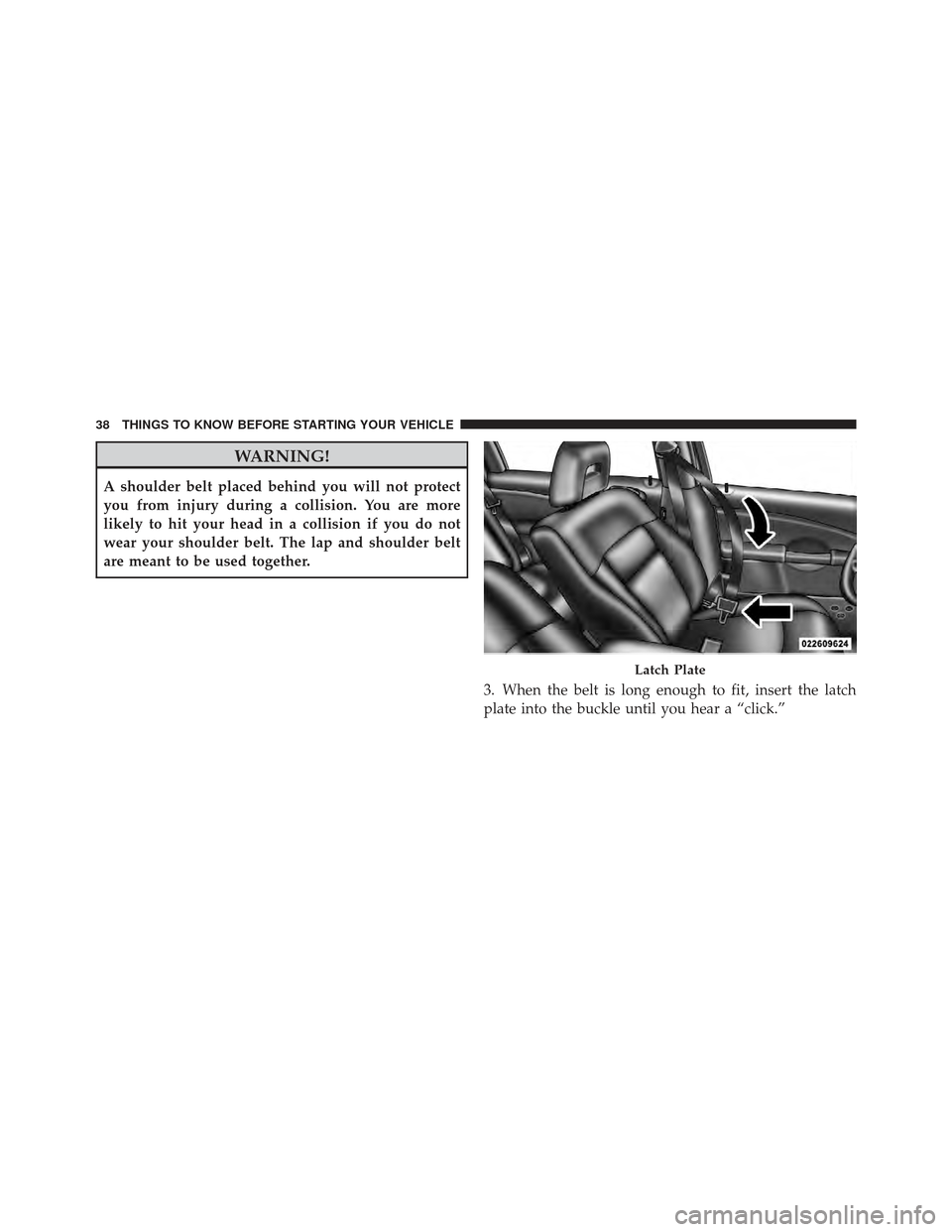
2. The seat belt latch plate is above the back of the front
seat, next to your arm. Grasp the latch plate and pull out
the belt. Slide the latch plate up the webbing as far as
necessary to allow the belt to go around your lap.
2
THINGS TO KNOW BEFORE STARTING YOUR VEHICLE 37
Page 39 of 368
WARNING!
A shoulder belt placed behind you will not protect
you from injury during a collision. You are more
likely to hit your head in a collision if you do not
wear your shoulder belt. The lap and shoulder belt
are meant to be used together.3. When the belt is long enough to fit, insert the latch
plate into the buckle until you hear a “click.”
Latch Plate
38 THINGS TO KNOW BEFORE STARTING YOUR VEHICLE