TRAILER TOWING
In this section you will find safety tips and information
on limits to the type of towing you can reasonably do
with your vehicle. Before towing a trailer carefully re-
view this information to tow your load as efficiently and
safely as possible.
To maintain warranty coverage, follow the requirements
and recommendations in this manual concerning ve-
hicles used for trailer towing.
Common Towing Definitions
The following trailer towing related definitions will assist
you in understanding the following information:
Gross Vehicle Weight Rating (GVWR)
The GVWR is the total allowable weight of your vehicle.
This includes driver, passengers, cargo and trailer tongue
weight. The total load must be limited so that you do not
exceed the GVWR.
Gross Trailer Weight (GTW)
The GTW is the weight of the trailer plus the weight of all
cargo, consumables and equipment (permanent or tem-
porary) loaded in or on the trailer in its�loaded and
ready for operation� condition. The recommended way to
measure GTW is to put your fully loaded trailer on a
vehicle scale. The entire weight of the trailer must be
supported by the scale.
Gross Combination Weight Rating (GCWR)
The GCWR is the total permissible weight of your vehicle
and trailer when weighed in combination.
NOTE: The GCWR rating includes an 150 lbs (68 kg)
allowance for the presence of a driver.
Gross Axle Weight Rating (GAWR)
The GAWR is the maximum capacity of the front and rear
axles. Distribute the load over the front and rear axles
evenly. Make sure that you do not exceed either front or
rear GAWR.
246 STARTING AND OPERATING
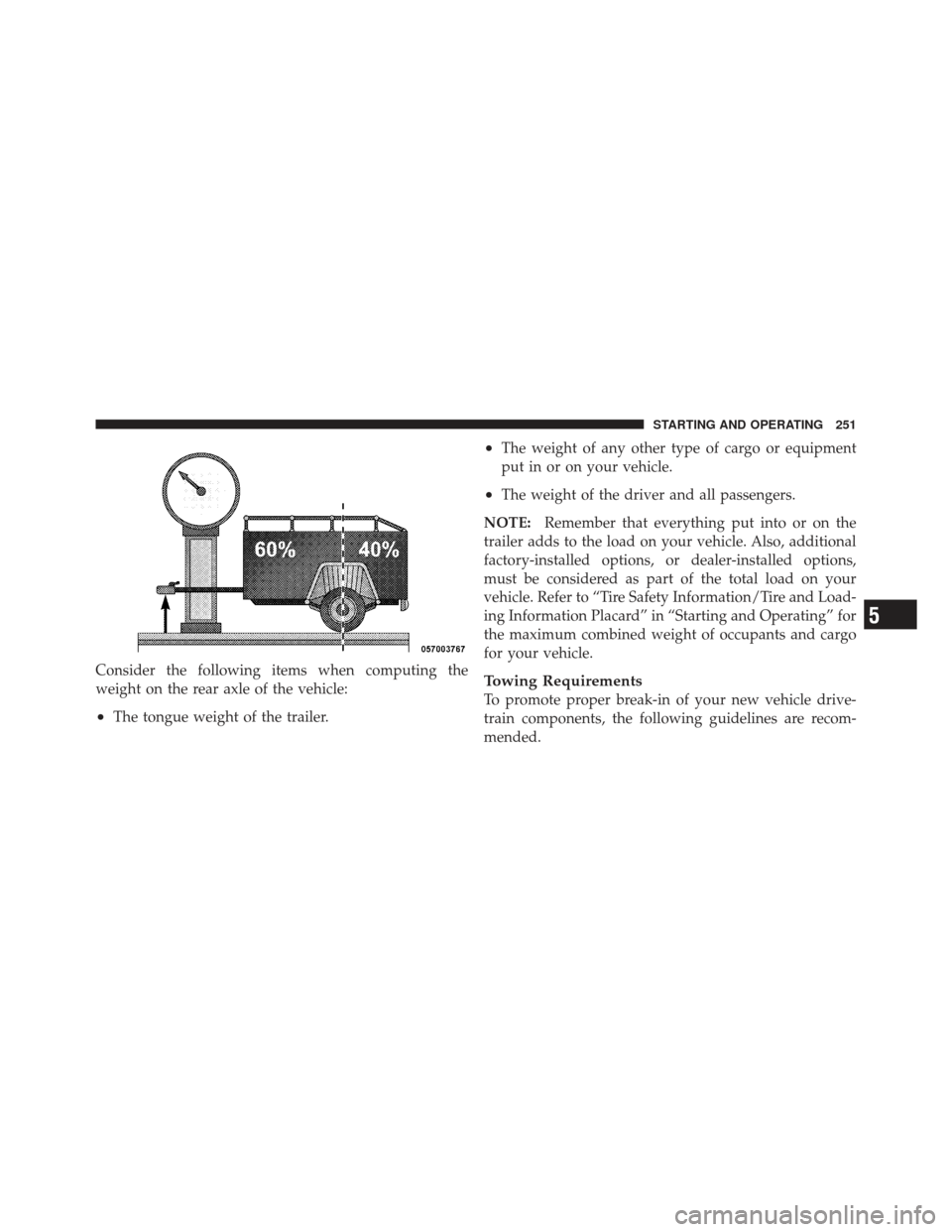
Consider the following items when computing the
weight on the rear axle of the vehicle:
•The tongue weight of the trailer.
•The weight of any other type of cargo or equipment
put in or on your vehicle.
•The weight of the driver and all passengers.
NOTE: Remember that everything put into or on the
trailer adds to the load on your vehicle. Also, additional
factory-installed options, or dealer-installed options,
must be considered as part of the total load on your
vehicle. Refer to “Tire Safety Information/Tire and Load-
ing Information Placard” in “Starting and Operating” for
the maximum combined weight of occupants and cargo
for your vehicle.
Towing Requirements
To promote proper break-in of your new vehicle drive-
train components, the following guidelines are recom-
mended.
5
STARTING AND OPERATING 251
Miles138,000 141,000 144,000 147,000 150,000
(Kilometers) (230 000) (235 000) (240 000) (245 000) (250 000)
Change engine oil and engine oil filter, if not re -
placed at three months. XXXXX
Rotate tires. XXX
Inspect the brake linings. X
Adjust parking brake on vehicles equipped with
four-wheel disc brakes. X
Replace the engine air cleaner filter.* X
Adjust the generator belt tension. X
Replace the spark plugs. X
Replace the make-up air filter.* X
* This maintenance is recommended by the manufacturer
to the owner, but is not required to maintain the emis-
sions warranty.
‡ This maintenance is not required if previously replaced.
† This maintenance is required only for police, taxi,
limousine-type operation, or trailer towing. \b
This maintenance is required only for police, taxi,
limousine-type operation, or trailer towing.
Inspection and service should also be performed anytime
a malfunction is observed or suspected. Retain all
receipts.
8
M A I
N T
E
N A
N CE
S
C
H E
D
U L
E
S332 MAINTENANCE SCHEDULES