2010 CHRYSLER 300 check engine
[x] Cancel search: check enginePage 449 of 538
Disposal of Used Coolant
Used ethylene glycol-based engine coolant (antifreeze) is
a regulated substance requiring proper disposal. Check
with your local authorities to determine the disposal
rules for your community. To prevent ingestion by ani-
mals or children, do not store ethylene glycol-based
engine coolant (antifreeze) in open containers or allow it
to remain in puddles on the ground. If ingested by a child
or pet, seek emergency assistance immediately. Clean up
any ground spills immediately.
Coolant Level
The coolant bottle provides a quick visual method for
determining that the coolant level is adequate. With the
engine OFF and cold, the level of the coolant in the bottle
should be between the ranges indicated on the bottle.
The radiator normally remains completely full, so there is
no need to remove the radiator cap unless checking forengine coolant (antifreeze) freeze point or replacing en-
gine coolant (antifreeze). Advise your service attendant
of this. As long as the engine operating temperature is
satisfactory, the coolant bottle need only be checked once
a month.
When additional engine coolant (antifreeze) is needed to
maintain the proper level, it should be added to the
coolant bottle. Do not overfill.
Points to Remember
NOTE:
When the vehicle is stopped after a few miles
(kilometers) of operation, you may observe vapor coming
from the front of the engine compartment. This is nor-
mally a result of moisture from rain, snow, or high
humidity accumulating on the radiator and being vapor-
ized when the thermostat opens, allowing hot engine
coolant (antifreeze) to enter the radiator.
448 MAINTAINING YOUR VEHICLE
Page 450 of 538
If an examination of your engine compartment shows no
evidence of radiator or hose leaks, the vehicle may be
safely driven. The vapor will soon dissipate.
•Do not overfill the coolant recovery bottle.
•Check engine coolant (antifreeze) freeze point in the
radiator and in the coolant recovery bottle. If engine
coolant (antifreeze) needs to be added, contents of
coolant recovery bottle must also be protected against
freezing.
•If frequent engine coolant (antifreeze) additions are
required, or if the level in the coolant recovery bottle
does not drop when the engine cools, the cooling
system should be pressure tested for leaks.
•Maintain engine coolant (antifreeze) concentration at
50% HOAT engine coolant (antifreeze) (minimum)
and distilled water for proper corrosion protection of
your engine, which contains aluminum components.
•Make sure that the radiator and coolant recovery
bottle overflow hoses are not kinked or obstructed.
•Keep the front of the radiator clean. If your vehicle is
equipped with air conditioning, keep the front of the
condenser clean.
•Do not change the thermostat for Summer or Winter
operation. If replacement is ever necessary, install
ONLY the correct type thermostat. Other designs may
result in unsatisfactory engine coolant (antifreeze)
performance, poor gas mileage, and increased
emissions.
Brake System
In order to assure brake system performance, all brake
system components should be inspected periodically.
Refer to “Maintenance Schedule” for the proper mainte-
nance intervals.7
MAINTAINING YOUR VEHICLE 449
Page 488 of 538
NOTE:
•The oil change indicator message will not monitor the
time since the last oil change. Change your vehicle’s
oil if it has been six months since your last oil change,
even if the oil change indicator message is NOT
illuminated.
•Change your engine oil more often if you drive your
vehicle off-road for an extended period of time.
•Under no circumstances should oil change intervals
exceed 6,000 miles (10,000 km) or six months, which-
ever comes first.
Your authorized dealer will reset the oil change indicator
message after completing the scheduled oil change. If a
scheduled oil change is performed by someone other
than your authorized dealer, the message can be reset by
referring to the steps described under “Electronic Vehicle
Information Center (EVIC)/Oil Change Required” in “Understanding Your Instrument Panel” or under “In-
strument Cluster Description/Odometer/Trip Odom-
eter” in “Understanding Your Instrument Panel” for
further information.
At Each Stop for Fuel
•Check the engine oil level. Refer to “Maintenance
Procedures/Engine Oil” in “Maintaining Your Ve-
hicle” for further information.
•Check the windshield washer solvent and add if
required.
Once a Month
•Check tire pressure and look for unusual wear or
damage.
•Inspect the battery, and clean and tighten the terminals
as required.
8
M A I
N T
E
N A
N CE
S
C
H E
D
U L
E
SMAINTENANCE SCHEDULES 487
Page 489 of 538
•Check the fluid levels of the coolant reservoir, brake
master cylinder, and power steering, add as needed.
•Check all lights and other electrical items for correct
operation.
At Each Oil Change
•Change the engine oil filter.
•Inspect the brake hoses and lines.
CAUTION!
Failure to perform the required maintenance items
may result in damage to the vehicle.
Required Maintenance Intervals
Refer to the Maintenance Schedules on the following
pages for the required maintenance intervals.
8
M A I
N T
E
N A
N CE
S
C
H E
D
U L
E
S488 MAINTENANCE SCHEDULES
Page 519 of 538

Fluid Check....................... 450,483
Master Cylinder ....................... 450
Parking ............................. 335
Warning Light ........................ 222
Brakes ............................... 449
Brake/Transmission Interlock ............... 317
Break-In Recommendations, New Vehicle ........ 80
Brightness, Interior Lights .................. 150
Bulb Replacement ..................... 468,470
Bulbs, Light .......................... 84,468
Calibration, Compass ..................... 243
Capacities, Fluid ........................ 480
Caps, Filler Fuel ............................... 379
Oil (Engine) .......................... 432
Power Steering ........................ 334
Radiator (Coolant Pressure) ............... 447
Car Washes ............................ 455 Carbon Monoxide Warning
...............81,378
Cargo (Vehicle Loading) ................... 381
Cellular Phone ........................ 96,292
Certification Label ....................... 382
Changing A Flat Tire ..................... 401
Chart, Tire Sizing ........................ 347
Check Engine Light
(Malfunction Indicator Light) ............... 427
Checking Your Vehicle For Safety ............. 81
Checks, Safety ........................... 81
Child Restraint .................. 71,72,73,76,77
Child Restraint Tether Anchors .............74,76
Child Safety Locks ........................ 37
Clean Air Gasoline ....................... 375
Cleaning Wheels ............................. 457
Windshield Wiper Blades ................ 440
Climate Control ......................... 292
Clock ..................... 251,252,254,257,266
518 INDEX
Page 522 of 538
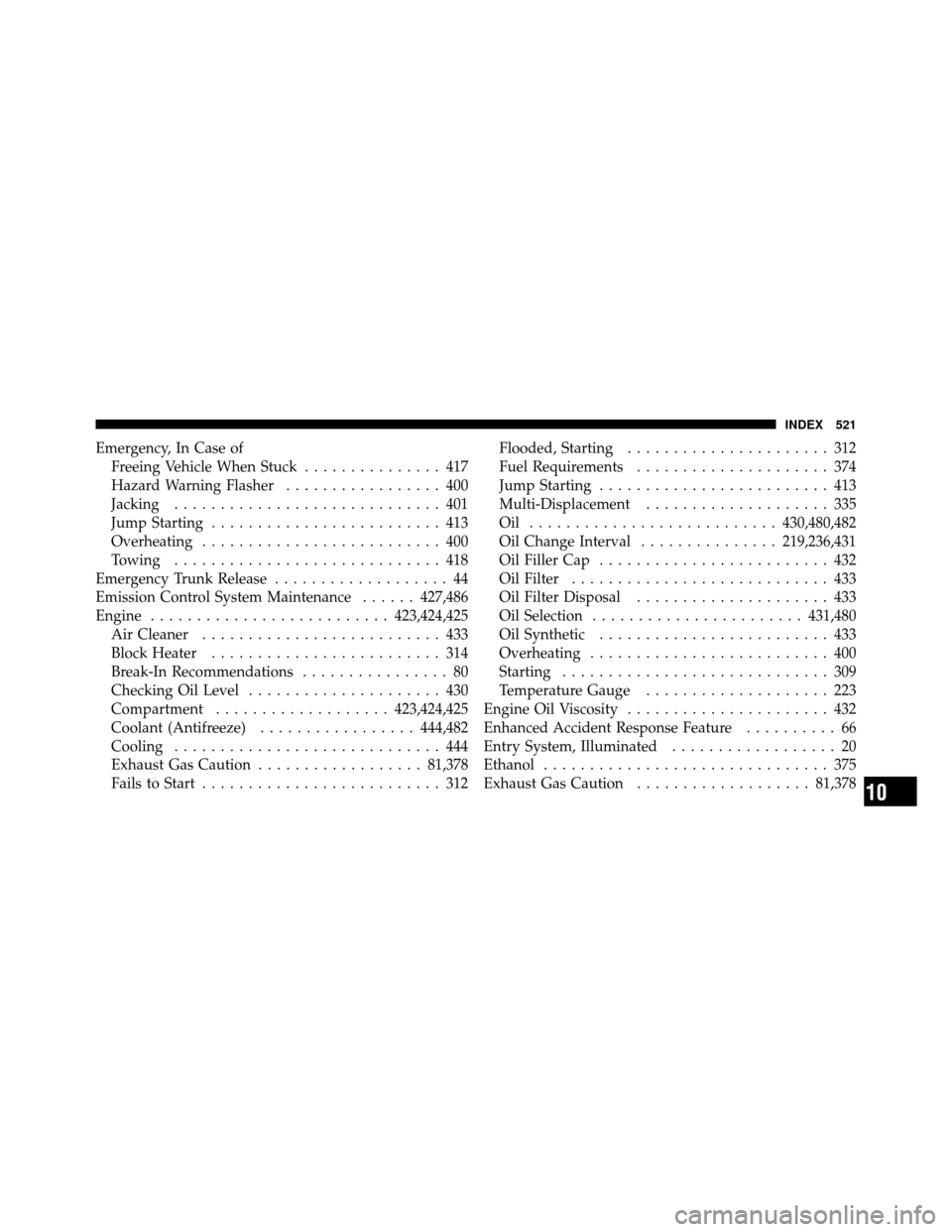
Emergency, In Case ofFreeing Vehicle When Stuck ............... 417
Hazard Warning Flasher ................. 400
Jacking ............................. 401
Jump Starting ......................... 413
Overheating .......................... 400
Towing ............................. 418
Emergency Trunk Release ................... 44
Emission Control System Maintenance ......427,486
Engine .......................... 423,424,425
Air Cleaner .......................... 433
Block Heater ......................... 314
Break-In Recommendations ................ 80
Checking Oil Level ..................... 430
Compartment ................... 423,424,425
Coolant (Antifreeze) ................. 444,482
Cooling ............................. 444
Exhaust Gas Caution .................. 81,378
Fails to Start .......................... 312 Flooded, Starting
...................... 312
Fuel Requirements ..................... 374
Jump Starting ......................... 413
Multi-Displacement .................... 335
Oil ........................... 430,480,482
Oil Change Interval ...............219,236,431
Oil Filler Cap ......................... 432
Oil Filter ............................ 433
Oil Filter Disposal ..................... 433
Oil Selection ....................... 431,480
Oil Synthetic ......................... 433
Overheating .......................... 400
Starting ............................. 309
Temperature Gauge .................... 223
Engine Oil Viscosity ...................... 432
Enhanced Accident Response Feature .......... 66
Entry System, Illuminated .................. 20
Ethanol ............................... 375
Exhaust Gas Caution ................... 81,378
10
INDEX 521
Page 523 of 538

Exhaust System....................... 81,441
Exterior Folding Mirrors ................... 93
Exterior Lighting ........................ 144
Exterior Lights .......................... 84
Filters Air Cleaner .......................... 433
Air Conditioning .................... 302,437
Engine Oil ........................ 433,482
Engine Oil Disposal .................... 433
Flashers Hazard Warning ....................... 400
Turn Signal ...................... 84,148,216
Flash-To-Pass ........................... 149
Flat Tire Changing ....................... 401
Flooded Engine Starting ................... 312
Floor Console .......................... 204
Fluid, Brake ........................... 483
Fluid Capacities ......................... 480 Fluid Leaks
............................. 84
Fluid Level Checks Automatic Transmission ................. 452
Brake .............................. 450
Cooling System ....................... 444
Engine Oil ........................... 430
Power Steering ........................ 334
Transfer Case ......................... 454
Fluids ................................ 482
Fluids, Lubricants and Genuine Parts .......... 482
Fog Lights .......................... 147,216
Folding Rear Seat ........................ 136
Freeing A Stuck Vehicle ................... 417
Fuel ................................. 374
Adding ............................. 379
Additives ............................ 377
Clean Air ............................ 375
Conserving .......................... 236
Ethanol ............................. 375
522 INDEX
Page 527 of 538

Automatic Headlights................... 145
Brake Assist Warning ................... 344
Brake Warning ........................ 222
Bulb Replacement ................... 468,470
Courtesy/Reading ................... 149,189
Cruise .............................. 216
Daytime Running ...................... 147
Dimmer Switch, Headlight .............148,149
Electronic Stability Program (ESP) Indicator . . . 344
Electronic Throttle Control Warning ......... 225
Engine Temperature Warning .............. 220
Exterior .............................. 84
Fog ............................. 147,216
Hazard Warning Flasher ................. 400
Headlight Switch ...................... 144
Headlights ........................ 144,472
Headlights On Reminder ................. 147
Headlights On With Wipers ............145,152
High Beam ........................ 149,225High Beam Indicator
.................... 225
High Beam/Low Beam Select ............. 149
Illuminated Entry ....................... 20
Instrument Cluster .................. 144,216
Intensity Control ...................... 150
Interior .......................... 149,189
License ............................. 479
Lights On Reminder .................... 147
Low Fuel ............................ 216
LowTire ............................ 226
Malfunction Indicator (Check Engine) ........ 228
Map Reading ...................... 149,189
Oil Pressure .......................... 229
Parade Mode (Daytime Brightness) ......... 150
Passing ............................. 149
Reading .......................... 149,189
Seat Belt Reminder ..................... 225
Service ........................... 468,470
Service Engine Soon (Malfunction Indicator) . . . 228
526 INDEX