2010 CHEVROLET IMPALA remote start
[x] Cancel search: remote startPage 1 of 432

In Brief........................................................... 1-1
Instrument Panel
........................................ 1-2
Initial Drive Information
............................... 1-4
Vehicle Features
......................................1-15
Performance and Maintenance
...................1-19
Seats and Restraint System............................. 2-1
Head Restraints
......................................... 2-2
Front Seats
............................................... 2-4
Rear Seats
..............................................2-10
Safety Belts
.............................................2-12
Child Restraints
.......................................2-32
Airbag System
.........................................2-56
Restraint System Check
............................2-74
Features and Controls..................................... 3-1
Keys
........................................................ 3-3
Doors and Locks
....................................... 3-9
Windows
.................................................3-14
Theft-Deterrent Systems
............................3-16
Starting and Operating Your Vehicle
...........3-19
Mirrors
....................................................3-33Universal Home Remote System
................3-35
Storage Areas
.........................................3-42
Sunroof
..................................................3-43
Instrument Panel............................................. 4-1
Instrument Panel Overview
.......................... 4-3
Climate Controls
......................................4-16
Warning Lights, Gages, and Indicators
. . . . . . . . 4-21
Driver Information Center (DIC)
..................4-37
Audio System(s)
.......................................4-57
Driving Your Vehicle....................................... 5-1
Your Driving, the Road, and the Vehicle
....... 5-2
Towing
...................................................5-26
Service and Appearance Care.......................... 6-1
Service
..................................................... 6-3
Fuel
......................................................... 6-5
Checking Things Under the Hood
...............6-12
Headlamp Aiming
.....................................6-43
Bulb Replacement
....................................6-43
Windshield Wiper Blade Replacement
. . . . . . . . . 6-49
2010 Chevrolet Impala Owner Manual
M
Page 5 of 432

Vehicle Symbol ChartHere are some additional symbols that may be found on
the vehicle and what they mean. For more information
on the symbol, refer to the index.9
:Airbag Readiness Light
#
:Air Conditioning
!
:Antilock Brake System (ABS)
g
:Audio Steering Wheel Controls or OnStar
®
$
:Brake System Warning Light
"
:Charging System
I
:Cruise Control
B
:Engine Coolant Temperature
O
:Exterior Lamps
#
:Fog Lamps
.
:Fuel Gage
+
:Fuses
i
:Headlamp High/Low-Beam Changer
j
:LATCH System Child Restraints
*
:Malfunction Indicator Lamp
:
:Oil Pressure
}
:Power
/
:Remote Vehicle Start
>
:Safety Belt Reminders
7
:Tire Pressure Monitor
F
:Traction Control
M
:Windshield Washer Fluid
v
Page 7 of 432

Instrument Panel..............................................1-2
Initial Drive Information....................................1-4
Remote Keyless Entry (RKE) System................1-4
Remote Vehicle Start......................................1-4
Door Locks....................................................1-5
Trunk Release...............................................1-5
Windows.......................................................1-6
Seat Adjustment.............................................1-6
Second Row Seats.........................................1-8
Head Restraint Adjustment...............................1-8
Safety Belt....................................................1-9
Sensing System for Passenger Airbag...............1-9
Mirror Adjustment.........................................1-10
Steering Wheel Adjustment............................1-11
Interior Lighting............................................1-11
Exterior Lighting...........................................1-12
Windshield Wiper/Washer...............................1-13
Climate Controls...........................................1-14Vehicle Features.............................................1-15
Radio(s)......................................................1-15
Satellite Radio..............................................1-16
Portable Audio Devices ..................................1-16
Steering Wheel Controls . . ..............................1-17
Bluetooth
®
...................................................1-17
Cruise Control..............................................1-18
Power Outlets..............................................1-18
Performance and Maintenance.........................1-19
Traction Control System (TCS).......................1-19
Electronic Stability Control (ESC)....................1-19
Tire Pressure Monitor....................................1-20
Engine Oil Life System ..................................1-20
Fuel E85 (85% Ethanol) . . ..............................1-20
Driving for Better Fuel Economy . . ...................1-21
Roadside Assistance Program........................1-21
OnStar
®
......................................................1-22
Section 1 In Brief
1-1
Page 10 of 432

Initial Drive InformationThis section provides a brief overview about some of
the important features that may or may not be on your
specific vehicle.
For more detailed information, refer to each of the
features which can be found later in this owner manual.Remote Keyless Entry (RKE)
SystemThe RKE transmitter is used to remotely lock and
unlock the doors from up to 60 m (195 feet) away from
the vehicle.
Press
K
to unlock the
driver door. Press again
within five seconds to
unlock all remaining doors.Press
Q
to lock all doors.
Lock and unlock feedback can be personalized.
Press and hold
V
for approximately one second to
open the trunk.
Press
L
and release to locate the vehicle.
Press
L
and hold for more than two seconds to sound
the panic alarm.
Press
L
again to cancel the panic alarm.
SeeKeys on page 3-3andRemote Keyless Entry
(RKE) System Operation on page 3-4.
Remote Vehicle StartWith this feature the engine can be started from outside
of the vehicle.Starting the Vehicle1. Aim the RKE transmitter at the vehicle.
2. Press
Q
.
3. Immediately after completing Step 2, press and
hold
/
until the turn signal lamps flash.
When the vehicle starts, the parking lamps will turn
on and remain on as long as the engine is running.
The doors will be locked and the climate control system
may come on.
1-4
Page 11 of 432

The engine will continue to run for 10 minutes. Repeat
the steps for a 10-minute time extension. Remote
start can be extended only once.Canceling a Remote StartTo cancel a remote start:•
Aim the RKE transmitter at the vehicle and press
and hold
/
until the parking lamps turn off.
•
Turn on the hazard warning flashers.
•
Turn the ignition switch out of LOCK/OFF position
and then back to LOCK/OFF.
SeeRemote Vehicle Start on page 3-7.
Door LocksFrom outside the vehicle, use the key in the door or the
Remote Keyless Entry (RKE) transmitter to lock or
unlock the vehicle. From the inside, pull up or push
down on the manual door lock knobs.
SeeDoor Locks on page 3-9.
Power Door LocksPower door lock switches are located on the front doors
near the handle.Q
:Press the bottom of the switch to lock all doors.
K
:Press the top of the switch to unlock all doors.
For more information, see:•
Power Door Locks on page 3-10.
•
Delayed Locking on page 3-10.
Trunk ReleaseIn addition to the trunk release button on the RKE
transmitter, there is a remote release
G
button
located on the left side of the instrument panel.
For more information seeTrunk on page 3-12.
1-5
Page 96 of 432
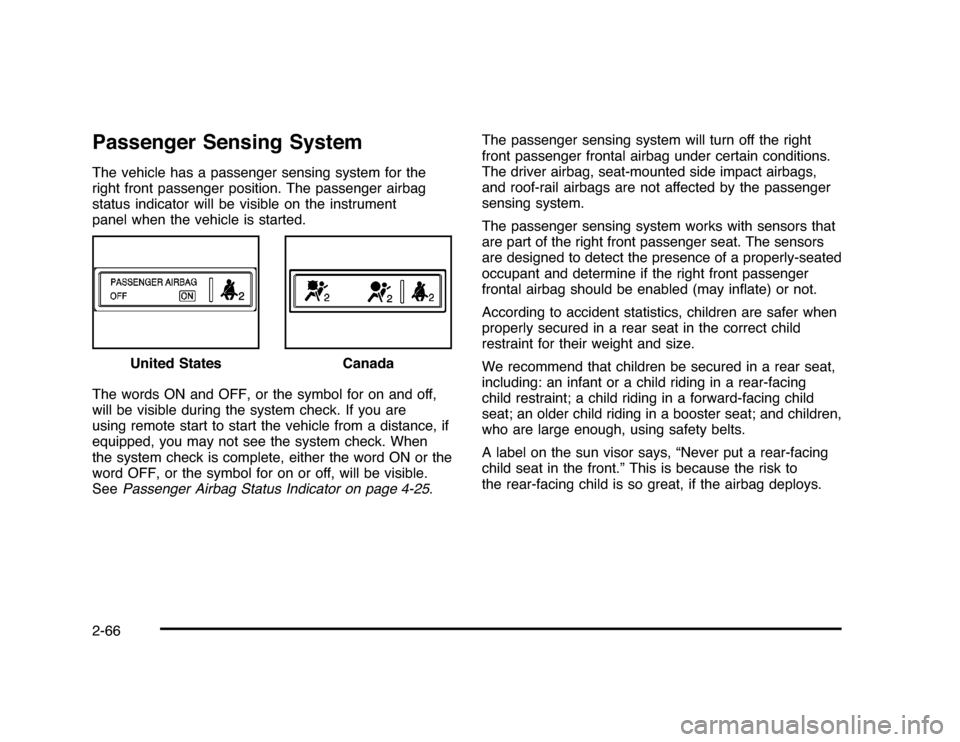
Passenger Sensing SystemThe vehicle has a passenger sensing system for the
right front passenger position. The passenger airbag
status indicator will be visible on the instrument
panel when the vehicle is started.
The words ON and OFF, or the symbol for on and off,
will be visible during the system check. If you are
using remote start to start the vehicle from a distance, if
equipped, you may not see the system check. When
the system check is complete, either the word ON or the
word OFF, or the symbol for on or off, will be visible.
SeePassenger Airbag Status Indicator on page 4-25.The passenger sensing system will turn off the right
front passenger frontal airbag under certain conditions.
The driver airbag, seat-mounted side impact airbags,
and roof-rail airbags are not affected by the passenger
sensing system.
The passenger sensing system works with sensors that
are part of the right front passenger seat. The sensors
are designed to detect the presence of a properly-seated
occupant and determine if the right front passenger
frontal airbag should be enabled (may inflate) or not.
According to accident statistics, children are safer when
properly secured in a rear seat in the correct child
restraint for their weight and size.
We recommend that children be secured in a rear seat,
including: an infant or a child riding in a rear-facing
child restraint; a child riding in a forward-facing child
seat; an older child riding in a booster seat; and children,
who are large enough, using safety belts.
A label on the sun visor says, “Never put a rear-facing
child seat in the front.” This is because the risk to
the rear-facing child is so great, if the airbag deploys. United States
Canada
2-66
Page 107 of 432

Keys...............................................................3-3
Remote Keyless Entry (RKE) System................3-4
Remote Keyless Entry (RKE) System
Operation . . .................................................3-4
Remote Vehicle Start......................................3-7
Doors and Locks.............................................3-9
Door Locks....................................................3-9
Power Door Locks........................................3-10
Delayed Locking...........................................3-10
Automatic Door Lock.....................................3-10
Programmable Automatic Door Unlock.............3-11
Rear Door Security Locks..............................3-11
Lockout Protection........................................3-12
Trunk . . . . . . ....................................................3-12
Windows........................................................3-14
Power Windows............................................3-15
Sun Visors...................................................3-16
Theft-Deterrent Systems..................................3-16
Content Theft-Deterrent.................................3-17
PASS-Key
®
III+ Electronic Immobilizer.............3-18
PASS-Key
®
III+ Electronic Immobilizer
Operation . . ...............................................3-18Starting and Operating Your Vehicle................3-19
New Vehicle Break-In....................................3-19
Ignition Positions..........................................3-20
Retained Accessory Power (RAP)...................3-21
Starting the Engine.......................................3-21
Engine Coolant Heater ..................................3-23
Automatic Transmission Operation...................3-24
Parking Brake..............................................3-27
Shifting Into Park..........................................3-28
Shifting Out of Park......................................3-29
Parking Over Things That Burn.......................3-30
Engine Exhaust............................................3-31
Running the Vehicle While Parked..................3-32
Mirrors...........................................................3-33
Manual Rearview Mirror.................................3-33
Automatic Dimming Rearview Mirror................3-33
Outside Power Mirrors . . .................................3-34
Outside Convex Mirror . . .................................3-34
Outside Heated Mirrors ..................................3-34
Universal Home Remote System......................3-35
Universal Home Remote System Operation
(With Three Round LED)............................3-35
Section 3 Features and Controls
3-1
Page 110 of 432

Remote Keyless Entry (RKE)
SystemSeeRadio Frequency Statement on page 8-20for
information regarding Part 15 of the Federal
Communications Commission (FCC) Rules and
RSS-210/211 of Industry and Science Canada.
Changes or modifications to this system by other than
an authorized service facility could void authorization to
use this equipment.
If there is a decrease in the RKE operating range,
try this:•
Check the distance. The transmitter may be too far
from the vehicle. Stand closer during rainy or
snowy weather.
•
Check the location. Other vehicles or objects may
be blocking the signal. Take a few steps to the
left or right, hold the transmitter higher, and
try again.
•
Check the transmitter’s battery. See “Battery
Replacement” later in this section.
•
If the transmitter is still not working correctly, see
your dealer/retailer or a qualified technician for
service.
Remote Keyless Entry (RKE)
System OperationThe Remote Keyless Entry (RKE) transmitter functions
work up to 195 feet (60 m) away from the vehicle.
There are other conditions which can affect the
performance of the transmitter. SeeRemote Keyless
Entry (RKE) System on page 3-4./
(Remote Vehicle Start):For vehicles with this
feature, press to start the engine from outside the vehicle
using the RKE transmitter. SeeRemote Vehicle Start on
page 3-7for additional information. With Remote Start
Shown, Without Remote
Start Similar
3-4