Page 123 of 432
Content Theft-DeterrentYour vehicle may have the optional content
theft-deterrent alarm system.
To activate the theft-deterrent system:
1. Open the door.
2. Lock the door with the power door lock switch
or the Remote Keyless Entry (RKE) transmitter.
If you are using the RKE transmitter, the door
does not need to be open.
3. Close all doors.
Once armed, the alarm will go off if someone tries to
enter the vehicle without using the RKE transmitter
or a key or turns the ignition on with an incorrect key.
The horn will sound and the turn signal lamps will flash
for about 30 seconds.
When the alarm is armed, the trunk may be opened
with the RKE transmitter. The power door lock switches
are disabled and the doors remain locked. You must
use your RKE transmitter or your key to unlock the doors
when the system is armed.
Arming with the Power Lock SwitchThe alarm system will arm when you use either power
lock switch to lock the doors while any door is open and
the key is removed from the ignition. The alarm system
will not arm if the truck is open when you use either power
lock switch to lock the doors.Arming with the RKE TransmitterThe alarm system will arm when you use your RKE
transmitter to lock the doors, if the key is not in
the ignition.Disarming with the RKE TransmitterThe alarm system will disarm when you use your RKE
transmitter to unlock the doors.
The first time a remote unlock command is received,
three flashes will be seen and three horn chirps heard to
indicate an alarm condition has occurred since last
arming.Disarming with Your KeyThe alarm system will disarm when you use your key to
unlock the doors or insert your key in the ignition and
turn it from the LOCK/OFF position.
3-17
Page 164 of 432

A high electrical load occurs when several of the
following are on, such as: headlamps, high beams,
fog lamps, rear window defogger, climate control fan at
high speed, heated seats, engine cooling fans, trailer
loads, and loads plugged into accessory power outlets.
EPM works to prevent excessive discharge of the battery.
It does this by balancing the generator’s output and the
vehicle’s electrical needs. It can increase engine idle
speed to generate more power, whenever needed.
It can temporarily reduce the power demands of some
accessories.
Normally, these actions occur in steps or levels, without
being noticeable. In rare cases at the highest levels of
corrective action, this action may be noticeable to the
driver. If so, a Driver Information Center (DIC) message
might be displayed, such as BATTERY SAVER ACTIVE,
BATTERY VOLTAGE LOW, or LOW BATTERY. If this
message is displayed, it is recommended that the driver
reduce the electrical loads as much as possible. SeeDIC
Warnings and Messages on page 4-44.
Battery Run-Down ProtectionThis feature helps prevent the battery from being drained,
if the interior courtesy lamps, reading/map lamps, visor
vanity lamps or trunk lamp are accidentally left on. If any
of these lamps are left on, they automatically turn off after
10 minutes, if the ignition is off. The lamps will not come
back on again until one of the following occurs:•
The ignition is turned on.
•
The exterior lamps control is turned off, then on
again.
The headlamps will timeout after 10 minutes, if they are
manually turned on with the ignition on or off.
4-14
Page 200 of 432
TIRE LOW ADD AIR TO TIREOn vehicles with the Tire Pressure Monitor System
(TPMS), this message displays when the pressure in one
or more of the vehicle’s tires is low. This message also
displays LEFT FRT (left front), RIGHT FRT (right front),
LEFT RR (left rear), or RIGHT RR (right rear) to indicate
the location of the low tire. The low tire pressure warning
light will also come on. SeeTire Pressure Light on
page 4-31. You can receive more than one tire pressure
message at a time. To read the other messages that may
have been sent at the same time, press the set/reset
button. If a tire pressure message appears on the DIC,
stop as soon as you can. Have the tire pressures
checked and set to those shown on the Tire Loading
Information label. SeeTires on page 6-51,Loading the
Vehicle on page 5-20, andInflation - Tire Pressure on
page 6-59. The DIC also shows the tire pressure values.
SeeDIC Operation and Displays on page 4-37.TRACTION CONTROL OFFIf your vehicle has the Traction Control System (TCS),
this message displays when the TCS turns off.
SeeTraction Control System (TCS) on page 5-7
for more information.
This message only displays while the ignition is in
ON/RUN and disappears after 10 seconds, unless
it is acknowledged or an urgent warning appears.Any of the following conditions may cause the TCS to
turn off:
•
The TCS is turned off by pressing the traction
control button. SeeTraction Control System (TCS)
on page 5-7for more information.
•
The battery is low.
•
There is a TCS failure. See your dealer/retailer for
service.
TRACTION CONTROL ONIf your vehicle has the Traction Control System (TCS),
this message displays when the TCS is turned on.
SeeTraction Control System (TCS) on page 5-7
for more information.TRANSMISSION HOT IDLE ENGINEThis message displays when the transmission fluid in
your vehicle is too hot. Stop the vehicle and allow it to idle
until it cools down. If the warning message continues to
display, have the vehicle serviced by your dealer/retailer
as soon as possible.TRUNK OPENThis message displays when the trunk is not closed
completely. Make sure that the trunk is closed
completely. SeeTrunk on page 3-12.
4-50
Page 282 of 432
Filling a Portable Fuel Container
{
WARNING:
Never fill a portable fuel container while it is in the
vehicle. Static electricity discharge from the
container can ignite the fuel vapor. You can be
badly burned and the vehicle damaged if this
occurs. To help avoid injury to you and others:
•
Dispense fuel only into approved containers.
•
Do not fill a container while it is inside a
vehicle, in a vehicle’s trunk, pickup bed, or on
any surface other than the ground.
•
Bring the fill nozzle in contact with the inside
of the fill opening before operating the nozzle.
Contact should be maintained until the filling
is complete.
•
Do not smoke while pumping fuel.
•
Do not use a cellular phone while
pumping fuel.
Checking Things Under
the Hood
{
WARNING:
An electric fan under the hood can start up and
injure you even when the engine is not running.
Keep hands, clothing, and tools away from any
underhood electric fan.{
WARNING:
Things that burn can get on hot engine parts and
start a fire. These include liquids like fuel, oil,
coolant, brake fluid, windshield washer and other
fluids, and plastic or rubber. You or others could
be burned. Be careful not to drop or spill things
that will burn onto a hot engine.
6-12
Page 317 of 432
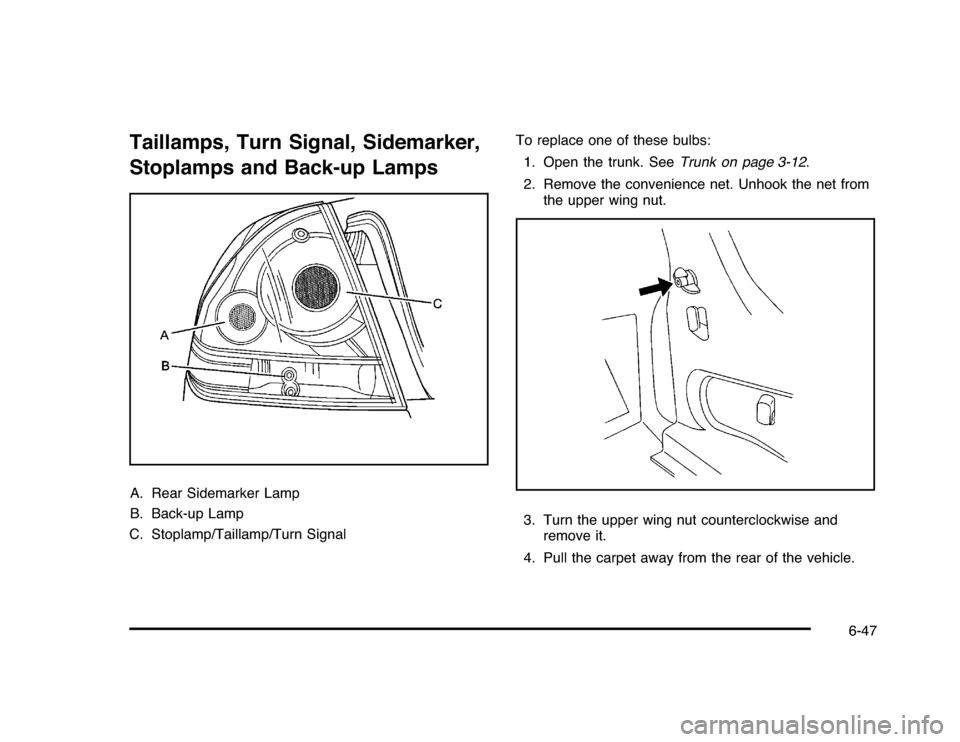
Taillamps, Turn Signal, Sidemarker,
Stoplamps and Back-up LampsA. Rear Sidemarker Lamp
B. Back-up Lamp
C. Stoplamp/Taillamp/Turn SignalTo replace one of these bulbs:
1. Open the trunk. SeeTrunk on page 3-12.
2. Remove the convenience net. Unhook the net from
the upper wing nut.
3. Turn the upper wing nut counterclockwise and
remove it.
4. Pull the carpet away from the rear of the vehicle.
6-47
Page 346 of 432
Removing the Spare Tire and ToolsThe equipment you will need is located in the trunk.
1. Open the trunk. SeeTrunk on page 3-12.
2. Remove the convenience net if the vehicle has one.
3. Remove the spare tire cover.
4. Turn the wing nut counterclockwise and remove it.
5. Remove the compact spare tire.6. Turn the nut holding the jack counterclockwise and
remove it. Then remove the jack and wrench.6-76
Page 348 of 432
If needed, use the flat end of the wheel wrench and pry
along the edge of the cover until it comes off. The edge of
the wheel cover could be sharp, so do not try to remove it
with your bare hands. Do not drop the cover or lay it face
down, as it could become scratched or damaged. Store
the wheel cover in the trunk until the flat tire is repaired or
replaced.
Once you have removed the wheel cover, use the
following procedure to remove the flat tire and install the
spare tire.
1. Do a safety check before proceeding. SeeChanging
a Flat Tire on page 6-75
2. Turn the wheel wrench counterclockwise once on
each wheel nut to loosen them. Do not remove
them yet.6-78
Page 353 of 432
Notice:Wheel covers will not fit on your vehicle’s
compact spare. If you try to put a wheel cover
on the compact spare, the cover or the spare could
be damaged.Storing a Flat or Spare Tire and
Tools
{
WARNING:
Storing a jack, a tire, or other equipment in the
passenger compartment of the vehicle could
cause injury. In a sudden stop or collision, loose
equipment could strike someone. Store all these in
the proper place.After the compact spare tire has been installed on the
vehicle, store the flat tire in the trunk.
When storing a full-size tire, use the extension with the
extension protector, located in the foam holder, to
help avoid wheel surface damage.
To store a full-size tire:
1. Install the tools in their original location in the trunk
area and secure.
2. Place the tire valve stem facing down and the
protector/guide placed through a wheel bolt hole
and threaded onto the bolt screw.
3. Remove the protector and attach the retainer
securely
4. Store the cover as far forward as possible.
When storing a compact spare tire in the trunk, put the
protector back in the foam holder.
The compact spare is for temporary use only. Replace
the compact spare tire with a full-size tire as soon as you
can. SeeCompact Spare Tire on page 6-86. Use this as
a guide for storing the compact spare tire and tools.
6-83