Page 275 of 378
Black plate (43,1)Chevrolet Camaro Owner Manual - 2010
Vehicle Care 9-43
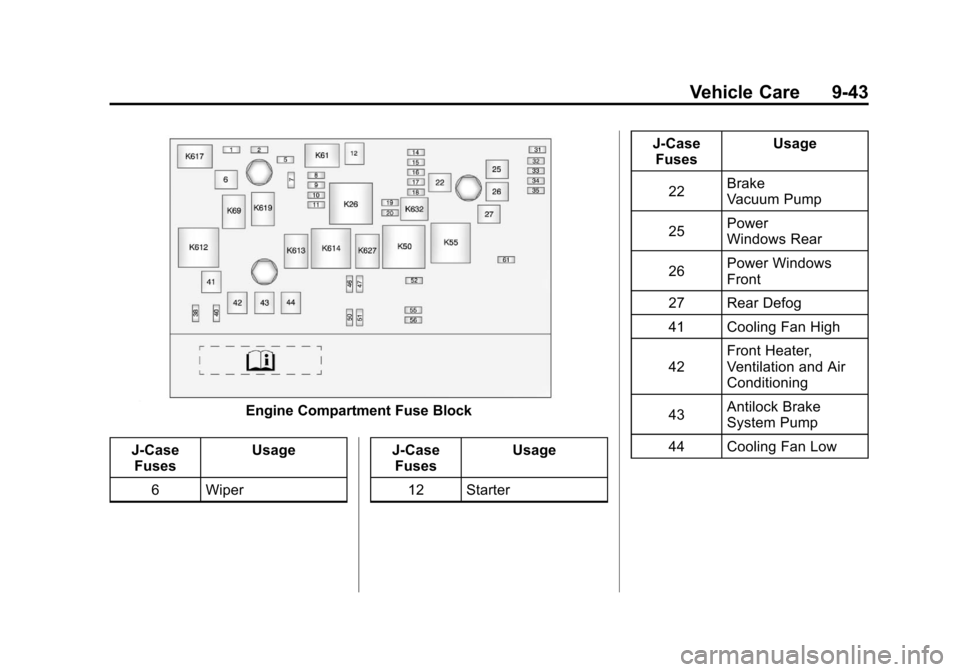
Engine Compartment Fuse Block
J-Case Fuses Usage
6 Wiper J-Case
Fuses Usage
12 Starter J-Case
Fuses Usage
22 Brake
Vacuum Pump
25 Power
Windows Rear
26 Power Windows
Front
27 Rear Defog
41 Cooling Fan High
42 Front Heater,
Ventilation and Air
Conditioning
43 Antilock Brake
System Pump
44 Cooling Fan Low
Page 276 of 378
Black plate (44,1)Chevrolet Camaro Owner Manual - 2010
9-44 Vehicle Care
Mini Fuses Usage1 Air Conditioning
Compressor Clutch
2 Transmission
Control Module
5 Engine Control
Module Main
7 Pre-Catalytic
Converter Oxygen
Sensor
8 Post-Catalytic
Converter Oxygen
Sensor
9 Fuel
Injectors
–Even Mini Fuses Usage
10 Fuel Injectors –Odd
11 Cooling Fan Relay
14 Manifold Air Flow/
Chassis Control
15 Ignition
16 Run/Crank IP
17 Sensing Diagnostic
Module/Ignition
18 Run/Crank Body
19 Transmission
Control Module/
Ignition
20 Engine Control
Module/Ignition Mini Fuses Usage
31 Outside Rear View
Mirror
32 Canister Vent
Solenoid
33 Body Control
Module #6
34 Sunroof
35 Front Heated Seats
38 Washer Pump Front
40 Antilock Brake
System Valves
46 HID Headlamp
–
Left Front
Page 277 of 378
Black plate (45,1)Chevrolet Camaro Owner Manual - 2010
Vehicle Care 9-45
Mini Fuses Usage47 HID Headlamp
–
Right Front
50 Fog Lamps
51 Horn
52 Spare
55 High Beam
Headlamp
–Right
Front
56 High Beam
Headlamp
–Left
Front
61 Heated Mirror
Mini Relays Usage K26 Powertrain
K50 Run / Crank
K55 Rear Defog
K612 Cooling Fan High
K614 Cooling Fan Control Micro
Relays Usage
K61 Starter
K69 Wiper Control
K613 Cooling Fan Low
K617 Air Conditioning
Compressor Clutch
K619 Wiper Speed
K627 High Intensity
Discharge
Headlamps
K632 Brake
Vacuum PumpInstrument Panel Fuse
Block
The instrument panel fuse block is
located on the end of the instrument
panel, on the driver side of the
vehicle. To access the fuses, open
the fuse panel door by pulling out.
To reinstall the door, push the door
back into its original location.
Page 278 of 378
Black plate (46,1)Chevrolet Camaro Owner Manual - 2010
9-46 Vehicle Care
Instrument Panel Fuse Block
Fuses Usage
F1 Discrete Logic
Ignition Switch
F2 Diagnostic Link
Connector
F3 Airbag
F4 Cluster Fuses
Usage
F5 Heating Ventilation
Air Conditioning
Controller
F6 Body Control
Module
F8 Battery Fuses
Usage
F9 Spare
F10 Spare
F11 Not Used
F12 Spare
F13 Display
F14 OnStar
®Universal
Hands Free Phone
F15 Body Control
Module 3
F16 Body Control
Module 4
F17 Power Outlet 1
F18 Power Outlet 2
F19 Steering Wheel
Controls Backlight
F20 Spare
F21 Spare
F22 Not Used
F23 Trunk
Page 285 of 378

Black plate (53,1)Chevrolet Camaro Owner Manual - 2010
Vehicle Care 9-53
(F) Service Description:These
characters represent the load
index and speed rating of the
tire. The load index represents
the load carrying capacity a tire
is certified to carry. The speed
rating is the maximum speed a
tire is certified to carry a load.
Tire Terminology and
Definitions
Air Pressure:The amount
of air inside the tire pressing
outward on each square inch
of the tire. Air pressure is
expressed in psi (pounds per
square inch) or kPa (kilopascal). Accessory Weight
:This
means the combined weight
of optional accessories.
Some examples of optional
accessories are, automatic
transmission, power steering,
power brakes, power windows,
power seats, and air
conditioning.
Aspect Ratio
:The relationship
of a tire's height to its width.
Belt
:A rubber coated layer of
cords that is located between
the plies and the tread. Cords
may be made from steel or other
reinforcing materials.
Bead
:The tire bead contains
steel wires wrapped by steel
cords that hold the tire onto
the rim. Bias Ply Tire
:A pneumatic tire
in which the plies are laid at
alternate angles less than
90 degrees to the centerline
of the tread.
Cold Tire Pressure
:The
amount of air pressure in a tire,
measured in psi (pounds per
square inch) or kPa (kilopascal)
before a tire has built up heat
from driving. See Tire Pressure
on page 9‑56.
Curb Weight
:The weight of a
motor vehicle with standard and
optional equipment including the
maximum capacity of fuel, oil,
and coolant, but without
passengers and cargo.
Page 290 of 378

Black plate (58,1)Chevrolet Camaro Owner Manual - 2010
9-58 Vehicle Care
Tire Pressure for
High-Speed Operation
{WARNING
Driving at high speeds, 160 km/h
(100 mph) or higher, puts an
additional strain on tires.
Sustained high-speed driving
causes excessive heat build up
and can cause sudden tire failure.
You could have a crash and you
or others could be killed. Some
high-speed rated tires require
inflation pressure adjustment for
high speed operation. When
speed limits and road conditions
are such that a vehicle can be
driven at high speeds, make sure
the tires are rated for high speed
operation, in excellent condition,
and set to the correct cold tire
inflation pressure for the
vehicle load.Vehicles with 245/45ZR20 103Y,
P245/50ZR19 104W and
275/40ZR20 106Y size tires,
have tires capable of high speed
use. Make sure the tires are inflated
to the recommended cold inflation
pressures before operating the
vehicle at speeds over 100 mph
(160 km/h). See
Vehicle Load Limits
on page 8‑12andTire Pressureon
page 9‑56.
When you end this high-speed
driving, return the tires to the cold
inflation pressure shown on the Tire
and Loading Information label. See
Vehicle Load Limits
on page 8‑12and Tire Pressure on page 9‑56.
Tire Pressure Monitor
System
The Tire Pressure Monitor System
(TPMS) uses radio and sensor
technology to check tire pressure
levels. The TPMS sensors monitor
the air pressure in your vehicle's
tires and transmit tire pressure
readings to a receiver located in
the vehicle.
Each tire, including the spare
(if provided), should be checked
monthly when cold and inflated to
the inflation pressure recommended
by the vehicle manufacturer on the
vehicle placard or tire inflation
pressure label. (If your vehicle has
tires of a different size than the size
indicated on the vehicle placard or
tire inflation pressure label, you
should determine the proper tire
inflation pressure for those tires.)
Page 292 of 378

Black plate (60,1)Chevrolet Camaro Owner Manual - 2010
9-60 Vehicle Care
Tire Pressure Monitor
Operation
This vehicle may have a Tire
Pressure Monitor System (TPMS).
The TPMS is designed to warn
the driver when a low tire pressure
condition exists. TPMS sensors are
mounted onto each tire and wheel
assembly, excluding the spare tire
and wheel assembly, if the vehicle
has one. The TPMS sensors
monitor the air pressure in the
vehicle's tires and transmits the
tire pressure readings to a receiver
located in the vehicle.
Using the Driver Information Center
(DIC), the driver can also check
tire pressure levels using the DIC.
For additional information and
details about the DIC operation and
displays seeTire Messages
on
page 4‑36.
When a low tire pressure condition
is detected, the TPMS illuminates
the low tire pressure warning light
located on the instrument panel
cluster. If the warning light comes
on, stop as soon as possible and
inflate the tires to the recommended
pressure shown on the tire loading
information label. See Vehicle Load
Limits on page 8‑12.
A DIC warning message to check
the pressure in a specific tire is also
shown on the DIC display screen.
The low tire pressure warning light
and the DIC warning message come
at each ignition cycle until the tires
are inflated to the correct inflation
pressure. The low tire pressure warning light
may come on in cool weather when
the vehicle is first started, and then
turn off as you start to drive. This
could be an early indicator that the
air pressure in the tire(s) are getting
low and need to be inflated to the
proper pressure.
The Tire and Loading Information
label, attached to your vehicle,
shows the size of your vehicle's
original equipment tires and the
correct inflation pressure for the
tires when they are cold. See
Vehicle Load Limits
on page 8‑12,
for an example of the Tire and
Loading Information label and its
location on your vehicle. Also see
Tire Pressure on page 9‑56.
Your vehicle's TPMS can warn you
about a low tire pressure condition
but it does not replace normal tire
maintenance. See Tire Inspection
on page 9‑63,Tire Rotationon
page 9‑63and Tires on page 9‑49.
Page 294 of 378

Black plate (62,1)Chevrolet Camaro Owner Manual - 2010
9-62 Vehicle Care
.Operating electronic devices or
being near facilities using radio
wave frequencies similar to the
TPMS could cause the TPMS
sensors to malfunction.
If the TPMS is not functioning it
cannot detect or signal a low tire
condition. See your dealer for
service if the TPMS malfunction
light and DIC message comes on
and stays on.
TPMS Sensor Matching
Process
Each TPMS sensor has a unique
identification code. Any time you
replace one or more of the TPMS
sensors or rotate your vehicle's
tires, the identification codes need
to be matched to the new tire/wheel
position. The sensors are matched
to the tire/wheel positions in the
following order: driver side front tire,
passenger side front tire, passenger
side rear tire, and driver side rear
tire using a TPMS diagnostic tool.
See your dealer for service. The TPMS sensors can also be
matched to each tire/wheel position
by increasing or decreasing the
tire's air pressure. If increasing the
tire's air pressure, do not exceed
the maximum inflation pressure
indicated on the tire's sidewall.
To decrease the tire's air-pressure
use the pointed end of the valve
cap, a pencil-style air pressure
gauge, or a key.
You have two minutes to match
the first tire/wheel position, and
five minutes overall, to match all
four tire/wheel positions. If it takes
longer than two minutes, to match
the first tire and wheel, or more than
five minutes to match all four tire
and wheel positions, the matching
process stops and you need to
start over.
The TPMS matching process is
outlined below:
1. Set the parking brake.
2. Turn the ignition switch to
ON/RUN with the engine off. 3. Go to the TPM vehicle
information screen on the DIC.
See Driver Information Center
(DIC)
on page 4‑28. Press set
to relearn the sensors. The horn
sounds twice to signal the
receiver is in relearn mode and
Tire Learning Active message
displays on the DIC screen.
4. Start with the driver side front tire.
5. Remove the valve cap from the valve stem. Activate the
TPMS sensor by increasing or
decreasing the tire's air pressure
for 10 seconds, or until a horn
chirp sounds. The horn chirp,
which can take up to 30 seconds
to sound, confirms that the
TPMS sensor identification code
has been matched to this tire
position.
6. Proceed to the passenger side front tire, and repeat the
procedure in Step 5.