2010 CHEVROLET CAMARO ABS
[x] Cancel search: ABSPage 209 of 378
Black plate (33,1)Chevrolet Camaro Owner Manual - 2010
Driving and Operating 8-33
To release the parking brake:
1. Hold the brake pedal down.
2. Pull the parking brake handle upuntil you can press the release
button.
3. Hold the release button in as you move the brake handle all
the way down.
Notice: Driving with the parking
brake on can overheat the brake
system and cause premature
wear or damage to brake system
parts. Make sure that the parking
brake is fully released and the
brake warning light is off before
driving. Driving with the parking brake
applied will cause a warning chime
to sound and the Park Brake
message to appear in the DIC.
The message will remain on until:
.the parking brake is released
.the vehicle comes to a stop.
If you are towing a trailer and you
are parking on a hill, see Driving
Characteristics and Towing Tips
on
page 8‑49.
Brake Assist
This vehicle has a brake assist
feature designed to assist the
driver in stopping or decreasing
vehicle speed in emergency driving
conditions. This feature uses the
stability system hydraulic brake control module to supplement
the power brake system under
conditions where the driver has
quickly and forcefully applied the
brake pedal in an attempt to quickly
stop or slow down the vehicle.
The stability system hydraulic brake
control module increases brake
pressure at each corner of the
vehicle until the ABS activates.
Minor brake pedal pulsation or
pedal movement during this time
is normal and the driver should
continue to apply the brake pedal
as the driving situation dictates.
The brake assist feature will
automatically disengage when
the brake pedal is released or
brake pedal pressure is quickly
decreased.
Page 228 of 378

Black plate (52,1)Chevrolet Camaro Owner Manual - 2010
8-52 Driving and Operating
When towing at high altitude on
steep uphill grades, consider the
following: Engine coolant will boil at
a lower temperature than at normal
altitudes. If the engine is turned off
immediately after towing at high
altitude on steep uphill grades, the
vehicle may show signs similar to
engine overheating. To avoid this,
let the engine run while parked,
preferably on level ground, with the
automatic transmission in P (Park)
for a few minutes before turning the
engine off. For vehicles with manual
transmissions, let the engine run
while parked, preferably on level
ground, with the transmission out of
gear and the parking brake applied,
for a few minutes before turning the
engine off. If the overheat warning
comes on, seeEngine Overheating
on page 9‑23.
Parking on Hills
{WARNING
Parking the vehicle on a hill
with the trailer attached can be
dangerous. If something goes
wrong, the rig could start to move.
People can be injured, and both
the vehicle and the trailer can be
damaged. When possible, always
park the rig on a flat surface.
If parking the rig on a hill:
1. Press the brake pedal, but do not shift into P (Park) yet for
vehicles with an automatic
transmission, or into gear
for vehicles with a manual
transmission. Turn the wheels
into the curb if facing downhill
or into traffic if facing uphill.
2. Have someone place chocks under the trailer wheels. 3. When the wheel chocks are in
place, release the brake pedal
until the chocks absorb the load.
4. Reapply the brake pedal. Then apply the parking brake and shift
into P (Park) for vehicles with an
automatic transmission or into
gear for vehicles with a manual
transmission.
5. Release the brake pedal.
Leaving After Parking on a Hill
1. Apply and hold the brake pedal while you:
.start the engine,
.shift into a gear, and
.release the parking brake.
2. Let up on the brake pedal.
3. Drive slowly until the trailer is clear of the chocks.
4. Stop and have someone pick up and store the chocks.
Page 241 of 378
Black plate (9,1)Chevrolet Camaro Owner Manual - 2010
Vehicle Care 9-9
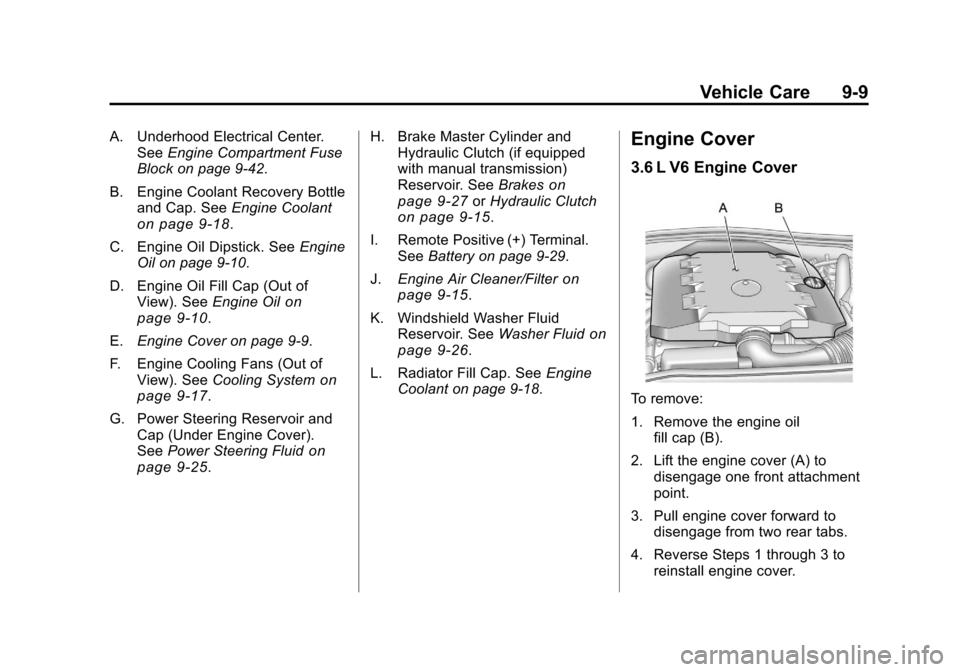
A. Underhood Electrical Center.See Engine Compartment Fuse
Block on page 9‑42.
B. Engine Coolant Recovery Bottle and Cap. See Engine Coolant
on page 9‑18.
C. Engine Oil Dipstick. See Engine
Oil on page 9‑10.
D. Engine Oil Fill Cap (Out of View). See Engine Oil
on
page 9‑10.
E. Engine Cover on page 9‑9.
F. Engine Cooling Fans (Out of View). See Cooling System
on
page 9‑17.
G. Power Steering Reservoir and Cap (Under Engine Cover).
See Power Steering Fluid
on
page 9‑25. H. Brake Master Cylinder and
Hydraulic Clutch (if equipped
with manual transmission)
Reservoir. See Brakes
on
page 9‑27or Hydraulic Clutchon page 9‑15.
I. Remote Positive (+) Terminal. See Battery on page 9‑29.
J. Engine Air Cleaner/Filter
on
page 9‑15.
K. Windshield Washer Fluid Reservoir. See Washer Fluid
on
page 9‑26.
L. Radiator Fill Cap. See Engine
Coolant on page 9‑18.
Engine Cover
3.6 L V6 Engine Cover
To remove:
1. Remove the engine oil fill cap (B).
2. Lift the engine cover (A) to disengage one front attachment
point.
3. Pull engine cover forward to disengage from two rear tabs.
4. Reverse Steps 1 through 3 to reinstall engine cover.
Page 269 of 378

Black plate (37,1)Chevrolet Camaro Owner Manual - 2010
Vehicle Care 9-37
Headlamps, Front Turn
Signal and Parking
Lamps (Base Vehicle)
The base model vehicle has a
halogen headlamp and a turn
signal/parking lamp on the
headlamp assembly.To replace one of these bulbs:
1. Open the hood. See
Hood
on
page 9‑5.
2. Press in on the tabs located on the sides of the duct and then
push the duct rearward into the
air cleaner/filter housing.
A. Parking/Turn Signal Lamp
B. Halogen Headlamp
3. Disconnect the wiring harness and turn the bulb socket
counterclockwise to remove it
from the headlamp assembly.
4. Pull the bulb straight out from the socket.
Page 270 of 378

Black plate (38,1)Chevrolet Camaro Owner Manual - 2010
9-38 Vehicle Care
5. Push the new bulb into thesocket and reinstall the socket
into the headlamp assembly by
turning it clockwise.
6. Reconnect the electrical connector.
7. Pull the duct back out of the air cleaner/filter housing until the
tabs snap the duct back into
position.
Headlamps, Front Turn
Signal and Parking
Lamps (Up-Level Vehicle)
The up–level model vehicle has a
HID headlamp and a turn signal
lamp on the headlamp assembly.
The park lamp is also the function
of the HID headlamp. See High
Intensity Discharge (HID) Lighting
on page 9‑36for more information. To replace the turn signal bulb:
1. Open the hood. See
Hood
on
page 9‑5.
2. Press in on the tabs located on the sides of the duct and then
push the duct rearward into the
air cleaner/filter housing.
3. Disconnect the wiring harnessand turn the bulb socket
counterclockwise to remove it
from the headlamp assembly.
4. Pull the bulb straight out from the socket.
Page 271 of 378

Black plate (39,1)Chevrolet Camaro Owner Manual - 2010
Vehicle Care 9-39
5. Push the new bulb into thesocket and reinstall the socket
into the headlamp assembly by
turning it clockwise.
6. Reconnect the electrical connector.
7. Pull the duct back out of the air cleaner/filter housing until the
tabs snap the duct back into
position.
Daytime Running
Lamps (DRL)
The up–level model vehicle may
have daytime running lamps which
would be located on the fascia. To replace one of these bulbs:1. Locate the bulb assembly under
the front fascia.
2. Disconnect the electrical connector from the bulb
assembly and pull out the bulb
assembly. 3. Push in the new bulb assembly
to lock it into place.
4. Reconnect the electrical connector to the bulb assembly.
The base model vehicle daytime
running lamps are the low beam on
the halogen headlamp. If one these
lamps fail, see Headlamps, Front
Turn Signal and Parking Lamps
(Base Vehicle)
on page 9‑37or
Headlamps, Front Turn Signal and
Parking Lamps (Up-Level Vehicle)
on page 9‑38for replacement
information.
Page 328 of 378
Black plate (96,1)Chevrolet Camaro Owner Manual - 2010
9-96 Vehicle Care
.Do not heavily saturate the
upholstery while cleaning.
.Damage to the vehicle's interior
may result from the use of many
organic solvents such as naptha,
alcohol, etc.
Fabric/Carpet
Use a vacuum cleaner with a soft
brush attachment to remove dust
and loose dirt. A canister vacuum
with a beater bar in the nozzle
may only be used on floor carpet
and carpeted floor mats. For soils,
always try to remove them first with
plain water or club soda. Before
cleaning, gently remove as much of
the soil as possible using one of the
following techniques:
.For liquids: gently blot the
remaining soil with a paper
towel. Allow the soil to absorb
into the paper towel until no
more can be removed.
.For solid dry soils: remove as
much as possible and then
vacuum.To clean:
1. Saturate a lint-free, clean white
cloth with water or club soda.
2. Remove excess moisture.
3. Start on the outside edge of the soil and gently rub toward the
center. Continue cleaning, using
a clean area of the cloth each
time it becomes soiled.
4. Continue to gently rub the soiled area.
5. If the soil is not completely removed, use a mild soap
solution and repeat the cleaning
process with plain water.
If any of the soil remains, a
commercial fabric cleaner or spot
lifter may be necessary. Test a small
hidden area for colorfastness before
using a commercial upholstery
cleaner or spot lifter. If the locally
cleaned area gives any impression
that a ring formation may result,
clean the entire surface. A paper towel can be used to blot
excess moisture from the fabric or
carpet after the cleaning process.
Leather
To remove dust, a soft cloth
dampened with water can be
used. If a more thorough cleaning is
necessary, a soft cloth dampened
with a mild soap solution can be
used. Allow the leather to dry
naturally. Do not use heat, steam,
spot lifters or spot removers,
or shoe polish on leather.
Many commercial leather cleaners
and coatings that are sold to
preserve and protect leather
may permanently change the
appearance and feel of the leather
and are not recommended. Do not
use silicone or wax-based products,
or those containing organic solvents
to clean the vehicle's interior
because they can alter the
appearance by increasing the
gloss in a non-uniform manner.
Page 367 of 378

Black plate (1,1)Chevrolet Camaro Owner Manual - 2010
INDEX i-1
A
Accessories andModifications . . . . . . . . . . . . . . . . . . 9-4
Accessory Power . . . . . . . . . . . . . . 8-19
Active Fuel Management™ . . . . 8-25
Add-On Electrical Equipment . . . . . . . . . . . . . . . . . . . 8-55
Adding Equipment to the Airbag-Equipped Vehicle . . . . . 2-34
Air Cleaner/Filter, Engine . . . . . . 9-15
Air Vents . . . . . . . . . . . . . . . . . . . . . . . 7-3
Airbag System Check . . . . . . . . . . . . . . . . . . . . . . . . 2-35
How Does an AirbagRestrain? . . . . . . . . . . . . . . . . . . . 2-27
Passenger Sensing
System . . . . . . . . . . . . . . . . . . . . . . 2-29
What Makes an Airbag Inflate? . . . . . . . . . . . . . . . . . . . . . . 2-27
What Will You See After
an Airbag Inflates? . . . . . . . . . . 2-28
When Should an Airbag Inflate? . . . . . . . . . . . . . . . . . . . . . . 2-25
Where Are the Airbags? . . . . . . 2-24 Airbags
Adding Equipment to the
Vehicle . . . . . . . . . . . . . . . . . . . . . . 2-34
Passenger Status Indicator . . . 4-19
Readiness Light . . . . . . . . . . . . . . 4-18
Servicing Airbag-Equipped Vehicles . . . . . . . . . . . . . . . . . . . . . 2-34
System Check . . . . . . . . . . . . . . . . 2-22
Alarm System Anti-Theft . . . . . . . . . . . . . . . . . . . . . . 1-9
AM-FM Radio . . . . . . . . . . . . . . . . . . . 6-7
Antenna
Satellite Radio . . . . . . . . . . . . . . . . 6-13
Anti-Theft Alarm System . . . . . . . . . . . . . . . . . 1-9
Alarm System Messages . . . . . 4-36
Antilock Brake System (ABS) . . . . . . . . . . . . . . . . 8-31
Warning Light . . . . . . . . . . . . . . . . . 4-24
Appearance Care Exterior . . . . . . . . . . . . . . . . . . . . . . . 9-90
Interior . . . . . . . . . . . . . . . . . . . . . . . . 9-95 Assistance Program,
Roadside . . . . . . . . . . . . . . . . . . . . . 12-6
Audio Players . . . . . . . . . . . . . . . . . 6-14 CD . . . . . . . . . . . . . . . . . . . . . . . . . . . 6-14
Audio System Backglass Antenna . . . . . . . . . . . 6-13
Radio Reception . . . . . . . . . . . . . . 6-12
Theft-Deterrent Feature . . . . . . . . 6-1
Automatic Dimming Mirrors . . . . . . . . . . . . . . 1-13
Headlamp System . . . . . . . . . . . . . 5-4
Automatic Transmission . . . . . . . 8-26 Fluid . . . . . . . . . . . . . . . . . . . . . . . . . . 9-14
Manual Mode . . . . . . . . . . . . . . . . . 8-29
Shiftlock Control SystemCheck . . . . . . . . . . . . . . . . . . . . . . . 9-31
Auxiliary Devices . . . . . . . . . . . . . . 6-16
Axle, Rear . . . . . . . . . . . . . . . . . . . . . 9-29