Page 103 of 616

Securing a Child Restraint in the
Right Front Seat Position
This vehicle has airbags. A rear seat is a safer place tosecure a forward-facing child restraint. SeeWhere toPut the Restraint on page 2!57.
In addition, the vehicle may have a passenger sensingsystem which is designed to turn off the right frontpassenger frontal airbag under certain conditions. SeePassenger Sensing Systemon page 2!84andPassenger Airbag Status Indicatoron page 4!31formore information, including important safety information.
A label on the sun visor says,“Never put a rear-facingchild seat in the front.”This is because the risk to therear-facing child is so great, if the airbag deploys.
{WARNING:
A child in a rear-facing child restraint can be
seriously injured or killed if the right front
passenger airbag inflates. This is because the
back of the rear-facing child restraint would be
very close to the inflating airbag.
(Continued)
WARNING: (Continued)
A child in a forward-facing child restraint can
be seriously injured or killed if the right front
passenger airbag inflates and the passenger
seat is in a forward position.
The vehicle may have a passenger sensing
system which is designed to turn off the right front
passenger frontal airbag under certain conditions.
Even if the passenger sensing system,
if equipped, has turned off the right front
passenger frontal airbag, no system is fail-safe.
No one can guarantee that an airbag will not
deploy under some unusual circumstance, even
though it is turned off.
Secure rear-facing child restraints in a rear seat,
even if the airbag is off. If you secure a
forward-facing child restraint in the right front seat,
always move the front passenger seat as far back
as it will go. It is better to secure the child restraint
in a rear seat.
SeePassenger Sensing Systemon page 2!84
for additional information.
2-71
Page 104 of 616

If the child restraint has the LATCH system, seeLowerAnchors and Tethers for Children (LATCH)onpage 2!59for how and where to install the childrestraint using LATCH. If a child restraint is securedusing a safety belt and it uses a top tether, seeLowerAnchors and Tethers for Children (LATCH)onpage 2!59for top tether anchor locations.
Do not secure a child seat in a position without a toptether anchor if a national or local law requires that thetop tether be anchored, or if the instructions that comewith the child restraint say that the top strap mustbe anchored.
In Canada, the law requires that forward-facing childrestraints have a top tether, and that the tether beattached.
You will be using the lap-shoulder belt to secure thechild restraint in this position. Follow the instructionsthat came with the child restraint.
1. Move the seat as far back as it will go beforesecuring the forward-facing child restraint.
2. Put the child restraint on the seat.
3. Pick up the latch plate, and run the lap andshoulder portions of the vehicle's safety beltthrough or around the restraint. The child restraintinstructions will show you how.
4. Push the latch plate into the buckle until it clicks.
Position the release button on the buckle so thatthe safety belt could be quickly unbuckled ifnecessary.
2-72
Page 105 of 616
5. Pull the rest of the shoulder belt all the way out ofthe retractor to set the lock.6. To tighten the belt, push down on the childrestraint, pull the shoulder portion of the belt totighten the lap portion of the belt and feed theshoulder belt back into the retractor. Wheninstalling a forward-facing child restraint, it may behelpful to use your knee to push down on the childrestraint as you tighten the belt.
7. Push and pull the child restraint in differentdirections to be sure it is secure.
2-73
Page 108 of 616
{WARNING:
Children who are up against, or very close to, any
airbag when it inflates can be seriously injured or
killed. Airbags plus lap-shoulder belts offer
protection for adults and older children, but not for
young children and infants. Neither the vehicle's
safety belt system nor its airbag system is
designed for them. Young children and infants
need the protection that a child restraint system
can provide. Always secure children properly in
your vehicle. To read how, seeOlder Childrenon
page 2!49orInfants and Young Childrenon
page 2!52.
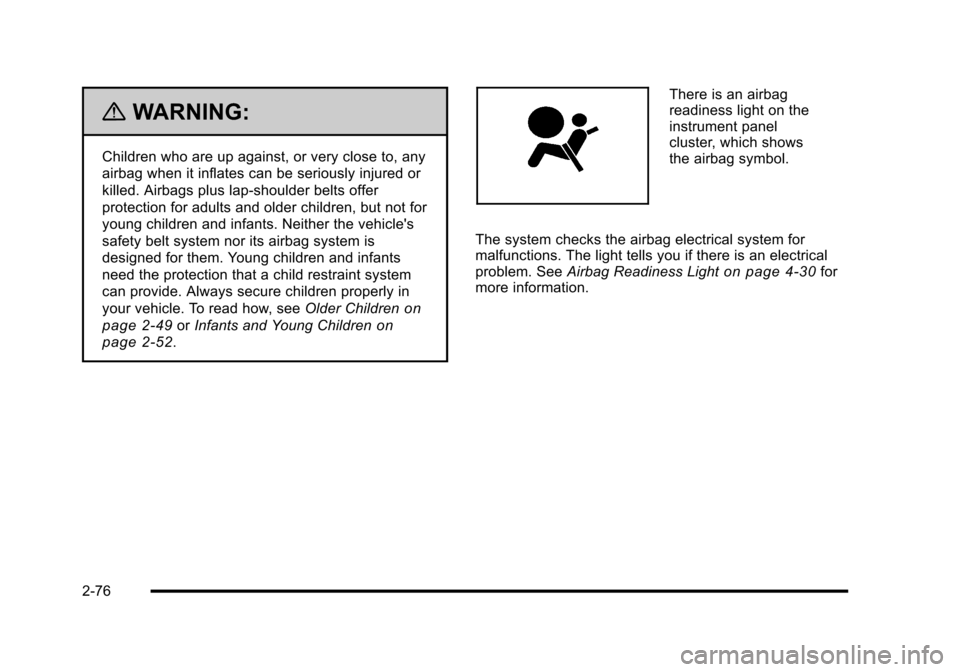
There is an airbagreadiness light on theinstrument panelcluster, which showsthe airbag symbol.
The system checks the airbag electrical system formalfunctions. The light tells you if there is an electricalproblem. SeeAirbag Readiness Lighton page 4!30formore information.
2-76
Page 111 of 616
Driver Side shown, Passenger Side similar
If the vehicle has a third row passenger seat, theroof-rail airbags are located in the ceiling above the rearwindows for the outboard passenger positions in thethird row.
{WARNING:
If something is between an occupant and an
airbag, the airbag might not inflate properly or it
might force the object into that person causing
severe injury or even death. The path of an
inflating airbag must be kept clear. Do not put
anything between an occupant and an airbag, and
do not attach or put anything on the steering
wheel hub or on or near any other airbag
covering.
Do not use seat accessories that block the
inflation path of a seat-mounted side impact
airbag.
Never secure anything to the roof of a vehicle with
roof-rail airbags by routing a rope or tie down
through any door or window opening. If you do,
the path of an inflating roof-rail airbag will be
blocked.
2-79
Page 116 of 616
Passenger Sensing System
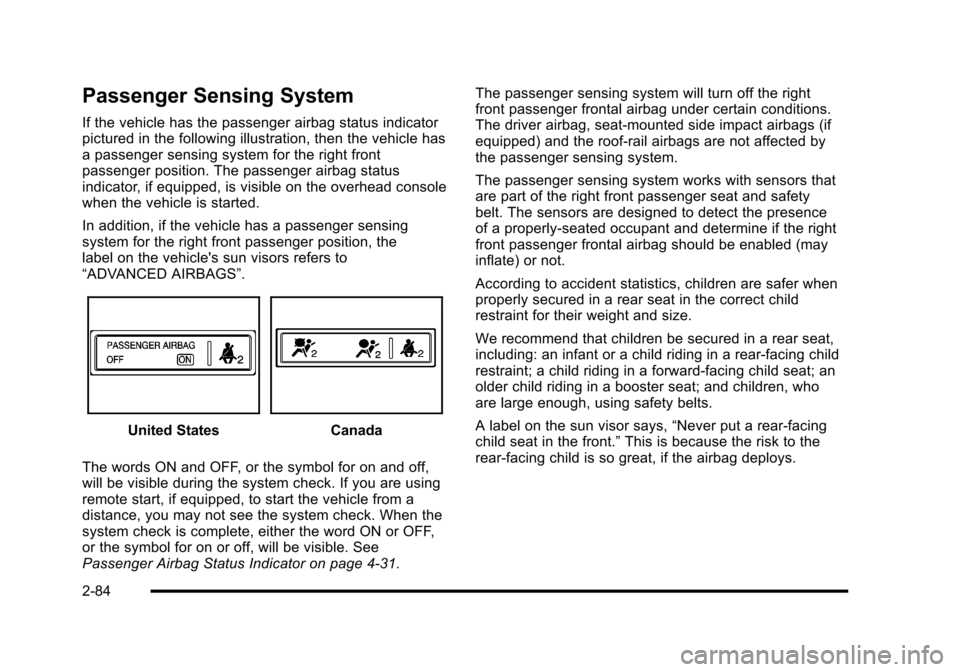
If the vehicle has the passenger airbag status indicatorpictured in the following illustration, then the vehicle hasa passenger sensing system for the right frontpassenger position. The passenger airbag statusindicator, if equipped, is visible on the overhead consolewhen the vehicle is started.
In addition, if the vehicle has a passenger sensingsystem for the right front passenger position, thelabel on the vehicle's sun visors refers to“ADVANCED AIRBAGS”.
United StatesCanada
The words ON and OFF, or the symbol for on and off,will be visible during the system check. If you are usingremote start, if equipped, to start the vehicle from adistance, you may not see the system check. When thesystem check is complete, either the word ON or OFF,or the symbol for on or off, will be visible. SeePassenger Airbag Status Indicator on page 4!31.
The passenger sensing system will turn off the rightfront passenger frontal airbag under certain conditions.The driver airbag, seat!mounted side impact airbags (ifequipped) and the roof-rail airbags are not affected bythe passenger sensing system.
The passenger sensing system works with sensors thatare part of the right front passenger seat and safetybelt. The sensors are designed to detect the presenceof a properly-seated occupant and determine if the rightfront passenger frontal airbag should be enabled (mayinflate) or not.
According to accident statistics, children are safer whenproperly secured in a rear seat in the correct childrestraint for their weight and size.
We recommend that children be secured in a rear seat,including: an infant or a child riding in a rear-facing childrestraint; a child riding in a forward-facing child seat; anolder child riding in a booster seat; and children, whoare large enough, using safety belts.
A label on the sun visor says,“Never put a rear-facingchild seat in the front.”This is because the risk to therear-facing child is so great, if the airbag deploys.
2-84
Page 117 of 616

{WARNING:
A child in a rear-facing child restraint can be
seriously injured or killed if the right front
passenger airbag inflates. This is because the
back of the rear-facing child restraint would be
very close to the inflating airbag. A child in a
forward-facing child restraint can be seriously
injured or killed if the right front passenger airbag
inflates and the passenger seat is in a forward
position.
Even if the passenger sensing system has turned
off the right front passenger frontal airbag, no
system is fail-safe. No one can guarantee that an
airbag will not deploy under some unusual
circumstance, even though the airbag is
turned off.
Secure rear-facing child restraints in a rear seat,
even if the airbag is off. If you secure a
forward-facing child restraint in the right front seat,
always move the front passenger seat as far back
as it will go. It is better to secure the child restraint
in a rear seat.
The passenger sensing system is designed to turn offthe right front passenger frontal airbag if:
.The right front passenger seat is unoccupied.
.The system determines an infant is present in achild restraint.
.A right front passenger takes his/her weight off ofthe seat for a period of time.
.Or, if there is a critical problem with the airbagsystem or the passenger sensing system.
When the passenger sensing system has turned off theright front passenger frontal airbag, the off indicator willlight and stay lit to remind you that the airbag is off. SeePassenger Airbag Status Indicator on page 4!31.
The passenger sensing system is designed to turn on(may inflate) the right front passenger frontal airbaganytime the system senses that a person of adult size issitting properly in the right front passenger seat.
When the passenger sensing system has allowed theairbag to be enabled, the on indicator will light and staylit to remind you that the airbag is active.
2-85
Page 118 of 616

For some children, including children in child restraints,and for very small adults, the passenger sensingsystem may or may not turn off the right front passengerfrontal airbag, depending upon the person's seatingposture and body build. Everyone in your vehicle whohas outgrown child restraints should wear a safety beltproperly—whether or not there is an airbag forthat person.
{WARNING:
If the airbag readiness light ever comes on and
stays on, it means that something may be wrong
with the airbag system. To help avoid injury to
yourself or others, have the vehicle serviced right
away. SeeAirbag Readiness Lighton page 4!30
for more information, including important safety
information.
If the On Indicator is Lit for a Child
Restraint
If a child restraint has been installed and the onindicator is lit:
1. Turn the vehicle off.
2. Remove the child restraint from the vehicle.
3. Remove any additional items from the seat such asblankets, cushions, seat covers, seat heaters,or seat massagers.
4. Reinstall the child restraint following the directionsprovided by the child restraint manufacturer andrefer toSecuring a Child Restraint in the RightFront Seat Position on page 2!71.
5. If, after reinstalling the child restraint and restartingthe vehicle, the on indicator is still lit, turn thevehicle off. Then slightly recline the vehicleseatback and adjust the seat cushion, if adjustable,to make sure that the vehicle seatback is notpushing the child restraint into the seat cushion.
Also make sure the child restraint is not trappedunder the vehicle head restraint. If this happens,adjust the head restraint. SeeHead Restraintsonp a g e 2!2.
6. Restart the vehicle.
The passenger sensing system may or may notturn off the airbag for a child in a child restraintdepending upon the child’s seating posture andbody build. It is better to secure the child restraintin a rear seat.
2-86