Page 453 of 616
Fuel
Use of the recommended fuel is an important part of theproper maintenance of this vehicle. To help keep theengine clean and maintain optimum vehicleperformance, we recommend the use of gasolineadvertised as TOP TIER Detergent Gasoline.
Look for the TOP TIER label on the fuel pump to ensuregasoline meets enhanced detergency standardsdeveloped by auto companies. A list of marketersproviding TOP TIER Detergent Gasoline can be foundat www.toptiergas.com.
This vehicle can use either unleaded gasoline orethanol fuel containing up to 85% ethanol (E85).SeeGasoline Octaneo n p a g e 7!8andFuel E85(85% Ethanol) on page 7!9.
7-7
Page 468 of 616

Engine Air Cleaner/Filter
SeeEngine Compartment Overviewon page 7!16forthe location of the engine air cleaner/filter.
Inspect the air cleaner/filter every other oil change andreplace it at the first oil change after each 50,000 mile(80 000 km) interval. SeeScheduled Maintenanceonp a g e 8!3for more information. If driving on dusty/dirtyconditions, inspect the filter at each engine oil change.
How to Inspect the Engine Air Cleaner/
Filter
To inspect the air cleaner/filter, remove the engine aircleaner/filter from the vehicle by following Steps 1through 6. When the engine air cleaner/filter isremoved, lightly shake it to release loose dust and dirt.If the engine air cleaner/filter remains caked with dirt, anew filter is required. Never use compressed air toclean the filter.
Replacing the Engine Air Cleaner/Filter
1. Locate the air cleaner/filter assembly . SeeEngine CompartmentOverviewonpage 7!16.
2. Loosen the four screws on the cover of thehousing and lift up the cover.
7-22
Page 470 of 616

Automatic Transmission Fluid
When to Check and Change Automatic
Transmission Fluid
It is usually not necessary to check the transmissionfluid level. The only reason for fluid loss is atransmission leak or overheating the transmission.If you suspect a small leak, then use the followingchecking procedures to check the fluid level. However,if there is a large leak, then it may be necessary to havethe vehicle towed to a dealer/retailer service departmentand have it repaired before driving the vehicle further.
Notice:Use of the incorrect automatic transmissionfluid may damage the vehicle, and the damages maynot be covered by the vehicle's warranty. Alwaysuse the automatic transmission fluid listed inRecommended Fluids and Lubricants on page 8!10.
Change the fluid and filter at the intervals listed in theMaintenance Schedule. SeeScheduled Maintenanceo n p a g e 8!3. Be sure to use the transmission fluidlisted inRecommended Fluids and Lubricantsonpage 8!10.
How to Check Automatic Transmission
Fluid
Notice:Too much or too little fluid can damage yourtransmission. Too much can mean that some of thefluid could come out and fall on hot engine parts orexhaust system parts, starting a fire. Too little fluidcould cause the transmission to overheat. Be sureto get an accurate reading if you check yourtransmission fluid.
Before checking the fluid level, prepare the vehicle asfollows:
1. Start the engine and park the vehicle on a levelsurface. Keep the engine running.
2. Apply the parking brake and place the shiftlever in P (Park).
3. With your foot on the brake pedal, move the shiftlever through each gear range, pausing for aboutthree seconds in each range. Then, move the shiftlever back to P (Park).
7-24
Page 486 of 616

Brakes
Brake Fluid
The brake master cylinderreservoir is filled with DOT3 brake fluid. SeeEngineCompartment Overviewon page 7!16for thelocation of the reservoir.
There are only two reasons why the brake fluid level inthe reservoir might go down:
.The brake fluid level goes down because ofnormal brake lining wear. When new linings areinstalled, the fluid level goes back up.
.A fluid leak in the brake hydraulic system can alsocause a low fluid level. Have the brake hydraulicsystem fixed, since a leak means that sooner orlater the brakes will not work well.
Do not top off the brake fluid. Adding fluid does notcorrect a leak. If fluid is added when the linings areworn, there will be too much fluid when new brakelinings are installed. Add or remove brake fluid, asnecessary, only when work is done on the brakehydraulic system.
{WARNING:
If too much brake fluid is added, it can spill on the
engine and burn, if the engine is hot enough. You
or others could be burned, and the vehicle could
be damaged. Add brake fluid only when work is
done on the brake hydraulic system. See
“Checking Brake Fluid”in this section.
When the brake fluid falls to a low level, the brakewarning light comes on. SeeBrake System WarningLight on page 4!33.
Refer to the Maintenance Schedule to determine whento check the brake fluid. SeeScheduled Maintenanceo n p a g e 8!3.
7-40
Page 495 of 616
3. Disconnect the red positive (+) cable from thevehicle with the good battery.
4. Disconnect the red positive (+) cable from theother vehicle.
5. Return the remote positive (+) terminal cover,if the vehicle has one, to its original position.
All-Wheel Drive
Transfer Case
If your vehicle is equipped with All-Wheel Drive, be sureto perform the lubricant checks described in thissection. There are two additional systems that needlubrication.
When to Check Lubricant
Refer to the Maintenance Schedule to determine howoften to check the lubricant. SeeScheduledMaintenance on page 8!3.
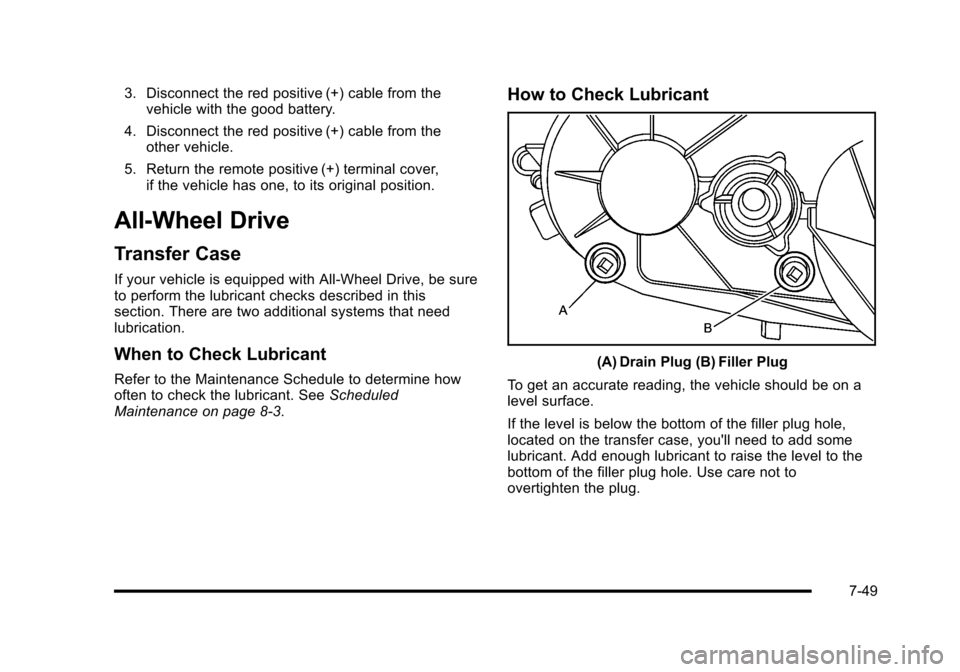
How to Check Lubricant
(A) Drain Plug (B) Filler Plug
To get an accurate reading, the vehicle should be on alevel surface.
If the level is below the bottom of the filler plug hole,located on the transfer case, you'll need to add somelubricant. Add enough lubricant to raise the level to thebottom of the filler plug hole. Use care not toovertighten the plug.
7-49
Page 496 of 616

What to Use
Refer to the Maintenance Schedule to determine whatkind of lubricant to use. SeeRecommended Fluids andLubricants on page 8!10.
Rear Axle
When to Check Lubricant
It is not necessary to regularly check rear axle fluidunless you suspect there is a leak or you hear anunusual noise. A fluid loss could indicate a problem.Have it inspected and repaired.
All axle assemblies are filled by volume of fluid duringproduction. They are not filled to reach a certain level.When checking the fluid level on any axle, variations inthe readings can be caused by factory fill differencesbetween the minimum and the maximum fluid volume.Also, if a vehicle has just been driven before checkingthe fluid level, it may appear lower than normal becausefluid has traveled out along the axle tubes and has notdrained back to the sump area. Therefore, a readingtaken five minutes after the vehicle has been driven willappear to have a lower fluid level than a vehicle thathas been stationary for an hour or two. Remember thatthe rear axle assembly must be supported to get a truereading.
How to Check Lubricant
To get an accurate reading, the vehicle should be on alevel surface.
.For Two-Wheel-Drive vehicles, the proper level isfrom 0.6 inch to 1.6 inches (15 mm to 40 mm) belowthe bottom of the filler plug hole, located on therear axle. Add only enough fluid to reach theproper level.
.For All-Wheel-Drive vehicles, the proper level isfrom 0.04 inch to 0.75 inch (1.0 mm to 19.0 mm)below the bottom of the filler plug hole, located onthe rear axle. Add only enough fluid to reach theproper level.
7-50
Page 497 of 616
What to Use
Refer to the Maintenance Schedule to determine whatkind of lubricant to use. SeeRecommended Fluids andLubricants on page 8!10.
Front Axle
When to Check and Change Lubricant
It is not necessary to regularly check front axle fluidunless you suspect there is a leak or you hear anunusual noise. A fluid loss could indicate a problem.Have it inspected and repaired.
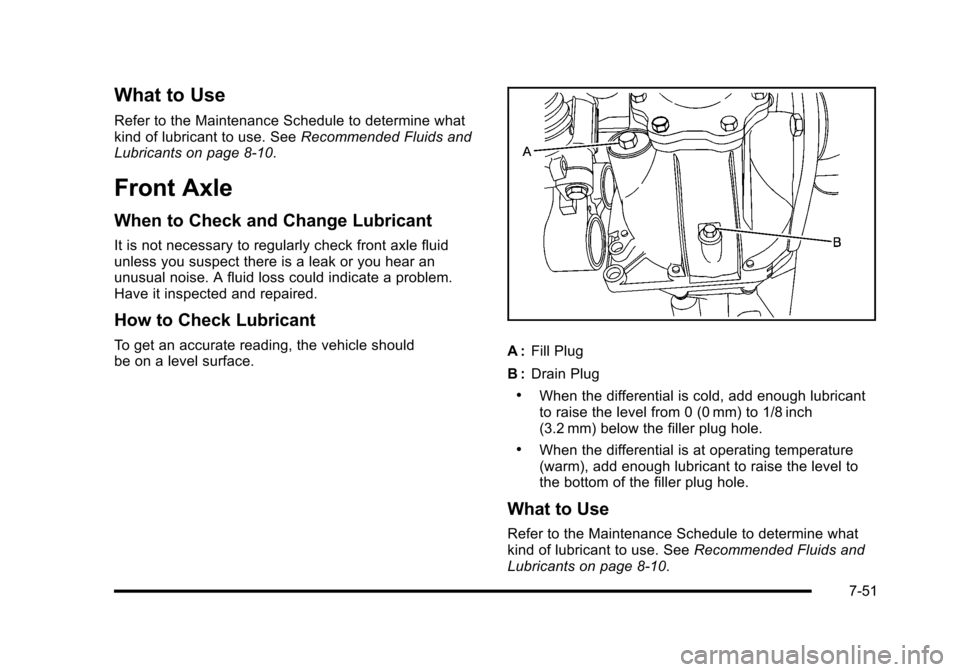
How to Check Lubricant
To get an accurate reading, the vehicle shouldbe on a level surface.A:Fill Plug
B:Drain Plug
.When the differential is cold, add enough lubricantto raise the level from 0 (0 mm) to 1/8 inch(3.2 mm) below the filler plug hole.
.When the differential is at operating temperature(warm), add enough lubricant to raise the level tothe bottom of the filler plug hole.
What to Use
Refer to the Maintenance Schedule to determine whatkind of lubricant to use. SeeRecommended Fluids andLubricants on page 8!10.
7-51
Page 503 of 616
Windshield Wiper Blade
Replacement
Windshield wiper blades should be inspected for wearor cracking. SeeScheduled Maintenance on page 8!3.
Replacement blades come in different types and areremoved in different ways. To replace the wiper bladeassembly:
1. Pull the windshield wiper arm connector away fromthe windshield.
2. Squeeze the grooved areas on each side of theblade, and turn the blade assembly away from thearm connector.
3. Install the new blade onto the arm connector andmake sure the grooved areas are fully set in thelocked position.
For the proper type and size, seeMaintenanceReplacement Parts on page 8!12.
7-57