2010 AUDI S6 weight
[x] Cancel search: weightPage 222 of 368
_,___C_ h_ il_d _ S_a _ f_ e _ t-= y ;....._ ____________________________________________ _
C. Forward-facing convertible child restraint
systems, manufactured on or after September 1,
2004:
• Britax Roundabout 161
• Century Encore 4612
• Century STE 1000 4416
• Cosco Olympian 02803
• Cosco Touriva 02519
• Evenflo Horizon V 425
• Evenflo Medallion 254
• Safety First Comfort Ride 22-400
& WARNING
To reduce the risk of serious injury, make sure that the
PASSENGER AIR BAG OFF light comes on and stays on whenever a
child restraint is installed on the front passenger seat and the ignition is switched on.
• Take the child restraint off the front passenger seat and install
it properly at one of the rear seat positions if the PASSENGER AIR BAG OFF light does not stay on.
• Have the airbag system inspected by your authorized Audi
dealer immediately.
W Tips
The child seats listed in categories A to C have been tested by Audi
only for the Advanced Airbag function. •
Important safety instructions for using
child safety seats
Correct use of child safety seats substantially reduces the
risk of injury in an accident!
As the driver, you are responsible for the safety of everybody
in the vehicle, especially children:
Always use the right child safety seat for each child and
always use it properly~
page 222.
-Always carefully follow the child safety seat manufac
turer's instructions on how to route the safety belt prop
erly through the child safety seat.
- When using the vehicle safety belt to install a child safety
seat, you must first activate the convertible locking retractor on the safety belt to prevent the child safety seat
from moving ~
page 227.
-Push the child safety seat down with your full weight to
get the safety belt really tight so that the seat cannot
move forward or sideways more than one inch (2.5 cm).
- If a strap or tether is being used to tie the child safety seat
to the front passenger seat, make sure that it is not so
tight that it causes the weight-sensing mat to measure more weight than is actually on the seat.
Always remember: Even though your vehicle is equipped with an
Advanced Airbag system, all children, especially those 12 years and
younger, should always ride in the back seat properly restrained for
their age and size . _,,
Page 225 of 368
-Push the child safety seat down with your full weight to
get the safety belt really tight so that the seat cannot
move forward or sideways more than one inch (2.5 cm).
Infants up to about one year (20 lbs. or 9 kg) are best protected in
special infant carriers and chi ld safety seats designed for t heir age
group. Many experts believe that infants and small childr en should
r ide only in spec ia l restra ints in w hich the child faces the back of the
vehicle. These infant seats support the baby's back, neck and head in
a crash=> fig. 189.
The airbag on the passenger side makes the front seat a potentially
dangerous place for a child to ride. The front seat is not the safest
place for a ch ild in a forward-facing child seat.
It is a very dangerous
place for an infant or a large r child in a rear ward-fac ing seat.
& WARNING
Not using a child safety seat, using the wrong child safety seat or
improperly installing a child restraint increases the risk of serious
personal injury and death in a crash.
• Never install rear-facing child safety seats or infant carriers on
the front passenger seat· even with an Advanced Airbag System.
A child will be seriously injured and can be killed when the
inflating airbag hits the child safety seat or infant carrier with
great force and smashes the child safety seat and child against the
backrest, center armrest, door or roof=>
page 197, "Child
restraints on the front seat -some important things to know".
• Always install rear-facing child safety seats or infant carriers
on the rear seat.
• Never install a rear-facing child rest raint in the forward-facing
direction. Such restraints are designed for the special needs of
infants and very small children and cannot protect them properly
if the seat is forward-facing.
• If you must install a rearward facing child safety seat on the
front passenger seat because of exceptional circumstances and
the PASSENGER AIR BAG
OFF light does not come on and stay on,
Safety
first Vehicle OP-eration
Child Safety
& WARNING (continued)
immediately install the rear-facing child safety seat in a rear
seating position and have the airbag system inspected by your
Audi dealer.
• Always read and heed all WARNINGS whenever using a child
restrained in a vehicle is being used=>
page 185, "Safety belts",
=>
page 195, "Airbag system" and=> page 217, "Important
things to know ".•
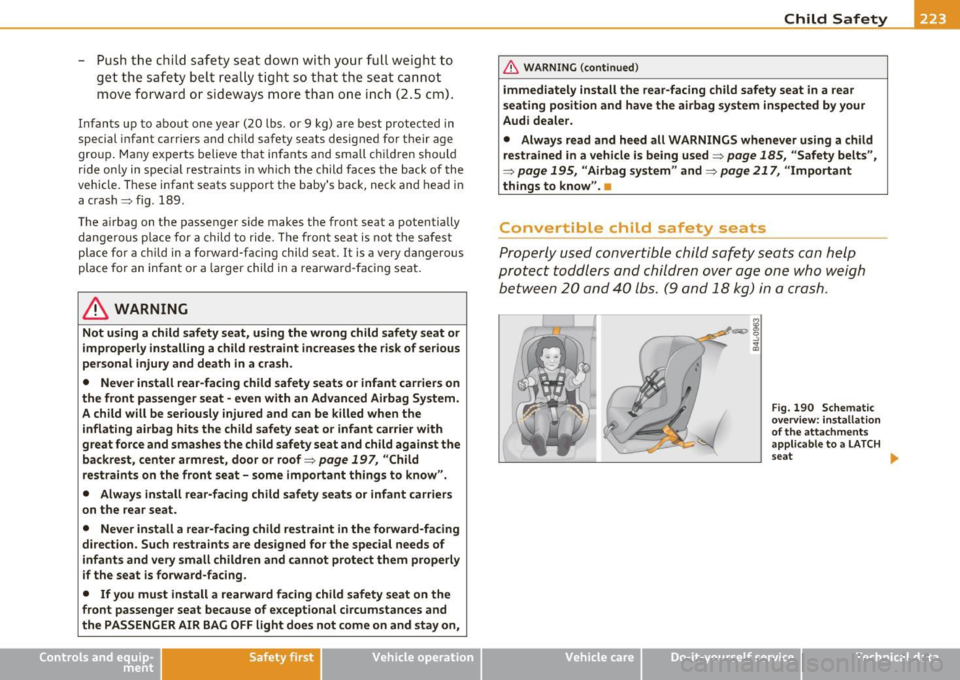
Convertible child safety seat:s
Properly used convertible child safety seats can help
protect toddlers and children over age one who weigh
b etween 20 and 40 lbs. (9 and 18 kg) in a crash.
Vehicle care
Fig . 190 Schematic
overview: installation
of the attachments
applicable to a LATCH
seat
ti,
Do-it-yourselt service iTechnical data
Page 226 of 368
Ill Child Safety __ .,.___ ____________ _
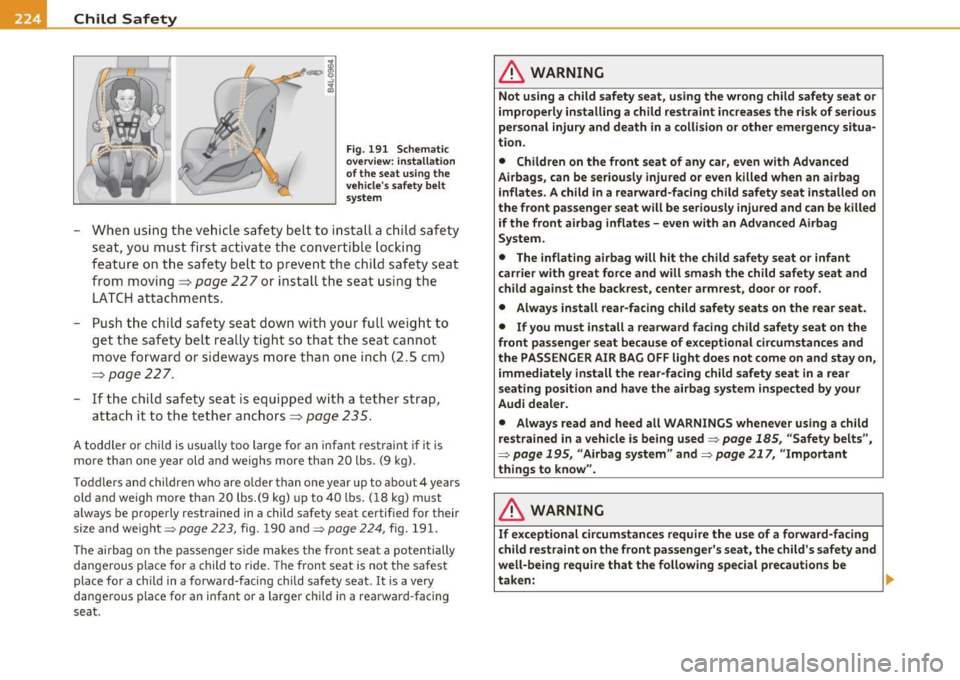
Fig. 191 Schematic
overview: installation
of the seat using the
vehicle's safety belt
system
- When using the vehicle safety belt to install a child safety
seat, you must first activate the convertible locking
feature on the safety belt to prevent the child safety seat
from moving~
page 227 or install the seat using the
LATCH attachments.
- Push the child safety seat down with your full weight to get the safety belt really tight so that the seat cannot
move forward or sideways more than one inch
(2.5 cm)
=>
page 227.
- If the child safety seat is equipped with a tether strap, attach it to the tether anchors=>
page 235.
A toddler or child is usually too large for an infant restraint if it is
more than one year old and weighs more than 20 lbs . (9 kg) .
Toddlers and children who are older than one year up to about 4 years old and weigh more than 20 lbs .(9 kg) up to 40 lbs. (18 kg) must
always be properly restrained in a child safety seat certified for their
size and weight~
page 223, fig. 190 and~ page 224, fig. 191.
The airbag on the passenger side makes the front seat a poten tially
dangerous place for a child to ride. The front seat is not the safest
place for a child in a forward-facing child safety seat . It is a very
dangerous place for an infant or a larger child in a rearward-facing
seat .
& WARNING
Not using a child safety seat, using the wrong child safety seat or
improperly installing a child restraint increases the risk of serious
personal injury and death in a collision or other emergency situa
tion.
• Children on the front seat of any car, even with Advanced
Airbags, can be seriously injured or even killed when an airbag
inflates. A child in a rearward-facing child safety seat installed on
the front passenger seat will be seriously injured and can be killed
if the front airbag inflates -even with an Advanced Airbag
System.
• The inflating airbag will hit the child safety seat or infant
carrier with great force and will smash the child safety seat and
child against the backrest, center armrest, door or roof.
• Always install rear-facing child safety seats on the rear seat.
• If you must install a rearward facing child safety seat on the
front passenger seat because of exceptional circumstances and
the PASSENGER AIR BAG OFF light does not come on and stay on,
immediately install the rear-facing child safety seat in a rear
seating position and have the airbag system inspected by your
Audi dealer.
• Always read and heed all WARNINGS whenever using a child
restrained
in a vehicle is being used~ page 185, "Safety belts",
~ page 195, "Airbag system" and~ page 217, "Important
things to know".
& WARNING
If exceptional circumstances require the use of a forward-facing
child restraint on the front passenger's seat, the child's safety and
well-being require that the following special precautions be
taken:
11'-
Page 230 of 368
.,.___C_ h_ il_d _ S_a _ f_ e _ t--= y '------------------------------------------------
& WARNING (cont inued)
• If the backrest is not securely latched, the child and the child
restraint will be thrown forward together with the backrest and
will strike parts of the vehicle interior. The child can be seriously
injured or killed.
• Never install rear-facing child safety seats or infant carriers on
the front passenger seat. A child will be seriously injured and can be killed when the passenger airbag inflates.
• The inflating airbag will hit the child safety seat or infant
carrier with great force and will smash the child safety seat and
child against the backrest, center armrest, door or roof .
• Always install rear-facing child safety seats or infant carriers
on the rear seat.
• Forward-facing child safety seats or infant carriers installed on
the front passenger's seat may interfere with the deployment of
the airbag and cause serious injury to the child.
• It is safer to install a forward -facing child safety seat on the
rear seat.
• Always read and heed all WARNINGS whenever using a child
restrained in a vehicle is being used~
page 217. Special precau
tions apply when installing a child safety seat on the front
passenger seat~
page 197, "Child restraints on the front seat -
some important things to know".
L1}. WARNING
Always take special precautions if you must install a forward or
rearward -facing child restraint on the front passenger's seat in
exceptional situations:
• Whenever a forward or rearward-facing child restraint is
installed on the front passenger seat, the PASSENGER AIR BAG
OFF light must come on and stay on whenever the ignition is
switched on.
& WARNING (co ntinued )
• If the PASSENGER AIR BAG OFF light does not come on and
stay on, perform the checks described
~ page 206, "Monitoring
the Advanced Airbag System".
• Take the child restraint off the front passenger seat and install
it properly at one of the rear seat positions if the PASSENGER AIR
BAG OFF light does not stay on whenever the ignition is switched
on.
• Improper installation of child restraints can reduce their effec
tiveness or even prevent them from providing any protection.
• An improperly installed child restraint can interfere with the
airbag as it deploys and seriously injure or even kill the child.
• Always carefully follow the manufacturer's instructions
provided with the child safety seat or carrier.
• Never place additional items on the seat that can increase the
total weight registered by the weight-sensing mat and can cause injury in a crash.
L1}. WARNING
Forward-facing child restraints:
• Always make sure the forward-facing seat has been designed
and certified by its manufacturer for use on a front seat with a
passenger front and side airbag .
• Never put the forward-facing child restraint up, against or very
near the instrument panel.
• Always move the passenger seat into its rearmost position in
the seat's fore and aft adjustment range, as far away from the airbag as possible before installing the forward-facing child
restraint . The backrest must be adjusted to an upright position.
• Make sure that the PASSENGER AIR BAG OFF light comes on
and stays on all the time whenever the ignition is switched on . _.
Page 231 of 368
_____________________________________________ C _h_i_ld _ S_ a_ f_ e_ t ... Y'--- __
& WARNING
Rearward-facing child restraints:
• A child in a rearward-facing child safety seat installed on the
front passenger seat will be seriously injured and can be killed if
the front airbag inflates -even with an Advanced Airbag System.
• The inflating airbag will hit the child safety seat or infant
carrier with great force and will smash the child safety seat and
child against the backrest, center armrest, door or roof.
• Always be especially careful if you must install a rearward
facing child safety seat on the front passenger seat in exceptional
circumstances.
• A tight tether strap on a rearward-facing child restraint
attached to the front passenger seat can put too much pressure on
the weight-mat in the seat and register a heavier weight in the
Advanced Airbag System. The heavier weight registered can make
the system work as though an adult were on the seat and deploy
the Advanced Airbag when it must be suppressed causing serious
or even fatal injury to the child.
• Make sure that the PASSENGER AIR BAG OFF light comes on
and stays on all the time whenever the ignition is switched on.
• If the PASSENGER AIR BAG OFF light does not come on and
stay on, immediately install the rear-facing child safety seat in a
rear seating position and have the airbag system inspected by
your Audi dealer. •
Activating the convertible Locking retractor
Use the convertible locking retractor to secure a child
restraint.
Always heed the child safety seat manufacturer's instruc
tions when installing a child restraint in your vehicle. To acti
vate the convertible locking retractor:
Controls and equip
ment Safety first Vehicle operation
-
Place the child restraint on a seat, preferably on the rear
seat.
- Slowly pull the belt
all the way out.
- Route it around or through the child restraint belt path
=>& .
- Push the child safety seat down with your full weight to
get the safety belt really tight.
- Insert the belt tongue into the buckle for that seating
position.
- Guide the safety belt back into the retractor until the belt
lies flat and snug on the child safety seat.
- You should hear a "clicking" noise as the belt winds back
i nto the inertia reel. Test the convertible locking retractor
by pulling on the belt. You should no longer be able to pull
the belt out of the retractor. The convertible locking
retractor is now activated.
- Make sure that the red release button is facing away from
the child restraint so that it can be unbuckled quickly.
- Pull on the belt to make sure the safety belt is properly
tight and fastened so that the seat cannot
move forward
or sideways more than one inch (2.S cm).
& WARNING
Using the wrong child restraint or an improperly installed child
restraint can cause serious personal injury or death in a crash.
• Always make sure that the safety belt retractor is locked when
installing a child safety seat. An unlocked safety belt retractor
cannot hold the child safety seat in place during normal driving or
in a crash. ._
Vehicle care Do-it-yourself service Technical data
Page 238 of 368
Ill Child Safety __ .,.___ ____________ _
& WARNING (continued )
to withstand only those loads imposed by correctly fitted child
restraints.
• Never mount two child restraint systems on one LATCH lower
anchor point .
• Never attach two child restraint system s to one tether strap or
tether anchorage.
• Never attach a tether strap to a tie-down hook in the luggage
compartment.
• Never u se child restraint tether anchorages to secure safety
belts or other kinds of occupant restraints .
• Never se cure or attach any luggage or other items to the LATCH
lower anchorages or to the tether anchors.
• If a tether or other strap i s used to attach a child restraint to
the front passenger seat, make sure that it is not so tight, that it
c auses the weight -sensing mat to mea sure more weight than is
actually on the seat .
• The heavier weight regi stered can make the Advan ced Airbag
System work as though an adult were on the seat and deploy the
Advanced Airbag when it must be suppre ssed causing serious or
e ven fatal injury to the child.
• If you must install a rearward facing child safety seat on the
front passenger seat because of e xceptional circumstances and
the PASSENGER AIR BAG OFF light does not come on and stay on,
immediately install the rear-facing child safety seat in a rear
seating position and have the airbag system inspected by your
Audi dealer. •
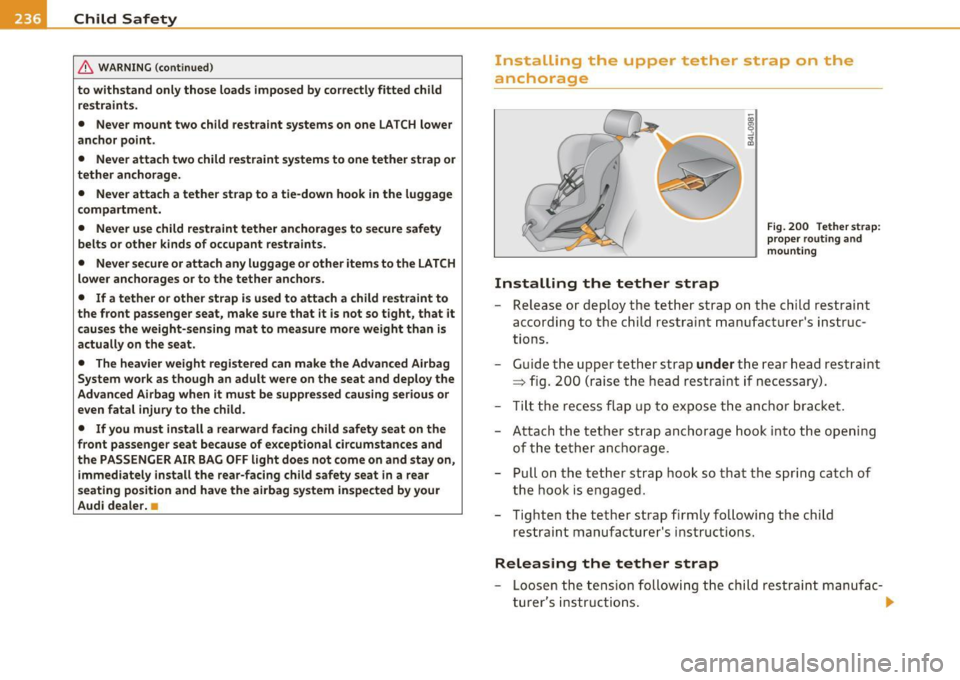
Installing the upper tether strap on the
anchorage
Installing the tether strap
Fig. 2 00 Tet her s tra p :
prop er rou ting and
mounting
- Release or deploy the tet her strap on the ch ild restrai nt
according to the c hild restrain t manufac ture r's instruc
tions .
- Guide t he u pper tet her strap
under th e rear head rest raint
=> fi g. 20 0 (raise t he head restraint if necessary).
- T ilt the recess fla p up to ex pose t he anc hor brac ke t.
- Attach the teth er st ra p anchora ge hoo k in to the openi ng
of t he t eth er anchora ge.
- Pu ll on the tet her s trap hoo k so that the s pri ng catch of
th e h ook is e ngag ed .
- Tighte n the te ther s trap firm ly followi ng the chi ld
res traint manufactu re r's i nstruc tio ns.
Releasing the tether strap
- Loos en the ten sion follow ing th e ch ild restr aint man ufac -
t u re r's instru ctio ns.
~
Page 239 of 368
___________________________________________ C_ h_il _d _ S_a _f _e _t =c,. y __ lft'II
- Depress the spring catch on the hook and re lease it from
the anchorage .
0 Note
If you leave the child restra int with the tether strap firmly insta lled
for several days, th is could leave a mark on the upho lstery on the seat
cus hion and backrest in the area where the tether strap was insta lled.
Th e upho lstery wou ld also be perma nent ly stretched a round the
tether strap. This applies espec ially to leather seats .•
Using tether straps on rearward-facing
child restraints
Currently, few rear-fac ing c hild restrai nt systems come w it h a t ether.
Please read and heed the c hild restraint system manufacturer's
instructions carefully to determine how to proper ly install the tether .
& WARNING
A child in a rearward-facing child safety seat installed on the front
pa ssenger s eat w ill be seriously injured and can be killed if the
front airbag inflates· even with an Advanced Airbag System.
• The inflat ing airbag w ill hit the child safety seat or infant
c arrier with great for ce and will sma sh the child safety seat and
c hild against the backrest, center armrest , or door.
• A tight tether
or other strap on a rearward -facing child
restraint attached to the front passenger seat can put too much
pre ssure on the weight-mat in the sea t and regi ster a heavier
weight
in the Advan ced Airbag System. The heavier weight regis
tered can make the sy stem work as though an adult were on the
seat and deploy the Advan ced A irbag when it mu st be suppressed
causing ser ious or even fatal injury to the child.
• If you must install a rearward facing child safety seat on the
front passenger seat becau se of exceptional circum stances and
Controls and equip ment Safety first Vehicle operation
& WARNING
(co ntinued )
the PASSENGER AIR BAG OFF light does not come on and stay on,
imm ediately install the rear -facing child safety s eat in a rear
seating position and have the airbag system inspected by your
Audi dealer. •
Additional Information
Sources of information about child
restraints and their use
Th ere are a numbe r of sources o f addi tional in forma tion abo ut child
restra int select ion, installation and use:
N HTSA adv ises that the best chi ld safety seat is the one that f its your
child and fits in your vehicle, a nd that you w ill use cor rectly and
cons istent ly .
Tr y before you buy!
U.S National H ighway Traffic Safety Administration
Tel. : 1-888-3 27- 4236 (T TY: 1-800- 424-91S3)
www.nhtsa.gov
Nat ional SAFE KIDS Campaign
Tel. : (20 2) 662 -060 0
www.safekids .org
Safety BeltSafe U .S.A
Tel. : (800) 745 -SAF E (English)
T el. : (80 0) 74 7-SA NO (Sp anish)
www.carseat.org
Transport Canada Information Centre
T el. : 1 ( 80 0) 333 -037 1 or ca ll 1 (613 ) 99 8-86 16 if you are i n the
O ttawa area
www.tc .gc .ca/roadsafety
Vehicle care Do-it-yourself service Technical data
Page 257 of 368
Operating instructions
Max imum tr aile r weight
A trai ler for your vehicle is lim ited to a typical class 1 or class 2 trailer.
Trail er lo ad di stribut ion
Be sure the load in the t ra iler is held secu rely in place to prevent it
from shift ing forward, backward or sideways.
N ev er a llow a pa ssenge r to ride in a traile r=>
& in "Driving instr uc
tions".
Eng ine c ooling s ystem
Towing a trailer makes the eng ine work harder. It is important that
the cooling system 's performance is up to the addi tional load. Make
sure that the cooling system has enough fluid.
Tire pre ssur e
When towing a tra iler, inflate the tires of your veh icle to the co ld tire
pressu re listed under "Full load" on the label located on the d river's
side 8 -pillar (visible when the door is open) . Inflate traile r tires to
t rai ler and tire manufacture rs' specificat io n s.
Light s
The headl ight sett ings shou ld be checked with the tr ailer attached
before driving off. Check to make sure both vehicle and trailer lights
are working properly .
Safety chain s
Be sure traile r safety cha ins are p roperly connected from the trai ler
to the hitch on the vehicle. Leave enough slack in the chains to perm it
tu rning corners. When you install sa fe ty cha ins, make s ure they will
not drag on the road when you are driving.
T he chains should cross under the trai ler tongue to prevent it from
dropping in case of separation from the h itch .
Controls and equip ment Safety first Vehicle operation
0 Note
If you are going to tow a t
railer, you must activate the tra iler opera
tion mode =>
page 168, "T owing a trai ler" .
Driving instructions
Driving with a trailer always requires e xtra care and
consideration .
To obtain the best possible handling of vehic le and trailer,
please note the following:
- Do not tow a loaded trailer when your car itself is not
loaded.
- Be especially careful when passing other veh icles .
- Observe speed limits .
- Do not dr ive at the maximum permissible speed.
- Always apply brakes early .
- Monitor the temperature gauge .
Weight distribut ion
T owing a loaded tra iler w ith an empty car results in a highly unstable
distribution of we ight . If this cannot be avoided, d rive at very low
speeds only to avoid the risk of losing steering control.
A "balanced" r ig is easier to operate and control. This means that the
t ow ve hicle sho uld be loaded to the exte nt poss ible and permissib le,
wh ile keeping the tra iler as light as poss ible under the circumstances.
Whenever poss ible, tra nsfer some cargo to the l uggage compart
ment of the tow vehicle while observing tongue load requirements
and vehicle load ing considerations .
Vehicle care Do-it-yourself service Technical data