2010 AUDI S6 seat adjustment
[x] Cancel search: seat adjustmentPage 204 of 368

........ _A_ i_rb _ a_,g,:;._ s_, y'- s_ t_e _m ________________________________________________ _
& WARNING (conti nued)
• If you must install a rearward facing child safety seat on the
front p assenger seat because of e xceptional circumstan ces and
the PASSENGER AIR BAG OFF light does not come on and stay on,
immed iately in stall the rear-facing child safety seat in a re ar
seating position and have the airbag system inspected by your
Audi dealer.
& WARNING
If, in exceptional circumstances, you must in stall a forward-facing
child restraint on the front passenger 's seat:
• Always make sure the forward-facing seat has been d esigned
and certified b y its manufacturer for use on a front seat with a
pas senger front and side airbag.
• Never put the forward-facing child restraint up against or very
near the instrument panel.
• Always move the passenger seat into its rearmo st position in
the seat 's fore and aft adjustment range, as far away from the
airbag as possible , before in stalling the forward-facing child
restraint. The backrest must be adjusted to an upright position.
• Make sure that the PASSENGER AIR BAG OFF light comes on
and stays on all the t ime whenever the ignition is switched on .•
Advanced Airbag System components
The front passenger seat in your veh icle has a lot of very important
parts o f the A dvanced A irbag System in it. These p arts incl ude t he
we ight-sens ing mat, sensors, wiring, brackets, and more. The func
t ion o f the sys tem in t he front passenger sea t is che cked by the elec
tron ic contro l unit when the ignit ion is on . The contro l unit mo nitors
t he Advanced Air bag System and t urns the airbag indica tor ligh t on
when a malfunction in t he system compone nts is detected. The func
tion of the a irbag indicator light is descr ibed in greater detail be low. Because the front passenger seat co
nta ins important parts of t he
Adv anced Ai rbag System, you mus t tak e ca re to p reve nt i t from be ing
damaged . Damage to the seat may p revent the Advanced A irbag for
the front passenge r seat from do ing its job in a crash .
The front Advanced Airbag System consists of the
following:
• Cras h sensors in the front of the ve hicle tha t meas ure vehicle
acc elera tion/de ce le ra tion to prov ide info rm ation to the Advanced
Airbag System about the severity of the crash .
• An e lec tron ic contro l unit, w it h i ntegr ate d crash sensors fo r front
and side i mpacts . The control unit "dec ides" w het her to fire the front
airbags based o n the information rece ived from the c rash sensors .
T he contro l unit also "decides" whether the safety be lt prete nsioners
should be activated.
• An Advanced Airbag with gas generator fo r the driver inside the
s teer in g wheel hub.
• An Advanced Airbag with gas generator inside the instrument
p ane l for the front p assenge r.
• A weight-sensi ng mat under the upho lstery padd ing of the front
passenge r seat cushion that measu res the tota l we ight on the se at.
The informat ion registered is sent continuously to the electronic
c ont rol uni t to re gulate deploymen t of t he fr ont Adv anced A irbag o n
the passenger side .
• An air ba g mon itoring syste m and indi ca tor ligh t in the in strume nt
cl uster =>
page 206.
• Th e PASSENGER AIR BAG OFF lig ht comes on an d stays on in t he
center of the instrument panel=>
page 207, fig. 184 and tells you
w hen the fron t A dvan ced A irb ag on t he passe nger side has been
turned off.
• A senso r below t he safety belt latch for t he front seat passenge r
to meas ure the tens ion on the safety belt . The tension on the safety
be lt a nd the we igh t regis tere d by the weig ht-sensing mat help t he
control un it "dec ide" w hethe r th e front airbag fo r the front
passenge r seat should be turned of f or not =>
page 19 7, "Chi ld
restraints on the front seat -some important things to know". ._
Page 220 of 368
-Child Safety ------ ~---------------------------------
& WA RNING (conti nued)
• Always install rear-facing child safet y seat s on the rear seat.
• If you must install a rearward facing child safety seat on the
front passenger seat in exceptional circumstances and the
PASSENGER AIR BAG OFF light do es not come on and stay on,
immediately in stall the rear-facing child safety seat in a rea r
seating position and have the airbag system inspected immedi
ately by you r Audi deale r.
& WARNING
If, in exceptional circumstances , you must in stall a forward-facing
child restraint on the front passenger' s seat:
• Always make sure the forward-facing seat has been designed
and certified by its manufacturer for use on a front seat with a
pa ssenger front and side airbag.
• Always follow the manufacturer 's instructions p rovided with
the child safety seat or carrier.
• Always move the passenger seat into its rearmost position in
the seat's fore and aft adjustment range, as far away from the
airbag as possible before install ing the child restra int . The back
re st must be adju sted to an upright position .
• Always make sure that the PASSENGER AIR BAG OFF light
c omes on and stays on all the time whenever the ignition i s
switched on .•
Advanced front airbag system and children
Your vehicle is equipped with an "Advanced Airbag System" in compli
ance wi th Uni ted St ates Federa l Mo to r Vehicle Safety St andar d
(FMVSS) 208 as applicable at the time your veh icle was manufac
tu red . The Advanced A
irbag system in yo ur vehicle has been certif ied to
mee t the "low -r is k" requiremen ts fo r 3-and 6-ye ar old ch ildre n on
t he passenger side and small adults on the dr iver side . The low risk
dep loyment criteria are inten ded to reduce the risk of injury through
interaction with the a irbag t hat can occur, for example, by being too
close to the stee ring wheel an d instr ument panel when the airbag
inflates. In addi tion, the sy stem has been certified to comp ly with t he
"suppression" requirements of the Safety Standa rd, to t urn off the
fron t air bag for infan ts u p to 1 2 months who a re res tra ined on the
front passenger seat in child restrai nts that are listed in the Stan
d ar d.
Even thoug h your vehicle is equipped with an Advanced Airbag
system , a ll ch ildren, especially those 12 years and yo unger, should
always r ide in t he back seat p roperly restrained for t heir ag e and si ze .
Th e ai rbag on the passenge r si de makes the front seat a potentia lly
dange rous p lace for a child to r ide. Th e front seat is not th e safest
place fo r a child in a forward- facing c hild safety seat. It can be a very
d an ge rous p lace for a n infan t or a large r chil d i n a re arwa rd-facing
seat. •
Advanced Airbags and the weight-sensing
mat in the front seat
Th e Advanced A irbag System i n your ve hicle de tects t he p resence o f
an infa nt o r ch ild in a child rest rai nt on the fro nt passenger sea t using
the we ight-sens ing mat in the seat cushion and the senso r be low the
saf ety belt la tch o n th e front passenge r seat tha t measur es t he
tension on the safety belt.
Th e weigh t-sens ing ma t me asures tot al we ight of the child and the
child safety seat and a child blanket on the fro nt passe nger seat . The
we ight on the fro nt passenger se at is re late d t o the desi gn of the
child res traint and i ts "footpri nt", the size and shape of t he bottom
of the ch ild restraint as it sits o n the seat . The weight of a child
restrain t an d its "foo tpr int" vary for differe nt kinds of child res tra ints .,_
Page 224 of 368
-Child Safety Pll:f __ .,.___ ____________ _
& WARNING (continued )
-Always move the front passenger seat into the rearmost
position of the passenger seat's fore and aft adjustment range,
and as far away from the airbag as possible before installing
the child restraint.
- Always make sure that nothing prevents the front
pas senger' s seat from being moved to the rearmost position in
its fore and aft adjustment range.
- Always make sure that the backrest i s in the upright pos i
tion.
• Always buckle the child safety seat firmly in place even if a
child i s not sitting in it. A loo se child safety seat can fly around
during a sudden stop or in a collision .
• Always read and heed all WARNINGS whenever using a child
restrained in a vehicle is being used~
page 185, "Safety belts",
~ page 195 , "Airbag system " and ~ page 217, "Child Safety ".
& WARNING
To reduce the risk of seriou s injury, make sure that the
PASSENGER AIR BAG OFF light comes on and stays on whenever a
child restraint is installed on the front passenger seat and the
ign ition is switched on.
• Take the child re straint off the front pa ssenger seat and install
it prope rly at one of the rear seat positions if the PASSENGER AIR
BAG OFF light does not stay on.
• Have the airbag system inspected by your authorized Audi
dealer immediately .
& WARNING
A child in a child restraint installed with the LATCH lower anchor
ages or with the standard safety belt on the rear seat may play
& WARNING (cont inued )
with unused rear seat safety belts and become entangled
re sulting in serious personal injury and even death.
• Always buc kle unused rear se at safety belts out of reach of chil
dren in child seats and p roperly activate the convertible locking
retractor so that the child cannot unreel the safety belt from the
retractor. •
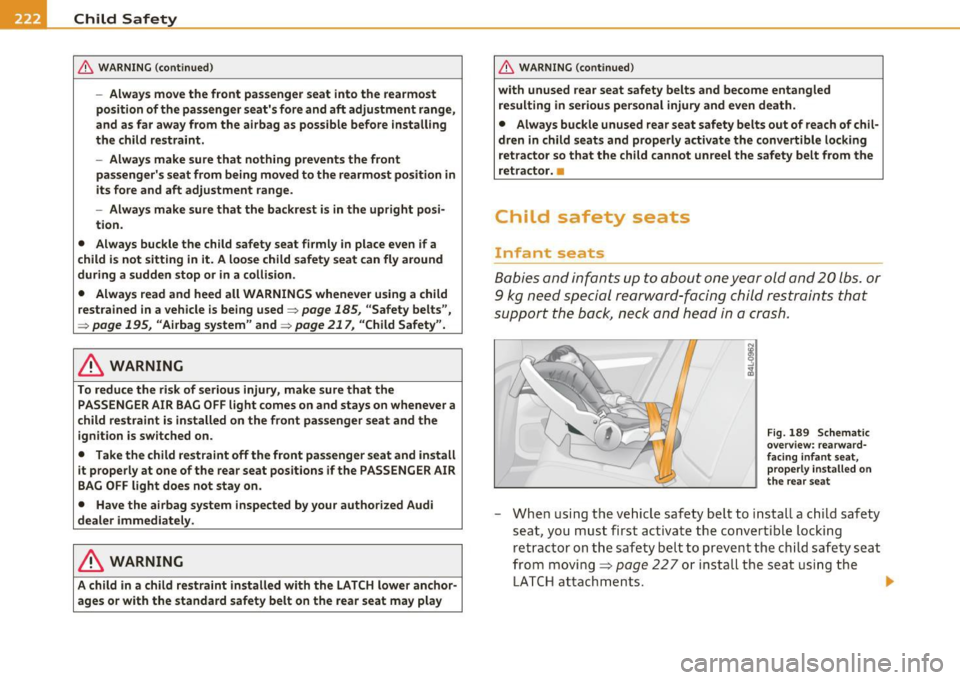
Child safety seats
Infant seats
Babi es an d infants up to about one year old and 20 lbs. or
9 k g n eed sp ecial r earward -facing child res traints tha t
suppor t the back, neck and head in a cras h.
Fig. 189 Schemati c
ove rview : re arwa rd
facing infan t seat ,
prope rly installed o n
t he rear s eat
- W hen usi ng the ve hicle safety bel t to i nstall a c hild safety
seat, you must first activa te the co nvert ible locki ng
ret ractor on the safety belt to preven t the child sa fety seat
fro m mo ving=>
page 227 or install the seat usi ng the
L ATCH attach ments. ..,_
Page 227 of 368
& WARNING (continued)
• Make sure the forward-facing seat has been designed and certi·
fied by its manufacturer for use
on a front seat with a passenger
front and side airbag.
• Always follow the manufacturer's instructions provided with
the child safety seat or infant carrier.
• Always move the front passenger seat into the rearmost posi
tion of the passenger seat's fore and aft adjustment range, and as
far away from the airbag as possible before installing the child
restraint.
• Always make sure that nothing prevents the front passenger's
seat from being moved to the rearmost position in its fore and aft
adjustment range.
• Always make sure the backrest is in an
upright position.
• Make sure that the PASSENGER AIR BAG
OFF light comes on
and stays on all the time whenever the ignition is switched
on.
• If the light does not stay on, perform the checks => page 206,
"Monitoring the Advanced Airbag System".
• Take the child restraint off the front passenger seat and install
it properly at one of the rear seat positions if the PASSENGER AIR
BAG
OFF light does not stay on whenever the ignition is switched
on. a
Safety first Vehicle OP-eration
Child Safety
Booster seats and safety belts
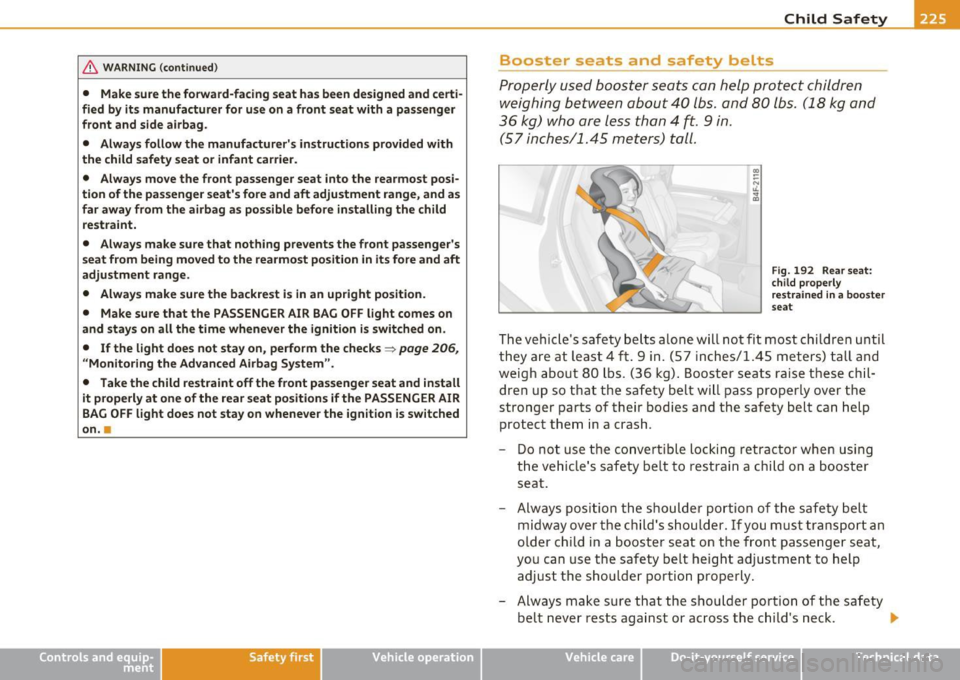
Properly used booster seats can help protect children
weighing between about 40 lbs. and 80 lbs. (18 kg and
36 kg) who are less than 4 ft.
9 in.
(57 inches/1.45 meters) tall .
Fig. 192 Rear seat:
child properly
restrained in a booster
seat
The vehicle's safety belts alone will not fit most children until
they are at least 4 ft. 9 in. (57 inches/1.45 meters) tall and
weigh about 80 lbs. (36 kg). Booster seats raise these chil
dren up so that the safety belt will pass properly over the
stronger parts of their bodies and the safety belt can help
protect them in a crash.
- Do not use the convertible locking retractor when using
the vehicle's safety belt to restrain a child on a booster
seat.
- Always position the shoulder portion of the safety belt
midway over the child's shoulder. If you must transport an
older child in a booster seat on the front passenger seat,
you can use the safety belt height adjustment to help
adjust the shoulder portion properly.
- Always make sure that the shoulder portion of the safety
belt never rests against or across the child's neck.
9'>
Vehicle care Do-it-yourselt service iTechnical data
Page 230 of 368
.,.___C_ h_ il_d _ S_a _ f_ e _ t--= y '------------------------------------------------
& WARNING (cont inued)
• If the backrest is not securely latched, the child and the child
restraint will be thrown forward together with the backrest and
will strike parts of the vehicle interior. The child can be seriously
injured or killed.
• Never install rear-facing child safety seats or infant carriers on
the front passenger seat. A child will be seriously injured and can be killed when the passenger airbag inflates.
• The inflating airbag will hit the child safety seat or infant
carrier with great force and will smash the child safety seat and
child against the backrest, center armrest, door or roof .
• Always install rear-facing child safety seats or infant carriers
on the rear seat.
• Forward-facing child safety seats or infant carriers installed on
the front passenger's seat may interfere with the deployment of
the airbag and cause serious injury to the child.
• It is safer to install a forward -facing child safety seat on the
rear seat.
• Always read and heed all WARNINGS whenever using a child
restrained in a vehicle is being used~
page 217. Special precau
tions apply when installing a child safety seat on the front
passenger seat~
page 197, "Child restraints on the front seat -
some important things to know".
L1}. WARNING
Always take special precautions if you must install a forward or
rearward -facing child restraint on the front passenger's seat in
exceptional situations:
• Whenever a forward or rearward-facing child restraint is
installed on the front passenger seat, the PASSENGER AIR BAG
OFF light must come on and stay on whenever the ignition is
switched on.
& WARNING (co ntinued )
• If the PASSENGER AIR BAG OFF light does not come on and
stay on, perform the checks described
~ page 206, "Monitoring
the Advanced Airbag System".
• Take the child restraint off the front passenger seat and install
it properly at one of the rear seat positions if the PASSENGER AIR
BAG OFF light does not stay on whenever the ignition is switched
on.
• Improper installation of child restraints can reduce their effec
tiveness or even prevent them from providing any protection.
• An improperly installed child restraint can interfere with the
airbag as it deploys and seriously injure or even kill the child.
• Always carefully follow the manufacturer's instructions
provided with the child safety seat or carrier.
• Never place additional items on the seat that can increase the
total weight registered by the weight-sensing mat and can cause injury in a crash.
L1}. WARNING
Forward-facing child restraints:
• Always make sure the forward-facing seat has been designed
and certified by its manufacturer for use on a front seat with a
passenger front and side airbag .
• Never put the forward-facing child restraint up, against or very
near the instrument panel.
• Always move the passenger seat into its rearmost position in
the seat's fore and aft adjustment range, as far away from the airbag as possible before installing the forward-facing child
restraint . The backrest must be adjusted to an upright position.
• Make sure that the PASSENGER AIR BAG OFF light comes on
and stays on all the time whenever the ignition is switched on . _.
Page 290 of 368

-L~C~ h~ e~c ~k :..!_i ~ n ~g ~ a~n ~d~ f~il ~l~in ~ g[_ ________________________________________ _
0 Note
Brake fluid will damage the paint of your vehicle.
the special tools required and the necessary expertise, we recom
mend that you have the brake fluid changed by your authorized Audi
dealer. •
Battery
General information
Under normal operating condit ions, the battery in your Aud i does not
need any maintenance. With
high outside temperatures or long daily
drives we recommend that you have the electrolyte level checked by
a service facility. The electrolyte level should also be checked each
time the battery is charged~
page 290.
Have the battery checked when you take your vehicle in for service.
You are well advised to replace a battery that is older than 5 years.
With certain types of a irbag deployment, the battery is disconnected
from the vehicle electrical system for safety reasons=>
& in "Repair,
care and disposal of the airbags" on
page 209.
Disconnecting the battery terminals
Some vehicle functions (power window regulators, for example) are
lost if the battery terminals are disconnected. These functions have
to be relearned after the battery terminals are connected aga in. To
prevent this, the battery should only be disconnected from the
vehicle electrical system when absolutely necessary for repairs.
Vehicles not driven for long periods
If you do not drive your veh icle over a period of severa l days or weeks,
electrical components are gradually cut back or switched off. This
reduces energy consumption and maintains starting capability over a
longer period~
page 247.
Take into consideration that when you unlock your vehicle, some
convenience functions, such as the master key remote function or
power seat adjustment, may not be available. The convenience func
tions will be available again when you turn on the ign ition and start
the engine.
Winter operation
During the winter months, battery capacity tends to decrease as
temperatures drop. This is because more power is also consumed
while starting, and the headlights, rear window defogger, etc., are used more often .
Avoid unnecessary power consumpt ion, particu larly in city traffic or
when traveling only short distances. Let your authorized Audi dealer
check the capacity of the vehicle battery before w inter sets in
=> page 290. A well charged battery will not only prevent starting
problems when the weather is cold, but will also last longe r.
(I] Tips
If your veh icle is left standing for several weeks at extreme ly low
temperatures, the vehicle battery should be removed and stored
where it will not freeze. This will prevent it from being damaged and
having to be replaced.•
Page 330 of 368
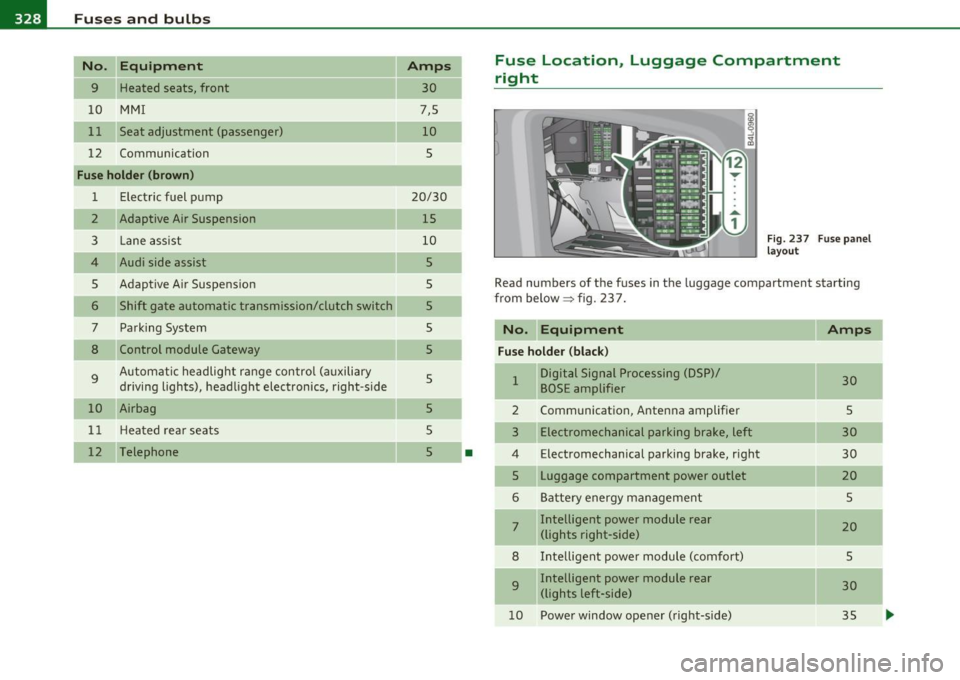
.,.,___F_ u_ s_e _ s_ a_n_ d_ b_u _ l_ b_ s _______________________________________________ _
No. Equipment Amps
9 Heated seats, front 30
10 MMI
7,5
11 Seat adjustment (passenger) 10
12 Communication 5
Fuse holder (brown)
1 Electric fuel pump 20/30
2 Adaptive Air Suspension
15
3 Lane assist 10
4 Audi side assist
5
5 Adaptive Air Suspension 5
6 Shift gate automatic transmission/clutch switch 5
7 Parking System 5
8 Control module Gateway 5
9
Automatic headlight range control (auxiliary 5
driving lights), headlight electronics, right-side
10 Airbag 5
11 Heated rear seats 5
12 Telephone
5 •
Fuse Location, Luggage Compartment
right
Fig. 237 Fuse panel
layout
Read numbers of the fuses in the luggage compartment starting
from below :::::> fig. 23 7.
No. Equipment
Amps
Fuse holder (black)
1 Digital Signal Processing (DSP)/ 30 BOSE amplifier
2 Communication, Antenna amplifier 5
3 Electromechanical parking brake, left 30
4 Electromechanical parking brake, right
30
5 Luggage compartment power outlet
20
6 Battery energy management 5
7 Intelligent power module rear
20 (lights right-side)
8 Intelligent power module (comfort)
5
9 Intelligent power module rear
30
(lights left-side)
10 Power window opener (right-side)
35
-
-
-
...
Page 356 of 368

-Alphabetical inde x ------',.__ ___________________________________ _
Driv ing messages ...... ...... .. .. .. .. 24
Dr iv ing safely . . . . . . . . . . . . . . . . . . . . . . 1 7 4
Dr iving through water ... ... ... .. .. .. 250
Dr iv ing time .. ............ .......... 34
Duplica te key . .... .... .. .. .. ........ 3 7
Dust fi lter
Climate controls .. .. .. .... .. .. . ... 96
DVD player for navigation system . .. . .. . 86
Dynam ic shift program ............ .. 156
E
Easy entry feature . .. .. .. .. .... ..... 108
Electric seat adjustment
See Power seat ................... 76
Electromechanical parking brake Emergency braking . ... .. .. .... .. . 11 5
Ma lf u nct ion . . . . . . . . . . . . . . . . . . . . . 115
Operation . . . . . . . . . . . . . . . . . . . . . . 113
Park ing .................... .. .. 114
Releasing and app ly ing ... .. ... .. .. 113
Starting off w ith a t railer ......... . 115
Wa rning/ind icator lights . .. .... .. .. 17
Electronic differential lock (EDL) How the system works ... ......... 241
Warning/ind icator lights . .......... 17
Electroni c immobili ze r ... .... .. .. .. .. . 40
Electronic powe r control
(EPC) war ning/ indicato r light .. .. ... . 14
E lectronic speed limiter ........ .... .. . 23
Ele ctro nic s tabiliza tion p rogram ( ESP)
How t he system wor ks ... ......... 2 40
W arning/ind icator lights . .......... 14 Emergency braking
..... .. .. .. .. .. .. 115
Emergency closing Power su nroof ... ... .. .. . ... ... 55, 56
Eme rgency flasher ................ ... 61
Wa rning/ind icator l ights . .. .. .. .. .. 15
Emergency locking of doors . .. .. .. .. .. 45
E mergency sta rt ing .... ..... ... .. .. . 331
Emergency towing .................. 334
Energy management ................ 247
Battery power .. .. .. .. .. .... ..... 248
Dr iver not ification ............... . 248
Engine Compartment . ... .. .. .. .. .. .. ... 2 78
Coolant .. ... .. .. .. .. .... .. .. .. . 284
Hood . ... .. .. .. .... ... .. .. .. .. . 276
Starting ....... .. .. ........ . 108, 109
Starting with jumpe r cab les . .. .... . 331
Stopping ...... .............. ... 110
E ngine compa rtment
Sa fety instructions . .... ... .. .. .. . 277
Working the eng ine compartment .. 277
En gine coolant system ........ .. .. .. . 28 4
Add ing coolant ................. . 285
C hecking coo la nt level . ..... .. .. .. 28 4
Checking the engine coo lant level . .. 284
Ma lfu nction ... .. ..... ..... .... .. . 27
Radiator fan ....... .. ... . .. .. ... 286
E ngine coo lant tempe rature
T emperat ure gauge ............. .. . 8
Engine data ....... ...... .... .. ..... 341
Engine hood Closing .... ..... ..... .... .. .. .. . 2 77
How to re lease the hood ..... .. ... . 2 76 Engine oil
.. ... .... ... .. . ... ... .. .. 279
Add ing .............. .... ... .. .. 282
Add itives .................. .... . 282
Changing .. ..... .......... .. .. .. 283
Checking the engine oil leve l ..... .. 281
Indi cat io ns and conditions requiring extr a
check ing . .. .. .. .. ............. 281
Oil consumption .... ............. 280
Oil grades . .. .. .... ..... ....... . 279
Recommended oil check intervals ... 281
Specification and viscosity ..... .. .. 279
Engine oil leve l .... .. .. ............. . 31
E ngine oil p ress ure
Mal fu nct ion .. .. .. .. .... .......... 28
Engine oil sensor defect ive . ...... ... .. 31
Engine speed limitation ....... ... .. .. . 32
E nvironmen t
Bre ak-in per iod ...... ...... .. .. .. 249
Ca taly tic converte r .. .... ......... 250
Disposing o f you r vehi cle bat tery .... 292
Driving at hig h speeds ..... ... . ... 252
Driving to minimize poll ution and noise . .
2 51
Fuel .. .. .... ....... ...... .... .. 273
F ue l economy .. .. .. ....... .. .. .. 251
Leaks unde r yo ur vehicle ... .. .. .. . 2 77
Lett ing the vehicle stand and warm up .. .
252
Proper disposa l of dra ined brake fluid 287
Prope r disposal of dra ined engine coo la nt
285
Proper disposal of drained engine oil 282, 283
Recy cling used e ng ine o il .......... 282