2010 AUDI S6 trailer
[x] Cancel search: trailerPage 258 of 368

Trailer towing
"---------------------------------------------------
Speed
T he higher the speed, the more difficult it becomes for the driver to
control the rig. Do not dr ive at the max imum permiss ible speed.
Reduce your speed even more if load, weather or wind conditions are
unfavorable -part icu larly when go ing downhill.
Reduce vehicle speed
immediately if the tra iler shows the slightest
sign of swaying.
Do not try to stop the swaying by accelerating.
Observe speed limits. In some areas, speeds for veh icles towing
trailers are lower than for regu lar vehicles.
Always apply brakes early. When driv ing dow nhill, shift in to a lower
gear to use the eng ine braking effect to slow the veh icle. Use of the
bra kes alone can cause them to overheat and fail.
Coolant temperature
Th e coolant temperature gauge~ page 8 must be observed care
fully. If the needle moves close to the upper end of the scale, reduce
speed immediately and/or turn off the air conditioner.
If the coolant temperature warning light in the instrument cluster
starts flashing
_f_ , pull off the road, stop and let the engine idle for
about two m inutes to prevent heat build-up.
& WARNING
Anyone not properly restrained in a moving vehicle is at a much
greater risk in an accident. Never let anyone ride in your car who is
not properly wearing the restraints provided by Audi.•
Trailer towing tips
Important to know
------------
Your vehicle handles differently when tow ing a trailer because of the
additiona l weight and different weight distribution. Safety, perfor- mance and economy will greatly depend on how carefully you load
your trailer and operate your rig.
Before you actually tow your trailer, practice turning, stopp ing and
backing up in an area away from traffic. Keep practicing until you have
become completely familiar with the way your vehicle-t railer comb i
nation behaves and responds.
Backing up is difficult and requires practice. Backing up with a trailer
generally requires steering action oppos ite to that when backing up
your vehicle without a trai ler.
Maintain a greater distance between your vehicle and the one in front
of you. You will need more room to stop. To compensate for the
trailer, you will need a larger than normal turning radius .
When passing, remember that you cannot accelerate as fast as you normally would because of the added load . Make sure you have
enoug h room to pass. After passing, allow plenty of room for your
trai ler before changing lanes again.
Avoid jerky sta rts, sharp tur ns or rapid lane changes.
W Tips
• Do not tow a trailer during the break-in per iod of your veh icle.
• If you tow a trai ler, your Audi may require more frequent mainte
nance due to the extra load
~ page 344. •
Parking on a slope
Do not park on a slope with a trailer. If it cannot be
avoided, do so only after doing the following:
When parking:
- Apply the foot brake.
- Have someone p lace chocks under both the vehicle and the
trailer wheels . ._
Page 301 of 368
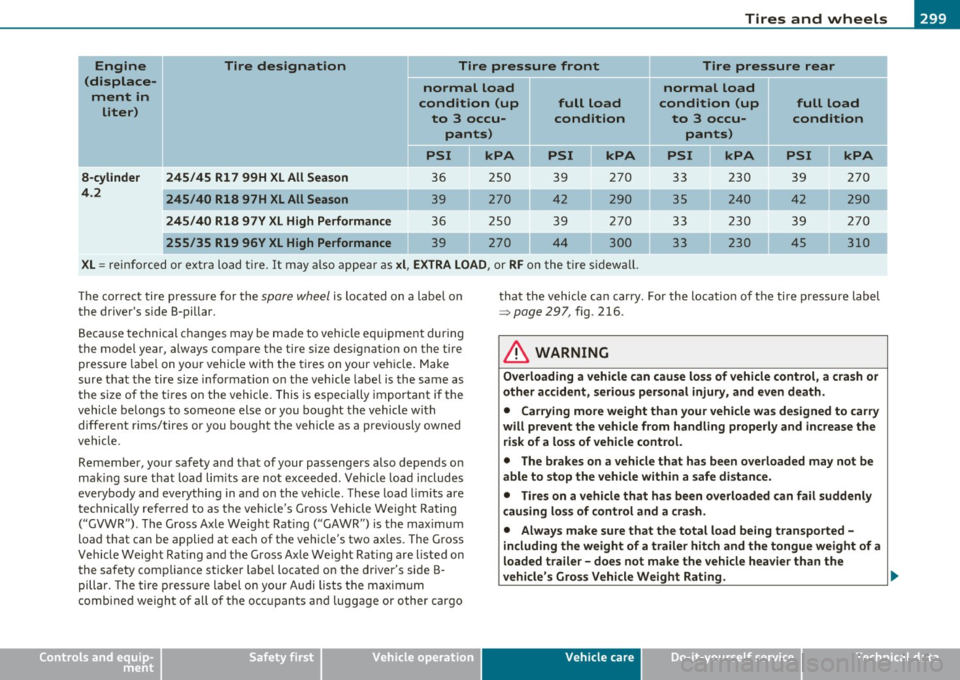
________________________________________________ T_i_re _ s_ a _ n_d_ w_ h_ e_ e_l_s __ _
Engine Tire designation Tire pressure front II Tire pressure rear
(displace- normal load normal load
ment in
liter) condition
(up full load condition (up full load
to 3 occu- condition to 3 occu- condition
pants) pants)
PSI II kPA PSI II kPA II PSI ll kPA PSI II kPA
a-cylinder 245/45 Rl 7 99H X L All Season 36 250 39 270 33 230 39 270
4
.2
245/40 R18 97H XL All Season 39 270 42 29 0 35 2 40 42 290
245 /40 R18 97Y XL High Performance 36 250
39 270
33 230
39 270
255
/35 R19 96Y XL High Performance 39 4 4 300 33 230 45 310
XL = reinf orced or extr a load t ire. It m ay a lso ap pear a s xl, EXTRA LOAD , or RF on the tire sidewa ll.
The correct tir e press ure for th e
spare wh eel is l ocat ed on a labe l on
the driver 's s ide B-pillar.
B eca u se technical c hanges may be ma de to vehicle e quipment dur ing
the model year, always compare the tire s ize des ignation on the tire
pressu re la b el on yo ur vehicle with the t ires on your veh icle. Make
sure that the tire size in forma tion on the vehicle labe l is the same as
the s ize of the t ires on the vehicle. This is especially important i f the
vehicle belongs to someone else or you bought the vehicle with
different r ims/tires or you bought the vehicle as a previously owned
vehicle. that the vehicle can carry.
For the loc atio n of t he ti re p ressure label
~ page 297, fig. 216 .
_& WARNING
Overloading a vehicle can cause loss of vehicle control , a cra sh or
other accident, serious personal injury, and even death .
• Carrying more weight than your vehicle wa s de signed to carr y
will prevent the veh icle from handling properly and increase the
risk of a los s of vehicle control.
• The brakes on a vehicle that has been overloaded may not be
able to stop the vehicle within a safe di stan ce.
• Tires on a vehicle that has been overloaded can fail suddenly
c ausing lo ss of control and a crash .
• Always make sure that the total load being transported -
including the weight of a trailer hitch and the tongue weight of a
loaded trailer -does not make the vehicle heavier than the
I
I
Remember, your safety and that of your passengers also depends on
m aki ng sure th at lo ad lim its are no t ex ceeded. Vehicle lo ad includes
everybody and everything in and on the veh icle. These load limits are
t echnically re fer red to as t he ve hicle's G ross Vehicle Weig ht Ra ting
("GVWR") . The Gross Axle Weight Rat ing ("GA WR") is the max imum
load that can be applied at each of the veh icle's two ax les. The Gross
Vehicle Weight Rat ing and the G ross Ax le We ight Ra ting are listed on
the safety comp liance sticke r label located on the driver's side B
pillar. The tire p re ssur e label on your Audi lists the maxim um
combined weight of a ll of th e occ upants and luggage or other cargo
vehicle 's Gros s Vehicle Weight Rating. ._
Safety first Vehicle care Technical data
Page 304 of 368
IIIIL-_T.:..:..: ir:....:e~ s=---= a~ n:..:..: d:......: w..:....:.. h:....:e~ e= ls=--------------------------------------------------
Yo ur sa fety and that of your passengers also depends o n mak ing s ure
t h at loa d limits are no t ex ceede d. Vehicle lo ad incl udes eve rybody
and everyth ing in and on the vehicle. These load limits are tech nica lly
referred to as the ve hicle 's
Gross Vehicle Weight Rating ("G VW R").
T he "G VWR" includes the we igh t of the b asic ve hicl e, all fa ctory
installe d accesso ries, a fu ll tank of fue l, o il, coo lant and other fluids
p lu s m aximu m lo ad. Th e maxi mum lo ad include s th e num ber of
passengers that the vehicle is intended to carry ("seating capacity")
w ith a n assu med we ight of 150 l bs (6 8 kg) for e ach p assenger at a
designated seating position and the tota l weight of any luggage in
t he vehicle . If you tow a trai le r, t he weight o f the t railer hitch and t he
tongue we ig ht of the loaded trailer must be included as pa rt of the
veh icle load .
T he
Gross Axle Weight Rating ("GAWR") is the m aximum load tha t
can be applied at each of the vehicle's two ax les.
Th e Gross Vehi cle We ight Ratin g a nd the Gross Axle Weigh t Ra ting
are listed o n the safety compliance sticker label located on the
dr ive r's side B-pillar. You r A udi has 5 sea ting positions, 2 in the fron t
and 3 in the rear fo r tota l seati ng ca pac ity of 5 . Eac h seat ing position
has a safety belt ~
page 18 5, "Safety belts".
T he fa ct t hat t here is an upper lim it to your ve hicle's G ross Veh icle
We ight Rating means that t he total weight of whatever is being
c arried in t he ve hicle (includi ng the wei ght of a tra ile r hit ch an d the
tongue weig ht of the loaded tra iler) is limited. The more passengers
i n th e ve hicl e or p assenge rs who are heavier th an the stan dard
we igh ts assumed mean that less we igh t can be ca rried as luggage.
The tire pressure label on yo ur A udi a lso lists the max imum combined
w eight of all of th e occ upants and luggag e or o ther cargo that th e
vehicle ca n car ry. Fo r the location o f the labe l~
page 297, fig . 216.
& WARNING
Overloading a vehicle can cause loss of vehicle control , a crash or
other accident, serious personal injury, and even death.
& WARNING (co ntinued )
• Carrying more weight than your vehicle was de signed to carry
will prevent the vehicle from handling properly and increase the risk of the loss of vehicle control.
• The brakes on a vehicle that has been overloaded may not be
able to stop the vehicle within a safe di stance.
• Tires on a vehicle that has been overloaded can fail suddenly,
including a blowout and sudden deflation, causing loss of control
and a crash .
• Always make sure that the total load being transported -
including the weight of a trailer hitch and the tongue weight of a
loaded trailer -does not make the vehicle heavier than the
vehicle's Gros s Vehicle Weight Rating. •
Determining correct load limit
Use the example below to calculate the
total weight of the passengers and luggage or other things that you plan to transport so
that you can make sure that your vehicle
will not be overloaded. .-.
Page 305 of 368
Steps for Determining Correct Load Limit
1.Locate the statement "THE COMBINED WEIGHT OF OCCUPANTS AND CARGO
SHOULD NEVER EXCEED XXX KG OR XXX LBS"on your vehicle's placard (tire infla
tion pressure label)=>
page 297,
fig. 216.
2. Determine the combined weight of the driver and passengers that will be riding in your vehicle.
3. Subtract the combined weight of the driver and passengers from
"XXX" kilo
grams or
"XXX" pounds shown on the
sticker =>
page 297, fig. 216.
4. The resulting figure equals the available amount of cargo and luggage load
capacity. For example, if the
"XXX"
amount equals 1400 lbs. and there will be five 150 lbs . passengers in your
vehicle, the amount of available cargo
and luggage load capacity is 650 lbs.
(1400-750 (5
X 150) = 650 lbs.)
Safety first
Tires and wheels -
5. Determine the combined weight of
luggage and cargo being loaded on the
vehicle. That weight may not safely exceed the available cargo and luggage
load capacity calculated in Step 4.
6. If your vehicle will be towing a trailer ,
load from your trailer will be transferred
to your vehicle. Consult this manual to
determine how this reduces the available cargo and luggage load capacity of your
vehicle.
- Check the tire sidewall(=>
page 305,
fig. 220) to determine the designated load rating for a specific tire . •
Vehicle care Technical data
Page 320 of 368

,.,___W_ h _a_t _ d _ o_ I_ d_ o_ n_o _w_ ? ____________________________________________ _
- Disengage and lower the floor panel before you close the
luggage compartment lid again.
Storing the replaced wheel
-Place the replaced wheel inside the spare wheel well in the
luggage compartment.
Tighten the knurled retaining screw clockwise to secure
the wheel in place.
- Disengage and lower the floor panel before you close the
luggage compartment lid again.
& WARNING
Loose items in the passenger compartment can cause serious
personal injury during hard braking or in an accident.
• Never store the spare wheel or jack and tools in the passenger
compartment.
• Always store all jacking equipment, tools, and the spare wheel
in the luggage compartment.
• Tighten the knurled retaining screw for the spare wheel
securely.
[ i] Tips
Check the inflation pressure of the spare tire periodically to keep the
tire ready for use.•
Changing a wheel
Before changing a wheel
Observe the following precautions for your own and your
passenger's safety when changing a wheel.
- After you experience a tire failure, pull the car well away
from moving traffic and try to reach
level ground before
you stop :::> & .
- All passengers should
leave the car and move to a safe
location (for instance, behind the guardrail) :::>& .
- Engage the
parking brake to prevent your vehicle from
rolling unintentionally:::> &.
- Move
selector lever to position P :::> & .
- If you are towing a trailer: unhitch the trailer from your
vehicle.
- Take the
jack and the spare tire out of the luggage
compartment:::>
page 316.
& WARNING
You or your passengers could be injured while changing a wheel if
you do not follow these safety precautions:
• If you have a flat tire, move a safe distance off the road. Turn
off the engine, turn the emergency flashers on and use other
warning devices to alert other motorists.
• Make sure that passengers wait in a safe place away from the
vehicle and well away from the road and traffic.
• To help prevent the vehicle from moving suddenly and possibly
slipping off the jack, always fully set the parking brake and block
the wheel diagonally opposite the wheel being changed. When
one front wheel is lifted off the ground, placing the Automatic
~
Page 347 of 368
______________________________________________ C _o_ n _ s_u_ m_ e_r_ I_n _f_ o_ r_m _ a_t_ i_ o _ n __ _
reliab ility. For deta iled vehicle maintenance cons ult your Warra nty &
Main tenan ce bookle t.
Under difficult operating conditions, for example at extremely low
outside temperatures, in very dusty regions, when towing a trailer
very frequently, etc., some service wo rk shou ld be performed
between the intervals specified. This app lies particu larly to:
• oil changes, and
• cleaning or rep lacing the air fi lter.
<£> For the sake of the environment
By regular ly maintaining your vehicle, you help make sure that emis
sion standards are mainta ined, t hus mi nimizing adve rse e ffects o n
the environment. •
Important considerations for you and your
vehicle
T he increasing use of electronics, sophisticated fuel injection and
em ission cont rol systems, and t he generally increasing techni cal
complex ity of today's automobiles, have stead ily reduced the scope
of mai ntenan ce and repairs w hich can be ca rried out by ve hicle
owners.
Also , safety and environm ental concerns p lace very strict
limits on the nature of repairs and adjustments to engine and trans
mission parts wh ich an owner can perform.
Maintenance, adj ustments and repairs usua lly req uire specia l tools,
test ing devices and other eq uipment available to specially t rained
workshop personnel in order to assure proper performance, re li
ability and safety of the vehicle and its many systems.
Improper maintenance, adjustments and repairs can impair the oper
ation and reliabili ty of your ve hicle and even void you r vehicle
warranty. Therefore, p roof of servicing in accordance with the main
t enance schedu le may be a condit ion fo r uphold ing a possible
warranty cla im made w it h in the warranty period .
Safety first
Above all, operational safety can be adversely affected, creating
unnecessary r is ks for you and you r passe ngers.
If in doubt about a ny servic ing, have it done by your authorized Audi
dealer or any other properly eq uipped and qualified works hop. We
st rongly urge you to give you r a utho rized Aud i dealer the opportunity
to perform a ll scheduled maintenance and necessary repairs. Your
dealer has t he facilities, o rigina l part s and trained spe ciali sts to keep
your vehicle running properly.
Performing limit ed maint enance yourself
The following pages describe a lim ited number of procedures which
can be perfo rmed on your vehicle w it h ordi na ry tools, should t he need
ar ise and trained personnel be unava ilab le. Before performing any of
t hese p rocedures, always tho roughly read all of the applicable text
and carefu lly follow the instructions given. Always rigorous ly observe
t he
WARNINGS p rov ided .
Before you ch eck anyth ing in the eng ine compartment, alwa ys read
and heed all WARNINGS~
& and~ & in "Working in the engine
compartmen t" on
page 277.
& WARNING
• Seriou s pe rs onal injury may occ ur as a result of improperly
perform ed maintenan ce, adju stments or repair s.
• Always be extremely careful when work ing on the vehicle.
Alway s foll ow commonly acc epted safety practic es and general
c ommon sense . N ever ri sk per son al injury .
• Do not attempt any of the maint enance, che cks or repair s
de scrib ed on the following p ages if you are not fully familiar with
the se or ot her procedure s with re spect to the vehicle , or are uncer
tain how to proceed .
• Do not do any work without the prop er tool s and equipment .
Ha ve the ne cessary work done by your authorized Audi dealer or
an other properly equipped and qu alified workshop. _,.
Do-it,yourself service Technical data
Page 362 of 368

-Alphabetical inde x __ __,_ ______________________________________________ _
Front seats . . . . . . . . . . . . . . . . . . . . . . 7 5
Head restraints . .. .. .. .. .. ....
81, 179
Lumbar support .. .. ... ....... .... 78
Seat belts
See Safety belts ................. 185
Seat memory . . . . . . . . . . . . . . . . . . . . . . . 79
Seating capacity ... .. .. .......... .. . 185
Seating position
Driver ............. ...... .... .. .
Front passenger .. .. .. .. .... .... .
How to adjust the front seats .. .... .
176
177
177
Incorrect seat position ... ......... 179
Occupants . .... .. .. .. ........ ... 176
Rear passengers
Seats 178
Number of seats ................. 185
Selective unlock feature ............... 44
Selector lever . .. ...................
147
Selector lever multitronic ® .... ... .... 154
Service and disposal
Safety belt pretensioner .. .........
194
Service interva l display ................ 22
Informational and alert stage signals 139
Messages in instrument cluster display . .
144
Operation .................... .. 139
Safety tips ................ ..... . 144
Sensor detection area ...... .. .... . 138
Settings ....... .. .. .... .... ..... 142
Locking the steering . ...... ... .. .. 108
Malfunction ...... ................ 28
Manually adjust ing the steering wheel
106
Steering wheel column
Adjusting electrically ........... ..
107
Adjusting manually ......... ...... 106
Side cu rtain airbags ................. 214 Steering wheel heating .. .. .. .. .. .. .. 104
Description ... ...... · · · · · · · · · · · · 214 Steps for determining correct load limit 302
How they work ...... ...... ..... . 215 Stopp,·n th · 110 g e engine .... .. .. ........ .
Safety instructions .... ...... .....
216 Storage ...... .. ...... ............. . 93
Side marker lights ........... .. .. .. .. 58 (upholder . .. ...... .............. 89
Ski sack . .. .... ............. ...... .. 86
Snow chains ....................... 310
Sockets ....... .................. 92, 93
Sound system display
Driver information display ...... .. .. 20
Sources of informat ion about child restraints
and their use . ........... .. .. .. .
23 7
Spare wheel .................. .... .
317
Speed control system
See Adaptive Cruise Control . .. .. .. .
Speed rating letter code ...... .. .. .. . 119
307
(upholder rear center armrest ....... 90
Glove compartment .......... ... .. 94
Luggage compartment . .. .. .. ...... 86
Sk i sack ....... ... .... .. .. .. .. .. . 86
Storage compartment
Expanding . .. .. .. .. ..............
83
Sun shade . ................. ... .. .. . 65
Sun visors .................. ... .. ... 64
Suspension
See Adaptive Air Suspension ....... 166
Switches
Service pos ition
Windshield wipe rs
68 Speed warning system ......... ..... .. 32 Emergency flashers .. .... .. .. .. ... 61
Servotronic
Power steering . .. .. .. .. .........
245
Shift buttons . .. ............... 151, 158
Side airbags
Description .. .. .................
211
How they work .................. 212
S ide assist
Activating and deactivating .... .. . .
137
Description .. .. .. .. .... ..... ... . 137
Speedometer ....... ....... ...... ... 10
Starting off with a trailer . ... .. .. .. ... 115
Starting the engine .......... .. . 108, 109
What should I do if the engine does not
start? ... .... .. .. ........ .....
109
Steering ................... .. ... .. 106
Easy entry feature . ... ............ 108
Electrically adjusting the steering wheel ..
107
Power sunroof . ........... ... .. .. . 53
Rear window defogger ..... ... .. .. 101
Symbols
Red .. .. ....................... .
25
Yellow .. ........... .... .. ... . .. . 29
Synchronization
Climate controls .. ...............
105
Synchronizing climate control .......... 98
Page 363 of 368

_____________________________________________ A_ L .... p_ h _ a_b_ e_ t_ ic_a_ l_ in_ d_e _ x __ _
T Tires ..... .... .. .. ...... .. .. ....... 293 TPMS
Service life . .. .. .... .. .. ... ... ...
304 Tire pressure monitoring system . ... 313
Tachometer .. .. ..... ..... .... .. . .. .. . 9 speed rating letter ,code .. ........ . 307 Trailer towing . .. ................. .. 254
Tank flap Tire
manufacturing date . ... .. .. ... 307 Operating instructions . ........... 255
Unlocking the fuel filler flap by hand . 275 Tire specifications ........ .... .. .. 306 Technical requirements ....... 254, 255
T ech nical modifications .... .......... 347 Tr ead depth .. .. ........ ......... 304 Trailer towing tips ......... .. .. .. . 256
Temperature
Climate controls ...... .. .. .. .. .. .. 99 Uniform tire
quality grading ... ..... 308
Winter tires ..................... 309
Transm ission
tiptronic ® .......................
146
Setting for the driver's and front passen-Tires
and vehicle load limits .. . ... ... .. 301 Transport Canada ..... ...... ... . ... . 184
ger's side ....................... 99 Tires and wheels
Tread Wear Indicator (TWI) ........... 304
Tether anchors .............. .... .. . 235
Tether strap ........... .......... .. . 235
Th e first 1,000 miles (1,500 km) and
afterwards ..... ... .. .. .. .. .. .. .
249
Tie-downs ............ .. ... ..... ... 183
Tips for the environment
Saving fuel ............. .. ........ 88 Checking tire pressure
.............
300
Cold tire inflation pressure ......... 297
Dimensions .. .... ............. .. 305
General notes ................... 293
Glossary of tire and loading terminology .
294
New tires and wheels ............ . 305
Replacing .... .... ............... 306
Tr ip computer
Fuel consumption .. ...............
34
Mileage ................. .... .. .. 34
Single-trip memory ................ 35
Total-trip memory ......... .. . ... .. 35
Tr ip odometer .. .. .... ............... 10
What does it mean when dEF appears in
Using the air conditioner only when
necessary ... ...... ........ .....
102
the trip odometer display? .. ....... 10
Snow chains .. ........... .... .. .. 310 Tr unk
Tires and vehicle load limits ... .....
301 tiptronic® ......................... 146
Wheel bolts .. ... ......... .... ... 311
See Rear lid ... .. .. ............... 46
Automatic Shift Lock (ASL) ......... 148
W.
t t· 309 Trunk escape handle ..... .. .. .. .... .. 316 in er ires ....... ....... ...... .
Dr iving ...... ...... .. .. .. .. .. .. . 146
Tires/Wheels
Dynamic shift program ... ......... 149
F ·
l f d 151 Low aspect ratio tires ...... .. .. ... 312 a, -sa e mo e ... ............... . Turn
signals ................ ... .. .. ..
62
Warning/indicator lights ....... .. .. 15
Kick-down ........ ... ... ... ... .. 149 Tire pressure monitoring system 15, 312
Manual shift program ... ... ... ... . 150 Tools · · · · · · · · · · · · · · · · · · · · · · · · · · ---317 u
Selector lever ...... ... ... ... .. ... 147 Torn or frayed safety belts ... ......... 188 Undercoating .. .. .. .. .............. 264
Tire pressure ................ .. .. .. . 300 Touch-up paint ..................... 262 Unfastening safety belts ............. 192
Tir e pressure monitoring system ....... 312 Towing
Unidirectional tires .................. 293
Loss of air pressure ........... 15, 313
Malfunction .............. .. .. ... 313
Resetting tire pressures ........... 314
Front eyelet ................. ... . 334
Rear eyelet ..... ................. 335
T ow truck procedures .. ........... 334
Uniform tire quality grading ......... . 308
Unlocking
Power locking switch ......... .. .. ..
44
Tire service life ..... ... . .... . ... ... . 304 Rear lid/trunk lid ... .... ........... 46
Controls and equip
ment Safety first Vehicle operation
Vehicle care Do-it-yourself service Technical data