2010 AUDI A5 COUPE heating
[x] Cancel search: heatingPage 279 of 360

___________________________________________ C_ h_e _c_ k_ i_n _g _ a_n _d_ f_il _li _n _g __ fflllll
•
& WARNING (continued)
• When removing the oil drain plug with your fingers, stay as far
away as possible. Always keep your forearm parallel to the ground
to help prevent hot oil from running down your arm.
• Drain the oil into a container designed for this purpose, one
large enough to hold at least the total amount of oil
in your engine.
• Engine oil is poisonous. Keep it well out of the reach of children.
• Continuous contact with used engine oil is harmful to your
skin. Always protect your skin by washing oil off thoroughly with
soap and water.
0 Note
Never mix oil additives with your engine oil. These additives can
damage your engine and adversely affect your Audi Limited New
Vehicle Warranty.
<£> For the sake of the environment
• Before changing your oil, first make sure you know where you
can properly dispose of the used oil.
• Always dispose of used engine oil properly. Do not dump it on
garden soil, wooded areas, into open streams or down sewage
drains.
• Recycle used engine oil by taking it to a used engine oil collec
tion facility in your area, or contact a service station. •
Engine cooling system
Coolant
The engine coolant performs two functions: it keeps the
engine from overheating and it protects the engine from
freezing in the winter.
The cooling system is sealed and generally requires little attention.
The cooling system has been filled at the factory with a permanent
coolant which does not need to be changed. The coolant consists of
a mixture of water and the manufacturer's glycol -basedcoolant
additive G12++ antifreeze with anti corrosion additives (50% for USA
models; 60% for Canadian models). This mixture both assures the
necessary frost protection and protects metal components in the
engine's cooling system from corrosion and scaling. It also raises
the boiling point of the coolant.
Do not reduce the concentration of the coolant in the summer by
adding plain water.
The proportion of coolant additive must be at
least 50% but not more than 60%
to maintain antifree ze protection
and cooling efficiency. If the coolant frost protection is too low, the
coolant could freeze and damage the vehicle heating and engine
cooling system.
For year-round driving, antifreeze is added at the factory for temper
atures down to:
• -31 °F
! -35 °ci usA
• - 40°F ( - 40°CJ Canada.
You can mix the G12++ coolant additive with other additives (G12 +
or G12) . Always check with your authorized Audi dealer .
& WARNING
Before you check anything in the engine compartment, always
read and heed all WARNINGS
~ & in "Working in the engine
compartment" on
page 271.
Vehicle care I t •
Page 280 of 360
___ C_h_ e_ c_k _in --== g'-- a_n _d_ f_il _li _n ..:::g:::..- ___________________________________________ _
0 Note
• Before winter sets in, have the coolant checked to see if the
coolant additive in your vehicle is sufficient to meet the climate
conditions. This is especia lly important if you live in a region where
the winter is extremely cold. If necessary, increase the proportion of
coo lant additive to 60%.
• When adding coolant additive to your coo ling system,
reme mber:
- We recommend using only coolant additive G12+ + (check the
label) for your vehicle. This coolant addit ive is ava ilable at autho
rized Audi dealers . Other types of antifreeze can significantly
reduce corrosion protection . The resulting corrosion can cause a
loss of coolant and serious engine damage.
• Do not add any type of radiator leak sealant to your vehicle's
engine coolant . Adding radiator repair fluid may adverse ly affect the
function and performance o f your cooling system and cou ld result
in damage not covered by your New Vehicle Limited Warranty. •
Checking the engine coolant level
The engine coolant level can be checke d with a quick
glance.
Fig . 2 25 Engine
c omp artmen t: Coo la n t
e xpan sion tank
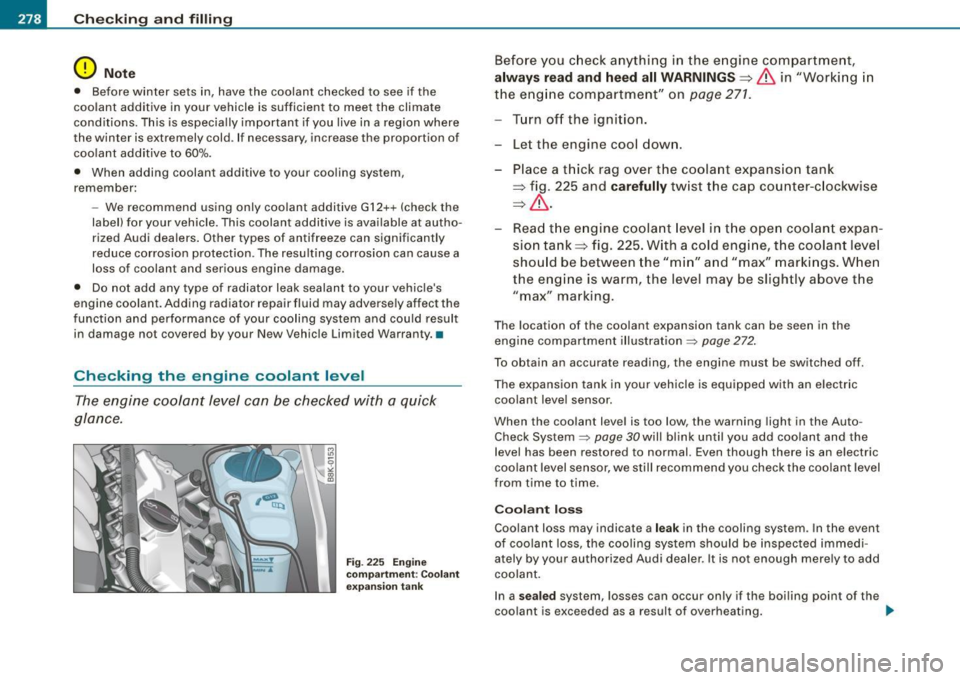
Be fo re y ou c heck anything in the e ngine compar tm en t,
always read and heed all WARNINGS==> & in "Working in
the eng ine compartment" on
page 271.
Tur n off the ignitio n.
- Let the engine coo l down.
P lace a th ick rag ove r the coola nt expans io n tank
==> fig. 225 and carefully twist th e cap counter-c lockwise
==> & .
Read t he e ngin e coola nt level i n the open coo la nt expan
sion tank==> fig. 225. W ith a cold eng ine, the coolant leve l
sho uld be bet ween the "m in" and "max" markings. W hen
t h e eng ine is warm, the level may be slightly above the
"max" marking .
The location of the coolant expansion tank can be seen in the
engine compartment illustration=>
page 272.
To obtain an accurate read ing, the engine must be switched off .
The expansion tank in your vehicle is equipped with an e lectric
coo lant leve l sensor.
When the coolant leve l is too low, the warning light in the Auto
Check System =>
page 30will blink until you add coolant and the
level has been restored to normal. Even though there is an electric
coo lant level sensor, we still recommend you check the co olant level
from t ime to time.
C oolant loss
Coolant loss may indicate a le ak in the cooling system . In the event
of coo lant loss, the co oling system should be inspec ted i mmedi
ately by your authorized Audi dealer. It is not enough mere ly to add
coo lant.
In a
s ealed system, losses can occur on ly if the boi ling point of the
coo lant is exceeded as a result of overheating. ...
Page 323 of 360

Fuses and bulbs -
------------------
Fuse Location, Instrument Panel left
Fig . 248 Fuse panel
layout
Some of the equipment items listed are optional or only available on
certain model configurations.
Note that the following table is accurate at the time of going to
press and is subject to change. In the event of discrepancies, the
label on the inside of the cover always takes precedence.
The power seats are protected by circuit breakers , which automati
cally reset after a few seconds after the overload has been reme
died.
No. Consumer
Fuse panel (black)
1 Dynamic steering
2 Not used
3 Homelink
4 Not used
5 Climate control
6 Right headlight range adjustment
___ ,
7 Left headlight range adjustment
8 Vehicle electrical system control module 1
5
5
5
5
5
5
No.
9
10
11
12
13
14
16
Consumer
Adaptive Cruise Control
Shift gate
Heater washer fluid nozzles
Climate control
Cell phone prep
Airbag
Terminal 15
Te rminal 15 engine
Fuse panel (brown)
1 Automatic dimming interior rearview mirror
2
3
5
6
7
8
9
Clutch sensor
Gasoline fuel pump
Auxiliary water pump 3.2L FSI
Left seat heating with/without seat heating
Electronic Stabilization Program
Horn
Left door window regulator motor
Wiper motor Electronic Stabilization Program
11 Left doors
12 Rain and light sensor
Fuse panel Ired)
1
2
Not used
Not used
Lumbar support
Vehicle care Do-it-yourself service
Ampere
5
5
5
5
5
5
25
40
5
5
25
5
15/30 10
25
30 30
25
15
5
10
irechnical data
Page 325 of 360

Fuses and bulbs -
------------------
No. Consumer
10 Climate control
11 Terminal 30 diagnostic connector
12 Steering column switch module Ampere
10
10
5
Fuse Location , Luggage Compartment right
Fig . 250 Fuse panel
layout
Read numbers of the fuses in the luggage compartment starting
from inside.
No. Consumer
Fuse panel B !black)
1 Luggage compartment lid control module
(Avant)
2 Trailer control module
3 Trailer control module
4 Trailer control module
5 Electromechanical parking brake
6 Electronic damping control Electromechanical parking brake Ampere
30
15
20
20
5
15
30
•
No. Consumer
8 Vehicle electrical system control module 2
9 quattro Sport
10 Vehicle electrical system control module 2
11 Vehicle electrical system control module
12 Terminal 30
Fuse panel C (brown)
1
2
3
4
5
6
7
8
9
Luggage compartment lid control module
Right front seat heating
DCDC converter path 1
DCDC converter path 2
Socket Not used
Electromechanical parking brake
Rear seat heating
Passenger side door control module
10 Not used
11 Passenger side door control module
12 Not used
Fuse panel D !red)
1 Rear center console outlet
2 Front center console outlet
3 Luggage compartment outlet
4 Cigarette lighter
6 Rear Seat Entertainment supply
Vehicle care Do-it-yourself service
Ampere
30
35
30
20 5
30 15
40
40
30
30
30
30
15
15
15 15
15
5
5
Technical data
Page 326 of 360

11111.___F_ u_ s _ e_s _ a_n _ d_ b_ u_lb _ s _______________________________________________ _
No. Consum er
7 Parking system
8 Rear wiper (Avant)
9 Electromechanical parking brake switch
10 Audi side assist
1 1 Rear seat heating
12 Terminal 15 control modu les
Fu se panel E (bla ck)
1 N ot used
2 Not used
3 DSP amp lifier, radio
4 MMI
5 Radio/navigation/cel l phone prep
6
Rearview camera
7 Not used
8 Not used
9 N ot used
10 Not us ed
1 1 Not used
12 Not used
Ampere
7,5
15 5
5
5
5
30/20
7,5
7,5
5
•
Bulbs
Replacing bulbs
For your s afety, we recommend th at you have your autho
ri zed Audi dealer replace any bulbs for you.
It is becoming increasingly more and more difficult to replace
vehic le light bulbs since in many cases, o ther parts of the car must
first be removed before you are able to get to the bu lb . This applies
especia lly to the light bu lbs in the front of your car which you can
only reach through the engine compartment .
Sheet metal and bulb holders can have sharp edges that can cause
serious cuts, parts must be correctly taken apart and then properly
put back together to help prevent breakage of parts and long term
damage from water that can enter housings that have not been
properly resealed.
Fo r your safety, we recommend that you have your authorized Audi
dea ler replace any bulbs for you, s ince your dealer has the proper
tools, the correct bulbs and the expertise.
Ga s di scharg e lamps (X enon ligh ts)*:
Due to the high electrical voltage, have the bulbs replaced by a qual
ified technician . Headlights with Xenon light are identified by the
high voltage sticker .
& WARNING
Changi ng Xeno n lamp s w ithout th e necess ary e quipm ent can
c a use se riou s pers on al injury .
• Bulb s are p ress urize d and can e xpl ode when being ch ange d.
Po tentia l ri sk of injury!
• On ve hic les equ ippe d with g as disc ha rg e bulb s (Xenon li ght )*
li fe -thre atening injuri es can re sult from impro per h andling of th e
hi gh-v olt age portion s of su ch lam ps! .,_
Page 355 of 360

Alphabetical index -
-------------=----
Reset button ... ...... .. ... ... . .. .. .. 11
Retractor ................. ......... 183
Rims Cast al loy ..... .. .... .... ..... .. . 258
Replacing ... .... ..... .. .... .... . 301
Roof luggage rack
Mounting points .................. 85
Roof rack ........... ...... .... .... .. 84
Roof load ...... ...... ...... ...... 85
See also Roof luggage rack ... .... .. 84
s
SA FE ... .... .... .... .... ... .... .... . 11
Safe driving hab its .. .... .... ... .... . 168
Safe ty belt position . . . . . . . . . . . . . . . . . . 184
Safety belts worn by p regnant women ..
185
Safety belt pretensioner ... .... .... ... 186
Service and disposal .............. 187
Saf ety b elt warning light .... .... .. 14,179
Safety belts . . . . . . . . . . . . . . . . . . . . . . . . 183
Cleaning ..... .... .... ........... 263
Danger to passengers who do not wear a
safe ty belt . .... .... ..... .. ... .. 181
Fastening ... .... .... .... ... .... . 183
Improperly worn ..... .... ........ 186
Not worn . . . . . . . . . . . . . . . . . . . . . . . . 181
Safety belt position ...... .... ..... 184
Safety instructions . ......... .... . 182
Securing child s afety seats ........ 223
Special considerations for pregnant women ....... .... .... ......... 185
Unfastening ..... ... ..... ...... .. 186
Controls and equip
ment Safety first
Warning
/indicator light .... ........ 179
Why YOU MUSTwearthem ... .... . 179
Worn properly ..... .... .... .... .. 182
Safety compliance sticker . .... ... .... 334
Safety equipment .... .... ..... .. .... 168
Safe ty fea tures for occupant restraint and
protection ... .. ........ .... ... . 168
Safety guidelines Seat adjustment ... ...... ... ... ... . 69
Saf ety instructions
Engin e compartm ent . .... .... ..... 271
for sid e curtain airbags . .......... . 211
for using child safety seats ....... .. 216
for using safety be lts .... .......... 182
Moni toring the Advanced Airbag System
201
Seat adjustment Driver's seat ........ ...... ... .... . 69
Easy entry function ........... ... .. 74
Easy entry manual function .. ..... .. 72
For -and -aft manua lly ..... ..... ... .. 71
Front passenger's seat .. .... ..... .. 70
Front seats ...... .. .. .... .... .... . 69
Head restraints ... ..... ... ..... .. . 173
Manual .. ...... .... ... .. ..... ... . 70
Power ....... .. .... .... .... .... .. 72
Seat back angle manually ........ ... 71
Seat height manually . ........ .... . 71
Seat belt s
See Safety belts
Seat heating 179
Front seats ...... .. .. .... .... .... 105
Seat memory ...... .. ... ... ..... .... . 74 Seating capacity
.... ..... .. . .... .. . . 179
Seating position Driver ......... ....... .. .. .... ... 170
Front passenger . ...... .. . .... .. .. 171
How to adjust the front seats ... .... 171
Incorr ect seat position .... .... .... 173
Occupan ts ... ... .. .... ...... .... . 170
Rear passengers . ...... .. . .... .. .. 172
Seats Number of seats .... .... .. .... .... 179
Se lect ive unlock feature ...... .... ..... 43
S elector le ve r .. .. .... ..... .. .... .... 149
Emergency release ...... .... ..... 154
Service and disposal
Safety belt pretensioner . ...... .... 187
Service interval display ... .... .... ... .. 21
S erv ice pos ition for w indsh ield wipers . .. 62
Servotronic Power steering .. ...... ....... .... 239
SET button . ...... .. .... .... ..... .. ... 9
Shift buttons ..... .. .... .... .... .... 153
Side airbags Description . ...... .... ....... .... 207
How they work .. ...... .... ... .. .. 208
Side assist Activating and deactivating .... .... 135
Description . ..................... 135
Informational and alert stage signals 137
Messages in instrument cluster display .
142
MMI settings ............... ...... 141
Operation .... .... ... ... ... .. .... 137
Vehicle operation Vehicle care Do-it-yourself service Technical data
Page 358 of 360

___ A_l.:,. p _h_ a_ b_e _t _ic _ a_l _in _ d_e _x ____________________________________________ _
Glossary of tire and loading terminology
288
New tires and wheels . . . . . . . . . . . . . 299
Tires and vehicle load limits ... .... 295
When must a safety belt be replaced? . . 182
When must the airbag system be inspected? 199
When should I adjust the tire pressures?
294 T
ires ... .. .... ..... .. ... ... .... . 240
Windows .. ... ...... ...... ...... 256
Winter tires ...... ...... .... ... .. ... 304
All -wheel drive ................ ... 304
Wiper blades Installing new wipe r blades ..... .... 63
X
When should I check the tire pressures? 294 Xenon headlights ....... ...... ... 56, 324
Where can I find the tire pressures for my
car? .......................... 293
Why safety belts? . . . . . . . . . . . . . . . 179 , 180
Window regulators Malfunctions ...... .... ........... 50
Power locks ........... .. .... .... . 49
Windows Cleaning ........................ 256
Windshield defogging/defrosting 95, 102
Windshield washer fluid Low level ... .. .... .... ...... ... .. 35
Windshield wiper Insta lling new wiper b lades ......... 63
Windshield wipers .... ....... ....... . 61
Faulty ... ................ .... .... 37
Service position . . . . . . . . . . . . . . . . . . 62
Washer reservoir . . . . . . . . . . . . . . . . . 286
Winter operation Battery . . . . . . . . . . . . . . . . . . . . . . . . . 281
Coolant system ............. .... . 277
Defrosting windows ... ...... .. 95, 102
Front seat heating . . . . . . . . . . . . . . . . 105
y
Yellow symbols .. ....... ....... .. .... 32