2010 AUDI A5 COUPE child lock
[x] Cancel search: child lockPage 178 of 360

___ o_ r_iv _ i _n....; g::;_ S_ a_f _e _ly=-- -------------------------------------------------
Loose items in the luggage compartment can shift
suddenly, changing vehicle handling characteristics. Loose
items can also increase the risk of serious personal injury in
a sudden vehicle maneuver or in a collision.
- Distribute the load evenly in the luggage compartment.
- Always place and properly secure heavy items in the
luggage compartment as low and as far forward as
possible
~ fig. 183.
Secure luggage using the tie-downs provided~
page 79.
- Make sure that the rear seat back is securely latched in
place.
& WARNING
Improperly stored luggage or other items can fly through the
vehicle causing serious personal injury in the event of hard braking or an accident. To help reduce the risk of serious personal injury:
• Always put objects , for example, luggage or other heavy items
in the luggage compartment.
• Always secure objects in the luggage compartment using the
tie-down eyelets and suitable straps.
& WARNING
Heavy loads will influence the way your vehicle handles. To help
reduce the risk of a loss of control leading to serious personal
injury:
• Always keep in mind when transporting heavy objects, that a
change in the center of gravity can also cause changes in vehicle
handling:
-Always distribute the load as evenly as possible.
& WARNING (continued)
-Place heavy objects as far forward in the luggage compart
ment as possible.
• Never exceed the Gross Axle Weight Rating or the Gross
Vehicle Weight Rating specified on the safety compliance sticker on the left door jamb. Exceeding permissible weight standards
can cause the vehicle to slide and handle differently.
• Please observe information on safe driving~
page 168.
& WARNING
To help prevent poisonous exhaust gas from being drawn into the
vehicle, always keep the rear lid closed while driving.
• Never transport objects larger than those fitting completely
into the luggage area because the rear lid cannot be fully closed.
• If you absolutely must drive with the rear lid open, observe the
following notes to reduce the risk of poisoning:
-Close all windows,
- Close the panoramic tilting sunroof*,
- Open all air outlets in the instrument panel,
- Switch off the air recirculation,
- Set the fresh air fan to the highest speed.
& WARNING
Always make sure that the doors, all windows, the panoramic
tilting sunroof* and the rear lid are securely closed and locked to
reduce the risk of injury when the vehicle is not being used.
• After closing the rear lid, always make sure that it is properly
closed and locked.
• Never leave your vehicle unattended especially with the rear lid
left open. A child could crawl into the vehicle through the luggage
compartment and close the rear lid becoming trapped and unable .,_
Page 202 of 360

_,.___A_ i_r _b _a __, g::,_ s_ y,:__ s_t _e _m ___________________________________________________ _
PASSENGER AIRBAG OFF light
Fig. 197 Sec tio n fr om
th e i nstrument panel:
PAS SENGER AIR BAG
OFF light
The PASSENGER AIR BAG OFF light is located in the center of the
instrument panel=> fig.
197 .
The PASSENGER AIR BAG OFF light will come on and stay on to tel l
you when the front Advanced Airbag on the passenger side has
been turned off by the electronic contro l unit . Each time you turn on
the ignition, the
PAS SENGER AIR BAG OFF light wi ll flash for a few
seconds and :
• will stay on if the front passenger seat is not occupied,
• will stay on if there is a small chi ld or chi ld restraint on the front
passenger seat ,
• will go out if the front passenger seat is occupied by an adult as
registered by the weight -sensing mat .
The
PASSENGER AIR BAG OFF light must come on and stay on if the
ignition is on and
• a car bed has been installed on the front seat, or
• a rearward-facing child restraint has been installed on the front
passenger seat, or
• a forward-facing child restraint has been insta lled on the front
passenger seat, or
• the weight registered on the front passenger seat is equal to or
less than the combined weight of a typical 1 year-old restrained in one of the rear
-facing or forward-facing infant restraints listed in
Federa l Motor Vehicle Safety Standard 208 with which the Advanced
Airbag System in your vehicle was certified .
I f the front passenger seat is not occupied, the front airbag wil l not
deploy, and the
PASSENGER AIR BAG OFF li ght wi ll stay on. Never
install a rearward -facing child restraint on the front passenger seat,
the safest place for a child in any kind of child restraint is at one o f
the seating posi tions on the rear seat=>
page 190, "Child restraints
o n the front seat -some important things to know" and=>
page 213,
"Chi ld Safety".
If the PASSENGER AIR BAG OFF light comes on when one of the
conditions listed above is met , be sure to check the light regularly
to make certain that the
PASSENGER AIR BAG OFF light stays on
continuously whenever the ignition is on. If the
PASSENGER AIR
BAG OFF
light does not appear and not stay on all the time, stop as
soon as it is safe to do so and
• reactivate the system by turning the ignition off and then turning
it on again;
• remove and reinstal l the child restraint. Make sure that the child
restraint is properly insta lled and that the safety belt for the front
passenger seat has been correctly routed around the child restraint
as described in the child restraint manufacturer's instructions;
• make sure that the convertible locking feature on the safety belt
for the front passenger seat has been activated and that the safety
belt has been pulled tight . The belt must not be loose or have loops
of slack so that the sensor below the safety belt latch on the seat can
do its job =>
page 223.
• make sure that things that may increase the weight of the child
and child safety seat are not being transported on the front
passenger seat;
• make sure that the safety belt tension sensor is not blocked .
Shake the safety belt latch on the front passenger seat back and
forth;
• If a strap or tether is being used to tie the child safety seat to the
front passenger seat, make sure that it is not so tight that it causes -.,
Page 218 of 360

___ C_h_ i_ ld _ S_ a_ f_ e_ t_y ____________________________________________ _
C. Forward-facing convertible child restraint systems,
manufactured on or after September 1, 2004:
• Britax Roundabout 161
• Britax Expressway
• Century Encore 4612
• Century STE 1000 4416
• Cosco Olympian 02803
• Cosco Touriva 02519
• Evenflo Horizon V 425
• Evenflo Medallion 254
• Safety First Comfort Ride 22-400
& WARNING
To reduce the risk of serious injury, make sure that the PASSENGER
AIR BAG OFF light comes on and stays on whenever a child
restraint is installed on the front passenger seat and the ignition
is switched on.
• Take the child restraint off the front passenger seat and install
it properly at one of the rear seat positions if the PASSENGER AIR
BAG OFF light does not stay on.
• Have the airbag system inspected by your authorized Audi
dealer immediately.
[ i] Tips
The child seats listed in categories A to C have been tested by Audi
only for the Advanced Airbag function. •
Important safety instructions for using child
safety seats
Correct use of child safety seats substantially reduces the
risk of injury in an accident!
As the driver, you are responsible for the safety of every
body in the vehicle, especially children:
- Always use the right child safety seat for each child and
always use it properly ::::>
page 218.
-Always carefully follow the child safety seat manufac
turer's instructions on how to route the safety belt prop
erly through the child safety seat.
- When using the vehicle safety belt to install a child safety
seat, you must first activate the convertible locking
retractor on the safety belt to prevent the child safety
seat from moving ::::>
page 223.
-Push the child safety seat down with your full weight to
get the safety belt really tight so that the seat cannot
move forward or sideways more than one inch (2.5 cm).
- If a strap or tether is being used to tie the child safety
seat to the front passenger seat, make sure that it is not
so tight that it causes the weight-sensing mat to
measure more weight than is actually on the seat.
Always remember: Even though your vehicle is equipped with an
Advanced Airbag system, all children, especially those 12 years and
younger, should always ride in the back seat properly restrained for
their age and size. _,,
Page 220 of 360
___ C_h_ i_ld _ S_ a_ f_ e_ t-= y'------------------------------------------------
& WARNING (continued)
- Always move the front passenger seat into the rearmost
position of the passenger seat's fore and aft adjustment range ,
and as far away from the airbag as possible before installing
the child restraint .
- Always make sure that nothing prevents the front
passenger's seat from being moved to the rearmost position in
its fore and aft adjustment range .
- Always make sure that the backrest is in the upright posi
tion.
• Always buckle the child safety seat firmly in place even if a
child is not sitting in it. A loose child safety seat can fly around
during a sudden stop or in a collision .
• Always read and heed all WARNINGS whenever using a child
restrained in a vehicle is being used=>
page 179, "Safety belts ",
=> page 188, "Airbag system" and => page 213, "Child Safety".
& WARNING
To reduce the risk of serious injury, make sure that the PASSENGER
AIR BAG OFF light comes on and stays on whenever a child
restraint is installed on the front passenger seat and the ignition
is switched on .
• Take the child restraint off the front passenger seat and install
it properly at one of the rear seat positions if the PASSENGER AIR
BAG OFF light does not stay on.
• Have the airbag system inspected by your authorized Audi
dealer immediately.
& WARNING
A child in a child restraint installed with the LATCH lower anchor
ages or with the standard safety belt on the rear seat may play
& WARNING (continued)
with unused rear seat safety belts and become entangled
resulting in serious personal injury and even death.
• Always buckle unused rear seat safety belts out of reach of chil
dren in child seats and properly activate the convertible locking
retractor so that the child cannot unreel the safety belt from the
retractor. •
Child safety seats
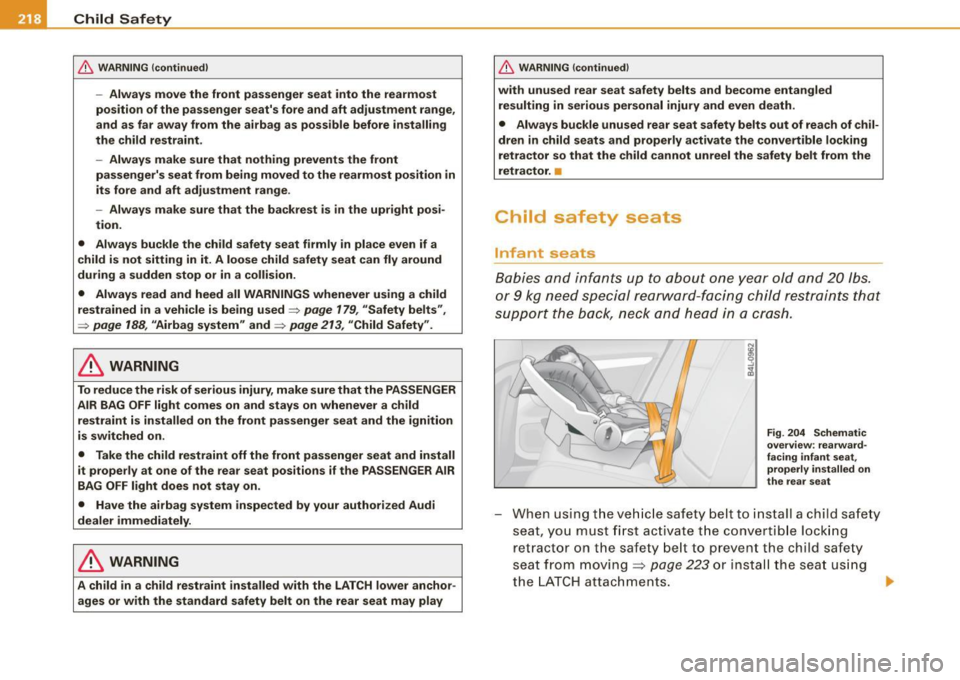
Infant seats
Babies and infants up to about one year old and 20 lbs.
or 9 kg need special rearward-facing child restraints that
support the back, neck and head in a crash.
Fig . 204 Schematic
overview: rearward
facing infant seat,
properly installed on
the rear seat
-When using the vehicle safety belt to install a child safety
seat, you must first activate the convertible locking
retractor on the safety belt to prevent the child safety
seat from moving=> page
223 or insta ll the seat using
the LATCH attachments. ..,_
Page 222 of 360

___ C_h_ i_ld _ S_ a_ f_ e_ t-= y'------------------------------------------------
Fig. 206 Schematic
overview: installation
of the seat using the
vehicle's safety belt
system
- When using the vehicle safety belt to install a child safety
seat, you must first activate the convertible locking
feature on the safety belt to prevent the child safety seat
from moving ==>
page 223 or install the seat using the
LATCH attachments
- Push the child safety seat down with your full weight to
get the safety belt really tight so that the seat cannot
move forward or sideways more than one inch (2.5 cm)
==> page 223.
If the child safety seat is equipped with a tether strap,
attach it to the tether anchors==>
page 230.
A toddler or child is usually too large for an infant restraint if it is
more than one year old and weighs more than 20 lbs. (9 kg) .
Toddlers and children who are older than one year up to about 4
years old and weigh more than 20 lbs. (9 kg) up to 40 lbs . (18 kg)
must always be properly restrained in a child safety seat certified for
their size and weight~
page 219, fig. 205 and~ page 220, fig. 206.
The airbag on the passenger side makes the front seat a potentially
dangerous place for a child to ride. The front seat is not the safest
place for a child in a forward-facing child safety seat . It is a very
dangerous place for an infant or a larger child in a rearward -facing
seat.
& WARNING
Not using a child safety seat, using the wrong child safety seat or
improperly installing a child restraint increases the risk of serious
personal injury and death in a collision or other emergency situa
tion.
• Children on the front seat of any car, even with Advanced
Airbags, can be seriously injured or even killed when an airbag
inflates. A child in a rearward-facing child safety seat installed on
the front passenger seat will be seriously injured and can be killed
if the front airbag inflates -even with an Advanced Airbag System.
• The inflating airbag will hit the child safety seat or infant
carrier with great force and will smash the child safety seat and
child against the backrest , center armrest, door or roof.
• Always install rearward-facing child safety seats on the rear
seat.
• If you must install a rearward facing child safety seat on the
front passenger seat because of exceptional circumstances and
the PASSENGER AIR BAG OFF light does not come on and stay on,
immediately install the rearward-facing child safety seat in a rear
seating position and have the airbag system inspected by your
authorized Audi dealer .
• Always read and heed all WARNINGS whenever using a child
restrained in a vehicle is being used~
page 179, "Safety belts",
~ page 188, "Airbag system" and~ page 213, "Important things
to know".
& WARNING
If exceptional circumstances require the use of a forward-facing
child restraint on the front passenger's seat, the child's safety and
well-being require that the following special precautions be taken:
• Make sure the forward-facing seat has been designed and certi
fied by its manufacturer for use on a front seat with a passenger
front and side airbag.
~
Page 223 of 360

& WARNING !continued)
• Always follow the manufacturer's instructions provided with
the child safety seat or infant carrier.
• Always move the front passenger seat into the rearmost posi
tion of the passenger seat's fore and aft adjustment range, and as
far away from the airbag as possible before installing the child
restraint.
• Always make sure that nothing prevents the front passenger's
seat from being moved to the rearmost position in its fore and aft
adjustment range .
• Always make sure the backrest is in an upright position .
• Make sure that the PASSENGER AIR BAG OFF light comes on
and stays on all the time whenever the ignition is switched on.
• If the light does not stay on, perform the checks~
page 199,
uMonitoring the Advanced Airbag System ".
• Take the child restraint off the front passenger seat and install
it properly at one of the rear seat positions if the PASSENGER AIR
BAG OFF light does not stay on whenever the ignition is switched
on. •
Safety first
Child Safety
Booster seats and safety be lts
Properly used booster seats can help protect children
weighing between about 40 lbs. and 80 lbs. (18 kg and
36 kg) who are less than 4
ft. 9 in. (57 inches/1.45 meters)
tall.
Fig . 207 Rear seat :
child properly
restrained in a booster
seat
The vehicle 's safety belts alone will not fit most children
until they are at least 4 ft. 9 in. (57 inches/1.45 meters) tall
and weigh about 80 lbs. (36 kg). Booster seats raise these
children up so that the safety belt will pass properly over the
stronger parts of their bodies and the safety belt can help
protect them in a crash.
- Do not use the convertible locking retractor when using
the vehicle 's safety belt to restrain a child on a booster
seat.
- Always position the shoulder portion of the safety belt midway over the child's shoulder. If you must transport
an older child in a booster seat on the front passenger
seat , you can use the safety belt height adjustment to
help adjust the shoulder portion properly.
- Always make sure that the shoulder portion of the safety
belt never rests against or across the child's neck.
I)),
Vehicle care I I irechnical data
Page 225 of 360

Child Safety -
--------------------''----
& WARNING (continued )
• If you must install a booster seat on the front passenger seat
because of exceptional c ircumstances the PASSENGER AIR BAG
OFF light must come on and stay on , whenever the ignition is
switched on.
• If the PASSENGER AIR BAG OFF light does not come on and stay
on , perform the checks described
=> page 199 , "Monitoring the
Advanced A irbag System ".
• Take the ch ild restraint off the front passenger seat and install
it properly at one of the rear seat positions if the PASSENGER AIR
BAG OFF light does not stay on wheneve r the ignition is switched
on .
• Always read and heed all WARNINGS whenever using a child
restrained in a vehicle is being used=>
page 179, "Safety belts",
=> page 188, "Airbag system " and => page 213 , "Important things
to know ".•
Installing a child safety seat
Securing a child safety seat using a safety
belt
S a fety belt s fo r the rear seats and the front passen ger 's
sea t can be l ocked with t he convert ib le lock ing retra cto r
t o prope rly s ecure child saf ety s ea ts .
The s afe ty bel ts e merge ncy lo cking re trac to rs fo r th e rea r sea ts
safety belts and for the front pass enger's seat safety belt have a
c o nve rtible loc king re tr ac tor fo r child r estrai nts. The sa fe ty b elt
must be loc ked so that be lt webbin g cannot unr eel. The re trac tor
c an be activa te d to lock the safety be lt and prevent the safet y belt
w ebbi ng fr om l oos en ing up dur in g n orm al dr ivi ng . A chi ld sa fety
seat can only be properly insta lled when t he safety be lt is locked so
th at th e child and chil d sa fet y seat will sta y in p lace .
Controls and equip ment Safety first Vehicle operation A
lways remember: Even though your vehic le is equipped with an
A dva nce d Airb ag sys tem, all chi ld re n, e sp ec ially those 12 yea rs a nd
youn ger, should a lways ride in the back seat prop erly restrained for
t hei r age and weigh t.
& WARNING
Improperly installed child safety seats increase the risk of serious
personal injury and death in a collision .
• Always make sure that the safety belt retractor is locked when
installing a child safety seat . An unlocked safety belt retractor
cannot hold the child safety seat in place during normal driving or
in a crash .
• Always buckle the child safety seat firmly in place even if a
child is not sitting in it . A loose child safety seat can fly around
during a sudden stop or in a collision .
• Always make sure that the rear seat backrest to which the
center rear safety belt is attached is securely latched whenever
the rear center safety belt is being used to secure a child restraint.
• If the backrest is not securely latched , the child and the child
restraint will be thrown forward together with the backrest and
will strike parts of the vehicle interior. The child can be seriously injured or killed.
• Never install rearward -facing child safety seats or infant
carriers on the front passenger seat . A child will be seriously
injured and can be killed when the passenger airbag inflates.
• The inflating airbag will hit the child safety seat or infant
carrier with great force and will smash the child safety seat and
child against the backrest , center armrest , door or roof .
• Always install rearward -facing child safety seats or infant
c arriers on the rear seat .
• Forward-facing child safety seats or infant carriers installed on
the front passenger's seat may interfere with the deployment of
the airbag and cause serious injury to the child . ..
Vehicle care Do-it-yourself service Technical data
Page 227 of 360

Child Safety -
--------------------''---
& WARNING (continued)
• Make sure that the PASSENGER AIR BAG OFF light comes on
and stays on all the time whenever the ignition is switched on.
• If the PASSENGER AIR BAG OFF light does not come on and stay
on, immediately install the rearward-facing child safety seat in a
rear seating position and have the airbag system inspected by
your authorized Audi dealer. •
Activating the convertible locking retractor
Use the convertible locking retractor to secure a child
restraint.
Always heed the child safety seat manufacturer 's instruc
tions when installing a child restraint in your vehicle. To
activate the convertible locking retractor:
- Place the child restraint on a seat, preferably on the rear
seat.
- Slowly pull the belt
all the way out.
- Route it around or through the child restraint belt path
=>& .
- Push the child safety seat down with your full weight to
get the safety belt really tight .
- Insert the belt tongue into the buckle for that seating
position.
- Gu ide the safety belt back into the retractor until the belt
lies flat and snug on the child safety seat.
Controls and equip
ment Safety first Vehicle operation
- You should
hear a "clicking" noise as the belt winds back
into the inertia reel. Test the convertible locking retractor
by pul ling on the belt. You should no longer be able to
pull the belt out of the retractor. The convertible locking
retractor is now activated .
- Make sure that the red release button is facing away from
the child restraint so that it can be unbuckled quickly.
- Pull on the belt to make sure the safety belt is properly
tight and fastened so that the seat cannot move forward
or sideways more than one inch (2.5 cm).
& WARNING
Using the wrong child restraint or an improperly installed child
restraint can cause serious personal injury or death in a crash.
• Always make sure that the safety belt retractor is locked when
installing a child safety seat. An unlocked safety belt retractor
cannot hold the child safety seat in place during normal driving or
in a crash.
• Always buckle the child safety seat firmly in place even if a
child is not sitting in it. A loose child safety seat can fly around
during a sudden stop or in a crash.
• Always make sure the seat backrest to which the child restraint
is installed is in an upright position and securely latched into place
and cannot fold forward. Otherwise, the seat back with the child
safety seat attached to it could fly forward in the event of an acci
dent or other emergency situation.
• Always read and heed all WARNINGS whenever using a child
restrained in a vehicle is being used=>
page 213. Special precau
tions apply when installing a child safety seat on the front
passenger seat=>
page 190, "Child restraints on the front seat -
some important things to know". •
Vehicle care Do-it-yourself service Technical data