2010 AUDI A5 COUPE light
[x] Cancel search: lightPage 263 of 360

_______________________________________________ C_l_e _a_ n_ in _____ g ___ a_n_ d ___ p_r _o _t_ e_ c_ t _i _o _ n __ _
•
The intensity of the color determines the visual characteristics and
appearance . If the surface of the leathe r has a typica l natura l loo k,
then the leather is a nappa leather that has been left in a re latively
natural condition . This leather offers particu lar ly good comfort and
breathes well. Fine veins , closed grains, insect bites, skin folds, and
subt le variations in color remain visible . These characte ristics
demonstrate that the material is natu ral.
Natura l nappa lea ther is not covered by a color finish. It is therefore
more sensitive to soi ling and wear, which is something you need to
consider if children, anima ls or other factors m ight prove to be
particula rly ha rd on the leather.
By contrast, leather types that are covered by a colored finish layer
are more durable. This has a positive effect on the leather's resis
tance to wear and so iling in daily use. On the other hand, the typica l
characteristics of natural leather are barely or not apparent .
However, this does not mean that the leather itself is of inferior
quality.
C are and handling
Because of the exclusive nature of the types of leather that Audi
uses and the ir unique properties (such as sensitivity to oi ls, grease,
soiling, etc.I, you will need to be somewhat careful with these
lea thers, a nd a certain type o f care is requ ired . For example, dark
clothing materials can discolor leather seats (especial ly if such
cloth ing is damp and wa s not dyed correctly). Dust and dirt particles
in pores, folds, and seams can have an abrasive effect and can
damage the leather surface as we ll as weaken seams .
The leather shou ld be c leaned regularly as needed . Af ter having
been used for a relative ly long time, your leather seats will acquire
a rich a ged finish. This is a cha racteristic of natural leather and a
sign of true qua lity.
I n orde r to mai ntain the value of this natura l p roduct over the life of
your vehic le, you should fo llow the recommendations below :
0 Note
• To keep your leather from bleaching out, do not allow it to be
exposed to bright sun light for long periods of time . If you have to
leave the vehicle parked outside for long periods, cover the lea ther
to protect it from direct exposure to sunlight.
• Sharp objects on c lothing, such as zippers, rivets or sharp p ieces
on belts can leave permanent scratches or sc rape marks on the
su rface of the leather.
[ i ] Tips
• After each t ime you clean the leather and a t regular i ntervals, use
a leather preservative cream that contains UV-blockers and that
wo rks int o the leathe r. This cream wil l n ou rish and moistur ize the
leather, helping it to breathe and stay supple . It a lso helps to build
up a protec tive coating on the surface .
• Clean the leather every 2 - 3 months, and c lean any areas that get
s o iled .
• Remove fresh marks made by bal lpoint pens, ink, lipstick, shoe
polish, etc . as soon as poss ible.
• P reserve the co lor of the leather as needed by using a special
colored leather ca re cream to touch up areas o f uneven colo r. •
A pp lies to ve hic les : w it h na tu ra l lea ther
Cleaning and caring for leather upholstery
and trim
N atural leather requires special care and attenti on .
Normal cleaning
- C lean so iled areas with a slig htly mo is tened cotto n or
woole n cloth .
Vehicle care I t •
Page 265 of 360

_____________________________________________ C_ l_ e _a_ n_ in_ g_a _ n_d_ p_ r_ o_ t _e_ c_t _io _ n __ lffllll
•
- Dab at the stain. Start at the outside and work inwards.
- Once the stain is no longer v isible, use a soft dry cloth or
tissue to soak up the moisture.
Do not use lea ther cleaning produc ts on Alcantara®.
You may use a suitable shampoo for removing dust and dirt.
Dust and grit in the pores and seams can scratch and damage the
surface. If the car is left standing in the sun for long periods, the
Alcantara® should be protected against direct sunlight to prevent it
from fading. Slight color variations will develop in normal use and are not an indication of material deterioration.
0 Note
• Never use chemical solvents (e.g. lighter fluid, turpentine),
waxes , shoe polish or similar products on Alcantara ® surfaces.
• To avoid damage, have stubborn stains removed by a commer
cial cleaning specialist.
• Do not use brushes, stiff sponges or similarly abrasive cleaning
aids. •
Safety belts
Only well-maintained safety belts work reliably when
needed.
- Keep belts clean.
- For cleaning, use a mild soap and water solution . Let
belts dry thoroughly and away from direct sunlight.
- Do not allow inertia reel safety belts to retract before
they are completely dry.
- Check the condition of your safety belts
regularly.
Heavily soiled safety belts may not retract properly .
& WARNING
Damaged safety belts can break in a crash.
• Anything that might damage your safety belts could mean that
you and your passengers would not be adequately protected in an
accident.
• Safety belt performance depends on correct installation. Never
remove belts from the vehicle to clean them .
• Do not use chemical cleaning agents, bleach or dyes. They have
corrosive properties which weaken the webbing.
• When cleaning your safety belts, inspect them for damage. If
you discover damage, see your authorized Audi dealer.
• Always read and heed all WARNINGS and other information
=> page 252. •
Engine compartment
Be especially careful when cleaning the engine comport
ment.
Always switch off the ignition before cleaning the engine => &.
Plenum panel
Remove leaves from the plenum panel in front of the windshield
under the engine hood. This prevents the water drain holes from
becoming blocked, and it prevents debris from entering the vehicle
interior through the heating and ventilation ducts .
Corrosion protection
The engine compartment and transmission have been corrosion
protected at the factory.
Good anti-corrosion treatment is very important, particularly in the
winter. If the vehicle is frequently driven on salt treated roads, the .,_
Vehicle care I t •
Page 267 of 360

•
Fuel supply and filling your fuel tank
Gasoline
Fuel supply Using the right fuel helps keep the environment clean and
prevents engine damage.
Fuel r ecomm end ati on
The fuel recommended for your vehic le is unl eade d prem ium grade
gaso line . See also ~
page 337, "Data". Audi recommends using TOP
T IER Detergent Gasoline with a minimum octane rating of 91 AKI (95
RON). For more information on TOP TIER Detergent Gaso line, please
go to the official website (www.toptiergas .com).
The recommended gasoline octane rating for your engine can also be found on a label located on the inside of the fuel fille r flap. This
rating may be specified as AK I or RON .
Your vehic le may also be operated us ing unleaded regular gasoline
with a minimum octane rating of 87 AKl/91 RON . However, using 87
AKl/9 1 RON octane fuel will slightly reduce engine performance.
Use unle ad ed ga so line only . Unleaded gaso line is avai lable
throughout the USA, Canada, and in most European countries. We
recommend that you do not take your vehicle to areas or countr ies
where un leaded gasoline may not be available .
For more information on refueling your vehicle, see~
page 266 .
Octane ra tin g
Octane rating indicates a gaso line's ability to resist engine
damaging "knock" caused by premature ignition and detonation.
Therefore, buying the correct grade of gaso line is very important to
help prevent possible engine damage and a loss of engine perfor
mance.
F ue l supply and fillin g you r fu el tank
Gasoline most common ly used in the United States and Canada has
the following octane ratings that can usua lly be found on the filler
pump:
• Premium Grade : 91 -96 AKI
• Regular Grade: 87 -90 AKI
Explanation of the abbreviations:
AKI = Anti Knock Index= (R +M)/2 = (RON +MON)/2
RON = Research Octane Number
MON
= M otor Octane Number .
0 Note
• Do not use any fue l with octane ratings lower than 87 AKI or 91
RON otherwise expensive engine damage will occur .
• Do
not use leaded gasoline. The use of leaded gasoline w ill
severe ly damage your vehicle's catalytic converter and its abi lity to
control exhaust emissions. •
Blended gasoline
Use of g aso line containing alco hol or M TB E ( meth yl
t er tiary butyl e ther )
You may use unleaded gasoline blended with alcohol or MTBE
(commonly referred to as oxygenates) if the blended mixture meets
the follow ing criteria:
Bl end of g asoline m eth anol (wood al coho l or methyl alc oh ol)
• Anti-knock index must be 87 AKI or higher .
• Blend must contain no more than 3% methanol.
• Blend must contain more than 2% co-solvents.
Vehicle care I t •
Page 272 of 360

___ C_ h_ e_c _ k_ i_ n ...;:g:- a_ n_ d_ f_ il _li _n ...::g ::.- _____________________________________________ _
Checking and filling
Engine hood
Releasing the engine hood
The engine hood is released from inside the vehicle.
-Open the driver's door .
Fig. 220 Driver's side
footwell: engine hood
release lever
-Pull the release lever on the left under the instrument
panel
~ fig. 220 in the direct ion of the arrow.
The hood pops up slightly under spring pressure. •
Opening the engine hood
Fig. 221 Release lever
under the engine hood
Before opening the engine hood, make sure that the wind
shield wipers are flat against the windshield. Otherwise,
they could damage the paint on the hood.
Pull up on the release under the hood :::} fig. 221. This
releases the catch .
- Open the hood all the way:::}& .
& WARNING
Hot engine coolant can burn you.
• To reduce the risk of being burned, never open the hood if you
see or hear steam or coolant escaping from the engine compart
ment. Wait until no steam or coolant can be seen or heard before
carefully opening the hood. •
Page 275 of 360

Checkin g and fillin g -
--------------~-
•
© Windshield/headlight * washer container (~ l . . . . . . . 286
0 Power steering reservoir . . . . . . . . . . . . . . . . . . . . . . . . . 239
The position of the engine oi l filling hole=> fig. 222 (item
@l can
differ depending on the engine design .
& WARNING
Befo re you che ck a nythin g in the en gin e com partment , always
read and h eed all WARNING S
=> & in "Workin g in th e e ngine
co mp artm ent " o n
page 271. •
Engine oil
Engine oil specifications
The engine oil used in your Audi needs the right kind of
oil.
T he engine in your Audi is a sophisticated power plant that was built
to exacti ng specifications . This engine needs the right kind of
engine oil that meets specifications regarding qua lity and viscosity
so that it can run smoothly and reliably. Choosing the right oil and
changing oil within the time and mileage intervals printed in your
vehicle's Warranty
& Maintenance booklet matters a lot more today
than it did years ago. Audi has developed a spec ial quality standard
for engine oi l that will help assure tha t your vehicle's engine will get
the lubr ication it needs for proper operation .
Modern engine lubrication has taken a quantum leap in the last few
years . Many synthe tic oi ls availab le today provide better engine
lubrication that can outlast traditional pet roleum-based oils ,
making them a smart choice for use throughout the life of your Audi.
Whether you use synthet ic or petroleum -based engine oil, the oi l
that you use must conform to Audi's oi l quality standard VW 502 00
to help keep your veh ic le's engine running smoothly and help prevent the formation of harmful deposits
, sometimes called
"sludge", that over time can lead to expensive repairs.
At the time of printing, engine oi ls avai lable in the U .S . and Canada
that meet the exacting specifications of Audi oil standard VW 502 00 are synthetic engine oils. This does not mean, however, that every
synthetic engine oil will meet Audi oil standard VW 502 00 . So
a lways be sure that you use an approved oi l.
To help prevent the formation of harmful deposits use only oil with
the fo llowing specifications printed on the oil container:
Audi oil sta ndard VW 502 0 0
Oil container labels may carry th e specification singly or in combi
nation with o ther designa tions and oil quality standards.
Visc osit y
Engine oils are graded according to their viscosity . The proper
v iscosity grade oi l for your engine depends on c limactic or seasona l
conditions where you drive. You can use oil wi th a viscosi ty grade of
SAE 5W40 across al l temperature ranges for normal driving condi
tions .
Howeve r, if engine oil viscosity grade SAE 5W40 is not available, you
can a lso use viscosity grade SAE 5W-30 or SAE 0W -40 as long as it
meets Audi oil qua lity standard VW 502 00 specifications.
Because engine o il that meets the Audi o il standard may not be
avai lable everywhere when you n eed it, we strongly recommend
that you a lways carry with you an extra quart (liter) of o il that
express ly conforms to the VW 502 00 specification, in case you have
to top off the oil while on the road .
Only if the level of the oil is at or below the minimum mark - and no
oi l that expressly conforms to Audi oil standard VW 502 00 specifi
cations is availab le - may you top o ff with a high qua lity engine oil,
preferably synthetic -based, that meets ACEA A3, ACEA A5 or
ACEA 85 or API SL specifications, but even then, on ly in viscosity
grades SAE 5W -40, SAE 5W -30, or SAE 0W -40. However, during the
en tire time between oil change intervals, never top off with more _,.
Vehicle care I t •
Page 276 of 360

-~_C_ h_e _c _ k_ i_n ...:::g::;...._ a_n_ d_ f_ i_ll _in -'g:::;.._ ___________________________________________ _
than a total of 0.5 qt/liter engine oil that does not conform to Audi
oi l specification VW 502 00.
For more information about engine oi l that has been approved for
your vehicle, please contact e ither your authorized Audi dealer or
Aud i Custo mer Relations at 1 (800) 822 -2834 or visit our web site at
www.audiusa.com or www.audicanada.ca. Here you will a lso find a
current list of o ils (manufacture rs, brand names etc.) that con form
to Audi oi l standard VW 502 00.
Changing the engine oil
The engine oil and oil fil ter must be changed according to the
mi leage (kilometers) and time intervals specified in your vehicle's
Warranty & Maintenance booklet. Do not exceed these intervals -
harmful deposits from old engine oil can reduce engine perfor
mance a nd can lead to expens ive eng ine repairs.
Changing the oil at the recommended intervals is so very important because the lubricating properties of oi l decrease gradual ly during
normal vehicle use. If you are not sure when you have your oil
changed, ask your authorized Audi Service Adviso r.
Under some circumstances the engine oil should even be changed more frequently . Change oil more often if you drive mostly short
distances, ope rate the vehicle in dusty areas or m ostly under stop
and -go traffic cond itions, or when you use your vehicle where
temperatu res stay below freezing point for long per iods.
Detergent additives in the oil will make fresh oil look dark after the
engine has been running for a short time. This is normal and is not
a reason to change the oi l more o ften than recommended.
Dam age or malfunctions d ue to la ck of ma inten ance
It is essential that you change your oi l a t the recommended in terva ls
using on ly engine oil that complies with Audi oil standard
VW 502 00. Your Limited New Vehicle Warranty does not cover
damag e or ma lfunctions due to failure to follow recommended
maintenance and use requirements as set forth in the Audi Owner's
Manual and War ranty & Mai ntenance booklet. Your dealer wi ll have
to deny warranty coverage unless you present to the dealer proof in the form of Service or Repair Orders that all schedu
led maintenance
was performed in a timely manner. •
Engine oil consumption
The e ngine in your vehicle depends on an adequate
amount o f oil to lubricate and cool all of its moving parts.
In order to provide effective lubrica tion and coo ling of in terna l
engine components, all interna l combustion engines consume a
cer tain amoun t of oil. Oi l consump tion varies from e ngine to engine
and may change significantly over the life of the engine. Typical ly,
engi nes w ith a specified break -in p eriod (see =>
page 243) consume
more o il during the break- in period than they consume after oil
consump tion has stabi lized .
Under normal conditions, the ra te of oil consumpt ion depends on
the quality and viscosity of the oil, the R PM (revolutions per minute)
at which the engine is operated, the ambient temperature and road
conditions. Further factors are the amount of oil di lution from water
con densa tion or fue l residue and the oxi dation leve l of t he oi l. As
any engine is subject to wear as mileage builds up, the oil consump
tion may increase over time until replacemen t of wo rn components
may become necessary.
With all these variables coming into play, no standard rate of oi l
consumptio n can be establ ished o r speci fied. There is no alternat ive
to regular and frequent checking of the oil level, see
Note .
If the yel low engine oil l evel warn ing sy mbol in t he instrumen t
cluster ._ lights up, you should check the oil level as soon as
p ossible :::::>
page 275. Top off the o il at your earliest conven ience
=>
page 275.
& WARNING
Befo re you che ck anything in the engine compartment , always
read and heed all WARNINGS
:::::> & in "Working in the engine
c ompartment " on
page 271 .
Page 280 of 360
___ C_h_ e_ c_k _in --== g'-- a_n _d_ f_il _li _n ..:::g:::..- ___________________________________________ _
0 Note
• Before winter sets in, have the coolant checked to see if the
coolant additive in your vehicle is sufficient to meet the climate
conditions. This is especia lly important if you live in a region where
the winter is extremely cold. If necessary, increase the proportion of
coo lant additive to 60%.
• When adding coolant additive to your coo ling system,
reme mber:
- We recommend using only coolant additive G12+ + (check the
label) for your vehicle. This coolant addit ive is ava ilable at autho
rized Audi dealers . Other types of antifreeze can significantly
reduce corrosion protection . The resulting corrosion can cause a
loss of coolant and serious engine damage.
• Do not add any type of radiator leak sealant to your vehicle's
engine coolant . Adding radiator repair fluid may adverse ly affect the
function and performance o f your cooling system and cou ld result
in damage not covered by your New Vehicle Limited Warranty. •
Checking the engine coolant level
The engine coolant level can be checke d with a quick
glance.
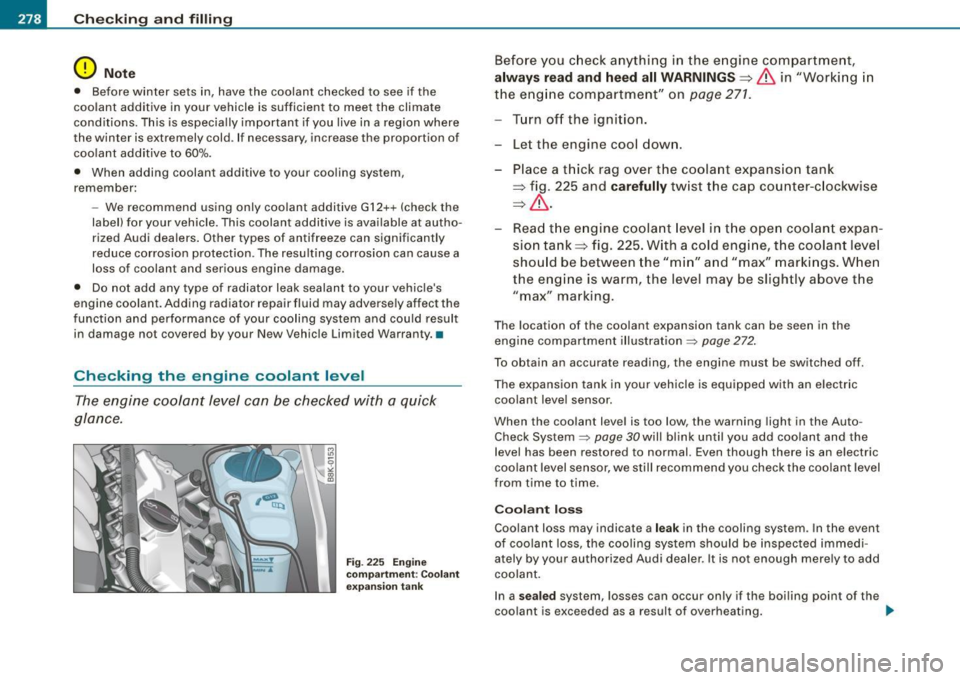
Fig . 2 25 Engine
c omp artmen t: Coo la n t
e xpan sion tank
Be fo re y ou c heck anything in the e ngine compar tm en t,
always read and heed all WARNINGS==> & in "Working in
the eng ine compartment" on
page 271.
Tur n off the ignitio n.
- Let the engine coo l down.
P lace a th ick rag ove r the coola nt expans io n tank
==> fig. 225 and carefully twist th e cap counter-c lockwise
==> & .
Read t he e ngin e coola nt level i n the open coo la nt expan
sion tank==> fig. 225. W ith a cold eng ine, the coolant leve l
sho uld be bet ween the "m in" and "max" markings. W hen
t h e eng ine is warm, the level may be slightly above the
"max" marking .
The location of the coolant expansion tank can be seen in the
engine compartment illustration=>
page 272.
To obtain an accurate read ing, the engine must be switched off .
The expansion tank in your vehicle is equipped with an e lectric
coo lant leve l sensor.
When the coolant leve l is too low, the warning light in the Auto
Check System =>
page 30will blink until you add coolant and the
level has been restored to normal. Even though there is an electric
coo lant level sensor, we still recommend you check the co olant level
from t ime to time.
C oolant loss
Coolant loss may indicate a le ak in the cooling system . In the event
of coo lant loss, the co oling system should be inspec ted i mmedi
ately by your authorized Audi dealer. It is not enough mere ly to add
coo lant.
In a
s ealed system, losses can occur on ly if the boi ling point of the
coo lant is exceeded as a result of overheating. ...
Page 281 of 360

___________________________________________ C_ h_e _c_ k_ i_n _g _ a_n _d_ f_il _li _n _g __ ll'I
•
& WARNING
The cooling sy stem i s under pre ssure and can get very hot . Redu ce
the risk of scalding from hot coolant by following these steps.
• Turn off the engine and allow it to cool down .
• Protect your face, hands and arms from escaping fluid and
ste am by cover ing the cap with a large , thick rag .
• Turn the cap slowly and very carefully
in a counter -clockwise
dire ction while applying light , downward pressure on the top of
the cap .
• To avoid being burned, do not spill antifreeze or coolant on the
e x haust system or hot engine parts . Under certain conditions, the
ethylene glycol in engine coolant can catch fire .
0 Note
Do not add any type of radiator leak sea lant to your vehicle's engine
coolant. Adding radia to r repa ir flu id may advers ely affect the fu nc
tion and performance of your coo ling system and could res ult in
damage not covered by y our New Vehic le Lim ited War ra nty .•
Adding coolant
B e very care ful when ad ding e ngine cool ant.
Be for e you check a nything in the engine com partmen t,
always read and heed all WARNINGS~ & in "Work ing in
t h e eng ine compa rtment" on
page 271 .
-Tur n o ff th e en gine.
- Let the e ng in e cool d own.
- Plac e a thi ck rag over the coo la nt expansion tank
~ page 2 78 , fig. 2 25 and carefully tur n t he cap coun te r
cl ockwi se
~ &.
Add coo lan t.
- Twist the cap on aga in
tightly.
Replacement engine coolant must conform to exact specifications
~ page 2 77, "C oolant". Even in an eme rgency, if co olant addi tive
G12+ +, G12 + or G12 is not availab le, do not use a different additive.
U se pla in water ins tead until you can ge t the c orrect add itive and
can res tore the correc t rat io. Th is shou ld be done as soon as
p os sible.
I f y ou hav e los t a co ns ide rab le amou nt of coo la nt, then y ou should
add cold antifreeze and cold water only when the engine is cold .
A lways use
new e ngine c oolant w he n r efil ling .
D o not fill coolant a bove the " MAX" mark. Excess coola nt w il l be
forced out through the pressure relief va lve in the cap when the
eng ine becomes hot.
& WARNING
• The cooling system is under pressure and can get very hot .
Reduce the risk of scalding from hot coolant by following these
steps.
-Turn off the engine and allow it to cool down .
- Protect your face , hands and arms from escaping fluid and
steam by covering the cap with a large , thick rag .
- Turn the cap slowly and very carefully in a counter -clockwise
direction while applying light, downward pressure on the top
of the cap.
- To avoid being burned, do not spill antifreeze or coolant on
the exhau st system or hot engine parts. Under certain condi
tions, the ethylene glycol in eng ine coolant can catch fire .
• Antifreeze is poisonous. Always store antifreeze in its original
container and well out of the reach of children .
• If you dra in the coolant , it must be caught and safely stored in
a proper container clearly marked "poison ".
~
Vehicle care I t •