Page 55 of 551
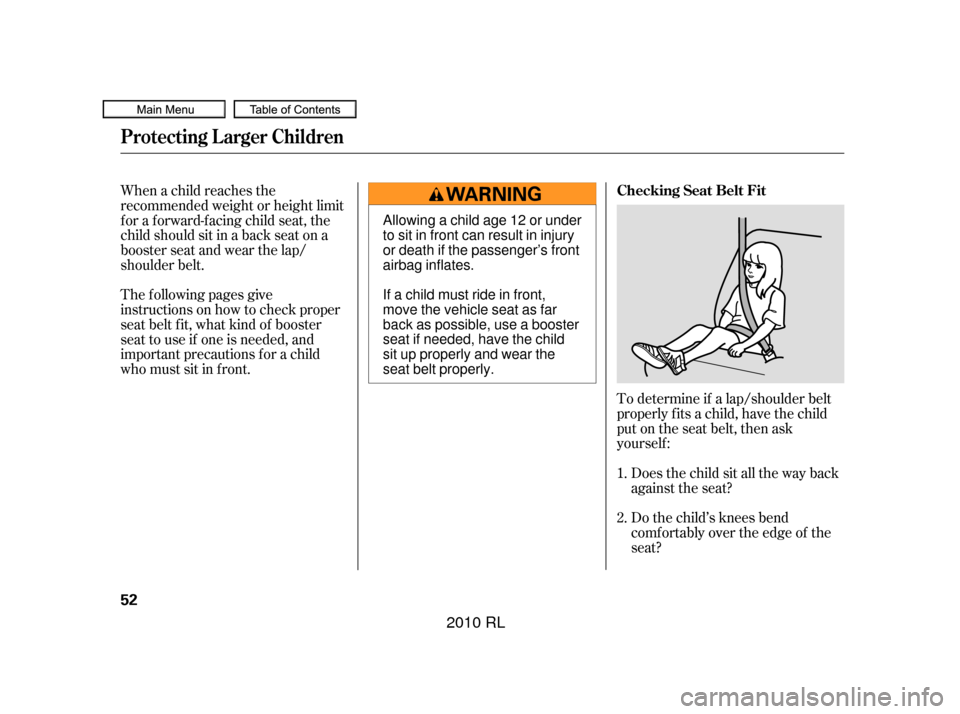
To determine if a lap/shoulder belt
properly f its a child, have the child
put on the seat belt, then ask
yourself :Does the child sit all the way back
against the seat?
Do the child’s knees bend
comf ortably over the edge of the
seat?
When a child reaches the
recommended weight or height limit
for a forward-facing child seat, the
child should sit in a back seat on a
booster seat and wear the lap/
shoulder belt.
The f ollowing pages give
instructions on how to check proper
seat belt f it, what kind of booster
seat to use if one is needed, and
important precautions f or a child
who must sit in f ront.
1.
2. Checking Seat Belt Fit
Protecting L arger Children
52
Allowing a child age 12 or under
to sit in front can result in injury
or death if the passenger’s front
airbag inflates.
If a child must ride in front,
move the vehicle seat as far
back as possible, use a booster
seat if needed, have the child
sit up properly and wear the
seat belt properly.
�����—�����—�����y�
���������
���y���
�(�����������y���������y
2010 RL
Page 57 of 551

If you decide that a child can saf ely
ride up f ront, be sure to:Caref ully read the owner’s manual,
and make sure you understand all
seat belt instructions and all saf ety
inf ormation.
Move the vehicle seat to the rear-
most position.
Have the child sit up straight, back
against the seat, and feet on or
near the f loor.
Check that the child’s seat belt is
properly and securely positioned.
Supervise the child. Even mature
children sometimes need to be
reminded to f asten the seat belts
or sit properly.
Of course, children vary widely. And
while age may be one indicator of
when a child can saf ely ride in f ront,
there are other important f actors you
should consider.
If the passenger’s front airbag
inf lates in a moderate to severe
f rontal collision, the airbag can cause
serious injuries to a child who is
unrestrained, improperly restrained,
sitting too close to the airbag, or out
of position.
A side airbag also poses risks. If any
part of a larger child’s body is in the
path of a deploying side airbag, the
child could receive possibly serious
injuries. The National Highway Traffic Safety
Administration and Transport
Canada recommend that all children
age 12 and under be properly
restrained in a back seat. Physically, a child must be large
enough f or the lap/shoulder belt to
properly f it (see pages and ). If
the seat belt does not f it properly,
with or without the child sitting on a
booster seat, the child should not sit
in f ront.
To saf ely ride in f ront, a child must
be able to f ollow the rules, including
sitting properly, and wearing the seat
belt properly throughout a ride.5217
Protecting L arger Children
Physical Size
Maturity
When Can a L arger Child Sit in
Front
54
�����—�����—�����y�
�������������y���
�(�����������y���������y
2010 RL
Page 64 of 551

�Î
�Î�Î
�Î
�Î
The U.S. instrument panel is shown. Dif f erences f or the Canadian models are noted in the text. If equipped.
:
Instrument Panel
Inst rument s and Cont rols
61
SEAT BELT REMINDER
INDICATOR
CHARGING SYSTEM
INDICATOR KEYLESS ACCESS
SYSTEM INDICATOR
LOW OIL PRESSURE
INDICATOR MALFUNCTION INDICATOR
LAMP
LOW FUEL INDICATORELECTRONICALLY
CONTROLLED
POWER STEERING
SYSTEM (ECPS)
INDICATOR
LIGHTS ON INDICATOR
FOG LIGHT INDICATOR
MULTI-INFORMATION
DISPLAY MESSAGE INDICATOR
SECURITY SYSTEM
INDICATOR
(P.64)
(P.68)
(P.68)
(P.69)
(P.71)
(P.21,62) (P.68)
ANTI-LOCK BRAKE
SYSTEM (ABS)
INDICATOR
(P.34, 63)
SUPPLEMENTAL RESTRAINT SYSTEM
(SRS) INDICATOR
VEHICLE STABILITY ASSIST (VSA)
SYSTEM INDICATOR
VSA
ACTIVATION
INDICATOR
HIGH BEAM
INDICATOR
SIDE AIRBAG OFF
INDICATOR(P.35,
63)
(P.65) (P.65)
IMMOBILIZER SYSTEM
INDICATOR PARKING BRAKE
AND BRAKE SYSTEM
INDICATOR(P.64)
SH-AWD INDICATOR (P.66)
LOW TIRE PRESSURE/TPMS INDICATOR(P.66)
ADAPTIVE FRONT LIGHTING SYSTEM
(AFS) INDICATOR ADAPTIVE CRUISE CONTROL (ACC)
INDICATOR
(P.65) /
CRUISE MAIN INDICATOR
COLLISION MITIGATION BRAKE
SYSTEM (CMBS) INDICATOR (P.
69)
(P.69, 144) (P.66,
319)
(P.62, 500)
(P.62, 501)
(P.62, 500)
(P.67, 423) (P.63,
502)
(P.64,
411)
(P.65,
429)
(P.429)
�����—�����—�����y�
�������������y���
�(�����������y���������y
2010 RL
Page 66 of 551

This indicator comes on brief ly when
you turn the ignition switch to the
ON (II) position. If it comes on at
any other time, it indicates a
potential problem with your f ront
airbags. This indicator will also alert
you to a potential problem with your
side airbags, passenger’s side airbag
automatic cutoff system, side curtain
airbags, automatic seat belt
tensioners driver’s seat position
sensor, the f ront passenger’s weight
sensors, or, on models with ACC,
seat belt e-pretensioners. You will
also see a ‘‘CHECK AIRBAG
SYSTEM’’ message on the multi-
inf ormation display (see page ).
For more inf ormation, see page .
This indicator has two f unctions:
Itcomesonwhenyouturnthe
ignition switch to the ON (II)
position. It is a reminder to check
the parking brake. Driving with
the parking brake not f ully
released can damage the rear
brakes, axles, and tires.
If you drive without releasing the
parking brake, a beeper will sound,
and you will also see a ‘‘RELEASE
PARKING BRAKE’’ message on
the multi-information display (see
page ).
If it stays on after you have fully
released the parking brake while
the engine is running, or if it
comes on while driving, it can
indicate a problem in the brake system. You will also see a
‘‘BRAKE FLUID LOW’’ or
‘‘CHECK BRAKE SYSTEM’’
message on the multi-inf ormation
display. For more inf ormation, see
page .
This indicator comes on when you
turn the ignition switch to the ON
(II) position. If it comes on at any
other time, it indicates that the
passenger’s side airbag has
automatically shut of f . You will also
see a ‘‘PASSENGER SIDE AIRBAG
OFF’’ message on the multi-
inf ormation display (see page ).
For more inf ormation, see page .
1.
2.
79
35 79
508
78 34
Instrument Panel Indicators
Supplemental Restraint
System Indicator
Parking Brake and Brake System
Indicator
Side Airbag Of f Indicator
Inst rument s and Cont rols
63
U.S. Canada
U.S. Canada
�����—�����—�����y�
�������������y���
�(�����������y���������y
2010 RL
Page 139 of 551
�Î�Î
�Î
�Î�Î �Î
�Î
�Î
�Î
�Î
�Î
�Î
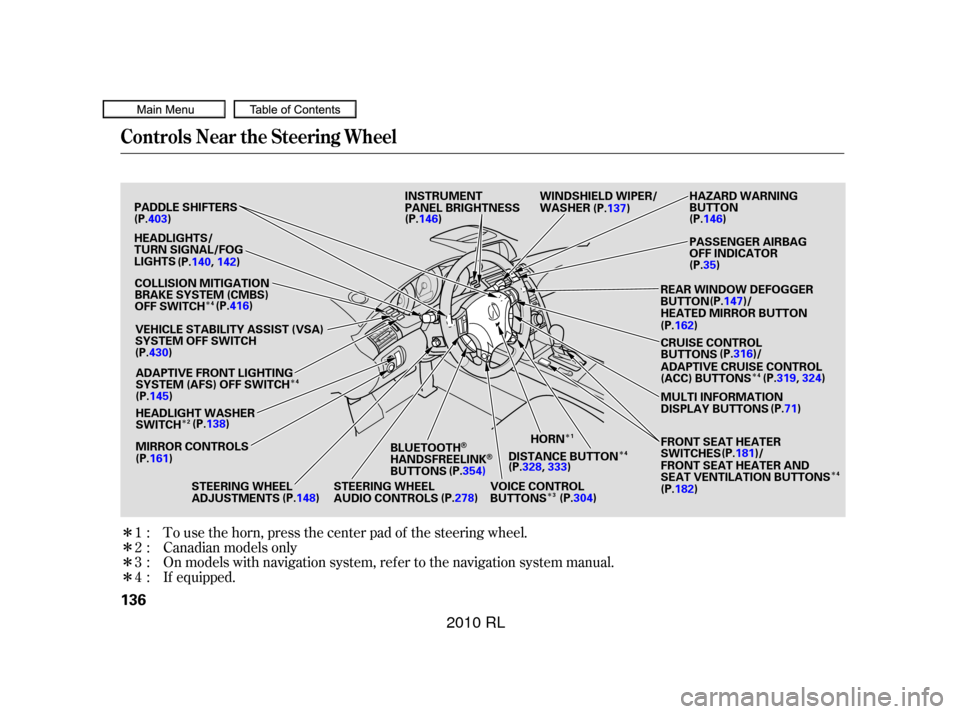
To use the horn, press the center pad of the steering wheel.
On models with navigation system, refer to the navigation system manual.
If equipped. Canadian models only
1:
2:
3:
4:
Controls Near the Steering Wheel
136
MIRROR CONTROLS
VEHICLE STABILITY ASSIST (VSA)
SYSTEM OFF SWITCH
PADDLE SHIFTERS
STEERING WHEEL
AUDIO CONTROLS
STEERING WHEEL
ADJUSTMENTS
HEADLIGHT WASHER
SWITCH
COLLISION MITIGATION
BRAKE SYSTEM (CMBS)
OFF SWITCH
ADAPTIVE FRONT LIGHTING
SYSTEM (AFS) OFF SWITCH
VOICE CONTROL
BUTTONSHORN
(P.138)
HEADLIGHTS/
TURN SIGNAL/FOG
LIGHTS
(P.140,142) INSTRUMENT
PANEL BRIGHTNESS
WINDSHIELD WIPER/
WASHER HAZARD WARNING
BUTTON
PASSENGER AIRBAG
OFF INDICATOR
(P.
35)
(P.137)
BLUETOOTHHANDSFREELINKBUTTONS HEATED MIRROR BUTTON
REAR WINDOW DEFOGGER
BUTTON
CRUISE CONTROL
BUTTONS
ADAPTIVE CRUISE CONTROL
(ACC) BUTTONS
FRONT SEAT HEATER AND
SEAT VENTILATION BUTTONS MULTI INFORMATION
DISPLAY BUTTONS
FRONT SEAT HEATER
SWITCHES (P.71)
(P.145)
(P.148) (P.278)(P.304)(P.182)(P.
181 )/
(P.316)/
(P.162)
(P.147)/
(P.
146 )
(P.146)
(P.328,333) (P.
319 ,324 )
(P.403)
(P.416)
(P.430)
(P.354)DISTANCE BUTTON
(P.161)
2 4
4
31 4
4
4
�����—�����—�����y�
�������������y���
�(�����������y���
���
�y
2010 RL
Page 184 of 551

In the LO setting, the heater runs
continuously. It does not cycle with
temperature changes.
Follow these precautions whenever
you use the seat heaters:Use the HI setting only to heat the
seats quickly, because it draws
large amounts of current f rom the
battery.
If the engine is lef t idling f or an
extended period, do not use the
seat heaters, even on the LO
setting. It can weaken the battery,
causing hard starting.
The ignition switch must be in the
ON (II) position to use the heaters.
Push the top of the switch, HI, to
rapidly heat up the seat. Af ter the
seat reaches a comfortable
temperature, select LO by pushing
the bottom of the switch. This will
keep the seat warm.
In the HI setting, the heater turns off
when the seat gets warm, and turns
back on after the seat’s temperature
drops.
Both f ront seats are equipped with
seat heaters. The passenger seat
only has heaters in the seat bottom
because of the side airbag cutof f
system.
RL models
FrontSeatHeaters
Inst rument s and Cont rols
181
Passenger’s
seat
Driver’s
seat
HEATERS FRONT SEAT HEATER SWITCHESHI
LOW
�����—�����—�����y�
������
��
�
�y���
�(�����������y���
�����y
2010 RL
Page 185 of 551

�Û
�Ý �Ý
�µ �µ
�µ �µ �Û
�Ý
�Û
When you press the button once,
the heater is set to HI. Af ter the seat
reaches a comf ortable temperature,
select MID or LOW by pressing the
button. This will keep the seat
warm. To shut down the heater,
press the button until the
indicators go of f .
In HI, when the seat gets warm, the
heater will change to MID after
about 5 minutes.
In MID, the heater will change to
LOW af ter about 60 minutes.
In LOW, the heater runs
continuously.
The ignition switch must be in the
ON (II) position to use the heaters
and the air ventilation system.
HI Three indicators on.
MID Two indicators on.
LO One indicator on.
OFF All indicators of f . To use the heaters, press the
button. The indicator (red) next to
the button will come on. There are
four settings in the heaters:
Both f ront seats are equipped with
seat heaters and an air ventilation
system. The passenger seat only has
heaters in the seat bottom because
of thesideairbagsystem.
If equipped
Front Seat Heaters and Seat Ventilation
182
BUTTON
INDICATORS
passenger’s
seat
Driver’s
seat
HEATERS FRONT SEAT HEATER AND
SEAT VENTILATION
SWITCHES
BUTTON
�����—�����—�����y�
������
������y���
�(�����������y���
�����y
2010 RL
Page 202 of 551
Each rear door has an integrated
sunshade. To use a sunshade, hold
the tab on the top, insert the
sunshade into the holder, and pull
the sunshade all the way up. Insert
the holes on the sunshade into the
hooks on the window f rame.To prevent the integrated sunshades
f rom being unhooked due to winds,
leave the rear windows closed while
driving.
The hooks are intended f or use only
by the sunshades. Do not hang any
other items on the hooks, as that
could interf ere with proper operation
of thesidecurtainairbags.
Integrated Sunshades
Interior Convenience Items
Inst rument s and Cont rols
199
TAB
HOLE
HOOK HOLDER
�����—�����—�����y�
���������
���y���
�(�����������y���������y
2010 RL
