2009 YAMAHA YZ250F valve
[x] Cancel search: valvePage 92 of 190

4-22
VALVES AND VALVE SPRINGS
REMOVING THE VALVE LIFTER
AND VALVE COTTER
1. Remove:
• Valve lifter "1"
• Pad "2"
Identify each lifter "1" and pad "2" po-
sition very carefully so that they can
be reinstalled in their original place.
2. Check:
•Valve sealing
Leakage at the valve seat→In-
spect the valve face, valve seat
and valve seat width.
Checking steps:
a. Pour a clean solvent "1" into the
intake and exhaust ports.
b. Check that the valve seals prop-
erly.
There should be no leakage at the
valve seat "2".
3. Remove:
• Valve cotter
Attach a valve spring compressor "1"
between the valve spring retainer and
the cylinder head to remove the valve
cotters.
CHECKING THE VALVE
1. Measure:
• Stem-to-guide clearance
Out of specification→Replace the
valve guide.
2. Replace:
• Valve guide
Replacement steps:
To ease guide removal, installation
and to maintain correct fit heat the
cylinder head in an over to 100 °C
(212 °F).
a. Remove the valve guide using a
valve guide remover "1".b. Install the new valve guide using a
valve guide remover "1" and valve
guide installer "2".
c. After installing the valve guide,
bore the valve guide using a valve
guide reamer "3" to obtain proper
stem-to-guide clearance.
After replacing the valve guide reface
the valve seat.
3. Inspect:
• Valve face
Pitting/wear→Grind the face.
• Valve stem end
Mushroom shape or diameter
larger than the body of the stem→
Replace. Valve spring compres-
sor:
YM-4019/90890-04019
Stem-to-guide clearance = valve
guide inside diameter "a" -
valve stem diameter "b"
Clearance (stem to
guide):
Intake:
0.010–0.037 mm
(0.0004–0.0015 in)
(0.003 in)
Exhaust:
0.025–0.052 mm
(0.0010–0.0020 in)
(0.004 in)
Valve guide remover:
Intake:4.0 mm (0.16 in)
YM-4111/90890-04111
Exhaust:4.5 mm (0.18
in)
YM-4116/90890-04116
Valve guide installer:
Intake:4.0 mm (0.16 in)
YM-4112/90890-04112
Exhaust:4.5 mm (0.18
in)
YM-4117/90890-04117
Valve guide reamer:
Intake:4.0 mm (0.16 in)
YM-4113/90890-04113
Exhaust:4.5 mm (0.18
in)
YM-4118/90890-04118
Page 93 of 190
4-23
VALVES AND VALVE SPRINGS
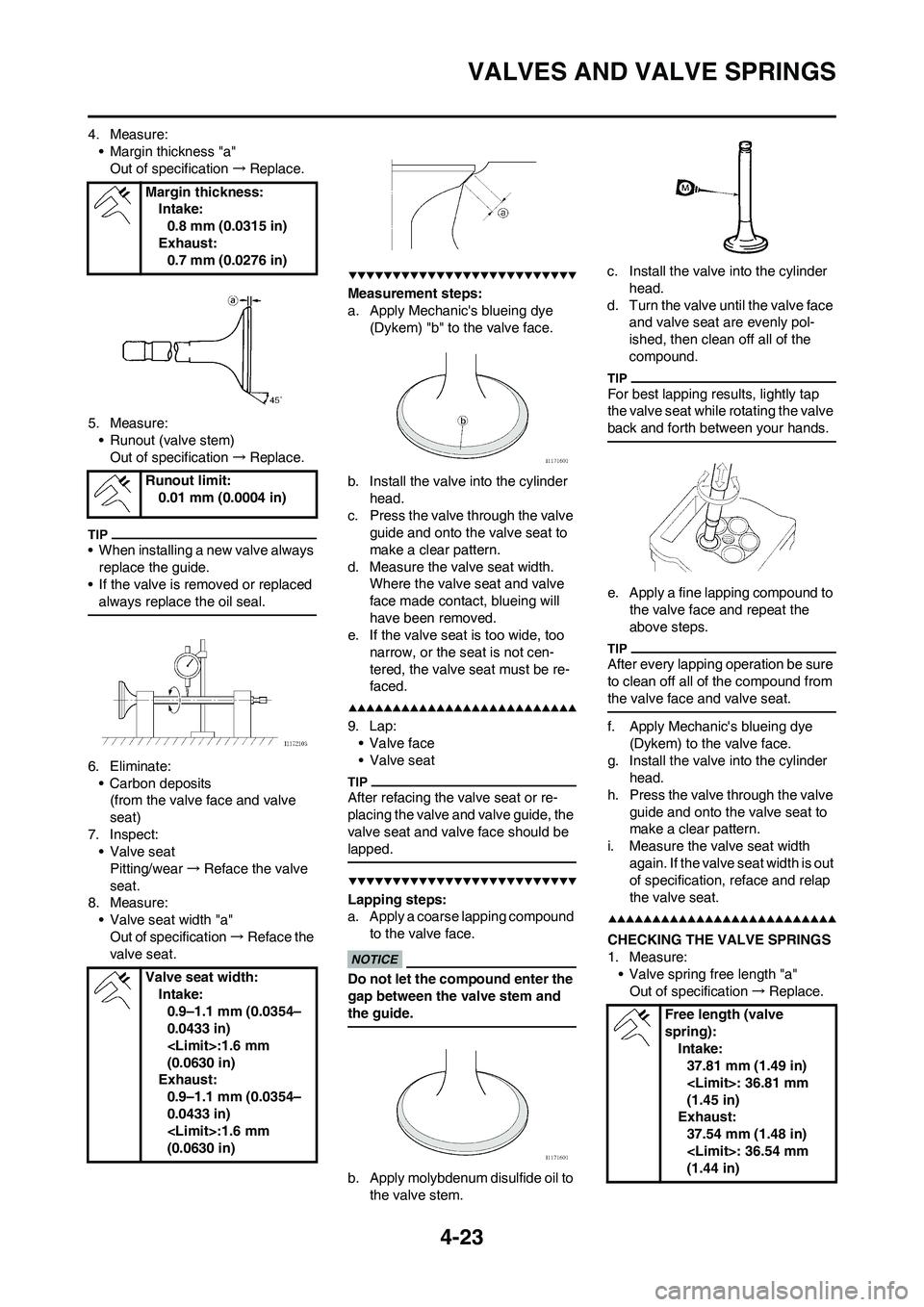
4. Measure:
• Margin thickness "a"
Out of specification→Replace.
5. Measure:
• Runout (valve stem)
Out of specification→Replace.
• When installing a new valve always
replace the guide.
• If the valve is removed or replaced
always replace the oil seal.
6. Eliminate:
• Carbon deposits
(from the valve face and valve
seat)
7. Inspect:
•Valve seat
Pitting/wear→Reface the valve
seat.
8. Measure:
• Valve seat width "a"
Out of specification→Reface the
valve seat.
Measurement steps:
a. Apply Mechanic's blueing dye
(Dykem) "b" to the valve face.
b. Install the valve into the cylinder
head.
c. Press the valve through the valve
guide and onto the valve seat to
make a clear pattern.
d. Measure the valve seat width.
Where the valve seat and valve
face made contact, blueing will
have been removed.
e. If the valve seat is too wide, too
narrow, or the seat is not cen-
tered, the valve seat must be re-
faced.
9. Lap:
• Valve face
• Valve seat
After refacing the valve seat or re-
placing the valve and valve guide, the
valve seat and valve face should be
lapped.
Lapping steps:
a. Apply a coarse lapping compound
to the valve face.
Do not let the compound enter the
gap between the valve stem and
the guide.
b. Apply molybdenum disulfide oil to
the valve stem.c. Install the valve into the cylinder
head.
d. Turn the valve until the valve face
and valve seat are evenly pol-
ished, then clean off all of the
compound.
For best lapping results, lightly tap
the valve seat while rotating the valve
back and forth between your hands.
e. Apply a fine lapping compound to
the valve face and repeat the
above steps.
After every lapping operation be sure
to clean off all of the compound from
the valve face and valve seat.
f. Apply Mechanic's blueing dye
(Dykem) to the valve face.
g. Install the valve into the cylinder
head.
h. Press the valve through the valve
guide and onto the valve seat to
make a clear pattern.
i. Measure the valve seat width
again. If the valve seat width is out
of specification, reface and relap
the valve seat.
CHECKING THE VALVE SPRINGS
1. Measure:
• Valve spring free length "a"
Out of specification→Replace. Margin thickness:
Intake:
0.8 mm (0.0315 in)
Exhaust:
0.7 mm (0.0276 in)
Runout limit:
0.01 mm (0.0004 in)
Valve seat width:
Intake:
0.9–1.1 mm (0.0354–
0.0433 in)
(0.0630 in)
Exhaust:
0.9–1.1 mm (0.0354–
0.0433 in)
(0.0630 in)
Free length (valve
spring):
Intake:
37.81 mm (1.49 in)
(1.45 in)
Exhaust:
37.54 mm (1.48 in)
(1.44 in)
Page 94 of 190

4-24
VALVES AND VALVE SPRINGS
2. Measure:
• Compressed spring force "a"
Out of specification→Replace.
b. Installed length
3. Measure:
• Spring tilt "a"
Out of specification→Replace.
CHECKING THE VALVE LIFTERS
1. Inspect:
• Valve lifter
Scratches/damage→Replace
both lifters and cylinder head.INSTALLING THE VALVES
1. Apply:
• Molybdenum disulfide oil
Onto the valve stem and valve
stem seal.
2. Install:
•Valve "1"
• Valve spring seat "2"
• Valve stem seal "3"
• Valve spring "4"
• Valve spring retainer "5"
To cylinder head.
• Make sure that each valve is in-
stalled in its original place, also re-
ferring to the painted color as
follows.
Intake (middle) "a": Orange
Intake (right/left) "b": Green
Exhaust "c": Purple
• Install the valve springs with the
larger pitch "d" facing upward.
e. Smaller pitch
3. Install:
• Valve cotter
While compressing the valve spring
with a valve spring compressor "1" in-
stall the valve cotters.
4. To secure the valve cotters onto
the valve stem, lightly tap the
valve tip with a piece of wood.
Hitting the valve tip with excessive
force could damage the valve.
5. Install:
• Adjusting pad "1"
• Valve lifter "2"
• Apply the molybdenum disulfide oil
on the valve stem end.
• Apply the engine oil on the valve lift-
ers.
• Valve lifter must turn smoothly
when rotated with a finger.
• Be careful to reinstall valve lifters
and pads in their original place.
Compressed spring
force:
Intake:
99–114 N at 29.13 mm
(9.9–11.4 kg at 29.13
mm, 22.27–25.57 lb at
1.15 in)
Exhaust:
126–144 N at 29.30
mm (12.6–14.4 kg at
29.30 mm, 28.44–
32.41 lb at 1.15 in)
Spring tilt limit:
Intake:
2.5°/1.7 mm (0.067 in)
Exhaust:
2.5°/1.6 mm (0.063 in)
Valve spring compres-
sor:
YM-4019/90890-04019
Page 148 of 190

5-17
FRONT FORK
DISASSEMBLING THE FRONT FORK
Order Part name Q'ty Remarks
1 Adjuster 1 Drain the fork oil. Refer to removal section.
2 Fork spring 1
3 Dust seal 1 Refer to removal section.
4 Stopper ring 1 Refer to removal section.
5 Inner tube 1 Refer to removal section.
6 Outer tube 1
7 Piston metal 1
8 Slide metal 1
9 Oil seal washer 1
10 Oil seal 1
11 Base valve 1 Drain the fork oil. Refer to removal section.
12 Damper assembly 1 Drain the fork oil. Refer to removal section.
30 Nm (3.0 m kg, 22 ft lb)
29 Nm (2.9 m kg, 21 ft lb)
29 Nm (2.9 m kg, 21 ft lb)
1 Nm (0.1 m kg, 0.7 ft lb)
55 Nm (5.5 m kg, 40 ft lb)
Page 149 of 190

5-18
FRONT FORK
HANDLING NOTE
Support the machine securely so
there is no danger of it falling over.
The front fork requires careful atten-
tion. So it is recommended that the
front fork be maintained at the deal-
ers.
To prevent an accidental explosion
of air, the following instructions
should be observed:
• The front fork with a built-in pis-
ton rod has a very sophisticated
internal construction and is par-
ticularly sensitive to foreign ma-
terial. Use enough care not to
allow any foreign material to
come in when the oil is replaced
or when the front fork is disas-
sembled and reassembled.
• Before removing the base valves
or front forks, be sure to extract
the air from the air chamber com-
pletely.
REMOVING THE DAMPER
ASSEMBLY
1. Loosen:
• Damper assembly "1"
Before removing the front fork from
the machine, loosen the damper as-
sembly with the cap bolt ring wrench
"2".
REMOVING THE ADJUSTER
1. Drain the outer tube of its front
fork oil at its top.
2. Loosen:
•Adjuster "1"3. Remove:
• Adjuster "1"
• While compressing the inner tube
"2", set the cap bolt ring wrench "4"
between the inner tube and locknut
"3".
• Hold the locknut and remove the
adjuster.
Do not remove the locknut as the
damper rod may go into the damp-
er assembly and not be taken out.
REMOVING THE INNER TUBE
1. Remove:
• Dust seal "1"
• Stopper ring "2"
Using slotted-head screwdriver.
Take care not to scratch the inner
tube.
2. Remove:
• Inner tube "1"
Oil seal removal steps:
a. Push in slowly "a" the inner tube
just before it bottoms out and then
pull it back quickly "b".
b. Repeat this step until the inner
tube can be pulled out from the
outer tube.
REMOVING THE BASE VALVE
1. Remove:
• Base valve "1"
From damper assembly "2".
Hold the damper assembly with the
cap bolt ring wrench "3" and use the
cap bolt wrench "4" to remove the
base valve.
CHECKING THE DAMPER
ASSEMBLY
1. Inspect:
• Damper assembly "1"
Bend/damage → Replace.
• O-ring "2"
Wear/damage → Replace.
The front fork with a built-in piston
rod has a very sophisticated inter-
nal construction and is particularly
sensitive to foreign material.
Use enough care not to allow any
foreign material to come in when
the oil is replaced or when the
front fork is disassembled and re-
assembled.Cap bolt ring wrench:
YM-01501/90890-01501
Cap bolt ring wrench:
YM-01501/90890-01501
Cap bolt wrench:
YM-01500/90890-01500
Cap bolt ring wrench:
YM-01501/90890-01501
Page 150 of 190

5-19
FRONT FORK
CHECKING THE BASE VALVE
1. Inspect:
• Base valve "1"
Wear/damage →Replace.
Contamination →Clean.
• O-ring "2"
Wear/damage →Replace.
• Piston metal "3"
Wear/damage →Replace.
• Spring "4"
Damage/fatigue →Replace base
valve.
• Air bleed screw "5"
Wear/damage →Replace.
CHECKING THE COLLAR
1. Inspect:
• Piston metal "1"
Wear/damage→Replace.
CHECKING THE FORK SPRING
1. Measure:
• Fork spring free length "a"
Out of specification→Replace.
CHECKING THE INNER TUBE
1. Inspect:
• Inner tube surface "a"
Score marks→Repair or replace.
Use #1,000 grit wet sandpaper.
Damaged oil lock piece→Re-
place.• Inner tube bends
Out of specification→Replace.
Use the dial gauge "1".
The bending value is shown by one
half of the dial gauge reading.
Do not attempt to straighten a bent
inner tube as this may dangerous-
ly weaken the tube.
CHECKING THE OUTER TUBE
1. Inspect:
• Outer tube "1"
Score marks/wear/damage→Re-
place.
CHECKING THE ADJUSTER
1. Inspect:
• Adjuster "1"
• O-ring "2"
Wear/damage→Replace.
ASSEMBLING THE FRONT FORK
1. Wash the all parts in a clean sol-
vent.
2. Stretch the damper assembly ful-
ly.
3. Fill:
• Front fork oil "1"
To damper assembly.
• Be sure to use recommended
fork oil. If other oils are used,
they may have an excessively ad-
verse effect on the front fork per-
formance.
• Never allow foreign materials to
enter the front fork.
4. After filling, pump the damper as-
sembly "1" slowly up and down
(about 200 mm (7.9 in) stroke)
several times to bleed the damper
assembly of air.
Be careful not to excessive full stroke.
A stroke of 200 mm (7.9 in) or more
will cause air to enter. In this case, re-
peat the steps 2 to 4.
5. Measure:
• Oil level (left and right) "a"
Out of specification → Adjust.
Fork spring free length:
454 mm (17.9 in)
in)
Inner tube bending limit:
0.2 mm (0.008 in)
Recommended oil:
Suspension oil "S1"
Oil capacity:
199 cm
3 (7.00 Imp oz,
6.73 US oz)
Standard oil level:
145-148 mm (5.71-5.83
in)
From top of fully
stretched damper as-
sembly.
Page 151 of 190

5-20
FRONT FORK
6. Tighten:
• Locknut "1"
Fully finger tighten the locknut onto
the damper assembly.
7. Loosen:
• Compression damping adjuster
"1"
• Loosen the compression damping
adjuster finger tight.
• Record the set position of the ad-
juster (the amount of turning out the
fully turned in position).
8. Install:
• Base valve "1"
To damper assembly "2".
First bring the damper rod pressure to
a maximum. Then install the base
valve while releasing the damper rod
pressure.
9. Check:
• Damper assembly
Not fully stretched → Repeat the
steps 2 to 8.
10. Tighten:
• Base valve "1"
Hold the damper assembly with the
cap bolt ring wrench "2" and use the
cap bolt wrench "3" to tighten the
base valve with specified torque.
11. After filling, pump the damper as-
sembly "1" slowly up and down
more than 10 times to distribute
the fork oil.
12. While protecting the damper as-
sembly "1" with a rag and com-
pressing fully, allow excessive oil
to overflow on the base valve
side.
Take care not to damage the damp-
er assembly.
13. Allow the overflowing oil to es-
cape at the hole "a" in the damper
assembly.14. Check:
• Damper assembly smooth move-
ment
Tightness/binding/rough spots →
Repeat the steps 2 to 13.
15. Install:
• Dust seal "1"
• Stopper ring "2"
•Oil seal "3"
• Oil seal washer "4"
• Slide metal "5"
To inner tube "6".
• Apply the fork oil on the inner tube.
• When installing the oil seal, use vi-
nyl seat "a" with fork oil applied to
protect the oil seal lip.
• Install the oil seal with its manufac-
ture's marks or number facing the
axle holder side.
16. Install:
• Piston metal "1"
Install the piston metal onto the slot
on inner tube.
Base valve:
29 Nm (2.9 m•kg, 21 ft•
lb)
Cap bolt wrench:
YM-01500/90890-01500
Cap bolt ring wrench:
YM-01501/90890-01501
Page 152 of 190

5-21
FRONT FORK
17. Install:
• Outer tube "1"
To inner tube "2".
18. Install:
• Slide metal "1"
• Oil seal washer "2"
To outer tube slot.
Press the slide metal into the outer
tube with fork seal driver "3".
19. Install:
•Oil seal "1"
Press the oil seal into the outer tube
with fork seal driver "2".
20. Install:
• Stopper ring "1"
Fit the stopper ring correctly in the
groove in the outer tube.
21. Install:
• Dust seal "1"
Apply the lithium soap base grease
on the inner tube.
22. Check:
• Inner tube smooth movement
Tightness/binding/rough spots →
Repeat the steps 15 to 21.
23. Measure:
• Distance "a"
Out of specification → Turn into
the locknut.
24. Install:
•Collar "1"
• Fork spring "2"
To damper assembly "3".
Install the collar with its larger dia.
end "a" facing the fork spring.
25. Install:
• Damper assembly "1"
To inner tube "2".
To install the damper assembly
into the inner tube, hold the inner
tube aslant. If the inner tube is held
vertically, the damper assembly
may fall into it, damaging the valve
inside.
26. Loosen:
• Rebound damping adjuster "1"
• Loosen the rebound damping ad-
juster finger tight.
• Record the set position of the ad-
juster (the amount of turning out the
fully turned in position).
27. Install:
• Push rod "1"
• Copper washer "2"
•Adjuster "3"
To damper assembly "4".
• While compressing the inner tube
"5", set the cap bolt ring wrench "7"
between the inner tube and locknut
"6".
• Fully finger tighten the adjuster onto
the damper assembly.
Fork seal driver:
YM-A0948/90890-01502
Fork seal driver:
YM-A0948/90890-01502
Distance "a":
16 mm (0.63 in) or more
Between the damper
assembly "1" bottom
and locknut "2" bot-
tom.
Cap bolt ring wrench:
YM-01501/90890-01501