Page 22 of 150

4-2
1
2
34
5
6
7
8
9
10
11
heats. When this occurs during operation, stop the
engine as soon as it is safe to do so and allow it to
cool down for about 10 minutes.
The electrical circuit of the warning light can be
checked according to the following procedure.
1. Set the engine stop switch to “” and turn the
key to “ON”.
2. Shift the transmission into the neutral position
or pull the clutch lever.
3. Push the start switch. If the warning light does
not come on while the start switch is pushed,
have a Yamaha dealer check the electrical cir-
cuit.
NOTICE
ECB00010
�
The engine may overheat if the ATV is over-
loaded. In this case, reduce the load to spec-
ification.
�
Start the engine after making sure that the
warning light is out. Continuous use while
the warning light is on may cause damage to
the engine.
EBU18061
Handlebar switches
EBU18080
Engine stop switch “/”
Set this switch to “” before starting the engine.
The engine stop switch controls the ignition and
stops the engine when it is running. Use this switch
to stop the engine in an emergency situation. The
engine will not start or run when this switch is set
to “”.
1. Light switch “/ /OFF”
2. Engine stop switch “/”
3. Start switch “”
1
2
3
Page 27 of 150
4-7
1
2
34
5
6
7
8
9
10
11
WARNING
EWB00220
�
Always set the parking brake before starting
the engine. The ATV could start moving un-
expectedly if the parking brake is not ap-
plied. This could cause loss of control or a
collision.
�
Always be sure you have released the park-
ing brake before you begin to ride. The brake
could overheat if you ride the ATV without re-
leasing the parking brake. You could lose
braking performance which could cause an
accident. You could also wear out the brakes
prematurely.
EBU18530
Shift pedal
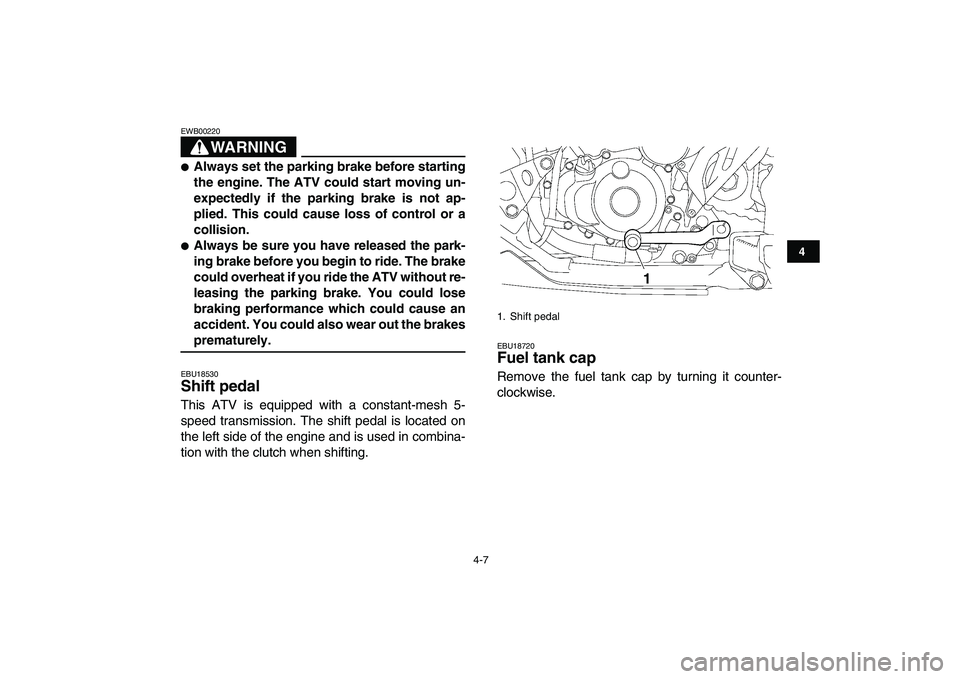
This ATV is equipped with a constant-mesh 5-
speed transmission. The shift pedal is located on
the left side of the engine and is used in combina-
tion with the clutch when shifting.
EBU18720
Fuel tank cap
Remove the fuel tank cap by turning it counter-
clockwise.
1. Shift pedal
1
Page 55 of 150
6-5
1
2
3
4
56
7
8
9
10
11
with the engine off, and do not tow the ATV
for long distances. The transmission is prop-
erly lubricated only when the engine is run-
ning. Inadequate lubrication may damage
the transmission.
�
Always use the clutch when changing gears.
The engine, transmission and drive train are
not designed to withstand the shock of
forced shifting and can be damaged by shift-
ing without using the clutch.
EBU20672
Engine break-in
TIP
�
For ATVs equipped with an odometer or an hour
meter, follow the figures given in km (mi) or the
figures given in hours.
�
For ATVs not equipped with an odometer or
hour meter, follow the figures given in hours.
There is never a more important period in the life of
your engine than the first 320 km (200 mi) or 20
hours of riding. For this reason, you should read
the following material carefully.
Since the engine is brand new, do not put an ex-
cessive load on it for the first 320 km (200 mi) or 20hours. The various parts in the engine wear and
polish themselves to the correct operating clear-
ances. During this period, prolonged full-throttle
operation or any condition that might result in en-
gine overheating must be avoided.
0–160 km (0–100 mi) or 0–10 hours
Avoid prolonged operation above 1/2 throttle. Vary
the speed of the ATV regularly. Do not operate it at
one set throttle position.
160–320 km (100–200 mi) or 10–20 hours
Avoid prolonged operation above 3/4 throttle. Rev
the engine through the gears freely, but do not use
full throttle at any time.
320 km (200 mi) or 20 hours and beyond
The ATV can now be operated normally.
NOTICE
ECB00220
If any engine trouble should occur during the
engine break-in period, immediately have a
Yamaha dealer check the ATV.
EBU20721
Parking
When parking the ATV, stop the engine, shift into
Page 101 of 150

8-21
1
2
3
4
5
6
78
9
10
11
3. If the coolant is at or below the minimum level
mark, remove panel A. (See page 8-9.)
4. Remove the reservoir cap, add coolant or dis-
tilled water to the maximum level mark, install
the reservoir cap, and then install the panel.NOTICE
ECB00401
�
If coolant is not available, use distilled water
or soft tap water instead. Do not use hard wa-
ter or salt water since it is harmful to the en-
gine.
�
If water has been used instead of coolant, re-
place it with coolant as soon as possible,
otherwise the cooling system will not be pro-
tected against frost and corrosion.
�
If water has been added to the coolant, have
a Yamaha dealer check the antifreeze con-
tent of the coolant as soon as possible, oth-
erwise the effectiveness of the coolant will
be reduced.
TIP
If the engine overheats, see page 8-55 for further
instructions.
EBU23561
To change the coolant
WARNING
EWB01890
Wait for the engine and radiator to cool before
removing the radiator cap. You could be
1. Maximum level mark
2. Minimum level mark
3. Coolant reservoir
4. Coolant reservoir cap
Coolant reservoir capacity (up to the maximum
level mark):
0.29 L (0.31 US qt, 0.26 Imp.qt)
1
24
3
Page 136 of 150
8-56
1
2
3
4
5
6
78
9
10
11
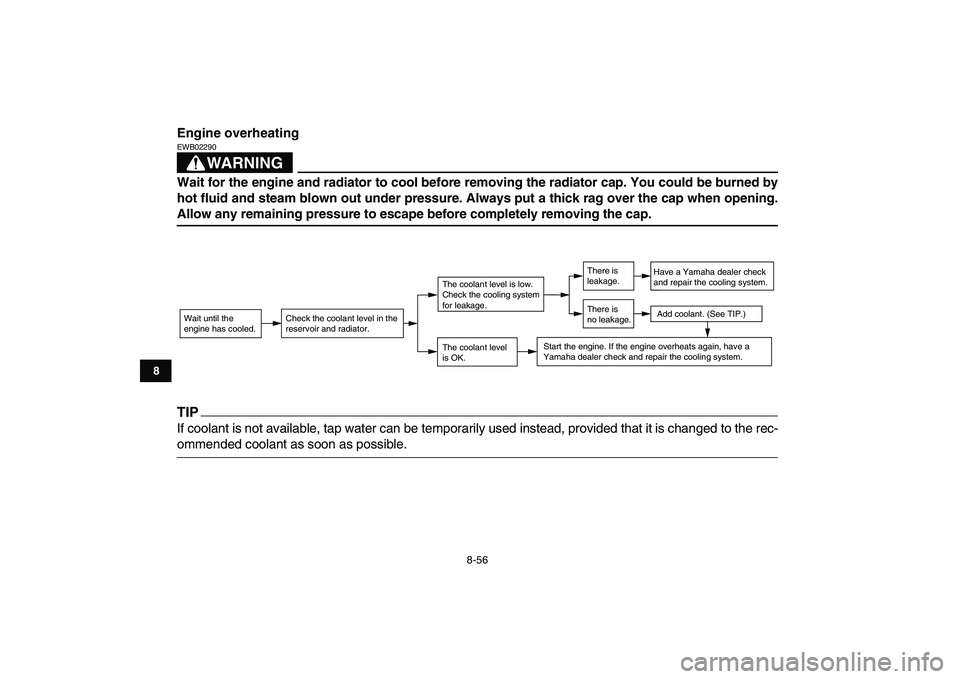
Engine overheating
WARNING
EWB02290
Wait for the engine and radiator to cool before removing the radiator cap. You could be burned by
hot fluid and steam blown out under pressure. Always put a thick rag over the cap when opening.
Allow any remaining pressure to escape before completely removing the cap.
TIP
If coolant is not available, tap water can be temporarily used instead, provided that it is changed to the rec-
ommended coolant as soon as possible.
Wait until the
engine has cooled.
Check the coolant level in the
reservoir and radiator.
The coolant level
is OK.The coolant level is low.
Check the cooling system
for leakage.
Have a Yamaha dealer check
and repair the cooling system.Add coolant. (See TIP.)
Start the engine. If the engine overheats again, have a
Yamaha dealer check and repair the cooling system.
There is
leakage.
There is
no leakage.