Page 61 of 116

7-12
1
2
3
4
5
67
8
9
10
11
Select a large, flat, unpaved area to become famil-
iar with your ATV. Make sure that this area is free
of obstacles and other riders. You should practice
control of the throttle, brakes, and turning tech-
niques in this area before trying more difficult ter-
rain. Always avoid riding on paved surfaces: the
ATV is designed for use on unpaved surfaces only,
and handling maneuvers are more difficult to per-
form on pavement.
Set the parking brake and follow the instruction on
page 6-1 to start the engine. Once it has warmed
up you are ready to begin riding your ATV. Re-
member that the engine and exhaust pipe will be
hot when riding and afterwards; do not allow skin
or clothing to come in contact with these compo-
nents.With the engine idling, shift the transmission into
the drive position and then release the parking
brake. Apply the throttle slowly and smoothly. The
centrifugal clutch will engage and you will start to
accelerate. If the throttle is applied too abruptly, the
front wheels may lift off the ground, resulting in a
loss of directional control. Avoid higher speeds un-
til you are thoroughly familiar with the operation of
your ATV.
When slowing down or stopping, release the throt-
tle and apply the brakes smoothly and evenly. Im-
proper use of the brakes can cause the tires to lose
traction, reducing control and increasing the possi-
bility of an accident.
TURNING YOUR ATV
To achieve maximum traction on unpaved surfac-
es, the two rear wheels are mounted solidly on one
axle and turn together at the same speed. There-
fore, unless the wheel on the inside of the turn is al-
lowed to slip or lose some traction, the ATV will
resist turning. A special turning technique must be
used to allow the ATV to make turns quickly and
easily. It is essential that this skill be learned first at
low speed.
Page 68 of 116
7-19
1
2
3
4
5
67
8
9
10
11
Owner’s Manual. Remember that wet brakes
may have reduced stopping ability. Test your
brakes after leaving water. If necessary, apply
them several times to let friction dry out the lin-
ings. If the ATV is operated through deep or
fast flowing water, the tires may float, causing
loss of traction and loss of control, which
could lead to an accident.
Test your brakes after leaving the water. Do not
continue to ride your ATV without verifying that you
have regained proper braking ability.
NOTICE
ECB00240
After riding your ATV in water, be sure to drain
the trapped water by removing the check hose
at the bottom of the air filter case. Wash the
ATV in fresh water if it has been operated in
salt water or muddy conditions.
Page 76 of 116
8-5
1
2
3
4
5
6
78
9
10
11
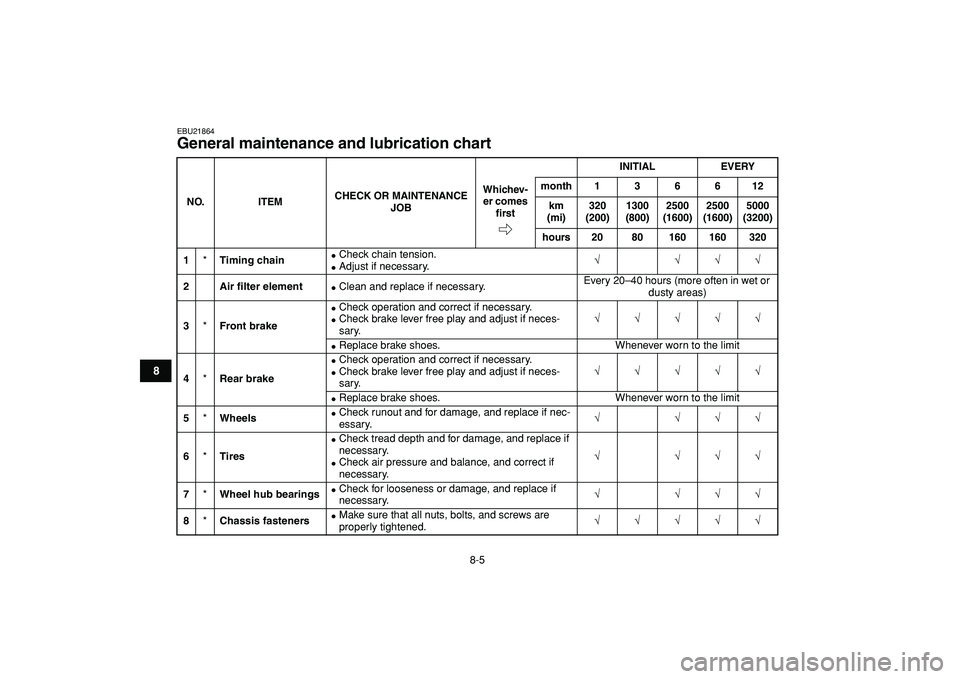
EBU21864
General maintenance and lubrication chart
NO. ITEMCHECK OR MAINTENANCE
JOBINITIAL EVERY
Whichev-
er comes
firstmonth 1 3 6 6 12
km
(mi)320
(200)1300
(800)2500
(1600)2500
(1600)5000
(3200)
hours 20 80 160 160 3201
*
Timing chain
�
Check chain tension.
�
Adjust if necessary.
√ √√√
2 Air filter element
�
Clean and replace if necessary.Every 20–40 hours (more often in wet or
dusty areas)
3
*
Front brake
�
Check operation and correct if necessary.
�
Check brake lever free play and adjust if neces-
sary.
√√√√√
�
Replace brake shoes. Whenever worn to the limit
4
*
Rear brake
�
Check operation and correct if necessary.
�
Check brake lever free play and adjust if neces-
sary.
√√√√√
�
Replace brake shoes. Whenever worn to the limit
5
*
Wheels
�
Check runout and for damage, and replace if nec-
essary.
√ √√√
6
*
Tires
�
Check tread depth and for damage, and replace if
necessary.
�
Check air pressure and balance, and correct if
necessary.
√ √√√
7
*
Wheel hub bearings
�
Check for looseness or damage, and replace if
necessary.
√ √√√
8
*
Chassis fasteners
�
Make sure that all nuts, bolts, and screws are
properly tightened.
√√√√√
Page 106 of 116
9-3
1
2
3
4
5
6
7
89
10
11
the spark plug cap.
6. Lubricate all control cables and the pivoting
points of all levers and pedals.
7. Check and, if necessary, correct the tire air
pressure, and then block up the ATV so that
all of its wheels are off the ground. Alternative-
ly, turn the wheels a little every month in order
to prevent the tires from becoming degraded
in one spot.
8. Cover the muffler outlet with a plastic bag to
prevent moisture from entering it.
9. Remove the battery and fully charge it. Store
it in a cool, dry place and charge it once a
month. Do not store the battery in an exces-
sively cold or warm place [less than 0 °C (30
°F) or more than 30 °C (90 °F)]. For more in-
formation on storing the battery, see page
8-26.
TIP
Make any necessary repairs before storing the
ATV.
Page 109 of 116
10-3
1
2
3
4
5
6
7
8
910
11
Secondary reduction ratio:
19/18
×
34/10 (3.588)
Transmission type:
Constant mesh 1-speed
Operation:
Left hand operation
1st:
38/14 (2.714)
Chassis:
Frame type:
Steel tube frame
Caster angle:
1.0 °
Trail:
3.4 mm (0.13 in)
Front tire:
Type:
Tubeless
Size:
AT16 x 7-7
Manufacturer/model:
DUNLOP/KT145
Rear tire:
Type:
Tubeless
Size:
AT16 x 8-7
Manufacturer/model:
DUNLOP/KT145
Loading:
Maximum loading limit:
40.0 kg (88 lb)
(Total weight of rider, cargo, accessories, and tongue)
Tire air pressure (measured on cold tires):
Recommended:
Front:
20 kPa (0.200 kgf/cm
2
, 2.9 psi)
Rear:
20 kPa (0.200 kgf/cm
2
, 2.9 psi)
Minimum:
Front:
17 kPa (0.170 kgf/cm
2
, 2.5 psi)
Rear:
17 kPa (0.170 kgf/cm
2
, 2.5 psi)
Front wheel:
Wheel type:
Panel wheel
Rim size:
7 x 5.5AT
Rear wheel:
Wheel type:
Panel wheel
Rim size:
7 x 6.5AT
Front brake:
Type:
Drum brake
Operation:
Right hand operation
Page 115 of 116
O
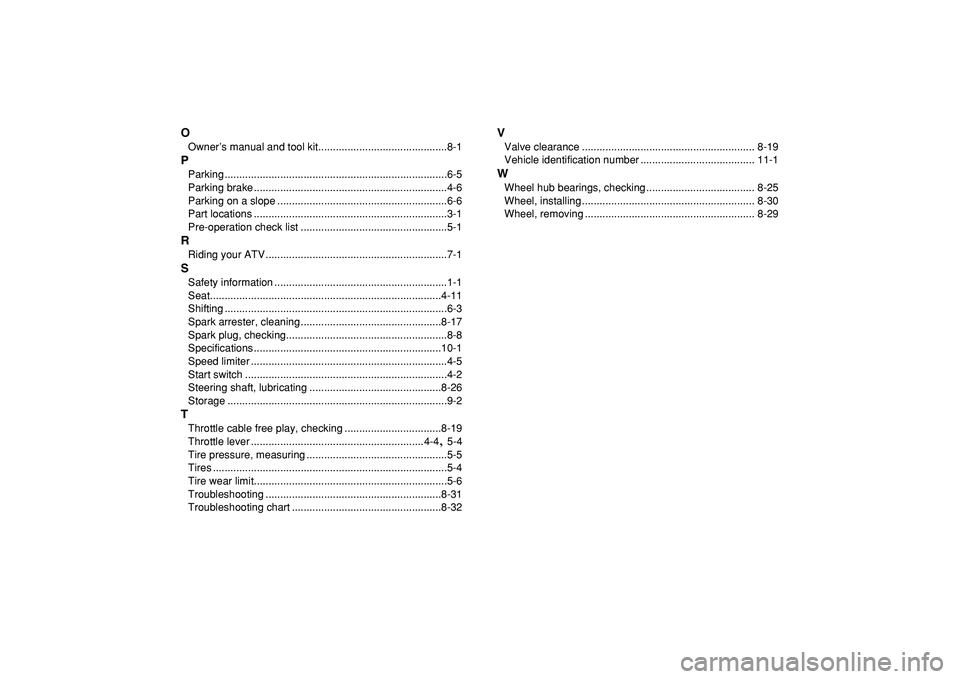
Owner’s manual and tool kit............................................8-1
P
Parking ............................................................................6-5
Parking brake ..................................................................4-6
Parking on a slope ..........................................................6-6
Part locations ..................................................................3-1
Pre-operation check list ..................................................5-1
R
Riding your ATV ..............................................................7-1
S
Safety information ...........................................................1-1
Seat...............................................................................4-11
Shifting ............................................................................6-3
Spark arrester, cleaning ................................................8-17
Spark plug, checking.......................................................8-8
Specifications ................................................................10-1
Speed limiter ...................................................................4-5
Start switch .....................................................................4-2
Steering shaft, lubricating .............................................8-26
Storage ...........................................................................9-2
T
Throttle cable free play, checking .................................8-19
Throttle lever ...........................................................4-4
,
5-4
Tire pressure, measuring ................................................5-5
Tires ................................................................................5-4
Tire wear limit..................................................................5-6
Troubleshooting ............................................................8-31
Troubleshooting chart ...................................................8-32
V
Valve clearance ........................................................... 8-19
Vehicle identification number ....................................... 11-1
W
Wheel hub bearings, checking ..................................... 8-25
Wheel, installing ........................................................... 8-30
Wheel, removing .......................................................... 8-29