Page 73 of 148

7-22
7 RIDING OVER ROUGH TERRAIN
Riding over rough terrain should be done with cau-
tion. Look out for obstacles which could cause
damage to the ATV or could lead to an upset or ac-
cident. Be sure to keep your feet firmly mounted on
the footboards at all times. Avoid jumping the ATV
as loss of control and damage to the ATV may re-
sult.
WARNING
EWB01650Before operating in a new area, check for ob-
stacles. Never attempt to ride over large obsta-
cles, such as large rocks or fallen trees. When
you go over obstacles, always follow proper
procedures as described in the Owner’s Manu-al.
SLIDING AND SKIDDING
Care should be used when riding on loose or slip-
pery surfaces since the ATV may slide. If unex-
pected and uncorrected, sliding could lead to an
accident.
To reduce the tendency for the front wheels to slide
in loose or slippery conditions, positioning your
weight over the front wheels will sometimes help.If the rear wheels of your ATV start to slide side-
ways, control can usually be regained (if there is
room to do so) by steering in the direction of the
slide. Applying the brakes or accelerating is not
recommended until you have corrected the slide.U3C263E0.book Page 22 Thursday, May 15, 2008 10:44 AM
Page 74 of 148

7-23
7With practice, over a period of time, skill at con-
trolled sliding can be developed. The terrain
should be chosen carefully before attempting such
maneuvers, since both stability and control are re-
duced. Bear in mind that sliding maneuvers should
always be avoided on extremely slippery surfaces
such as ice, since all control may be lost.
WARNING
EWB01661Learn to safely control skidding or sliding by
practicing at low speeds and on level, smooth
terrain.On extremely slippery surfaces, such as ice,
go slowly and be very cautious in order to re-
duce the chance of skidding or sliding out of
control.
WHAT TO DO IF...
This section is designed to be a reference guide
only. Be sure to read each section on riding tech-
niques completely.
WHAT TO DO...�If your ATV doesn’t turn when you want it to:
Bring the ATV to a stop and practice the turning
maneuvers again. Be sure you are putting your
weight on the footboard to the outside of the
turn. Position your weight over the front wheels
for better control. (See page 7-12.)�If your ATV begins to tip while turning:
Lean more into the turn to regain balance. If nec-
essary, gradually let off the throttle and/or steer
to the outside of the turn. (See page 7-12.)�If your ATV starts to slide sideways:
Steer in the direction of the slide if you have the
room. Applying the brakes or accelerating is not
recommended until you have corrected the
slide. (See page 7-22.)
U3C263E0.book Page 23 Thursday, May 15, 2008 10:44 AM
Page 80 of 148

8-5
8
EBU21864General maintenance and lubrication chart NO. ITEMCHECK OR MAINTENANCE
JOBINITIAL EVERY
Whichev-
er comes
firstmonth136612
km
(mi)320
(200)1300
(800)2500
(1600)2500
(1600)5000
(3200)
hours 20 80 160 160 320
1 Air filter elementClean and replace if necessary.Every 20–40 hours (more often in wet or
dusty areas)
2*Front brakeCheck operation and correct if necessary.
Check fluid level and ATV for fluid leakage, and
correct if necessary.√√√√√
Replace brake pads. Whenever worn to the limit
3*Rear brakeCheck operation and correct if necessary.
Check brake lever free play and adjust if neces-
sary.
Check fluid level and ATV for fluid leakage, and
correct if necessary.√√√√√
Replace brake pads. Whenever worn to the limit
4*Brake hosesCheck for cracks or other damage, and replace if
necessary.√√√√
Replace. Every 4 years
5*WheelsCheck runout and for damage, and replace if nec-
essary.√ √√√
6*TiresCheck tread depth and for damage, and replace if
necessary.
Check air pressure and balance, and correct if
necessary.√ √√√
7*Wheel hub bearingsCheck for looseness or damage, and replace if
necessary.√ √√√
U3C263E0.book Page 5 Thursday, May 15, 2008 10:44 AM
Page 114 of 148

8-39
8
EBU24071Adjusting the drive select lever safety
system cable The drive select lever safety system cable stretch-
es with use, which can result in improper function.
Therefore, the safety system cable should be
checked and adjusted by a Yamaha dealer at the
intervals specified in the periodic maintenance and
lubrication chart.EBU24130Checking the front and rear brake pads The front and rear brake pads must be checked for
wear at the intervals specified in the periodic main-
tenance and lubrication chart.EBU24171Front brake pads
Check each front brake pad for damage and mea-
sure the lining thickness. If a brake pad is dam-
aged or if the lining thickness is less than 1.0 mm
(0.04 in), have a Yamaha dealer replace the brake
pads as a set.
TIPThe wheels need to be removed to check thebrake pads. (See page 8-55.)EBU26460Rear brake pads
Each rear brake pad is provided with wear indica-
tor grooves, which allow you to check the brake
pad wear without having to disassemble the brake.
To check the brake pad wear, check the wear indi-
cator grooves. If a brake pad has worn to the point
that the wear indicator grooves have almost disap-
peared, have a Yamaha dealer replace the brake
pads as a set.1. Lining thickness
U3C263E0.book Page 39 Thursday, May 15, 2008 10:44 AM
Page 115 of 148
8-40
8
TIPThe wheels need to be removed to check thebrake pads. (See page 8-55.)EBU26471Checking the brake fluid level Insufficient brake fluid may allow air to enter the
brake system, possibly causing it to become inef-
fective.
Before riding, check that the brake fluid is above
the minimum level mark and replenish if neces-
sary. A low brake fluid level may indicate wornbrake pads and/or brake system leakage. If the
brake fluid level is low, be sure to check the brake
pads for wear and the brake system for leakage.
Front brake1. Wear indicator groove
1. Minimum level mark
U3C263E0.book Page 40 Thursday, May 15, 2008 10:44 AM
Page 122 of 148

8-47
8
EBU24962Checking the wheel hub bearings The front and rear wheel hub bearings must be
checked at the intervals specified in the periodic
maintenance and lubrication chart. If there is play
in a wheel hub or if a wheel does not turn smoothly,
have a Yamaha dealer check the wheel hub bear-
ings.EBU25102Lubricating the steering shaft The steering shaft must be lubricated at the inter-
vals specified in the periodic maintenance and lu-
brication chart.
EBU29180Battery This model is equipped with a VRLA (Valve Regu-
lated Lead Acid) battery. There is no need to check
the electrolyte or to add distilled water. However,
the battery lead connections need to be checked
and, if necessary, tightened.NOTICEECB00620Never attempt to remove the battery cell seals,as this would permanently damage the battery.
WARNING
EWB02160Battery electrolyte is poisonous and danger-
ous, as it contains sulfuric acid, which can
cause severe burns. Avoid contact with skin,
eyes or clothing. Always shield your eyes
when working near batteries.
Antidote:
EXTERNAL: Flush with water.
INTERNAL: Drink large quantities of water or
milk. Follow with milk of magnesia, beaten egg
or vegetable oil. Call a physician immediately.Recommended lubricant:
Lithium-soap-based grease
U3C263E0.book Page 47 Thursday, May 15, 2008 10:44 AM
Page 125 of 148
8-50
8 the battery. If you do not have access to a
constant-voltage battery charger, have a
Yamaha dealer charge your battery.EBU25324Replacing a fuse
The main fuse and the fuse box are located under
the seat. (See page 4-12.)
If a fuse is blown, replace it as follows.
1. Turn the key to “OFF” and turn off all electrical
circuits.
1. Main fuse
2. Spare main fuse
3. Fuse box
1. Headlight fuse
2. Ignition fuse
3. Auxiliary DC jack fuse (for optional auxiliary DC jack)
4. Four-wheel-drive motor fuse
5. Signaling system fuse
6. Backup fuse (for odometer and tripmeter)
7. Spare fuse
U3C263E0.book Page 50 Thursday, May 15, 2008 10:44 AM
Page 126 of 148
8-51
8
NOTICEECB00640To prevent accidental short-circuiting, turn off
the main switch when checking or replacing afuse.
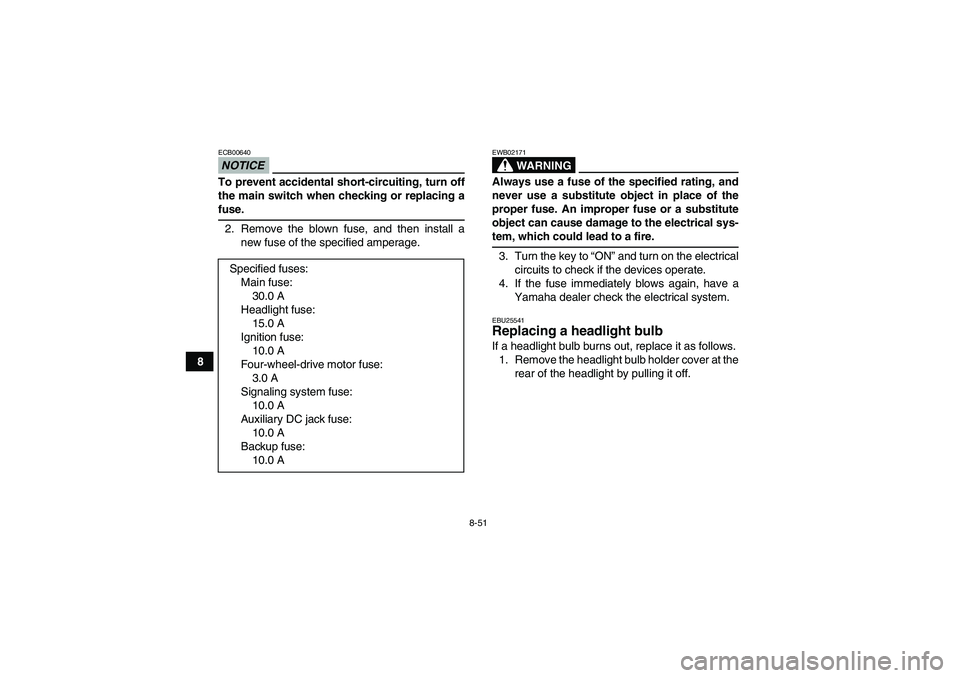
2. Remove the blown fuse, and then install a
new fuse of the specified amperage.
WARNING
EWB02171Always use a fuse of the specified rating, and
never use a substitute object in place of the
proper fuse. An improper fuse or a substitute
object can cause damage to the electrical sys-tem, which could lead to a fire.
3. Turn the key to “ON” and turn on the electrical
circuits to check if the devices operate.
4. If the fuse immediately blows again, have a
Yamaha dealer check the electrical system.EBU25541Replacing a headlight bulb If a headlight bulb burns out, replace it as follows.
1. Remove the headlight bulb holder cover at the
rear of the headlight by pulling it off. Specified fuses:
Main fuse:
30.0 A
Headlight fuse:
15.0 A
Ignition fuse:
10.0 A
Four-wheel-drive motor fuse:
3.0 A
Signaling system fuse:
10.0 A
Auxiliary DC jack fuse:
10.0 A
Backup fuse:
10.0 A
U3C263E0.book Page 51 Thursday, May 15, 2008 10:44 AM

