Page 24 of 102
INSTRUMENT AND CONTROL FUNCTIONS
3-10
1
2
3
4
5
6
7
8
9
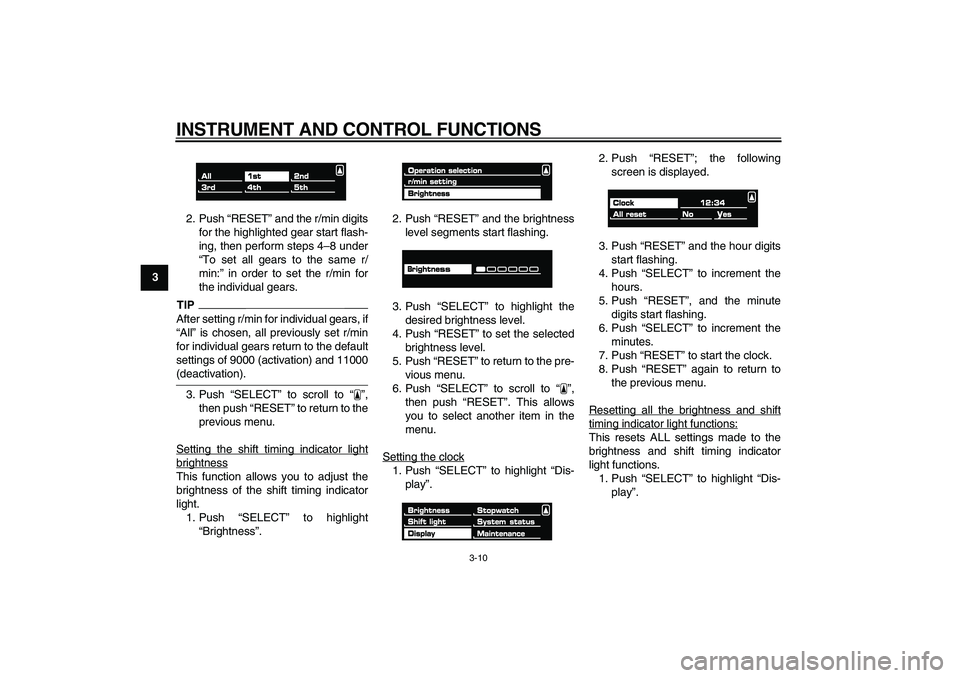
2. Push “RESET” and the r/min digits
for the highlighted gear start flash-
ing, then perform steps 4–8 under
“To set all gears to the same r/
min:” in order to set the r/min for
the individual gears.
TIP
After setting r/min for individual gears, if
“All” is chosen, all previously set r/min
for individual gears return to the default
settings of 9000 (activation) and 11000
(deactivation).
3. Push “SELECT” to scroll to “”,
then push “RESET” to return to the
previous menu.
Setting the shift timing indicator light
brightnessThis function allows you to adjust the
brightness of the shift timing indicator
light.
1. Push “SELECT” to highlight
“Brightness”.2. Push “RESET” and the brightness
level segments start flashing.
3. Push “SELECT” to highlight the
desired brightness level.
4. Push “RESET” to set the selected
brightness level.
5. Push “RESET” to return to the pre-
vious menu.
6. Push “SELECT” to scroll to “”,
then push “RESET”. This allows
you to select another item in the
menu.
Setting the clock
1. Push “SELECT” to highlight “Dis-
play”.2. Push “RESET”; the following
screen is displayed.
3. Push “RESET” and the hour digits
start flashing.
4. Push “SELECT” to increment the
hours.
5. Push “RESET”, and the minute
digits start flashing.
6. Push “SELECT” to increment the
minutes.
7. Push “RESET” to start the clock.
8. Push “RESET” again to return to
the previous menu.
Resetting all the brightness and shift
timing indicator light functions:This resets ALL settings made to the
brightness and shift timing indicator
light functions.
1. Push “SELECT” to highlight “Dis-
play”.
Page 25 of 102

INSTRUMENT AND CONTROL FUNCTIONS
3-11
2
34
5
6
7
8
9
2. Push “RESET”.
3. Push “SELECT” to highlight “All re-
set”.
4. Push “RESET”, then push “SE-
LECT” to highlight “Yes”.
5. Push “RESET” to reset the bright-
ness and shift timing light indicator
values to the factory setting. The
display returns to the Normal
mode.
TIP
To perform further multi-function dis-
play settings, enter the Select mode
again by pushing and holding “SE-
LECT” and “RESET” for at least three
seconds.
Using the stopwatch
The stopwatch can be activated as fol-
lows.
1. Push “SELECT” to highlight “Stop-
watch”.
2. Push “RESET”.
3. Push “SELECT” to highlight “Stop-
watch”.
4. Push “RESET”.
The multi-function display chang-
es to the Normal mode and the
stopwatch is displayed in place of
the clock.5. Push “SELECT” to start the stop-
watch.
6. Push “SELECT” or the start switch
“” to stop the stopwatch.
7. Push “RESET” to reset the stop-
watch.
TIP
�
If neither “SELECT” or “RESET”
are pushed for one minute, the
screen automatically changes to
the Normal mode.
�
Pushing “RESET” for at least two
seconds changes the screen to
the Normal mode.
�
To perform further multi-function
display settings, enter the Select
mode again by pushing and hold-
ing “SELECT” and “RESET” for at
least three seconds.
Using the countdown clock:
The countdown clock can be activated
as follows.
1. Push “SELECT” to highlight “Stop-
watch”.
2. Push “RESET”.
3. Push “SELECT” to highlight
“Countdown”.
Page 26 of 102

INSTRUMENT AND CONTROL FUNCTIONS
3-12
1
2
3
4
5
6
7
8
9
4. Push “RESET”. The multi-function
display changes to the Normal
mode, the stopwatch is displayed
in place of the clock, and the trans-
mission gear indicator changes to
the countdown clock.
5. Push “SELECT” or shift into gear
and the countdown clock starts
counting down from “5”. Simulta-
neously, the shift timing indicator
flashes according to the number
displayed (i.e., when “5” is dis-
played, the indicator flashes five
times, when “4” is displayed, the
indicator flashes four times, etc.).
The stopwatch starts counting
when the countdown clock finishes
counting.
6. Push “SELECT” or push the start
switch “” to stop the countdown
clock.
7. Push “RESET” to reset the count-
down clock and stopwatch.
8. Push “RESET” to reset the count-down clock, and then repeat steps
5–6, OR push “RESET” again for
at least two seconds to enter the
Normal mode.
TIP
To perform further multi-function dis-
play settings,
be sure the transmis-
sion is in neutral,
then enter the
Select mode again by pushing and
holding “SELECT” and “RESET” for at
least three seconds.
Checking and resetting the system sta-
tusThe status/readings of the following
items are displayed, and the tripmeters
can be reset.
�
tripmeters and odometer
�
fuel consumption
�
air intake temperature
�
throttle opening position
TIP
�
The “System status” menu cannot
be entered if the fuel level warning
light or coolant temperature warn-
ing light is on.
�
If, when the engine is runningwhile the system status menu is
displayed, the fuel level warning
light or coolant temperature warn-
ing light comes on, the Normal
mode is automatically displayed.
1. Push “SELECT” to highlight “Sys-
tem status”, then push “RESET”.
2. Push “SELECT” to highlight “Yes”,
then push “RESET”. (Highlighting
“No” and pushing “RESET” returns
to the previous menu.)
The display changes to the status
screen.
Push “SELECT” and the various trip-
meters and the odometer are displayed
Page 32 of 102

INSTRUMENT AND CONTROL FUNCTIONS
3-18
1
2
3
4
5
6
7
8
9
EAU12941
Brake pedal
The brake pedal is on the right side of
the motorcycle. To apply the rear
brake, press down on the brake pedal.
EAU46390
ABS
The Yamaha ABS (Anti-lock Brake
System) features a dual electronic con-
trol system, which acts on the front and
rear brakes independently. The ABS is
monitored by an ECU (Electronic Con-
trol Unit), which will have recourse to
manual braking if a malfunction occurs.
WARNING
EWA10090
�
The ABS performs best on long
braking distances.
�
On certain (rough or gravel)
roads, the braking distance may
be longer with than without the
ABS. Therefore, always keep a
sufficient distance to the vehi-
cle ahead to match the riding
speed.
TIP
�
When the ABS is activated, the
brakes are operated in the usual
way. A pulsating action may be felt
at the brake lever or brake pedal,
but this does not indicate a mal-
function.
�
This ABS has a test mode whichallows the owner to experience the
pulsating at the brake lever or
brake pedal when the ABS is oper-
ating. However, special tools are
required, so please consult your
Yamaha dealer when performing
this test.
NOTICE
ECA16120
Keep any type of magnets (including
magnetic pick-up tools, magnetic
screwdrivers, etc.) away from the
front and rear wheel hubs, otherwise
the magnetic rotors equipped in the
wheel hubs may be damaged, result-
ing in improper performance of the
ABS system.
1. Brake pedal
1
1. Front wheel hub
1
Page 33 of 102
INSTRUMENT AND CONTROL FUNCTIONS
3-19
2
34
5
6
7
8
9
EAU46850
Fuel tank cap
To remove the fuel tank cap
1. Pull the rider seat backrest release
lever on the left side of the vehicle
as shown. The backrest will slide
forward.
2. Insert the key into the lock, and
then turn it 1/4 turn clockwise. The
lock will be released and the fuel
tank cap can be removed.
1. Rear wheel hub
1
1. Rider seat backrest release lever
1
1. Rider seat backrest
1. Unlock.
1
1
Page 34 of 102

INSTRUMENT AND CONTROL FUNCTIONS
3-20
1
2
3
4
5
6
7
8
9To install the fuel tank cap
1. Insert the fuel tank cap into the
tank opening with the key inserted
in the lock and with the mark on the
cap aligned with the mark on the
fuel tank.
2. Turn the key counterclockwise to
the original position, and then re-
move it.
3. Return the backrest to the original
position.
TIP
The fuel tank cap cannot be installed
unless the key is in the lock. In addition,
the key cannot be removed if the cap is
not properly installed and locked.
WARNING
EWA10131
Make sure that the fuel tank cap is
properly installed before riding.
Leaking fuel is a fire hazard.
EAU13212
Fuel
Make sure there is sufficient gasoline in
the tank.
WARNING
EWA10881
Gasoline and gasoline vapors are
extremely flammable. To avoid fires
and explosions and to reduce the
risk of injury when refueling, follow
these instructions.
1. Before refueling, turn off the en-
gine and be sure that no one is sit-
ting on the vehicle. Never refuel
while smoking, or while in the vi-
cinity of sparks, open flames, or
other sources of ignition such as
the pilot lights of water heaters and
clothes dryers.
2. Do not overfill the fuel tank. Stop
filling when the fuel reaches the
bottom of the filler tube. Because
fuel expands when it heats up,
heat from the engine or the sun
can cause fuel to spill out of the
fuel tank.
1. Match marks
1
Page 57 of 102
PERIODIC MAINTENANCE AND ADJUSTMENT
6-7
2
3
4
5
67
8
9
EAU46471
Panel A
To remove the panel
1. Insert the key into the lock, and
then turn it 1/4 turn clockwise.
2. Pull the panel outward.
To install the panel1. Place the panel in the original po-
sition.2. Turn the key counterclockwise to
the original position, and then re-
move it.
Panel B
To remove the panel
1. Remove the bolt.2. Pull the panel outward.
To install the panel
Place the panel in the original position,
and then install the bolt.
1. Unlock.
2. Panel A
2
1
1. Bolt
2. Panel B
1
2
Page 73 of 102

PERIODIC MAINTENANCE AND ADJUSTMENT
6-23
2
3
4
5
67
8
9
EAU46540
Checking the brake fluid level
Front brake
Rear brake
Insufficient brake fluid may allow air toenter the brake system, possibly caus-
ing it to become ineffective.
Before riding, check that the brake fluid
is above the minimum level mark and
replenish if necessary. A low brake fluid
level may indicate worn brake pads
and/or brake system leakage. If the
brake fluid level is low, be sure to check
the brake pads for wear and the brake
system for leakage.
TIP
The rear brake fluid reservoir is located
under the passenger seat. (See
page 3-22.)
Observe these precautions:
�
When checking the fluid level,
make sure that the top of the brake
fluid reservoir is level.
�
Use only the recommended quality
brake fluid, otherwise the rubber
seals may deteriorate, causing
leakage and poor braking perfor-
mance.
�
Refill with the same type of brakefluid. Mixing fluids may result in a
harmful chemical reaction and
lead to poor braking performance.
�
Be careful that water or dust does
not enter the brake fluid reservoir
when refilling. Water will signifi-
cantly lower the boiling point of the
fluid and may result in vapor lock,
and dirt may clog the ABS hydrau-
lic unit valves.
�
Brake fluid may deteriorate paint-
ed surfaces or plastic parts. Al-
ways clean up spilled fluid
immediately.
�
As the brake pads wear, it is nor-
mal for the brake fluid level to grad-
ually go down. However, if the
brake fluid level goes down sud-
denly, have a Yamaha dealer
check the cause.
1. Minimum level mark
1. Minimum level mark
1
1
Recommended brake fluid:
DOT 4

