Page 113 of 142

8-38
1
2
3
4
5
6
78
9
10
11
1/8 turn and tighten its locknut to the specified
torque.
NOTICE
ECB00520
When tightening the locknut, hold the adjust-
ing bolt with a wrench so that it does not turn
together with the locknut.WARNING
EWB02090
Operating with improperly serviced or adjust-
ed brakes could cause the brakes to malfunc-
tion, resulting in reduced braking
performance. This could increase the chance
of a collision or accident. After adjusting the
parking brake free play, block the rear of the
ATV off the ground and spin the rear wheels.
Check to make sure there is no brake drag. If
brake drag is noticed, perform the adjustment
again.
EBU24740
Brake light switches
The operation of the brake light switches must be
checked and, if necessary, adjusted at the inter-
vals specified in the periodic maintenance and lu-
brication chart.
The brake light switch for the brake pedal can be
adjusted as follows, but the other brake light
switches should be adjusted by a Yamaha dealer.
TIP
The brake light switch is properly adjusted when
the brake light comes on just before braking takes
1. Adjusting bolt
2. Locknut
Tightening torque:
Locknut (rear brake caliper):
16 Nm (1.6 m·kgf, 11 ft·lbf)
1
2
Page 116 of 142
8-41
1
2
3
4
5
6
78
9
10
11
3. Loosen the locknut on each side of the swing-
arm. To tighten the drive chain, turn the ad-
justing bolts in direction (a). To loosen the
drive chain, turn the adjusting bolts in direction
(b) and push the wheels forward. Turn each
adjusting bolt exactly the same amount to
maintain correct axle alignment.
TIP
There are alignment marks on each side of the
swingarm and on the wheel hubs. Use them to
check for proper wheel axle alignment.
NOTICE
ECB00541
Improper drive chain slack will overload the en-
gine as well as other vital parts of the ATV and
can lead to drive chain slippage or breakage.
To prevent this from occurring, keep the drive
chain slack within the specified limits.
4. Tighten the locknuts and the axle holding nuts
to the specified torques.
1. Axle holding nut (upper)
2. Axle holding nut (lower)
1
2
1. Locknut
2. Drive chain slack adjusting bolt
3. Alignment marks
1 23
Page 119 of 142
8-44
1
2
3
4
5
6
78
9
10
11
EBU24962
Checking the wheel hub bearings
The front and rear wheel hub bearings must be
checked at the intervals specified in the periodic
maintenance and lubrication chart. If there is play
in a wheel hub or if a wheel does not turn smoothly,
have a Yamaha dealer check the wheel hub bear-
ings.
EBU25003
Lubricating the rear suspension relay
arm and connecting arm pivoting
points
The rear suspension relay arm and connecting
arm pivoting points must be lubricated at the inter-
vals specified in the periodic maintenance and lu-
brication chart.
Lubricate the pivoting points using a grease gun.Recommended lubricant:
Silicone grease
Recommended lubricant:
Lithium-soap-based grease
1. Grease nipple
1. Grease nipple
1
1
Page 124 of 142
8-49
1
2
3
4
5
6
78
9
10
11
EBU25610
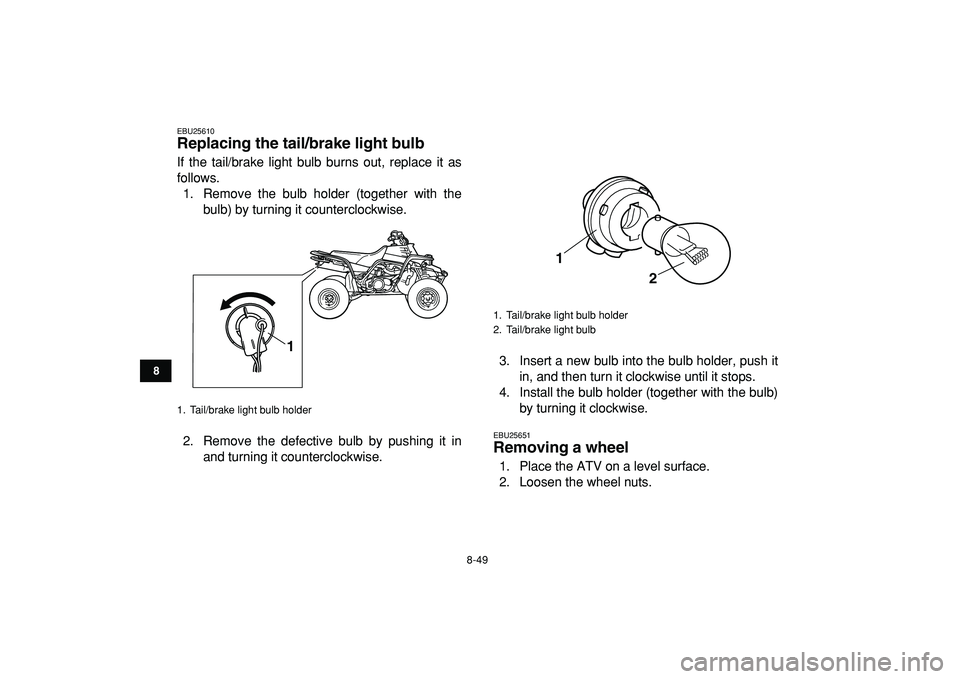
Replacing the tail/brake light bulb
If the tail/brake light bulb burns out, replace it as
follows.
1. Remove the bulb holder (together with the
bulb) by turning it counterclockwise.
2. Remove the defective bulb by pushing it in
and turning it counterclockwise.3. Insert a new bulb into the bulb holder, push it
in, and then turn it clockwise until it stops.
4. Install the bulb holder (together with the bulb)
by turning it clockwise.
EBU25651
Removing a wheel
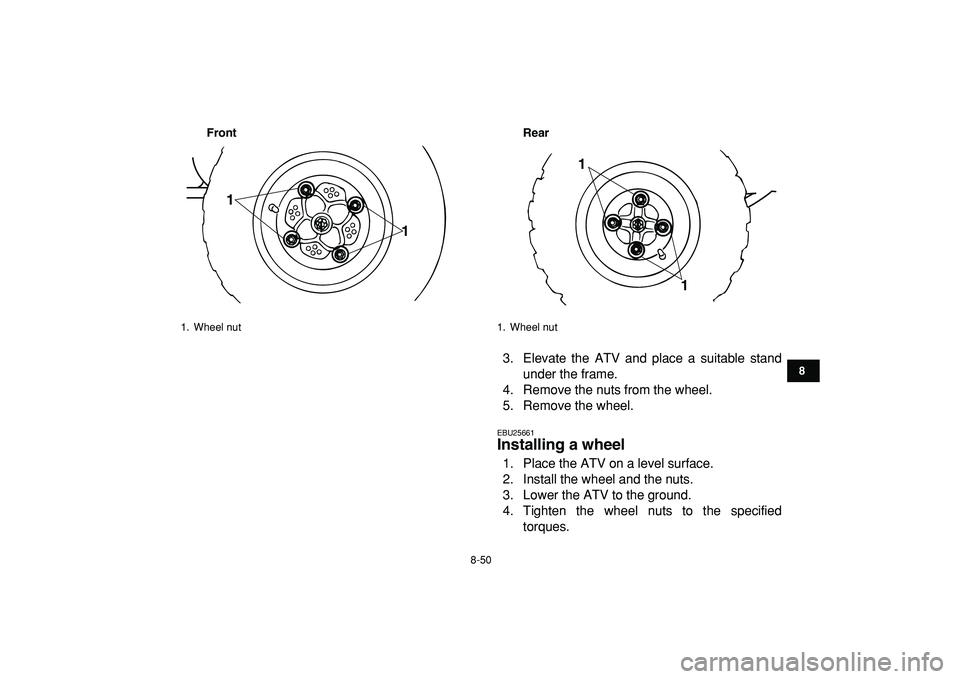
1. Place the ATV on a level surface.
2. Loosen the wheel nuts.
1. Tail/brake light bulb holder
1
1. Tail/brake light bulb holder
2. Tail/brake light bulb
1
2
Page 125 of 142
8-50
1
2
3
4
5
6
78
9
10
11
Front Rear
3. Elevate the ATV and place a suitable stand
under the frame.
4. Remove the nuts from the wheel.
5. Remove the wheel.
EBU25661
Installing a wheel
1. Place the ATV on a level surface.
2. Install the wheel and the nuts.
3. Lower the ATV to the ground.
4. Tighten the wheel nuts to the specified
torques.
1. Wheel nut
1
1
1. Wheel nut
1
1
Page 126 of 142

8-51
1
2
3
4
5
6
78
9
10
11
EBU25740
Troubleshooting
Although Yamaha ATVs receive a thorough in-
spection before shipment from the factory, trouble
may occur during operation. Any problem in the fu-
el, compression, or ignition systems, for example,
can cause poor starting and loss of power.
The following troubleshooting charts represent
quick and easy procedures for checking these vital
systems yourself. However, should your ATV re-
quire any repair, take it to a Yamaha dealer, whose
skilled technicians have the necessary tools, expe-
rience, and know-how to service the ATV properly.
Use only genuine Yamaha replacement parts. Im-
itation parts may look like Yamaha parts, but they
are often inferior, have a shorter service life and
can lead to expensive repair bills.WARNING
EWB02280
Do not smoke when checking the fuel system.
Fuel can ignite or explode, causing severe inju-
ry or property damage. Make sure there are no
open flames or sparks in the area, including pi-
lot lights from water heaters or furnaces.
Tightening torques:
Front wheel nut:
45 Nm (4.5 m·kgf, 32 ft·lbf)
Rear wheel nut:
45 Nm (4.5 m·kgf, 32 ft·lbf)
Page 129 of 142

9-1
1
2
3
4
5
6
7
89
10
11
EBU25860
CLEANING AND STORAGE
EBU25920
Cleaning
Frequent, thorough cleaning of your ATV will not
only enhance its appearance but will improve its
general performance and extend the useful life of
many components.
1. Before cleaning the ATV:
a. Block off the end of the exhaust pipe to
prevent water entry. A plastic bag and
strong rubber band may be used.
b. Make sure the spark plugs and all filler
caps are properly installed.
2. If the engine case is excessively greasy, apply
degreaser with a paint brush. Do not apply de-
greaser to the chain, sprockets or wheel ax-
les.
3. Rinse the dirt and degreaser off with a garden
hose. Use only enough pressure to do the job.
NOTICE
ECB00710
Excessive water pressure may cause water
seepage and deterioration of wheel bearings,
brakes, transmission seals and electrical de-
vices. Many expensive repair bills have result-ed from improper high-pressure detergent
applications such as those available in coin-
operated car washers.
4. Once most of the dirt has been hosed off,
wash all surfaces with warm water and mild,
detergent-type soap. An old toothbrush or bot-
tle brush is handy for hard-to-reach places.
5. Rinse the ATV off immediately with clean wa-
ter and dry all surfaces with a chamois, clean
towel or soft absorbing cloth.
6. Dry the chain and lubricate it to prevent it from
rusting.
7. Clean the seat with a vinyl upholstery cleaner
to keep the cover pliable and glossy.
8. Automotive type wax may be applied to all
painted and chrome plated surfaces. Avoid
combination cleaner-waxes. Many contain
abrasives which may mar the paint or protec-
tive finish. When finished cleaning, start the
engine and let it idle for several minutes.WARNING
EWB02310
Wet brakes may have reduced stopping ability,
Page 131 of 142
9-3
1
2
3
4
5
6
7
89
10
11
with oil.)
e. Remove the spark plug caps from the
spark plugs, and then install the spark
plugs and the spark plug caps.
6. Lubricate all control cables and the pivoting
points of all levers and pedals.
7. Check and, if necessary, correct the tire air
pressure, and then block up the ATV so that
all of its wheels are off the ground. Alternative-
ly, turn the wheels a little every month in order
to prevent the tires from becoming degraded
in one spot.
8. Cover the muffler outlet with a plastic bag to
prevent moisture from entering it.
TIP
Make any necessary repairs before storing the
ATV.