2009 VOLVO XC90 engine
[x] Cancel search: enginePage 106 of 282

04 InteriorInterior lighting
04106
Reading lights and courtesy light
G026960
Driver's side front reading lampCourtesy lightsPassenger's side front reading lamp The
reading lights can be switched on or off by
pressing buttons 1 or 3. The courtesy light-
ing (including footwell lighting) can be
turned on or off by pressing button 2. This
also activates the automatic function.
G027153
Rear reading lights
Driver's side rear reading lightPassenger's side rear reading light The
rear reading lights can be switched on and
off by pressing buttons (4) or (5).
Automatic functionThe reading lights and courtesy lights will
switch off automatically approximately
10 minutes after the engine has been turned
off. The lights can be turned off sooner by
pressing the respective buttons.The courtesy lights come on automatically
1
and remain on for approximately 30 seconds
when:•
The vehicle has been unlocked from the
outside with the remote control or key
•
If the engine has been switched off and the
ignition key has been turned to position 0
The courtesy lights will come on and remain on
for approximately 10 minutes when:
•
One of the doors is opened (assuming the
courtesy lighting has not previously been
switched off)
The courtesy lighting will go off when:
•
The engine is started
•
The vehicle is locked from the outside with
the remote control or key
The automatic function can be disconnected
by pressing button (2) for more than 3 seconds.
Briefly pressing the button again automatically
reconnects the function.
The courtesy light timer periods can be
changed. Contact a trained and qualified Volvo
service technician.
1This function is light dependent and is only activated in dark conditions.
Page 118 of 282

05 Locks and alarmKeys and remote controls
05118
Keys
G030177
Your vehicle is equipped with two coded
remote control transmitters with integrated
ignition key blades called Key Integrated
Remote (KIR).
To unlock/lock the vehicle using the key blade:•
Insert the key blade in the driver's door lock
and turn it once to unlock the driver's door
only.
•
Turn the key blade again (within 10 sec-
onds) to unlock all doors and the tailgate.
•
Turn the key blade once in the opposite
direction to lock all doors and the tailgate.Use the switch on the driver's door armrest to
lock/unlock the vehicle from the inside.
WARNING
If the doors are locked while driving, this
may hinder rapid access to the occupants
of the vehicle in the event of an accident.
(Also see information on "Child safety locks"
NOTE
To help prevent accidentally locking the
keys in the vehicle, the central locking sys-
tem is designed to unlock the doors imme-
diately if the key is left in the ignition switch,
the vehicle is locked using the lock button
on the door and the door is then closed. A
sound from the lock will be audible at this
time.
Please note that this function will not unlock
the doors if the engine is running.Immobilizer (start inhibitor)Each of the keys supplied with your vehicle
contains a coded transmitter. The code in the
key is transmitted to an antenna in the ignition
switch where it is compared to the code stored
in the start inhibitor module. The vehicle will
start only with a properly coded key.
Each key has a unique code, which your Volvo
retailer uses if new keys are required. A maxi-mum of six remote controls/keys can be pro-
grammed and used for one vehicle.
If you misplace a key, take the other keys to an
authorized Volvo retailer for reprogramming as
an antitheft measure.
If two of the keys to your vehicle are close
together, e.g., on the same key ring, when you
try to start the vehicle, this could cause inter-
ference in the immobilizer system and result in
the vehicle not starting. If this should occur,
remove one of the keys from the key ring before
trying to start the vehicle again.
NOTE
This device complies with part 15 of the
FCC rules. Operation is subject to the fol-
lowing condition: (1) This device may not
cause harmful interference, and (2) this
device must accept any interference
received, including interference that may
cause undesired operation.
Page 120 of 282

05 Locks and alarmKeys and remote controls
05120
NOTE
•
If an airbag deploys, your vehicle's SRS
control module will attempt to automat-
ically unlock all doors.
•
The key blade may also be used to lock
and unlock the doors, and to activate
and deactivate the alarm system.
•
To avoid leaving your keys in the vehi-
cle, make a habit of always locking the
vehicle with the remote control.
•
If the key blade section of the remote is
not fully folded out when starting the
vehicle, the immobilizer function may
make it impossible to start the engine.
•
The vehicle can be locked even if a door
is open. When the door(s) are closed,
they will be locked. Please be aware
that the keys could be locked in the car
when this is done.
Automatic re-lockingIf the doors are unlocked, the locks will auto-
matically reengage (re-lock) and the alarm will
rearm after 2 minutes unless a door or the tail-
gate has been opened. This helps prevent the
car from inadvertently being left unlocked.
FCC ID: LQNP2T-APU
This device complies with part 15 of the FCC
rules. Operation is subject to the following con-ditions: (1) This device may not cause harmful
interference, and (2) this device must accept
any interference received, including interfer-
ence that may cause undesired operation.
Canadian 2306104388
Model 504 2927 by Donnelly
Operation is subject to the following condi-
tions: (1) this device may not cause interfer-
ence, and (2) this device must accept any
interference, including interference that may
cause undesired operation of the device.
Canadian 2306104388A
Model 509 977 by Connaught Electronics
Operation is subject to the following condi-
tions: (1) this device may not cause interfer-
ence, and (2) this device must accept any
interference, including interference that may
cause undesired operation of the device.
WARNING
Never use the transmitter to lock the doors
from inside the vehicle.•
Doing so would ACTIVATE:
•
the break-in alarm, which would sound
if one of the doors were opened
•
the optional interior motion and inclina-
tion alarm sensors.
•
Doing so would DEACTIVATE:
•
the moonroof and interior courtesy light
controls.
•
the central locking buttons on the front
door armrests, although the interior
door handles would still function to
allow occupants to leave the vehicle.
•
Disabled features would remain disa-
bled until the remote is used again to
unlock the vehicle.
•
In addition, locking an occupied vehicle
would hinder rapid access to the occu-
pants in an accident or emergency.
Page 128 of 282

06 Starting and drivingGeneral information
06128
Engine oilAlthough some oil consumption occurs during
normal engine operation, more oil is consumed
when the engine is new as the internal parts
generate higher friction while wearing-in to
each other. From the time the engine is new
until the first maintenance is performed, the oil
consumption could be higher than normal. For
this reason, it is especially important to check
the oil every time you refuel your vehicle during
this period, see page 209.Fuel requirementsDeposit control gasoline (detergent
additives)Volvo recommends the use of detergent gas-
oline to control engine deposits. Detergent
gasoline is effective in keeping injectors and
intake valves clean. Consistent use of deposit
control gasolines will help ensure good driva-
bility and fuel economy. If you are not sure
whether the gasoline contains deposit control
additives, check with the service station oper-
ator.
NOTE
Volvo does not recommend the use of
external fuel injector cleaning systems.
Unleaded fuelEach Volvo has a three-way catalytic converter
and must use only unleaded gasoline. U.S. and
Canadian regulations require that pumps deliv-
ering unleaded gasoline be labelled "UNLEA-
DED". Only these pumps have nozzles which
fit your vehicle's filler inlet. It is unlawful to dis-
pense leaded fuel into a vehicle labelled
"unleaded gasoline only". Leaded gasoline
damages the three-way catalytic converter and
the heated oxygen sensor system. Repeated
use of leaded gasoline will lessen the effec-
tiveness of the emission control system and
could result in loss of emission warranty cov-
erage. State and local vehicle inspection pro-
grams will make detection of misfueling easier,
possibly resulting in emission test failure for
misfueled vehicles.
NOTE
Some U.S. and Canadian gasolines contain
an octane enhancing additive called methyl-
cyclopentadienyl manganese tricarbonyl
(MMT). If such fuels are used, your Emission
Control System performance may be affec-
ted, and the Check Engine Light (malfunc-
tion indicator lamp) located on your instru-
ment panel may light. If this occurs, please
return your vehicle to a trained and qualified
Volvo service technician for maintenance.
Gasoline containing alcohol and ethers"Oxygenated fuels"
Some fuel suppliers sell gasoline containing
"oxygenates" which are usually alcohols or
ethers. In some areas, state or local laws
require that the service pump be marked indi-
cating use of alcohols or ethers. However,
there are areas in which the pumps are
unmarked. If you are not sure whether there is
alcohol or ethers in the gasoline you buy, check
with the service station operator. To meet sea-
sonal air quality standards, some areas require
the use of "oxygenated" fuel.
Volvo allows the use of the following "oxygen-
ated" fuels; however, the octane ratings listed
on page 129 must still be met.
Alcohol – Ethanol: Fuels containing up to 10%
ethanol by volume may be used. Ethanol may
also be referred to as Ethyl alcohol, or "Gaso-
hol".
Ethers – MTBE: Fuels containing up to 15%
MTBE may be used.
Page 129 of 282

06 Starting and driving
Fuel requirements
06``129 Octane rating
Minimum octane
G028920
Typical pump octane labelVolvo recommends premium for best perform-
ance, but using 87 octane or above will not
affect engine reliability.
Volvo engines are designed to achieve rated
horsepower, torque, and fuel economy per-
formance using premium 91 octane fuel.Demanding drivingIn demanding driving conditions, such as oper-
ating the vehicle in hot weather, towing a trailer,
or driving for extended periods at higher alti-
tudes than normal, it may be advisable to
switch to higher octane fuel (91 or higher) or to
change gasoline brands to fully utilize yourengine's capacity, and for the smoothest pos-
sible operation.
NOTE
When switching to higher octane fuel or
changing gasoline brands, it may be neces-
sary to fill the tank more than once before a
difference in engine operation is noticeable.Fuel FormulationsDo not use gasoline that contains lead as a
knock inhibitor, and do not use lead additives.
Besides damaging the exhaust emission con-
trol systems on your vehicle, lead has been
strongly linked to certain forms of cancer.
Many fuels contain benzene as a solvent.
Unburned benzene has been strongly linked to
certain forms of cancer. If you live in an area
where you must fill your own gas tank, take
precautions. These may include:•
standing upwind away from the filler nozzle
while refueling
•
refueling only at gas stations with vapor
recovery systems that fully seal the mouth
of the filler neck during refueling
•
wearing neoprene gloves while handling a
fuel filler nozzle.
Use of AdditivesWith the exception of gas line antifreeze during
winter months, do not add solvents, thicken-
ers, or other store-bought additives to your
vehicle's fuel, cooling, or lubricating systems.
Overuse may damage your engine, and some
of these additives contain organically volatile
chemicals. Do not needlessly expose yourself
to these chemicals.
WARNING
Carbon monoxide is a poisonous, colorless,
and odorless gas. It is present in all exhaust
gases. If you ever smell exhaust fumes
inside the vehicle, make sure the passenger
compartment is ventilated, and immediately
return the vehicle to a trained and qualified
Volvo service technician for correction.
Page 130 of 282

06 Starting and drivingFuel requirements
06130
WARNING
Driving with the tailgate open: Driving with
the tailgate open could lead to poisonous
exhaust gases entering the passenger com-
partment.•
If the tailgate must be kept open for any
reason, proceed as follows:
•
Close the windows
•
Set the ventilation system control to air
flow to floor, windshield and side win-
dows and blower control to its highest
setting.
Weight distribution affects handlingAt the specified curb weight your vehicle has a
tendency to understeer, which means that the
steering wheel has to be turned more than
might seem appropriate for the curvature of a
bend.
This ensures good stability and reduces the
risk of rear wheel skid. Remember that these
properties can alter with the vehicle load.
The heavier the load in the cargo area, the less
the tendency to understeer.Handling, roadholdingVehicle load, tire design and inflation pressure
all affect vehicle handling. Therefore, check
that the tires are inflated to the recommendedpressure according to the vehicle load. See
"Tire pressure" section.
Loads should be distributed so that capacity
weight or maximum permissible axle loads are
not exceeded.
Conserving electrical currentKeep the following in mind to help minimize
battery drain:•
When the engine is not running, avoid turn-
ing the ignition key to position II (see
page 135). Many electrical systems (the
audio system, the optional infotainment/
navigation systems, power windows, etc)
will function with the ignition key in position
I. This position reduces drain on the bat-
tery.
•
Please keep in mind that using systems,
accessories, etc that consume a great deal
of current when the engine is not running
could result in the battery being completely
drained.NOTE
A warning message will be displayed in the
text window in the instrument panel when
the battery charge is low.
Page 131 of 282
06 Starting and driving
Refueling
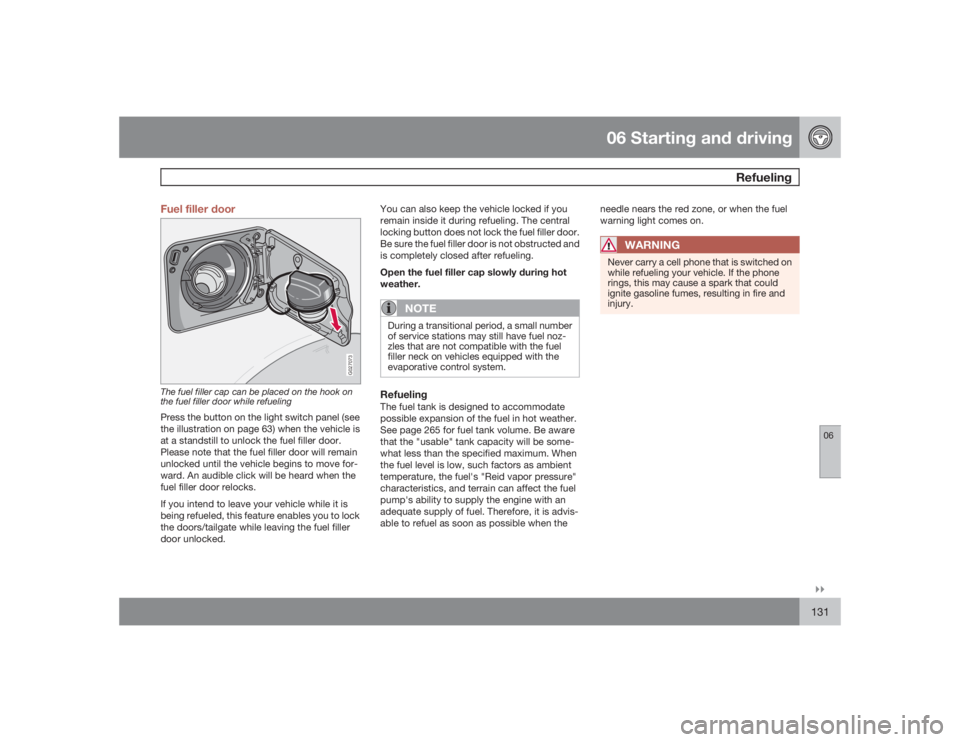
06``131 Fuel filler door
G027073
The fuel filler cap can be placed on the hook on
the fuel filler door while refuelingPress the button on the light switch panel (see
the illustration on page 63) when the vehicle is
at a standstill to unlock the fuel filler door.
Please note that the fuel filler door will remain
unlocked until the vehicle begins to move for-
ward. An audible click will be heard when the
fuel filler door relocks.
If you intend to leave your vehicle while it is
being refueled, this feature enables you to lock
the doors/tailgate while leaving the fuel filler
door unlocked.You can also keep the vehicle locked if you
remain inside it during refueling. The central
locking button does not lock the fuel filler door.
Be sure the fuel filler door is not obstructed and
is completely closed after refueling.
Open the fuel filler cap slowly during hot
weather.
NOTE
During a transitional period, a small number
of service stations may still have fuel noz-
zles that are not compatible with the fuel
filler neck on vehicles equipped with the
evaporative control system.RefuelingThe fuel tank is designed to accommodate
possible expansion of the fuel in hot weather.
See page 265 for fuel tank volume. Be aware
that the "usable" tank capacity will be some-
what less than the specified maximum. When
the fuel level is low, such factors as ambient
temperature, the fuel's "Reid vapor pressure"
characteristics, and terrain can affect the fuel
pump's ability to supply the engine with an
adequate supply of fuel. Therefore, it is advis-
able to refuel as soon as possible when theneedle nears the red zone, or when the fuel
warning light comes on.
WARNING
Never carry a cell phone that is switched on
while refueling your vehicle. If the phone
rings, this may cause a spark that could
ignite gasoline fumes, resulting in fire and
injury.
Page 132 of 282

06 Starting and drivingRefueling
06132
CAUTION
•
Do not refuel with the engine running
1.
Turn the ignition off or to position I. If the
ignition is on, an incorrect reading could
occur in the fuel gauge.
•
After refueling, close the fuel filler cap
by turning it clockwise until it clicks into
place
1.
•
Avoid overfilling the fuel tank. Do not
press the handle on the filler nozzle
more than one extra time. Too much
fuel in the tank in hot weather conditions
can cause the fuel to overflow. Overfill-
ing could also cause damage to the
emission control systems.
•
Avoid spilling gasoline during refueling.
In addition to causing damage to the
environment, gasolines containing
alcohol can cause damage to painted
surfaces, which may not be covered
under the New Vehicle Limited War-
ranty.
•
Do not use gasolines containing meth-
anol (methyl alcohol, wood alcohol).
This practice can result in vehicle per-
formance deterioration and can dam-
age critical parts in the fuel system.
Such damage may not be covered
under the New Vehicle Limited War-
ranty.
1If the fuel filler cap is not closed tightly or if the engine is running when the vehicle is refueled, the Check Engine Light (malfunction indicator lamp) may indicate a fault. However, your vehicle's
performance will not be affected. Use only Volvo original or approved fuel filler caps.