2009 VOLVO XC90 weight
[x] Cancel search: weightPage 112 of 282

04 InteriorSecuring cargo
04112
G027031
As a safety precaution, all cargo in your vehicle
should be securely anchored to keep it from
being thrown forward in the event of sudden
braking, etc. The vehicle is equipped with eye-
lets in the cargo space to which straps or other
cargo restraints can be attached.
WARNING
The eyelets are not to be used as passenger
restraints or as anchorages for child
restraints.Consult your Volvo retailer about suitable
accessories for this purpose.Remember that an object weighing 44 lbs
(20 kg) produces a force of 2,200 lbs
(1,000 kg) in a head-on collision at 30 mph
(50 km/h)!
Keep the following in mind when loading the
vehicle:
•
The load carrying capacity of your vehicle
is determined by factors such as the num-
ber of passengers, the amount of cargo,
the weight of any accessories that may be
installed, etc. See the section "Vehicle
loading" in the chapter "Wheel and tires"
for more detailed information.
•
Load the cargo against the backrest.
•
Load heavy cargo as low as possible.
•
If no one is sitting in the outboard rear
seat(s), reinforce the backrest by fastening
the seat belts.
•
Never load cargo above the backrest with-
out a cargo net.WARNING
When the rear backrest(s) are folded down,
the vehicle should not be loaded to a level
higher than 2 in. (5 cm) below the upper
edge of the rear side windows. Objects
placed higher than this level could impede
the function of the inflatable curtain.
G027058
Attachment bracketNylon cargo net (accessory)The Volvo XC90 can be equipped with a cargo
net made of strong nylon fabric.
This net can be installed in two places:•
Behind the rear seat backrests (the second
row of seats in seven-seat models)
•
Behind the front seat backrests if the rear
seat backrests (the second row of seats in
seven-seat models) have been folded
down.
Page 130 of 282

06 Starting and drivingFuel requirements
06130
WARNING
Driving with the tailgate open: Driving with
the tailgate open could lead to poisonous
exhaust gases entering the passenger com-
partment.•
If the tailgate must be kept open for any
reason, proceed as follows:
•
Close the windows
•
Set the ventilation system control to air
flow to floor, windshield and side win-
dows and blower control to its highest
setting.
Weight distribution affects handlingAt the specified curb weight your vehicle has a
tendency to understeer, which means that the
steering wheel has to be turned more than
might seem appropriate for the curvature of a
bend.
This ensures good stability and reduces the
risk of rear wheel skid. Remember that these
properties can alter with the vehicle load.
The heavier the load in the cargo area, the less
the tendency to understeer.Handling, roadholdingVehicle load, tire design and inflation pressure
all affect vehicle handling. Therefore, check
that the tires are inflated to the recommendedpressure according to the vehicle load. See
"Tire pressure" section.
Loads should be distributed so that capacity
weight or maximum permissible axle loads are
not exceeded.
Conserving electrical currentKeep the following in mind to help minimize
battery drain:•
When the engine is not running, avoid turn-
ing the ignition key to position II (see
page 135). Many electrical systems (the
audio system, the optional infotainment/
navigation systems, power windows, etc)
will function with the ignition key in position
I. This position reduces drain on the bat-
tery.
•
Please keep in mind that using systems,
accessories, etc that consume a great deal
of current when the engine is not running
could result in the battery being completely
drained.NOTE
A warning message will be displayed in the
text window in the instrument panel when
the battery charge is low.
Page 151 of 282
06 Starting and driving
Towing a trailer
06``151
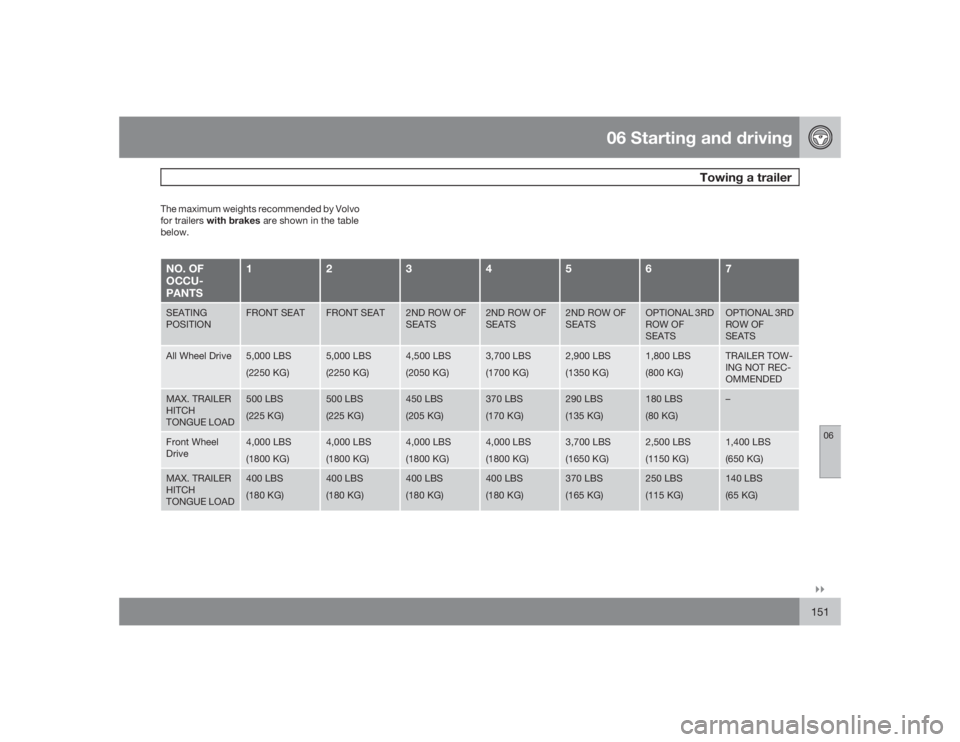
The maximum weights recommended by Volvo
for trailers with brakes are shown in the table
below.NO. OF
OCCU-
PANTS
1
2
3
4
5
6
7
SEATING
POSITION
FRONT SEAT
FRONT SEAT
2ND ROW OF
SEATS
2ND ROW OF
SEATS
2ND ROW OF
SEATS
OPTIONAL 3RD
ROW OF
SEATS
OPTIONAL 3RD
ROW OF
SEATS
All Wheel Drive
5,000 LBS
(2250 KG)
5,000 LBS
(2250 KG)
4,500 LBS
(2050 KG)
3,700 LBS
(1700 KG)
2,900 LBS
(1350 KG)
1,800 LBS
(800 KG)
TRAILER TOW-
ING NOT REC-
OMMENDED
MAX. TRAILER
HITCH
TONGUE LOAD
500 LBS
(225 KG)
500 LBS
(225 KG)
450 LBS
(205 KG)
370 LBS
(170 KG)
290 LBS
(135 KG)
180 LBS
(80 KG)
–
Front Wheel
Drive
4,000 LBS
(1800 KG)
4,000 LBS
(1800 KG)
4,000 LBS
(1800 KG)
4,000 LBS
(1800 KG)
3,700 LBS
(1650 KG)
2,500 LBS
(1150 KG)
1,400 LBS
(650 KG)
MAX. TRAILER
HITCH
TONGUE LOAD
400 LBS
(180 KG)
400 LBS
(180 KG)
400 LBS
(180 KG)
400 LBS
(180 KG)
370 LBS
(165 KG)
250 LBS
(115 KG)
140 LBS
(65 KG)
Page 152 of 282

06 Starting and drivingTowing a trailer
06152
NOTE
•
Recommended hitch tongue load:
not more than 10% of the trailer's
weight. The trailer load should be posi-
tioned so that it does not shift and the
tongue load should be 10% of the trail-
er's weight. However, the tongue load
should not exceed the maximum per-
missible weights indicated in the table
above.
•
When towing trailers without brakes,
the maximum permissible trailer weight
is 1,700 lbs (750 kg).
•
If necessary, redistribute the weight of
any cargo in the trailer to avoid exces-
sive weight on the trailer hitch.
•
The maximum trailer weight listed in the
table for All Wheel Drive models,
5,000 lbs (2250 kg) is only applicable
when there are not more than two occu-
pants in the vehicle, in the front seats,
with a combined weight of 300 lbs
(135 kg), with no other cargo in the vehi-
cle.
•
The maximum weight listed for Front
Wheel Drive models, 4,000 lbs (1800 kg)
is only applicable when there are not
more than four occupants in the vehicle,
in the front seats and second row of
seats, with a combined weight of
600 lbs (270 kg), with no other cargo in
the vehicle.
NOTE
•
Vehicles used for towing a trailer on a
regular basis, or for long-distance high-
way towing should be equipped with an
automatic transmission oil cooler and
Volvo's automatic self-leveling system
for the rear suspension. Consult your
Volvo retailer.
•
Volvo recommends the use of Volvo
trailer hitches that are specially
designed for the vehicle.
•
All Volvo models are equipped with
energy-absorbing shock-mounted
bumpers. Trailer hitch installation
should not interfere with the proper
operation of this bumper system.
•
Increase tire pressure to recommended
full inflation pressure. See chapter
"Wheels and tires."
•
When your vehicle is new, avoid towing
heavy trailers during the first 620 miles
(1,000 km).
•
Engine and transmission are subject to
increased loads. Therefore, engine
coolant temperature should be closely
watched when driving in hot climates or
hilly terrain. Use a lower gear and turn
off the air conditioner if the temperature
gauge needle enters the red range.
Page 156 of 282
06 Starting and drivingLoad carriers (accessory)
06156
Positioning load carriersIf wing-shaped load carriers are used, make
sure that they are installed on the roof rails with
the rounded edge forward. Load carriers of this
type are identical and can be placed anywhere
along the roof rails.
When not in use, we recommend that the front
load carrier be placed approximately 2 inches
(5 cm) in front of the center roof rail anchorage
point and the rear load carrier approximately
1.5 inches (3.5 cm) in front of the rear rail
anchorage. This will help to reduce wind noise.Installing load carriersMake sure that the load carriers are pressed
firmly out against the roof rail and securely
tightened place. Check regularly that any load
carriers are securely in place.
WARNING
Loads carried on the vehicle's roof should
not exceed 220 lbs (100 kg), including the
weight of the load carriers and any other
load carrying equipment (ski boxes, bicycle
racks, etc.). Excessive loads on the roof can
adversely affect the handling and roadhold-
ing characteristics of the vehicle.
Page 174 of 282

07 Wheels and tiresGlossary of tire terminology
07174
•
Tire information placard: A placard
showing the OE (Original Equipment) tire
sizes, recommended inflation pressure,
and the maximum weight the vehicle can
carry.
•
Tire Identification Number (TIN): A num-
ber on the sidewall of each tire providing
information about the tire brand and man-
ufacturing plant, tire size and date of man-
ufacturer.
•
Inflation pressure: A measure of the
amount of air in a tire.
•
Standard load: A class of P-metric or Met-
ric tires designed to carry a maximum load
at 35 psi [37 psi (2.5 bar) for Metric tires].
Increasing the inflation pressure beyond
this pressure will not increase the tires load
carrying capability.
•
Extra load: A class of P-metric or Metric
tires designed to carry a heavier maximum
load at 41 psi [43 psi (2.9 bar) for Metric
tires]. Increasing the inflation pressure
beyond this pressure will not increase the
tires load carrying capability.
•
kPa: Kilopascal, a metric unit of air pres-
sure.
•
PSI: Pounds per square inch, a standard
unit of air pressure.
•
B-pillar: The structural member at the side
of the vehicle behind the front door.
•
Bead area of the tire: Area of the tire next
to the rim.
•
Sidewall of the tire: Area between the
bead area and the tread.
•
Tread area of the tire: Area of the perim-
eter of the tire that contacts the road when
mounted on the vehicle.
•
Rim: The metal support (wheel) for a tire or
a tire and tube assembly upon which the
tire beads are seated.
•
Maximum load rating: a figure indicating
the maximum load in pounds and kilo-
grams that can be carried by the tire. This
rating is established by the tire manufac-
turer.
•
Maximum permissible inflation pres-
sure: the greatest amount of air pressure
that should ever be put in the tire. This limit
is set by the tire manufacturer.
•
Recommended tire inflation pressure:
inflation pressure, established by Volvo,
which is based on the type of tires that are
mounted on a vehicle at the factory. This
inflation pressure is affected by the number
of occupants in the vehicle, the amount of
cargo, and the speed at which the vehicle
will be driven for a prolonged period. This
information can be found on the tire infla-
tion placard(s) located on the driver's side
B-pillar or on the inside of the fuel filler dooron Canadian models, and in the tire infla-
tion table in this chapter.
•
Cold tires: The tires are considered to be
cold when they have the same temperature
as the surrounding (ambient) air. This tem-
perature is normally reached after the vehi-
cle has been parked for at least 3 hours.
Page 175 of 282

07 Wheels and tires
Vehicle loading
07
175
Properly loading your vehicle will provide maxi-
mum return of vehicle design performance.
Before loading your vehicle, familiarize yourself
with the following terms for deter-mining your
vehicle's weight ratings, with or without a
trailer, from the vehicle's Federal/ Canadian
Motor Vehicle Safety Standards (FMVSS/
CMVSS) label, and the vehicle's tire informa-
tion placard.Curb weightThe weight of the vehicle including a full tank
of fuel and all standard equipment. It does not
include passengers, cargo, or optional equip-
ment.Capacity weightAll weight added to the curb weight, including
cargo and optional equipment. When towing,
trailer hitch tongue load is also part of cargo
weight.
NOTE
For trailer towing information, please refer to
the section "Towing a trailer."Permissible axle weightThe maximum allowable weight that can be
carried by a single axle (front or rear). Thesenumbers are shown on the Federal/Canadian
Motor Vehicle Safety Standards (FMVSS/
CMVSS) label. The total load on each axle must
never exceed its maximum permissible weight.
Gross vehicle weight (GVW)The vehicle's curb weight + cargo + passen-
gers.
A table listing important weight limits for your
vehicle, is in chapter "Dimension and weights".
For the location of the various labels in your
vehicle, see page 258Steps for Determining Correct Load
Limit•
Locate the statement "the combined
weight of occupants and cargo should
never exceed XXX pounds" on your vehi-
cle's placard.
•
Determine the combined weight of the
driver and passengers that will be riding in
your vehicle.
•
Subtract the combined weight of the driver
and passengers from XXX kilograms or
XXX pounds.
•
The resulting figure equals the available
amount of cargo and luggage load
capacity. For example, if the "XXX" amount
equals 1400 lbs. and there will be five150 lb. passengers in your vehicle, the
amount of available cargo and luggage
load capacity is 650 lbs. (1400-750 (5 x
150) = 650 lbs.)
•
Determine the combined weight of luggage
and cargo being loaded on the vehicle.
That weight may not safely exceed the
available cargo and luggage load capacity
calculated in Step 4.
•
If your vehicle will be towing a trailer, load
from your trailer will be transferred to your
vehicle. Consult this manual
1 to determine
how this reduces the available cargo and
luggage load capacity of your vehicle.
WARNING
•
Exceeding the permissible axle weight,
gross vehicle weight, or any other
weight rating limits can cause tire over-
heating resulting in permanent defor-
mation or catastrophic failure.
•
Do not use replacement tires with lower
load carrying capacities than the tires
that were original equipment on the
vehicle because this will lower the vehi-
cle's GVW rating. Replacement tires
with a higher limit than the originals do
not increase the vehicle's GVW rating
limitations.
1For "Towing a trailer" see page 151.
Page 184 of 282
07 Wheels and tiresChanging wheels
07184
WARNING
•
The jack must correctly engage the bar
in the jack attachment. The vehicle's
weight must not rest on the jack attach-
ment. See illustration "Attaching the
jack" on the previous page.
•
Be sure the jack is on a firm, level, non-
slippery surface.
•
Never allow any part of your body to be
extended under a vehicle supported by
a jack.
•
Use the jack intended for the vehicle
when replacing a wheel. For any other
job, use stands to support the side of
the vehicle being worked on.
•
Apply the parking brake and put the
gear selector in the (P)ark position.
•
Block the wheels standing on the
ground, use rigid wooden blocks or
large stones.
•
The jack should be kept well-greased
and clean, and should not be damaged.
•
No objects should be placed between
the base of jack and the ground, or
between the jack and the attachment
bar on the vehicle.
The jack and tools should be returned to their
storage spaces. The jack should be cranked
down fully so that it fits into the intended space.