Page 188 of 282

07 Wheels and tiresTire Sealing System
07188
CAUTION
The compressor should not be used for
more than 10 minutes at a time to avoid
overheating.
WARNING
If the pressure remains below 22 psi (1.8
bar) after approximately seven minutes, turn
off the compressor. In this case, the hole is
too large to be sealed and the vehicle should
not be driven.12. Switch off the compressor and disconnect
the electrical wire from the 12-volt socket.
13. Unscrew the hose from the tire’s inflation
valve and reinstall the valve cap.
14. Immediately drive the vehicle for approxi-
mately 2 miles (3 km) at a maximum speed
of 50 mph (80 km/h) to distribute the seal-
ing compound in the tire.
NOTE
•
Safely stow the tire sealing system in a
convenient place as it will soon be used
again to check the tire’s inflation pres-
sure.
•
The empty bottle of sealing compound
cannot be removed from the bottle
holder. Consult a trained and qualified
Volvo service technician to have the
bottle removed and properly disposed
of.WARNING
If heavy vibrations, unsteady steering
behavior, or noises should occur while driv-
ing, reduce speed and park the vehicle in a
safe place. Recheck the tire for bumps,
cracks, or other visible damage, and
recheck its inflation pressure. If the pressure
is below 19 psi (1.3 bar), do not continue
driving. Have the vehicle towed to a trained
and qualified Volvo service technician.Stage 2: Checking inflation pressure1. Connect the tire sealing system as descri-
bed in stage 1.
2. Refer to the inflation pressure tablesfor the
correct inflation pressure. If the tire needs
to be inflated, start the tire sealing system’s
compressor. If necessary, release air fromthe tire by turning the air release knob
counterclockwise.
CAUTION
The compressor should not be used for
more than 10 minutes at a time to avoid
overheating.
WARNING
If you interrupt your trip for more than 1
hour, check the inflation pressure in the
damaged tire again before continuing.Replacing the sealing compound
containerThe sealing compound container must be
replaced if:•
the tire sealing system has been used to
repair a tire
•
the container’s expiration date has passed
(see the date on decal).
Page 189 of 282

07 Wheels and tires
Tire Sealing System
07
189
NOTE
•
After use, the sealing compound bottle,
the hose, and certain other system
components must be replaced. Please
consult your Volvo retailer for replace-
ment parts.
•
If the sealing compound bottle’s expi-
ration date has passed, please take it to
a Volvo retailer or a recycling station
that can properly dispose of harmful
substances.
Inflating tiresThe tire sealing system can be used to inflate
the tires. To do so:
1. Park the car in a safe place.
2. The compressor should be switched off.
Ensure that the on/off switch is in position
0 (the 0 side of the switch should be
pressed down).
3. Take out the electrical wire and hose.
4. Remove the valve cap from the tire’s infla-
tion valve and screw the hose connector
onto the valve as tightly as possible by
hand.
5. Connect the electrical wire to the nearest
12-volt socket in the vehicle.6. Start the vehicle’s engine.
WARNING
•The vehicle’s engine should be running
when the tire sealing system is used to
avoid battery drain. Therefore, be sure
the vehicle is parked in a well ventilated
place, or outdoors, before using the sys-
tem.•Children should never be left unattended
in the vehicle when the engine is running.
7. Check the tire’s inflation pressure on the
gauge. Switch off the compressor briefly to
get a clear reading from the pressure
gauge.
8. Refer to the tire inflation tables for the cor-
rect inflation pressure. If the tire needs to
be inflated, start the tire sealing system’s
compressor (press the on/off switch to
position I). If necessary, release air from the
tire by turning the air release knob coun-
terclockwise.
CAUTION
The compressor should not be used for
more than 10 minutes at a time to avoid
overheating.
9. Turn off the compressor (press the on/off
switch to position 0) when the correct infla-
tion pressure has been reached.
10. Unscrew the hose from the tire’s inflation
valve and reinstall the valve cap.
11. Disconnect the electrical wire from the 12-
volt socket.
Page 218 of 282

09 Maintenance and servicingReplacing bulbs
09218
Location of the bulbs in the headlight
housing
G027082
Low beam headlight/Active Bi-Xenon
headlight (option)High beam headlightTurn signalParking lightSide marker light
Replacing the low beam bulb (Halogen
headlights)
G027088
1. Remove the plastic cover over the bulb (1)
by turning it counterclockwise.
2. Pull the connector from the lamp housing
(2).
3. Loosen the bulb's retaining spring by first
moving it to the right and then moving it out
of the way.
4. Pull out the bulb from the holder.
5. Insert the new bulb (without touching the
glass) in the holder.
6. Move the retaining spring up and push it
slightly to the left until it seats properly.7. Press the bulb holder into place on the
headlight housing.
8. Reinstall the plastic cap. The letters
"HAUT" on the cap must be upward.
Replacing the high beam bulb (Halogen
headlights)
G027085
1. Remove the rubber cover (1) by pulling it
off.
2. Pull the connector from the lamp housing
(2).
3. Loosen the bulb's retaining spring by first
moving it to the right and then moving it out
of the way.
Page 219 of 282

09 Maintenance and servicing
Replacing bulbs
09``219
4. Pull out the bulb from the holder.
5. Insert the new bulb (without touching the
glass) in the holder.
6. Move the retaining spring up and push it
slightly to the left until it seats properly.
7. Press the bulb holder into place on the
headlight housing.
8. Press the rubber cover into place.Replacing the high beam bulb (Active
Bi-Xenon headlights)
G027090
1. Remove the rubber cover over the bulb (1)
by pulling it off.2. Turn the bulb holder counterclockwise and
pull it out of the headlight housing.
3. Remove the connector from the bulb unit
(2) by pressing the lock tab out and pulling.
4. Connect the connector to the new bulb unit
until it clicks into place.
5. Press a new bulb unit into the headlight
housing and turn it clockwise into place.
6. Reinstall the plastic cover.
Replacing parking light/side marker
light bulbs
G028409
1. Turn the lamp holder approximately 1/4
turn counterclockwise and pull it out of the
headlight housing.
2. Pull the bulb straight out.
3. Align the guide lugs on the side of the base
of the new bulb in the grooves in the holder
and press it into place.
4. Press the lamp holder into the place in the
headlight housing and turn it approxi-
mately 1/4 turn clockwise.Replacing the turn signal bulb
G027089
1. Turn the lamp holder approximately 1/4
turn counterclockwise and pull it out of the
headlight housing.
Page 220 of 282

09 Maintenance and servicingReplacing bulbs
09220
2. Press in the bulb slightly and pull it out of
the holder.
3. Align the guide lugs on the side of the base
of the new bulb in the grooves in the holder.
Press it in and turn it slightly clockwise.
4. Press the lamp holder into the place in the
headlight housing and turn it approxi-
mately 1/4 turn clockwise.Front fog lights
G027078
NOTE
Avoid touching the glass on the bulb with
your fingers.
1. Switch off the ignition.
2. Turn the bulb holder slightly counterclock-
wise to release it.
3. Replace the bulb. The shape of the foot of
the bulb corresponds to the shape of the
bulb holder.
4. Reinstall the bulb holder by turning it
slightly clockwise. The side of the holder
markedTOP should face upward.Location of tail light bulbs
G027094
Parking lightTurn signal
Back-up lightParking lightBrake lightNOTE
If the message indicating a burned out bulb
remains in the information display after a
bulb has been replaced, consult a trained
and qualified Volvo service technician.
Page 221 of 282

09 Maintenance and servicing
Replacing bulbs
09``221 Replacing bulbs in the taillight cluster
G027077
1. Switch off all lights and turn ignition key to
position0.
2. Fold down the lower section of the tailgate,
and fold up the rear section of the cargo
area floor.
3. If the vehicle is equipped with the optional
grocery bag holder, detach the holder's
bands.
4. Remove the corner panel (A in the illustra-
tion above).
5. Open the cover (B) in the side panel by
pulling the tab (C) upward/outward.
6. Loosen the bolts (D).7. Pull the entire tail light housing straight out.
8. Disconnect the wiring.
9. Place the tail light housing on a soft cloth
to avoid scratching the lens.
10. Turn the lamp holder(s) counterclockwise
and pull out.
11. Turn signal, back-up light, brake light
bulbs: Turn the bulb counterclockwise and
remove it.
12. Parking light bulbs: Pull the bulb straight
out.
13. Insert a new bulb.14. Place the lamp holder in the groove and
turn clockwise.
15. Press wiring back into place.
16. Align the tail light housing with the holes for
the retaining bolts and press it into place.
17. Tighten the retaining bolts.
18. Reinsert the side and corner panels.
Page 222 of 282
09 Maintenance and servicingReplacing bulbs
09222
Rear fog light
G027093
1. Switch off the ignition.
2. Carefully insert a small screwdriver (see
illustration above).
3. Pry out the lamp housing.
4. Turn the bulb holder counterclockwise and
remove it.
5. Turn the bulb counterclockwise and
remove it.
6. Insert a new bulb and press the lamp hous-
ing back into place.
Door step courtesy lights
G027079
The door step courtesy lights are located under
the dashboard on the driver's and passenger's
sides.
To replace a bulb:
1. Carefully insert a screwdriver and pry out
the lens.
2. Replace the defective bulb.
3. Reinstall the lens.
Cargo compartment light
G027084
1. Carefully insert a screwdriver and pry out
the lens.
2. Pry out the bulb and replace it.
3. Press the lens back into place.
Page 223 of 282
09 Maintenance and servicing
Replacing bulbs
09
223 Vanity mirror lights
G027080
1. Carefully insert a screwdriver and pry out
the lens.
2. Pry out the bulb and replace it.
3. Carefully press the lower edge of lens onto
the four tabs and press the upper edge of
the lens into place.
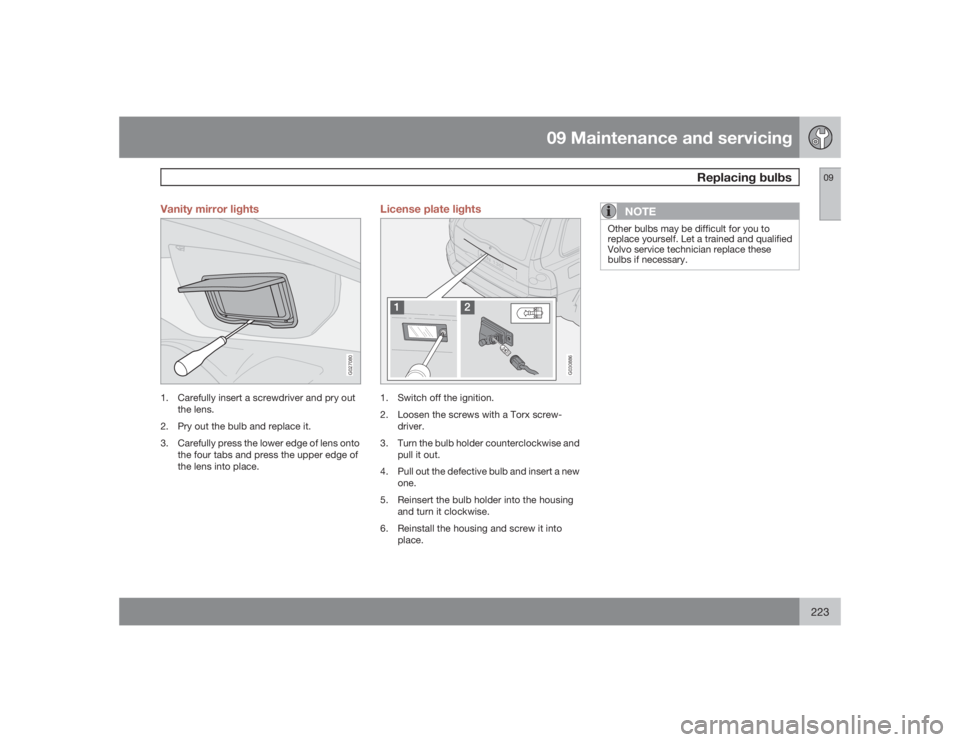
License plate lights
G030886
1. Switch off the ignition.
2. Loosen the screws with a Torx screw-
driver.
3. Turn the bulb holder counterclockwise and
pull it out.
4. Pull out the defective bulb and insert a new
one.
5. Reinsert the bulb holder into the housing
and turn it clockwise.
6. Reinstall the housing and screw it into
place.
NOTE
Other bulbs may be difficult for you to
replace yourself. Let a trained and qualified
Volvo service technician replace these
bulbs if necessary.