2009 VOLVO XC90 warning
[x] Cancel search: warningPage 175 of 282

07 Wheels and tires
Vehicle loading
07
175
Properly loading your vehicle will provide maxi-
mum return of vehicle design performance.
Before loading your vehicle, familiarize yourself
with the following terms for deter-mining your
vehicle's weight ratings, with or without a
trailer, from the vehicle's Federal/ Canadian
Motor Vehicle Safety Standards (FMVSS/
CMVSS) label, and the vehicle's tire informa-
tion placard.Curb weightThe weight of the vehicle including a full tank
of fuel and all standard equipment. It does not
include passengers, cargo, or optional equip-
ment.Capacity weightAll weight added to the curb weight, including
cargo and optional equipment. When towing,
trailer hitch tongue load is also part of cargo
weight.
NOTE
For trailer towing information, please refer to
the section "Towing a trailer."Permissible axle weightThe maximum allowable weight that can be
carried by a single axle (front or rear). Thesenumbers are shown on the Federal/Canadian
Motor Vehicle Safety Standards (FMVSS/
CMVSS) label. The total load on each axle must
never exceed its maximum permissible weight.
Gross vehicle weight (GVW)The vehicle's curb weight + cargo + passen-
gers.
A table listing important weight limits for your
vehicle, is in chapter "Dimension and weights".
For the location of the various labels in your
vehicle, see page 258Steps for Determining Correct Load
Limit•
Locate the statement "the combined
weight of occupants and cargo should
never exceed XXX pounds" on your vehi-
cle's placard.
•
Determine the combined weight of the
driver and passengers that will be riding in
your vehicle.
•
Subtract the combined weight of the driver
and passengers from XXX kilograms or
XXX pounds.
•
The resulting figure equals the available
amount of cargo and luggage load
capacity. For example, if the "XXX" amount
equals 1400 lbs. and there will be five150 lb. passengers in your vehicle, the
amount of available cargo and luggage
load capacity is 650 lbs. (1400-750 (5 x
150) = 650 lbs.)
•
Determine the combined weight of luggage
and cargo being loaded on the vehicle.
That weight may not safely exceed the
available cargo and luggage load capacity
calculated in Step 4.
•
If your vehicle will be towing a trailer, load
from your trailer will be transferred to your
vehicle. Consult this manual
1 to determine
how this reduces the available cargo and
luggage load capacity of your vehicle.
WARNING
•
Exceeding the permissible axle weight,
gross vehicle weight, or any other
weight rating limits can cause tire over-
heating resulting in permanent defor-
mation or catastrophic failure.
•
Do not use replacement tires with lower
load carrying capacities than the tires
that were original equipment on the
vehicle because this will lower the vehi-
cle's GVW rating. Replacement tires
with a higher limit than the originals do
not increase the vehicle's GVW rating
limitations.
1For "Towing a trailer" see page 151.
Page 176 of 282

07 Wheels and tiresUniform Tire Quality Grading
07176
ALL PASSENGER VEHICLE TIRES MUST
CONFORM TO FEDERAL SAFETY
REQUIREMENTS IN ADDITION TO THESE
GRADES
Quality grades can be found, where appli-
cable, on the tire sidewall between the tread
shoulder and maximum section width. For
example:
Treadwear 200 Traction AA Temperature ATREADWEARThe treadwear grade is a comparative rating
based on the wear rate of the tire when tested
under controlled conditions on a specified gov-
ernment test course. For example, a tire gra-
ded 150 would wear one and one half (1 1/2)
times as well on the government course as a
tire graded 100. The relative performance of
tires depends upon the actual conditions of
their use, however, and many depart signifi-
cantly from the norm due to variation in driving
habits, maintenance practices and differences
in road characteristics and climate.TRACTIONThe traction grades, from highest to lowest, are
AA, A, B, and C, as measured under controlled
conditions on specified government test sur-
faces of asphalt and concrete. A tire marked C
may have poor traction performance.
WARNING
The traction grade assigned to this tire is
based on braking (straight-ahead) traction
tests and is not a measure of cornering
(turning) traction.TEMPERATUREThe temperature grades are AA (the highest),
A, B, and C, representing the tire's resistance
to the generation of heat and its ability to dis-
sipate heat when tested under controlled con-
ditions on a specified indoor laboratory test
wheel. Sustained high temperature can cause
the material of the tire to degenerate and
reduce tire life, and excessive temperature can
lead to sudden tire failure. The grade C corre-
sponds to a minimum level of performance that
all passenger vehicle tires must meet under the
Federal Motor Safety Standard No. 109.
Grades B and A represent higher levels of per-
formance on the laboratory test wheel than the
minimum required by law.
WARNING
The temperature grade for this tire is estab-
lished for a tire that is properly inflated and
not overloaded. Excessive speed, under-
inflation, or excessive loading, either sepa-
rately or in combination, can cause heat
buildup and tire failure.
Page 178 of 282
07 Wheels and tiresTemporary spare
07178
The spare tire in your vehicle is called a "Tem-
porary Spare".
Recommended tire pressure (see the placard
on the B-pillar or on the fuel filler door) should
be maintained irrespective of which position on
the vehicle the temporary spare tire is used.
In the event of damage to this tire, a new one
can be purchased from your Volvo retailer.
WARNING
Current legislation prohibits the use of the
"Temporary Spare" tire other than as a tem-
porary replacement for a punctured tire. It
must be replaced as soon as possible by a
standard tire. Road holding and handling
may be affected with the "Temporary
Spare" in use. Do not exceed 50 mph
(80 km/h).
CAUTION
The vehicle must not be driven with wheels
of different dimensions or with a spare tire
other than the one that came with the vehi-
cle. The use of different size wheels can
seriously damage your vehicle's transmis-
sion.
Page 181 of 282

07 Wheels and tires
Changing wheels
07``181
If the vehicle is equipped with the optional gro-
cery bag holder: Fold up the rear section of the
cargo area floor, disconnect the grocery bag
holder's retaining cords and fold up the lower
section of the floor.
CAUTION
Seven-seat models: Do not store objects
in the area for the rear seat cushions (when
the backrests are to be folded down). This
could damage the cushions.Lowering the spare wheelThe spare wheel is located under the floor of
the rear cargo compartment. It can be lowered
using the crank (see previous page for loca-
tion).
WARNING
When raising or lowering the spare wheel,
please keep in mind that components in the
exhaust system may be very hot.To lower the spare wheel:1. Fold down the lower section of the tailgate.
2. Fold up the rear section of the floor in the
cargo compartment.3. Connect the two sections of the jack's
crank.
4. Insert the hooked end of the crank in the
spare wheel retaining attachment.
5. Lower the spare wheel under the vehicle by
turning the crank counterclockwise until it
is not possible to turn it further.
6. Pivot the toggle at the end of the cable 90
degrees to release it from the spare wheel
CAUTION
When the spare wheel is mounted on the
vehicle, the retaining cable could damage
the underside of the vehicle if it is not retrac-
ted.7. Crank up the cable again by turning the
crank clockwise.
8. Place the wheel with the flat tire in the vehi-
cle's cargo compartment.
NOTE
The space under the vehicle is designed to
hold the special spare wheel only. Other full-
size wheels will not fit in this compartment.
G026996
Returning the spare wheel to the storage
compartment1. Use the crank (turn it counterclockwise) to
lower the spare wheel's retaining cable.
2. Pass the toggle at the end of the cable
through the center hole in the spare wheel.
Pivot the toggle 90 degrees so that when
raised, the wheel will rest on the toggle.
3. Retract the retaining cable slightly by
slowly turning the crank clockwise several
times.
4. Position the wheel so that it is not obstruc-
ted by components in the exhaust system.
Page 182 of 282

07 Wheels and tiresChanging wheels
07182
5. Continue to raise the wheel by turning the
crank clockwise. Raise the wheel a little bit
at a time and guide it around the rear axle
until it is securely seated in the storage
area.
6. When it is no longer possible to turn the
crank any further, check that the spare
wheel is securely in position in the storage
compartment.
G026997
Jack attachment pointsJack attachmentsThere are two attachment points for the jack on
each side of the vehicle. These attachment
points are under the center of each door.
WARNING
There is an attachment point on each side
of the vehicle located under the pillars
between the front and rear doors. This point
is used during the production process only,
and is NOT intended for attaching the jack.
G020332
WARNING
The undersides of accessory running
boards are not intended for attaching the
jack.
Changing a wheel•
Park the vehicle on a firm, level, non-slip-
pery surface.
•
Engage the parking brake and put the gear
selector in the Park position.
•
Loosen the wheel bolts by exerting down-
ward pressure on the lug wrench.
•
Remove the wheel cap (where applicable)
using the lug wrench in the tool bag.
•
With the wheels still on the ground, use the
lug wrench to loosen the wheel bolts
1/2 – 1 turn. Turn the bolts counterclock-
wise to loosen the bolts.CAUTION
•
The vehicle must not be driven with
wheels of different dimensions or with a
spare tire other than the one that came
with the vehicle. The use of different size
wheels can seriously damage your vehi-
cle's transmission.
•
Correct tightening torque on wheel
bolts must be observed.
•
The wheel bolts should never be
greased or lubricated.
•
Extended, chromed wheel bolts must
not be used with steel rims, as they
make it impossible to fit the hub caps.
Page 184 of 282
07 Wheels and tiresChanging wheels
07184
WARNING
•
The jack must correctly engage the bar
in the jack attachment. The vehicle's
weight must not rest on the jack attach-
ment. See illustration "Attaching the
jack" on the previous page.
•
Be sure the jack is on a firm, level, non-
slippery surface.
•
Never allow any part of your body to be
extended under a vehicle supported by
a jack.
•
Use the jack intended for the vehicle
when replacing a wheel. For any other
job, use stands to support the side of
the vehicle being worked on.
•
Apply the parking brake and put the
gear selector in the (P)ark position.
•
Block the wheels standing on the
ground, use rigid wooden blocks or
large stones.
•
The jack should be kept well-greased
and clean, and should not be damaged.
•
No objects should be placed between
the base of jack and the ground, or
between the jack and the attachment
bar on the vehicle.
The jack and tools should be returned to their
storage spaces. The jack should be cranked
down fully so that it fits into the intended space.
Page 185 of 282
07 Wheels and tires
Tire Sealing System
07``185 Introduction
Certain models are equipped with a tire sealing
system that enables you to temporarily seal a
hole in the tread surface and re-inflate a flat tire,
or to adjust a tire’s inflation pressure.
The system consists of an air compressor, a
container for the sealing compound, wiring to
connect the system to the vehicle’s electrical
system via one of the 12-volt sockets, and a
hose used to connect the system to the tire’s
inflation valve.
The 12-volt sockets are located on the rear side
of the center console (in the rear seat) and in
the cargo area.Accessing the tire sealing systemThe tire sealing system is stowed under the
floor of the cargo area. To access it:
1. Fold up or remove any protective floor cov-
ering or carpet.
2. Open the floor hatch.
3. Lift out the tire sealing system.
NOTE
•
The tire sealing system is only intended
to seal holes on the tire’s tread area, not
the sidewall.
•
Tires with large holes or tears cannot be
repaired with the tire sealing system.WARNING
•
After using the tire sealing system, the
vehicle should not be driven farther than
approximately 120 miles (200 km).
•
Have the tire inspected by a trained and
qualified Volvo service technician as
soon as possible to determine if it can
be permanently repaired or must be
replaced.
•
The vehicle should not be driven faster
than 50 mph (80 km/h) while using a tire
that has been temporarily repaired with
the tire sealing system.
•
After using the tire sealing system, drive
carefully and avoid abrupt steering
maneuvers and sudden stops.
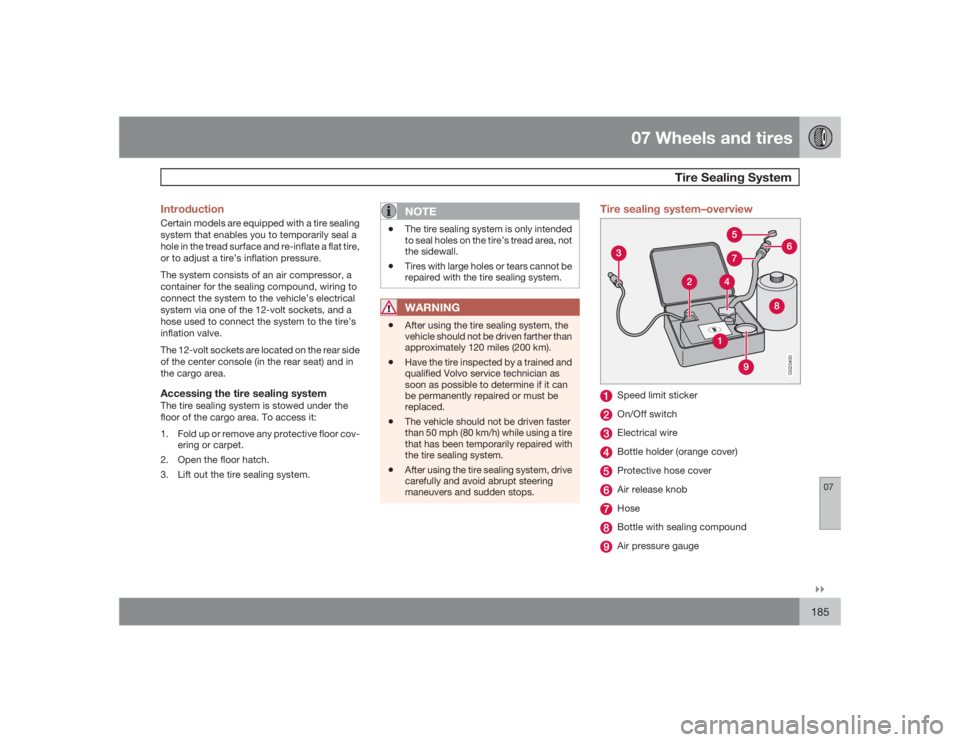
Tire sealing system–overview
G020400
Speed limit stickerOn/Off switchElectrical wireBottle holder (orange cover)Protective hose coverAir release knobHoseBottle with sealing compoundAir pressure gauge
Page 186 of 282
07 Wheels and tiresTire Sealing System
07186
WARNING
Please keep the following points in mind
when using the tire sealing system:•
The sealing compound bottle (no. 8 in
the illustration) contains 1.2-Ethanol
and natural rubber-latex. These sub-
stances are harmful if swallowed.
•
The contents of this bottle may cause
allergic skin reactions or otherwise be
potentially harmful to the skin, the cen-
tral nervous system, and the eyes.
Precautions:
•
Keep out of reach of children.
•
Do not ingest the contents.
•
Avoid prolonged or repeated contact
with the skin.
•
Hands should be washed thoroughly
after handling.
First aid:
•
Skin: Wash affected areas of skin with
soap and water. Get medical attention
if symptoms occur.
•
Eyes: Flush with plenty of water for least
15 minutes, occasionally lifting the
upper and lower eyelids. Get medical
attention if symptoms occur.
•
Inhalation: Move the person to fresh air.
If irritation persists, get medical atten-
tion.
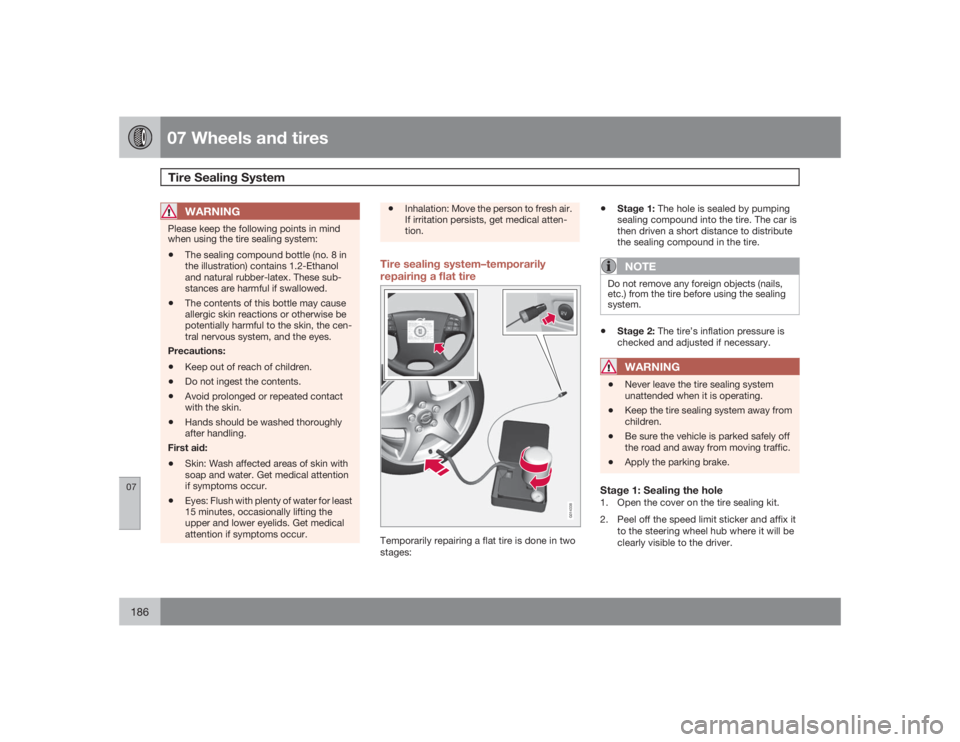
Tire sealing system–temporarily
repairing a flat tire
G014338
Temporarily repairing a flat tire is done in two
stages:
•
Stage 1: The hole is sealed by pumping
sealing compound into the tire. The car is
then driven a short distance to distribute
the sealing compound in the tire.NOTE
Do not remove any foreign objects (nails,
etc.) from the tire before using the sealing
system.•
Stage 2: The tire’s inflation pressure is
checked and adjusted if necessary.WARNING
•
Never leave the tire sealing system
unattended when it is operating.
•
Keep the tire sealing system away from
children.
•
Be sure the vehicle is parked safely off
the road and away from moving traffic.
•
Apply the parking brake.
Stage 1: Sealing the hole1. Open the cover on the tire sealing kit.
2. Peel off the speed limit sticker and affix it
to the steering wheel hub where it will be
clearly visible to the driver.