Page 3 of 388
1
OVERVIEW
FEAT URES/OPER AT IONS
SAFETY AND E MERGENCY FEAT U RES
Engine maintenance 7Fuel tank door release and cap6Hood release 7Indicator symbols 4-5Instrument cluster 4
Instrument panel2-3Keyless entry16
Trunk release 6
Air Conditioning /Heating 13Audio 12-13 Automatic Transmission 8Bottle holders-R ear seat 15
Clock 14Cruise control 14Cup holders 15Light control-Instrument panel14
Lights & turn signals11Parking brake 9Power outlet 13Seat ad justments -Front 9Seat ad justments -Rear 10Seats-Head restraints 10Tilt steering wheel 8Windows-Power 9
Windshield wipers & washers10
Door locks-P ower 16Doors-Child safety locks 16Seat belts 16
Seat belts -Shoulder belt anchor 17Spare tire & tools 17Trunk-Internal release 17
Tire Pressure Monitoring (warning ) System 16
OVERVI EW
FEATUR ES/OPERAT IONS
SAFETY AND
EMERGENC Y FEATUR ES
INDEX
1Visi t your Toyota dealer for information o n this and other customizable
opt ions.
412738M2_r1.qxd 7/30/08 5:37 AM Page 1
Page 11 of 388
9
OVERVIEW
FEAT URES/OPER AT IONS
SAFETY AND EMERGENCY FEAT URES
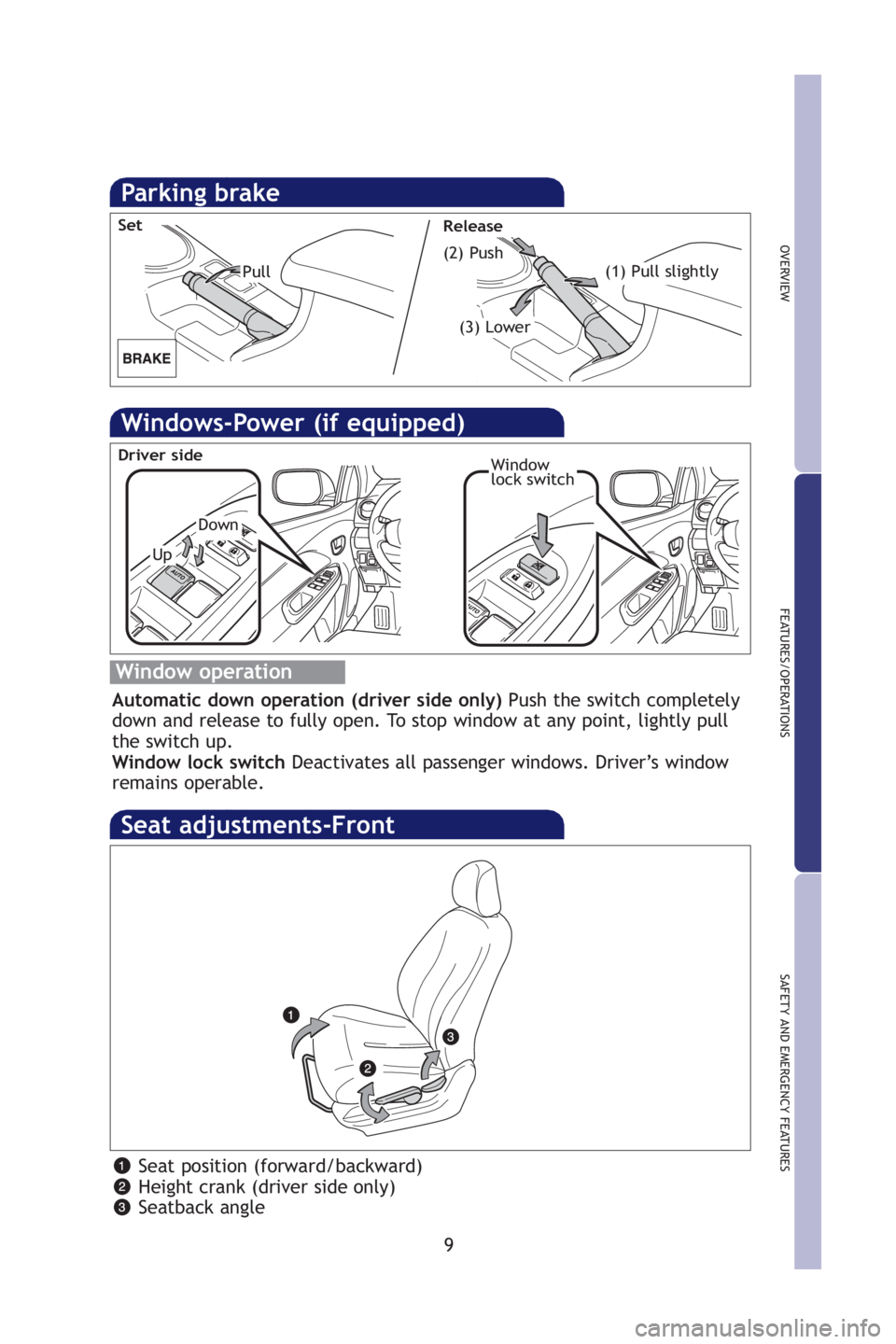
Seat adjustments-Front
Seat position (forward/backward )
Height crank (driver side only)
Seatback angle
Parking brake
Windows-Power (if equipped)
Window operation
Window
lock switch
Up
Driver side
Down
Pull (2)
Push
Set
Release
(1) Pull slightly
(3) Lower
Automatic down operation (driver side only) Push the switch completely
down and release to fully open. To stop window at any point, lightly pull
the switch up.
Window lock switch Deactivates all passenger windows. Driver’s window
remains operable.
M2.qxd 7/28/08 3:45 PM Page 9
Page 33 of 388
11
∗: If equipped
Console box P. 195
Power outlet∗
Cigarette lighter
∗
P. 205
P. 204
Cup holder P. 197
Parking brake lever P. 114
Page 111 of 388
96
2-1. Driving procedures
Driving the vehicle
The following procedures should be observed to ensure safe driv-
ing.
n Starting the engine ( → P. 106)
n Driving
Automatic transmission
With the brake pedal depressed, shift the shift lever to D. (→ P. 110)
Release the parking brake. ( →P. 114)
Gradually release the brake pedal and gently depress the
accelerator pedal to accelerate the vehicle.
Manual transmission With the clutch pedal fully depressed, shift the shift lever to
1. (→ P. 112)
Release the parking brake. ( →P. 114)
Gradually release the clutch pedal. At the same time, gently
depress the accelerator pedal to accelerate the vehicle.
n Stopping
Automatic transmission
With the shift lever in D, depress the brake pedal.
If necessary, set the parking brake.
When the vehicle is stopped for an extended period of time, shift
the shift lever to P or N. ( →P. 110)
Manual transmission
With the clutch pedal fully depressed, depress the brake
pedal.
If necessary, set the parking brake.
When the vehicle is stopped for an extended period of time, shift
the shift lever to N. ( →P. 112)
Page 112 of 388

97
2-1. Driving procedures
2
When driving
Starting on a steep uphill
Automatic transmission With the brake pedal depressed, firmly set the parking brake
and shift the shift lever to D.
Gently depress the accelerator pedal.
Release the parking brake.
Manual transmission With the parking brake firmly set and the clutch pedal fully
depressed, shift the shift lever to 1.
nParking the vehicle
Automatic transmission
With the shift lever in D, depress the brake pedal.
Set the parking brake. ( →P. 114)
Shift the shift lever to P. ( →P. 110)
When parking on a hill, if necessary, block the wheels.
Turn the engine switch off to stop the engine.
Lock the door, making sure that you have the key on your
person.
Manual transmission
With the clutch pedal fully depressed, depress the brake
pedal.
Set the parking brake. ( →P. 114)
Shift the shift lever to N. ( →P. 112)
When parking on a hill, shift the shift lever to 1 or R. If necessary,
block the wheels.
Turn the engine switch off to stop the engine.
Lock the door, making sure that you have the key on your
person.
Page 113 of 388

98 2-1. Driving procedures
Lightly depress the accelerator pedal at the same time as
gradually releasing the clutch pedal.
Release the parking brake.
nDriving in the rain
lDrive carefully when it is raining, because visibility will be reduced, the
windows may become fogged-up, and the road will be slippery.
l Drive carefully when it starts to rain, because the road surface will be
especially slippery.
l Refrain from high speeds when driving on an expressway in the rain,
because there may be a layer of water between the tires and the road
surface, preventing the steering and brakes from operating properly.
n Breaking in your new Toyota
To extend the life of the vehicle, the following precautions are recommended
to observe:
lFor the first 200 miles (300 km):
Avoid sudden stops.
l For the first 500 miles (800 km):
Do not tow a trailer.
l For the first 1000 miles (1600 km):
• Do not drive at extremely high speeds.
• Avoid sudden acceleration.
• Do not drive continuously in the low gears.
• Do not drive at a constant speed for extended periods.
n Operating your vehicle in a foreign country
Comply with the relevant vehicle registration laws and confirm the availability
of the correct fuel. ( →P. 331)
n Normal characteristics afte r turning off the engine
Approximately five hours after the engine is turned off, you may hear sound
coming from under the vehicle for several minutes. This is the sound of a
fuel evaporation leakage check and, it does not indicate a malfunction.
Page 115 of 388

100 2-1. Driving procedures
CAUTION
nWhen driving the vehicle
lDo not under any circumstances shift the shift lever to P, R or N (automatic
transmission) or R (manual transmission) while the vehicle is moving.
Doing so can cause significant damage to the transmission system and
may result in a loss of vehicle control.
l Do not shift the shift lever to N while the vehicle is moving.
Doing so may cause the engine brake to not operate properly and lead to
an accident.
l Do not turn the engine off while driving.
The power steering and brake booster systems will not operate properly if
the engine is not running.
l Use engine braking (downshift) to maintain a safe speed when driving
down a steep hill.
Using the brakes continuously may cause the brakes to overheat and lose
effectiveness. ( →P. 110,112)
l When stopped on an inclined surface, use the brake pedal and parking
brake to prevent the vehicle from rolling backward or forward and causing
an accident.
l Do not adjust the position of the steering wheel, the seat, or the inside or
outside rear view mirrors while driving.
Doing so may result in a loss of vehicle control that can cause accidents
that may result in death or serious injury.
l Always check that all passengers’ arms, heads or other parts of their bod-
ies are not outside the vehicle, as this may result in death or serious injury.
l Do not drive in excess of the speed limit. Even if the legal speed limit per-
mits it, do not drive over 85 mph (140 km/h) unless your vehicle has high-
speed capability tires. Driving over 85 mph (140 km/h) may result in tire
failure, loss of control and possible injury. Be sure to consult a tire dealer
to determine whether the tires on your vehicle are high-speed capability
tires or not before driving at such speeds.
n When driving on slippery road surfaces
lSudden braking, acceleration and steering may cause tire slippage and
reduce your ability to control the vehicle, resulting in an accident.
Page 117 of 388

102 2-1. Driving procedures
CAUTION
nWhen the vehicle is parked
lDo not leave glasses, cigarette lighters, spray cans, or soft drink cans in
the vehicle when it is in the sun.
Doing so may result in the following.
• Gas may leak from a cigarette lighter or spray can, and may lead to a
fire.
• The temperature inside the vehicle may cause the plastic lenses and plastic material of eye glasses to deform or crack.
• Soft drink cans may fracture, causing the contents to spray over the interior of the vehicle, and may also cause a short circuit in the vehi-
cle’s electrical components.
l Always apply the parking brake, shift the shift lever to P (automatic trans-
mission only), stop the engine and lock the vehicle.
Do not leave the vehicle unattended while the engine is running.
l Do not touch the exhaust pipe while the engine is running or immediately
after turning the engine off.
Doing so may cause burns.
l Do not leave the engine running in an area with snow build-up, or where it
is snowing. If snowbanks build up around the vehicle while the engine is
running, exhaust gases may collect and enter the vehicle. This may lead
to death or a serious health hazard.
n Exhaust gases
Exhaust gases include harmful carbon monoxide (CO) that is colorless and
odorless. Inhaling exhaust gases may lead to death or a serious health haz-
ard.
lIf the vehicle is in a poorly ventilated area, stop the engine. In a closed
area, such as a garage, exhaust gases may collect and enter the vehicle.
This may lead to death or a serious health hazard.
l The exhaust should be checked occasionally. If there is a hole or crack
caused by corrosion, damage to a joint or abnormal exhaust noise, be
sure to have the vehicle inspected and repaired by your Toyota dealer.
Failure to do so may allow exhaust gases to enter the vehicle, resulting in
death or a serious health hazard.