Page 115 of 392
When driving2
115
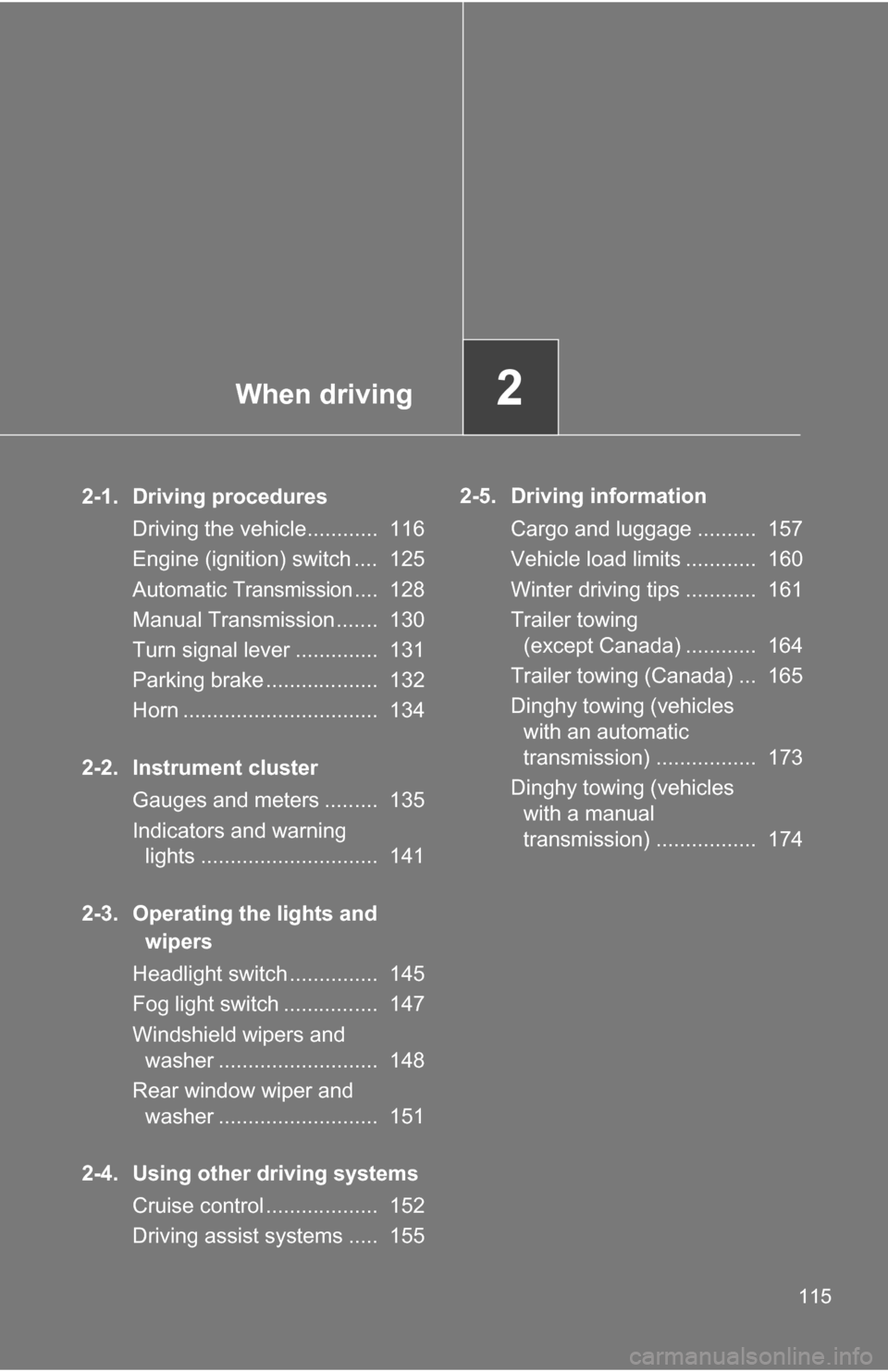
2-1. Driving proceduresDriving the vehicle............ 116
Engine (ignition) switch .... 125
Automatic
Transmission.... 128
Manual Transmission ....... 130
Turn signal lever .............. 131
Parking brake ................... 132
Horn ................................. 134
2-2. Instrument cluster Gauges and meters ......... 135
Indicators and warning lights .............................. 141
2-3. Operating the lights and wipers
Headlight switch ............... 145
Fog light switch ................ 147
Windshield wipers and washer ........................... 148
Rear window wiper and washer ........................... 151
2-4. Using other driving systems Cruise control ................... 152
Driving assist systems ..... 155 2-5. Driving information
Cargo and luggage .......... 157
Vehicle load limits ............ 160
Winter driving tips ............ 161
Trailer towing (except Canada) ............ 164
Trailer towing (Canada) ... 165
Dinghy towing (vehicles with an automatic
transmission) ................. 173
Dinghy towing (vehicles with a manual
transmission) ................. 174
Page 123 of 392

123
2-1. Driving procedures
2
When driving
CAUTION
■
When braking the vehicle
●If the power brake assist function does not operate, do not follow other
vehicles closely and avoid downhills or sharp turns that require braking.
In this case, braking is still possible, but it will require more force on the
pedal than usual. Braking distance may also increase.
● Do not pump the brake pedal if the engine stalls.
Each push on the brake pedal uses up the reserve for the power-assisted
brakes.
● The brake system consists of 2 individual hydraulic systems: If one of the
systems fails, the other will still operate. In this case, the brake pedal
should be depressed more firmly than usual and braking distance
becomes longer.
Do not drive your vehicle with only a single brake system. Have your
brakes fixed immediately.
NOTICE
■When driving the vehicle
Vehicles with a manual transmission
● Do not rest your foot on the clutch pedal while driving.
Doing so may cause clutch trouble.
● Do not use any gears other than the first gear when starting off and mov-
ing forward.
Doing so may damage the clutch.
● Do not use the clutch to hold the vehicle when stopping on an uphill grade.
Doing so may damage the clutch.
Vehicles with an automatic transmission
● Do not use the accelerator pedal or depress accelerator and brake pedals
together to hold the vehicle on a hill.
■ When parking the vehicle
Vehicles with an automatic transmission: Always put the shift lever in P.
Failure to do so may cause the vehicle to move or the vehicle may acceler-
ate suddenly if the accelerator pedal is accidentally depressed.
Page 298 of 392
298 5-1. Essential information
■Emergency towin g procedure
Release the parking brake.
Put the transmission in N.
Turn the engine switch to the ACC (engine off) or ON (engine run-
ning) position.
CAUTION
■ Caution while towing
●Use extreme caution when towing the vehicle.
Avoid sudden starts or erratic driving maneuvers which place excessive
stress on the emergency towing eyelet and the cables or chains.
● If the engine is not running, the power assist for the brakes and steering
will not function, making steering and braking more difficult.
NOTICE
■To prevent causing serious dama ge to the transmission
(vehicles with an automatic transmission)
Never tow this vehicle from the rear with the front wheels on the ground.
This may cause serious damage to the transmission.
■ When towing a vehicle without using a towing dolly
(vehicles with a manual transmission)
Do not tow with the key removed or in the LOCK position.
