2009 TOYOTA YARIS Upright
[x] Cancel search: UprightPage 47 of 392
47
1-3. Adjustable components (s
eats, mirrors, steering wheel)
1
Before driving
CAUTION
■Seat adjustment
●Do not recline the seat more than necessary when the vehicle is in motion
to reduce the risk of sliding under the lap belt. If the seat is too reclined,
the lap belt may slide past the hips and apply restraint forces directly to the
abdomen or your neck may contact the shoulder belt, increasing the risk of
death or serious injury in the event of an accident.
● After adjusting the seat, make sure that the seat is locked in position.
■ After returning the seatback to the upright position
Observe the following precautions. Failure to do so may result in death or
serious injury.
●Make sure that the seatback is securely locked in position by lightly rock-
ing it back and forth.
● Check that the seat belts and buckles are not twisted or caught under the
seat.
● Arrange the seat belts in the proper positions for ready use.
NOTICE
■Stowing the seat belts
The seat belts and the buckles must be stowed before you fold down the
rear seat backs.
■ When returning the seatback to the upright position
Do not pull the pocket that stores the seat belt comfort guide.
Page 79 of 392
79
1
Before driving
1-7. Safety information
Correct driving posture
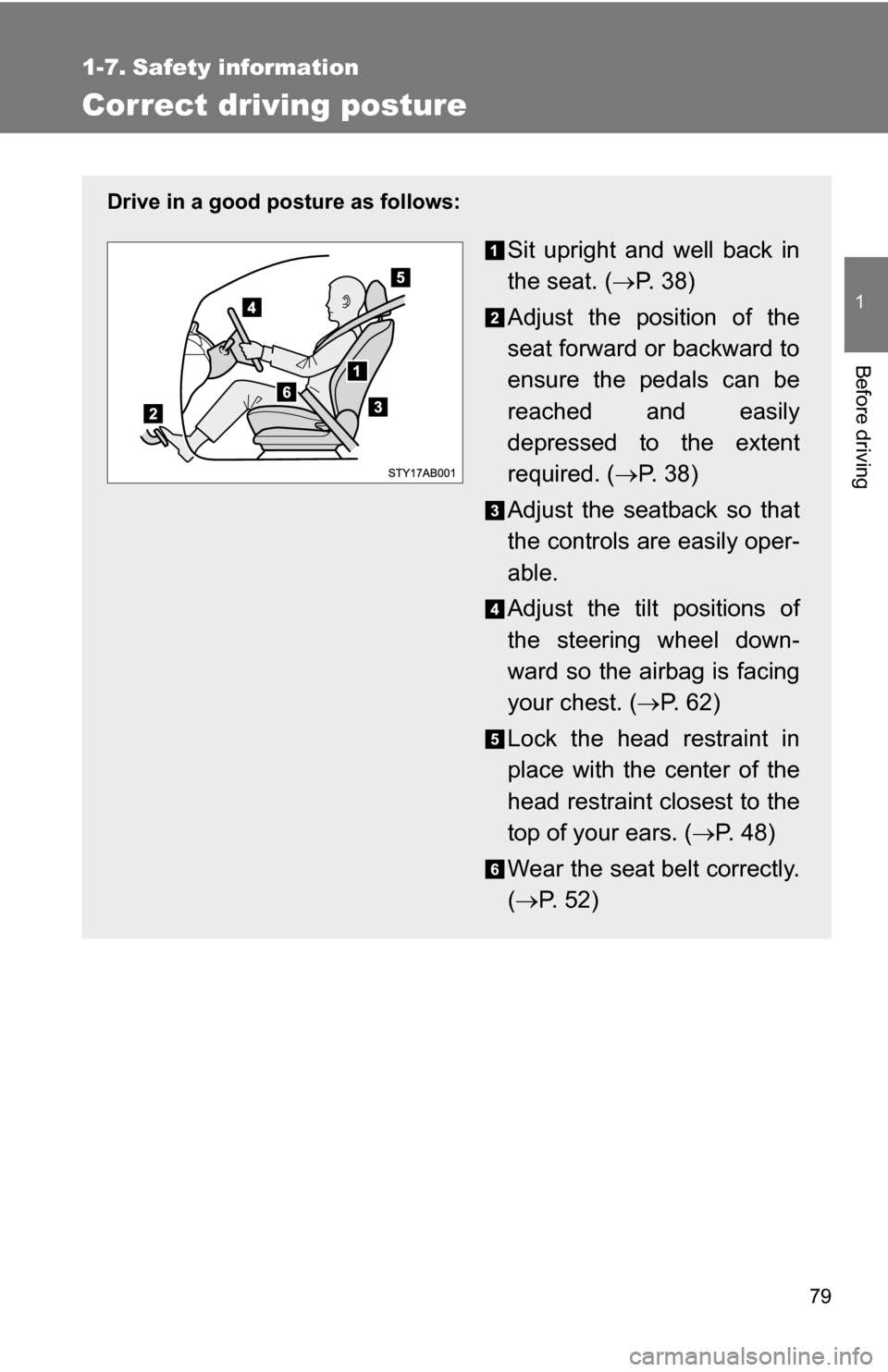
Drive in a good posture as follows:
Sit upright and well back in
the seat. (P. 3 8 )
Adjust the position of the
seat forward or backward to
ensure the pedals can be
reached and easily
depressed to the extent
required. ( P. 38)
Adjust the seatback so that
the controls are easily oper-
able.
Adjust the tilt positions of
the steering wheel down-
ward so the airbag is facing
your chest. ( P. 6 2 )
Lock the head restraint in
place with the center of the
head restraint closest to the
top of your ears. ( P. 48)
Wear the seat belt correctly.
( P. 52)
Page 89 of 392
89
1-7. Safety information
1
Before driving
CAUTION
■
SRS airbag precautions
●The SRS front passenger airbag also deploys with considerable force, and
can cause death or serious injury especially if the front passenger is very
close to the airbag. The front passenger seat should be as far from the air-
bag as possible with the seatback adjusted, so the front passenger sits
upright.
● Improperly seated and/or restrained infants and children can be killed or
seriously injured by a deploying airbag. An infant or child who is too small
to use a seat belt should be properly secured using a child restraint sys-
tem. Toyota strongly recommends that all infants and children be placed in
the rear seats of the vehicle and properly restrained. The rear seats are
the safest for infants and children. ( P. 98)
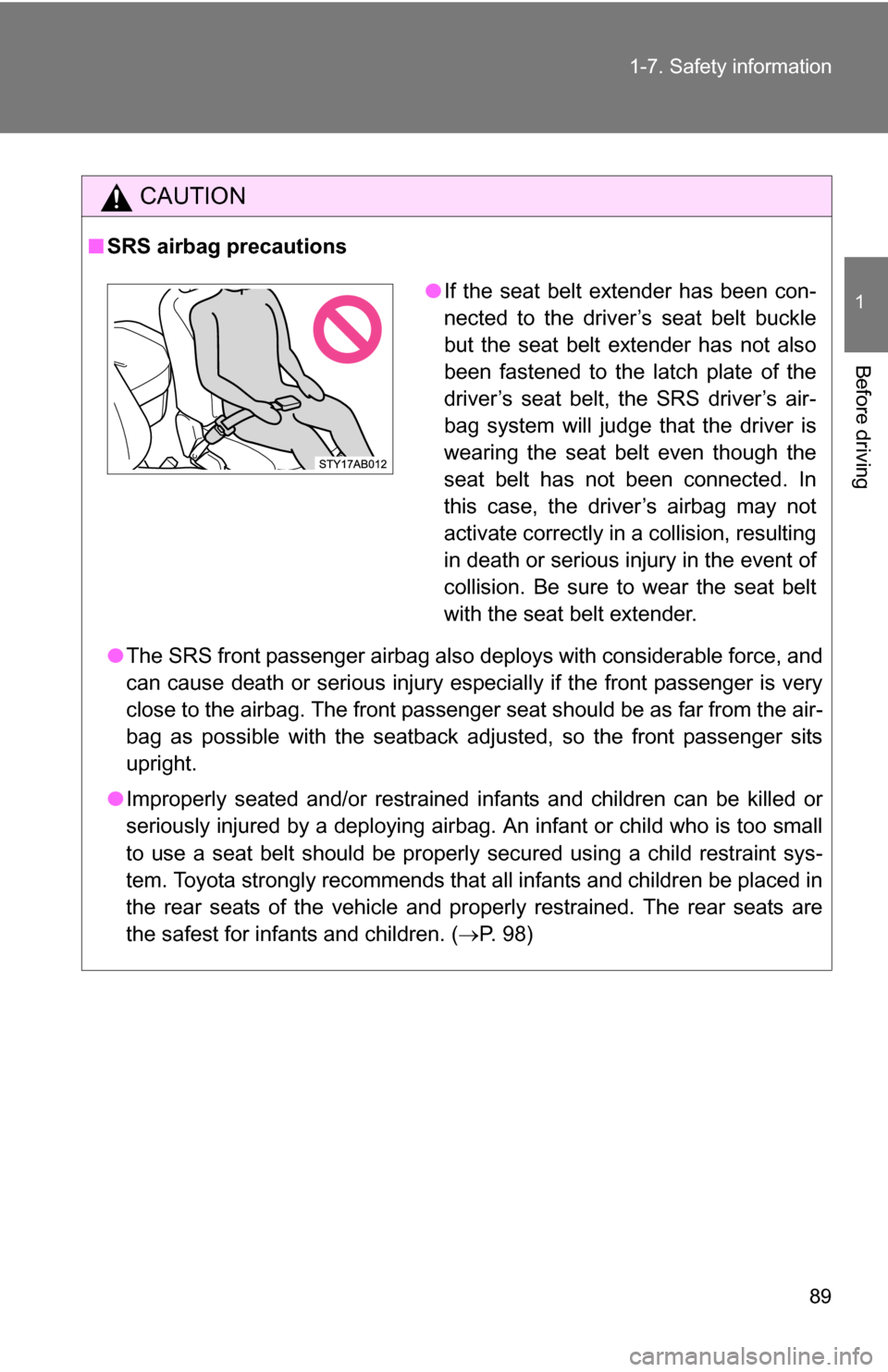
●If the seat belt extender has been con-
nected to the driver’s seat belt buckle
but the seat belt extender has not also
been fastened to the latch plate of the
driver’s seat belt, the SRS driver’s air-
bag system will judge that the driver is
wearing the seat belt even though the
seat belt has not been connected. In
this case, the driver’s airbag may not
activate correctly in a collision, resulting
in death or serious injury in the event of
collision. Be sure to wear the seat belt
with the seat belt extender.
Page 96 of 392
96 1-7. Safety information
CAUTION
■Front passenger occupant cl assification system precautions
Observe the following precautions regarding front passenger occupant clas-
sification system.
Failure to do so may cause death or serious injury.
● Wear the seat belt properly.
● Make sure the front passenger’s seat belt tab has not been left inserted
into the buckle before someone sits in the front passenger seat.
● Make sure the AIR BAG OFF indicator light is not illuminated when using
the seat belt extender for the front passenger seat. If the AIR BAG OFF
indicator light is illuminated, disconnect the extender tongue from the seat
belt buckle, then reconnect the seat belt. Reconnect the seat belt extender
after making sure the AIR BAG ON indicator light is illuminated. If you use
the seat belt extender while the AIR BAG OFF indicator light is illuminated,
the front passenger airbag and side airbag on the front passenger side
may not activate correctly, which could cause death or serious injury in the
event of collision.
● Do not apply a heavy load to the front passenger seat or equipment.
● Do not put weight on the front passenger seat by putting your hands or
feet on the front passenger seat seatback from the rear passenger seat.
● Do not let a rear passenger lift the front passenger seat with their feet or
press on the seatback with their legs.
● Do not put objects under the front passenger seat.
● Do not recline the front passenger seatback so far that it touches a rear
seat. This may cause the AIR BAG OFF indicator light to be illuminated,
which indicates that the passenger’s airbags will not deploy in the event of
a severe accident. If the seatback touches the rear seat, return the seat-
back to a position where it does not touch the rear seat. Keep the front\
passenger seatback as upright as possible when the vehicle is moving.
Reclining the seatback excessively may lessen the effectiveness of the
seat belt system.
Page 100 of 392
100 1-7. Safety information
CAUTION
■Child restraint precautions
●For effective protection in automobile accidents and sudden stops, a child
must be properly restrained, using a seat belt or child restraint system
depending on the age and size of the child. Holding a child in your arms is
not a substitute for a child restraint system. In an accident, the child can be
crushed against the windshield, or between you and the vehicle's interior.
● Toyota strongly urges the use of a proper child restraint system that con-
forms to the size of the child, installed on the rear seat. According to acci-
dent statistics, the child is safer when properly restrained in the rear seat
than in the front seat.
● Never install a rear-facing child restraint system on the front passenger
seat even if AIR BAG OFF indicator light is illuminated. In the event of an
accident, the force of the rapid inflation of the front passenger airbag can
cause death or serious injury to the child if the rear-facing child restraint
system is installed on the front passenger seat.
● A forward-facing child restraint system may be installed on the front pas-
senger seat only when it is unavoidable. A child restraint system that
requires a top tether strap should not be used in the front passenger seat
since there is no top tether strap anchor for the front passenger seat.
Adjust the seatback as upright as possible and always move the seat as
far back as possible even if the AIR BA G OFF indicator light is illuminated,
because the front passenger airbag could inflate with considerable speed
and force. Otherwise, the child may be killed or seriously injured.
● Do not use the seat belt extender when installing a child restraint system
on the front or rear passenger seat. If installing a child restraint system
with the seat belt extender connected to the seat belt, the seat belt will not
securely hold the child restraint system, which could cause death or seri-
ous injury to the child or other passengers in the event of collision.
● Vehicles with side airbags and curtain shield airbags: Do not allow the
child to lean his/her head or any part of his/her body against the door or
the area of the seat, front and rear pill ars or roof side rail from which the
side airbags or curtain shield airbags deploy even if the child is seated in
the child restraint system. It is dangerous if the side airbags and curtain
shield airbags inflate, and the impact could cause death or serious injury to
the child.
Page 104 of 392
104 1-7. Safety information
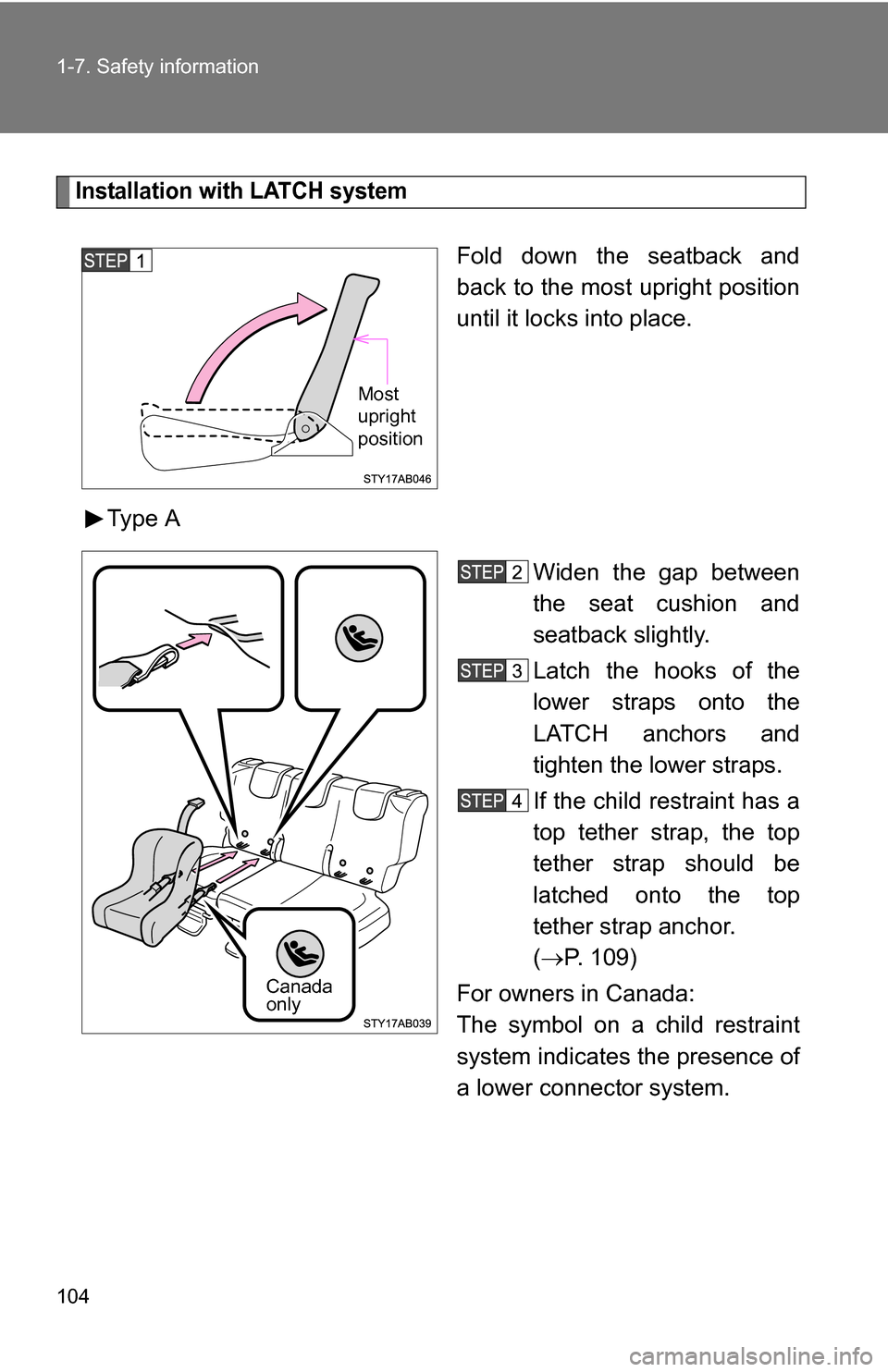
Installation with LATCH system
Fold down the seatback and
back to the most upright position
until it locks into place.
Type A Widen the gap between
the seat cushion and
seatback slightly.
Latch the hooks of the
lower straps onto the
LATCH anchors and
tighten the lower straps.
If the child restraint has a
top tether strap, the top
tether strap should be
latched onto the top
tether strap anchor.
( P. 109)
For owners in Canada:
The symbol on a child restraint
system indicates the presence of
a lower connector system.
Most
upright
position
Canada
only
Page 112 of 392
112 1-7. Safety information
CAUTION
■When installing a child restraint system
●Split rear seats: When installing a child restraint system in the rear center
seat, adjust both seat cushions to the same position and align seatbacks
at the same angle. The seatbacks must be adjusted to the same angle.
Otherwise, the child restraint system cannot be securely restrained and
this may cause death or serious injuries in a collision.
● Split rear seats: When using the LATCH anchors for a child restraint sys-
tem, move the seat as far back as possible and adjust the seatback as
upright as possible.
● When a booster seat is installed, always ensure that the shoulder belt is
positioned across the center of the child's shoulder. The belt should be
kept away from the child's neck, but not so that it could fall off the child's
shoulder. Failing to do so may result in death or serious injury in the event
of an accident or sudden braking.
● Ensure that the belt and tab are securely locked and the seat belt is not
twisted.
● Push and pull the child restraint system from side to side and forward to be
sure it is secure.
● After securing a child restraint system, never adjust the seat.
● Follow all installation instructions provided by the child restraint system
manufacturer.
● Split rear seats: When a child restraint system with a top tether strap is
installed, do not install the head restraint. The head restraint may interfere
with the top tether strap preventing secure installation of the child restraint
system.
● Split rear seats: Make sure to properly store the removed head restraint in
a secure place when you use the child restraint system on the rear seats.