Page 265 of 392
265
4-3. Do-it-yourself maintenance
4
Maintenance and care
■
Inspection and adjustment procedure
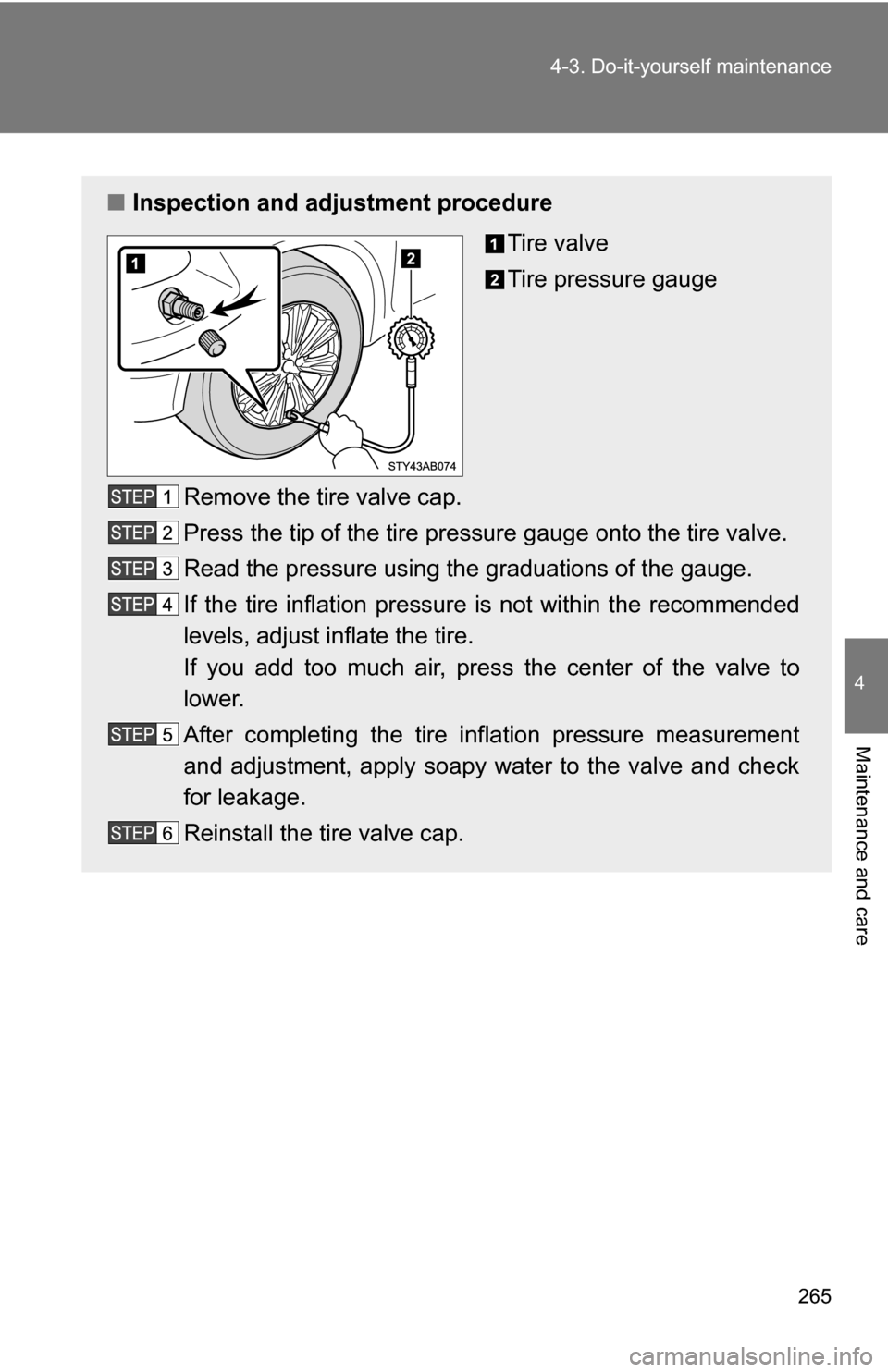
Tire valve
Tire pressure gauge
Remove the tire valve cap.
Press the tip of the tire pressure gauge onto the tire valve.
Read the pressure using the graduations of the gauge.
If the tire inflation pressure is not within the recommended
levels, adjust inflate the tire.
If you add too much air, pres s the center of the valve to
lower.
After completing the tire inflation pressure measurement
and adjustment, apply soapy water to the valve and check
for leakage.
Reinstall the tire valve cap.
Page 266 of 392
266 4-3. Do-it-yourself maintenance
■Tire inflation pressure check interval
You should check tire pressure every two weeks, or at least once a
month.
Do not forget to check the spare tire.
■Effects of incorrect tire inflation pressure
Driving with incorrect tire inflation pressure ma y result in the following:
●Reduced fuel efficiency
●Reduced driving comfort and tire life
●Reduced safety
●Damage to the drive train
If a tire needs frequent refilling, have it checked by your Toyota dealer.
■
Instructions for checking tire inflation pressure
When checking tire inflation pressure, observe the following:
●Check only when the tires are cold.
If your vehicle has been parked for at least 3 hours and has not been
driven for more than 1 mile or 1.5 km, you will get an accurate cold
tire inflation pressure reading.
●Always use a tire pressure gauge.
The appearance of the tire can be mi sleading. In addition, tire infla-
tion pressures that are even just a few pounds off can degrade ride
and handling.
●Do not bleed or reduce tire inflation pressure after driving. It is normal
for the tire inflation pressure to be higher after driving.
●Never exceed the vehicle capacity weight.
Passengers and luggage weight should be placed so that the vehicle
is balanced.
Page 268 of 392
268
4-3. Do-it-yourself maintenance
Wheels
■When replacing wheels
The wheels of your Toyota are equipped with tire pressure warning
valves and transmitters that allow the tire pressure warning system to
provide advanced warning in the event of a loss in tire inflation pressure.
Whenever wheels are replaced, the tire pressure warning valves and
transmitters must be installed. (P. 259)
If a wheel is bent, cracked or heavily corroded, it should be
replaced.
Otherwise, the tire may separate from the wheel or cause loss of
handling control.
■ Wheel selection
When replacing wheels, care should be taken to ensure that
they are equivalent to those removed in load capacity, diameter,
rim width, and offset.
Replacement wheels are available at your Toyota dealer.
Toyota does not recommend using:
●Wheels of different sizes or types
● Used wheels
● Bent wheels that have been straightened
■ Aluminum wheel precautions (if equipped)
●Use only Toyota wheel nuts and wrench designed for use with
your aluminum wheels.
● When rotating, repairing or changing your tires, check that the
wheel nuts are still tight after driving 1000 miles (1600 km).
● Be careful not to damage the aluminum wheels when using
tire chains.
● Use only Toyota genuine balance weights or equivalent and a
plastic or rubber hammer when balancing your wheels.
Page 271 of 392
271
4-3. Do-it-yourself maintenance
4
Maintenance and care
■
Checking interval
Inspect and replace the air conditioning filter according to the maintenance
schedule. In dusty areas or areas with heavy traffic flow, early replacement
may be required. (For scheduled maintenance information, please refer to
the “Scheduled Maintenance Guide” or “Owner’s Manual Supplement”.)
■ If air flow from the vents decreases dramatically
The filter may be clogged. Check the filter and replace if necessary.
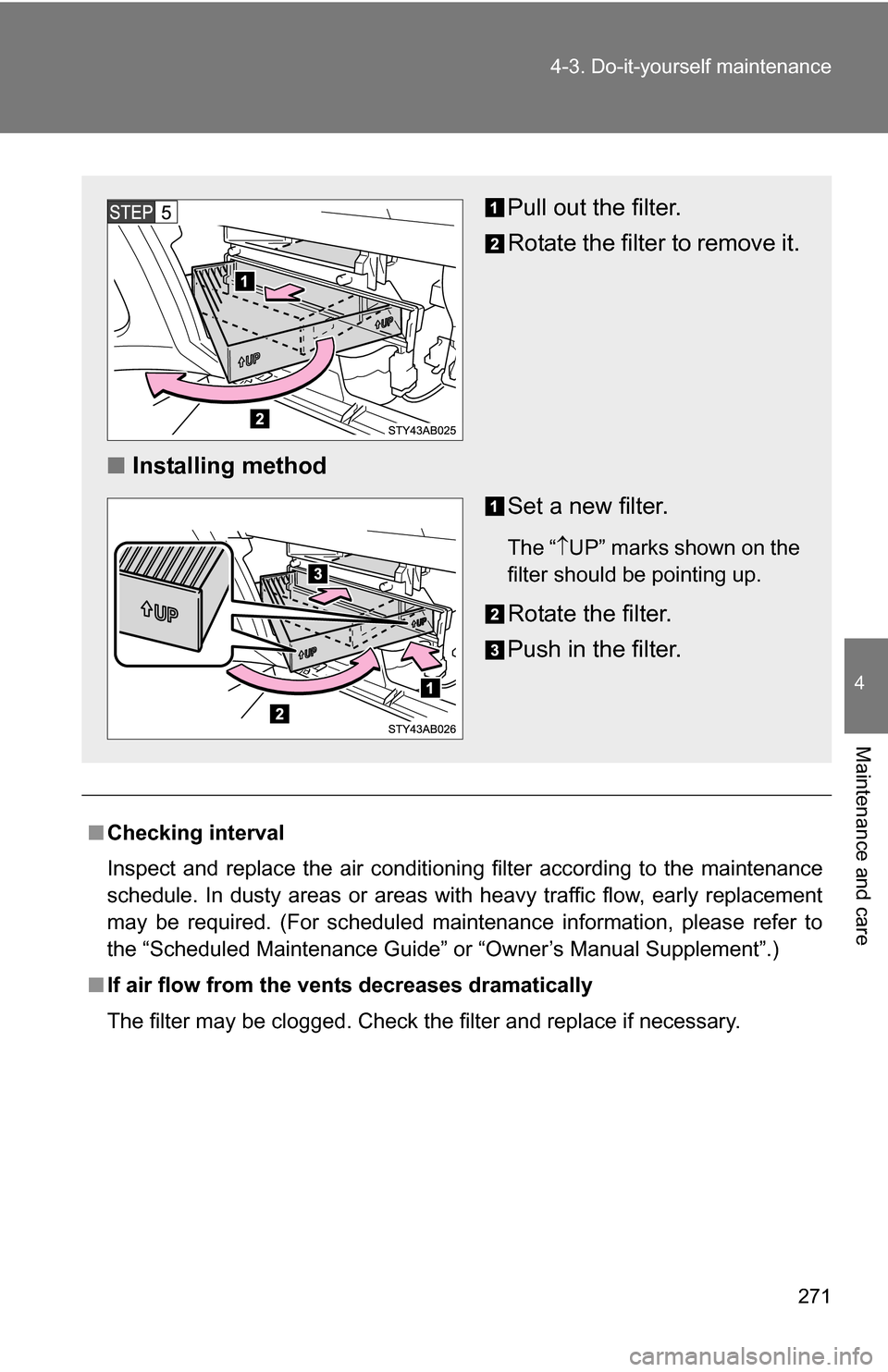
Pull out the filter.
Rotate the filter to remove it.
■ Installing method
Set a new filter.
The“ UP” marks shown on the
filter should be pointing up.
Rotate the filter.
Push in the filter.
Page 275 of 392
275
4-3. Do-it-yourself maintenance
4
Maintenance and care
Checking and replacing fuses
If any of the electrical components do not operate, a fuse may have
blown. If this happens, check and replace the fuses as necessary.
Turn the engine switch off.
The fuses are located in the following places. To check the
fuses, follow the in structions below.
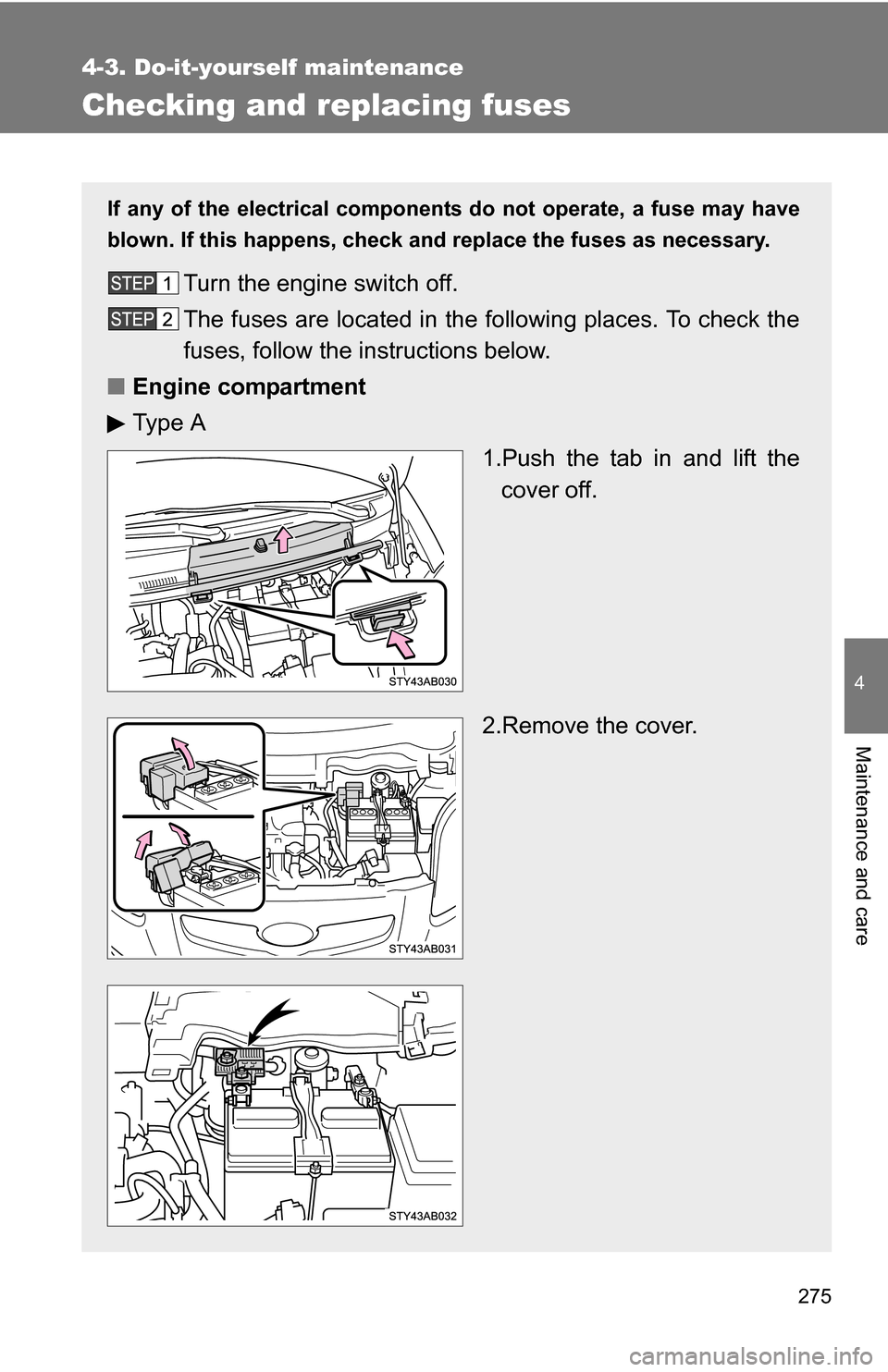
■ Engine compartment
Ty p e A
1.Push the tab in and lift thecover off.
2.Remove the cover.
Page 277 of 392
277
4-3. Do-it-yourself maintenance
4
Maintenance and care
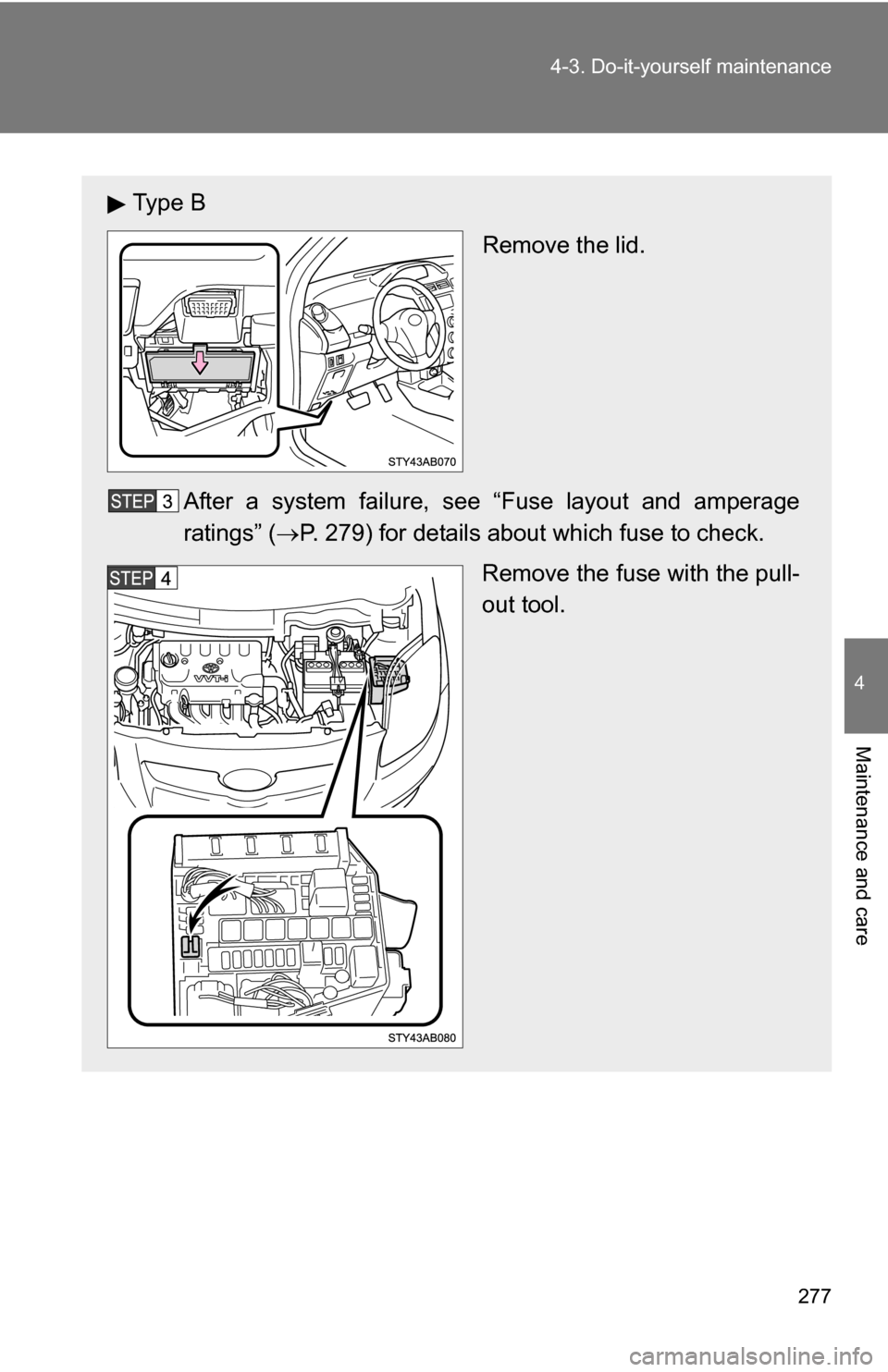
Ty p e B
Remove the lid.
After a system failure, s ee “Fuse layout and amperage
ratings” ( P. 279) for details about which fuse to check.
Remove the fuse with the pull-
out tool.
Page 278 of 392
278 4-3. Do-it-yourself maintenance
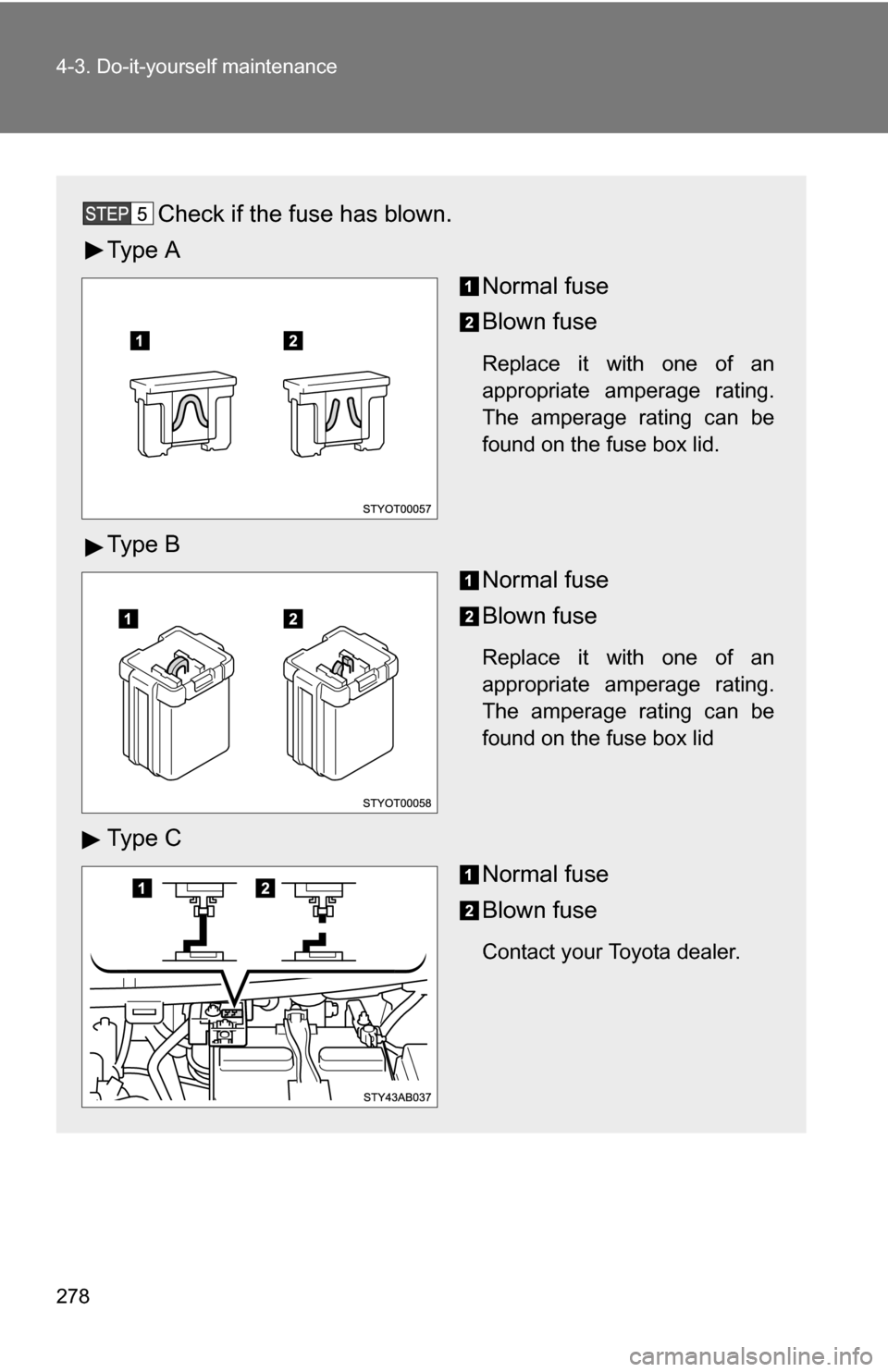
Check if the fuse has blown.
Ty p e A Normal fuse
Blown fuse
Replace it with one of an
appropriate amperage rating.
The amperage rating can be
found on the fuse box lid.
Ty p e BNormal fuse
Blown fuse
Replace it with one of an
appropriate amperage rating.
The amperage rating can be
found on the fuse box lid
Ty p e CNormal fuse
Blown fuse
Contact your Toyota dealer.
Page 286 of 392
286
4-3. Do-it-yourself maintenance
Light bulbs
You may replace the following bulbs yourself. The difficulty level of
replacement varies depending on the bulb. If necessary bulb
replacement seems difficult to perfor m, contact your Toyota dealer.
For more information about replacing other light bulbs, contact your
Toyota dealer.
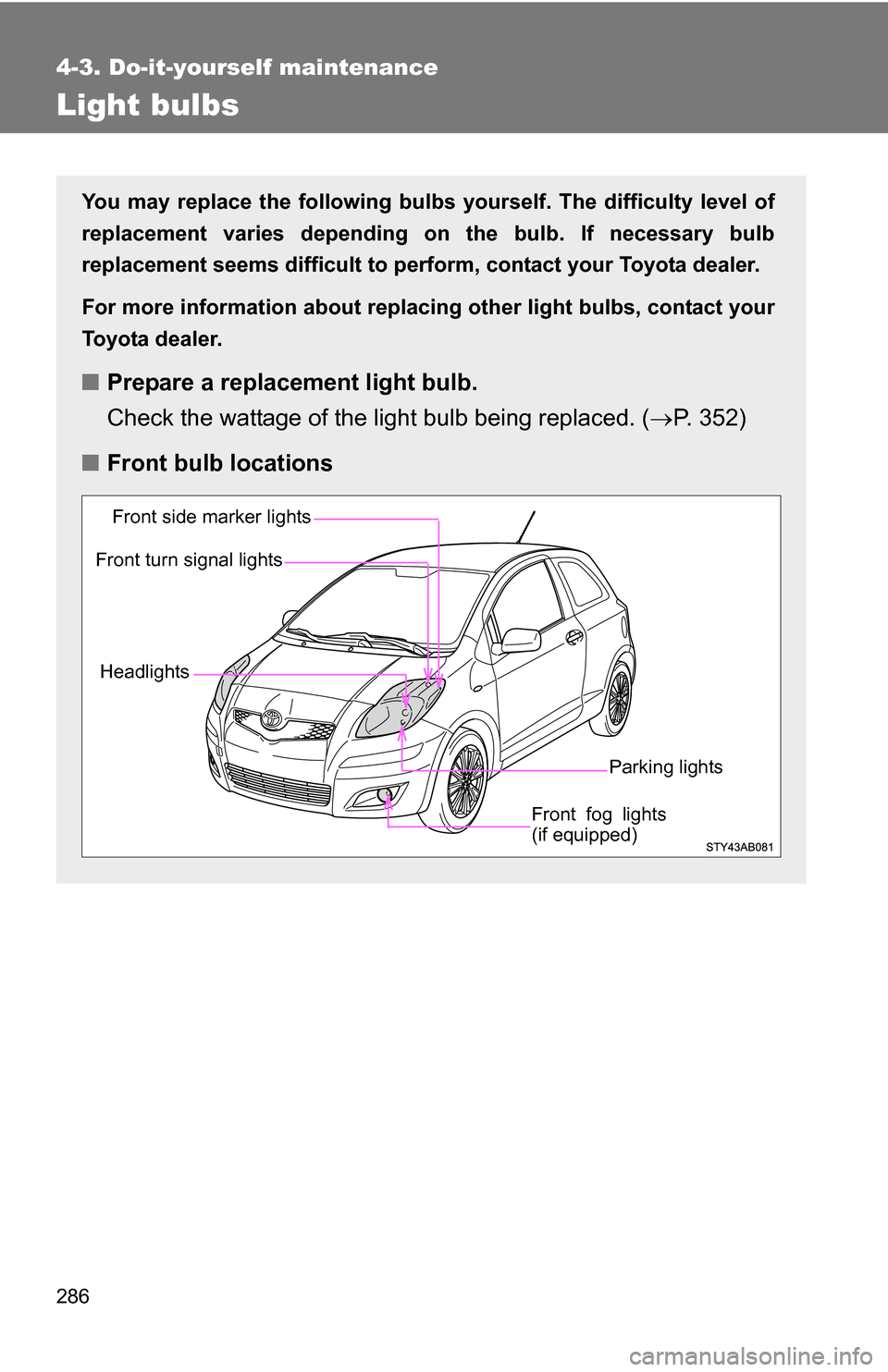
■ Prepare a replacement light bulb.
Check the wattage of the light bulb being replaced. ( P. 352)
■ Front bulb locations
Headlights
Front fog lights
(if equipped)
Front side marker lights
Front turn signal lights
Parking lights