Page 76 of 402
62
1-3. Adjustable components (seats, mirrors, steering wheel)
Steering wheel
CAUTION
nCaution while driving
Do not adjust the steering wheel while driving.
Doing so may cause the driver to mishandle the vehicle and an accident
may occur resulting in death or serious injury.
n After adjusting the steering wheel
Make sure that the steering wheel is securely locked.
Otherwise, the steering wheel may move suddenly, possibly causing an
accident and resulting in death or serious injury.
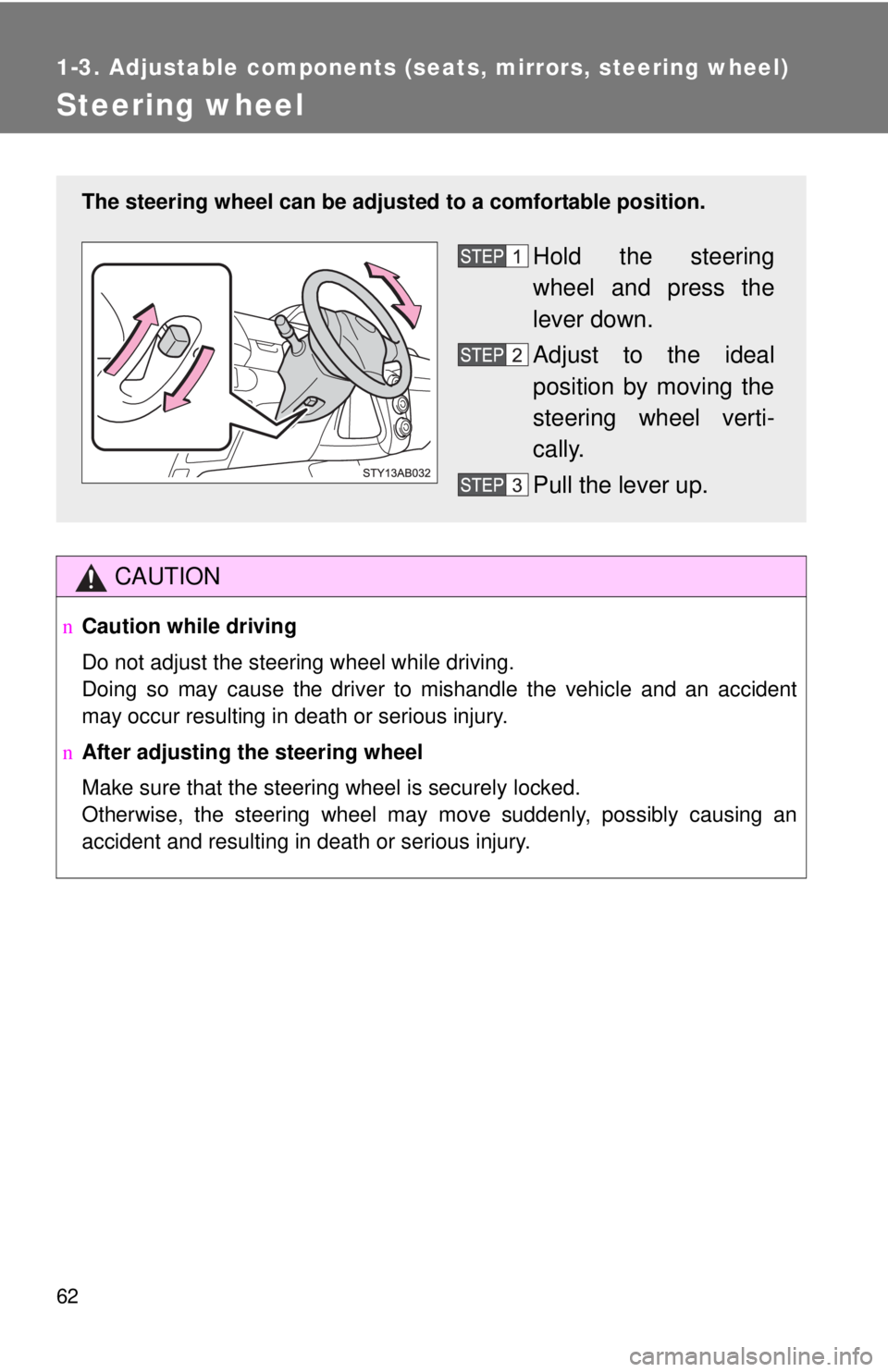
The steering wheel can be adjust ed to a comfortable position.
Hold the steering
wheel and press the
lever down.
Adjust to the ideal
position by moving the
ste
ering wheel verti -
cally.
Pull the lever up.
Page 77 of 402
63
1
1-3. Adjustable components (seats, mirrors, steering wheel)
Before driving
Anti-glare inside rear view mirror
CAUTION
nCaution while driving
Do not adjust the position of the mirror while driving.
Doing so may lead to mishandling of the vehicle and an accident, resulting in
death or serious injury.
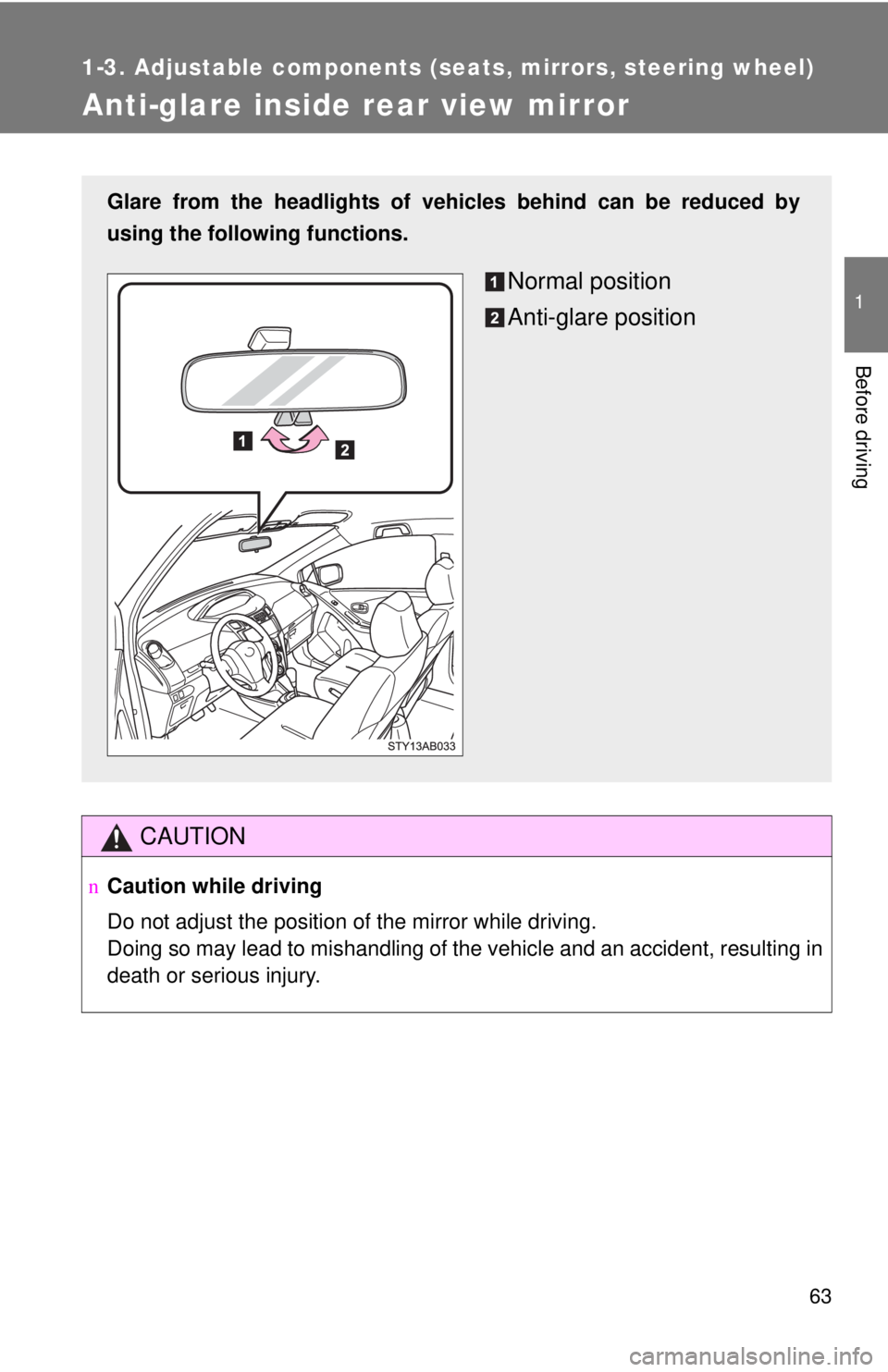
Glare from the headlights of vehic les behind can be reduced by
using the following functions.
Normal position
Anti-glare position
Page 78 of 402
64
1-3. Adjustable components (seats, mirrors, steering wheel)
Outside rear view mirrors
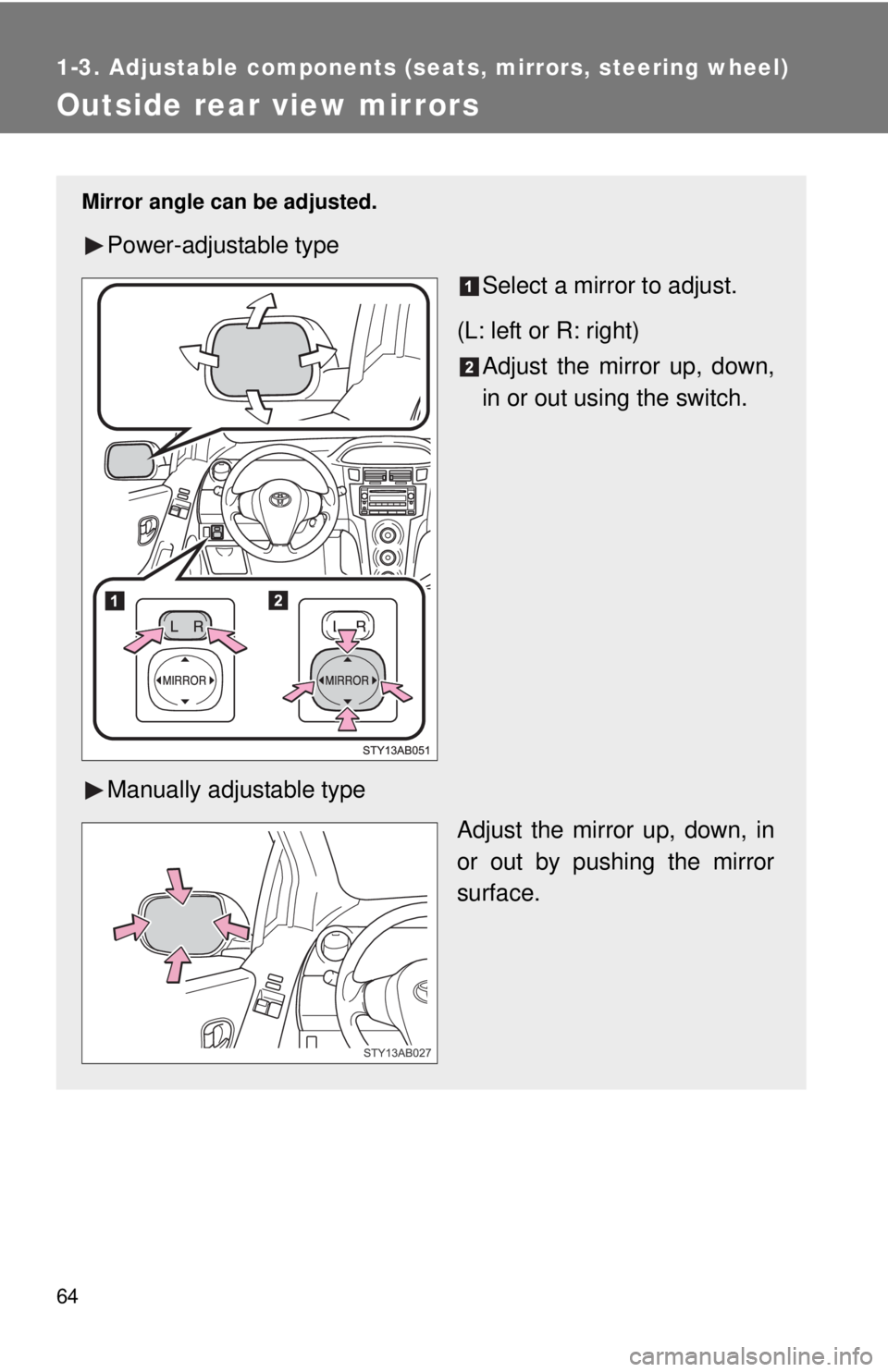
Mirror angle can be adjusted.
Power-adjustable type
Select a mirror to adjust.
(L: left or R: right) Adjust the mirror up, down,
in or out using the switch.
Manually adjustable type Adjust the mirror up, down, in
or
out by pushing the mirror
surface.
Page 79 of 402
65
1-3. Adjustable components (s
eats, mirrors, steering wheel)
1
Before driving
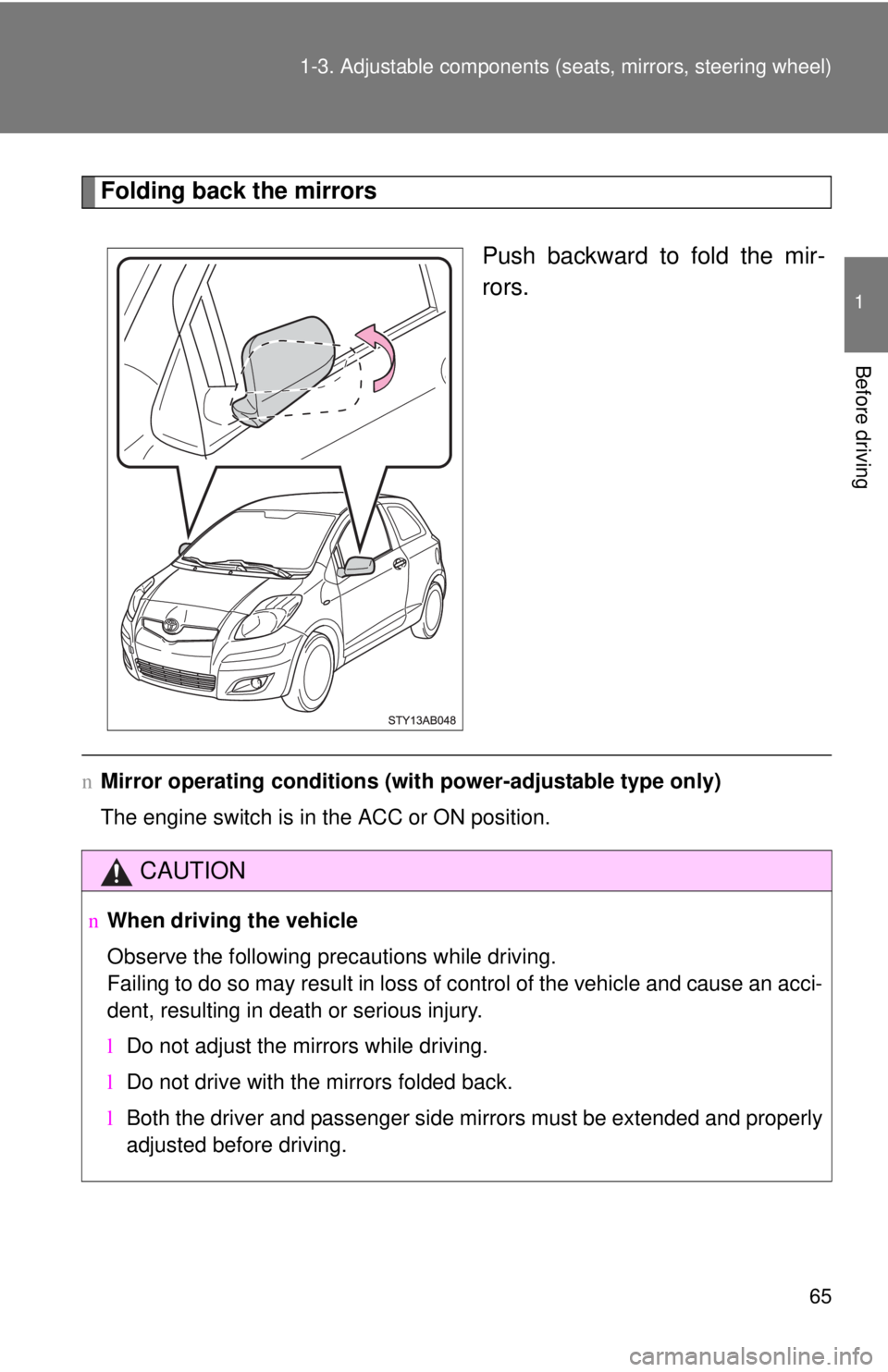
Folding back the mirrors
Push backward to fold the mir -
rors.
n Mirror operating conditions (wit h power-adjustable type only)
The engine switch is in the ACC or ON position.
CAUTION
nWhen driving the vehicle
Observe the following precautions while driving.
Failing to do so may result in loss of control of the vehicle and cause an acci-
dent, resulting in death or serious injury.
l Do not adjust the mirrors while driving.
l Do not drive with the mirrors folded back.
l Both the driver and passenger side mirrors must be extended and properly
adjusted before driving.
Page 80 of 402
66 1-3. Adjustable components (seats, mirrors, steering wheel)
NOTICE
nIf ice should jam the mirror
Do not operate the control or scrape the mirror face. Use a spray de-icer to
free the mirror.
Page 133 of 402

120 2-1. Driving procedures
CAUTION
nWhen driving the vehicle
lDo not shift the shift lever to N while the vehicle is moving.
Doing so may cause the engine brake to not operate properly and lead to
an accident.
l Do not turn the engine off while driving.
The power steering and brake booster systems will not operate properly if
the engine is not running.
l Use engine braking (downshift) to maintain a safe speed when driving
down a steep hill.
Using the brakes continuously may cause the brakes to overheat and lose
effectiveness. ( →P. 128,130)
l When stopped on an inclined surface, use the brake pedal and parking
brake to prevent the vehicle from rolling backward or forward and causing
an accident.
l Do not adjust the position of the steering wheel, the seat, or the inside or
outside rear view mirrors while driving.
Doing so may result in a loss of vehicle control that can cause accidents
that may result in death or serious injury.
l Always check that all passengers' arms, heads or other parts of their bod-
ies are not outside the vehicle, as this may result in death or serious injury.
l Do not drive in excess of the speed limit. Even if the legal speed limit per-
mits it, do not drive over 85 mph (140 km/h) unless your vehicle has high-
speed capability tires. Driving over 85 mph (140 km/h) may result in tire
failure, loss of control and possible injury. Be sure to consult a tire dealer
to determine whether the tires on your vehicle are high-speed capability
tires or not before driving at such speeds.
n When driving on slippery road surfaces
lSudden braking, acceleration and steering may cause tire slippage and
reduce your ability to control the vehicle, resulting in an accident.
l Sudden changes in engine speed, such as engine braking caused by up-
shifting or down-shifting, may cause the vehicle to skid, resulting in an
accident.
Page 174 of 402

161
2-5. Driving information
2
When driving
Winter driving tips
Carry out the necessary preparations and inspections before driving
the vehicle in winter. Always drive the vehicle in a manner appropri
-
ate to the prevailing weather conditions.
n Pre-winter preparations
lUse
fluids that are appropriate to the prevailing outside tem -
peratures.
• Engine oil
• Engine coolant
• Washer fluid
l Have a se
rvice technician inspect the level and specific grav -
ity of battery electrolyte.
l Have the veh
icle fitted with four snow tires or purchase a set
of tire chains for the front tires.
Ensure that all tires are the same size and brand, and that chains
match the size of the tires.
n Before driving the vehicle
Perform the following according to the driving conditions.
lDo
not try to forcibly open a window, scrape an outside rear
view mirror surface or move a wiper or outside rear view mir -
ror that is frozen. Pour warm water over the frozen area to
me
lt the ice. Wipe away the water immediately to prevent it
from freezing.
l T
o ensure proper operation of th e climate control system fan,
remove any snow that has accumulated on the air inlet vents
in front of the windshield.
l Remove a
ny ice that has accumu lated on the vehicle chassis.
l Pe
riodically check for and remove any excess ice or snow
that may have accumulated in the wheel well or on the
brakes.
Page 180 of 402

167
2-5. Driving information
2
When driving
n
Before towing
Check that the following conditions are met:
lEnsure that your vehicle’
s tires are properly inflated. ( →P. 351)
l T
railer tires should be inflated according to the trailer manufacturer’s rec -
ommendation.
l All trailer light
s work to be legal.
l Confirm all light
s work each time you connect them.
l Check
that your vehicle remains level when a loaded or unloaded trailer
is hitched. Do not drive if the vehicle is not level, and check for improper
tongue load, overloading, worn suspension, or other possible causes.
l Make s
ure the trailer cargo is securely loaded.
lCheck
that your rear view mirrors c onform to any federal, state/provincial
or local regulations. If they do not, inst all rear view mirrors appropriate for
towing purposes.
n Break-in schedule
l T
oyota recommends that you do not use a new vehicle or a vehicle with
any new power train components (engine, transmission, differential,
wheel bearings, etc.) to tow a trailer for the first 500 miles (800 km) of
driving.
n Main
tenance
lIf you tow a trailer
, your vehicle will require more frequent maintenance
due to the additional load. (See “Scheduled Maintenance Guide” or
“Owner’s Manual Supplement”.)
l Retighten the fixing
bolts of the towing ball and bracket after approxi -
mately 600 miles (1000 km).