Page 100 of 672
100 1-4. Opening and closing the windows and moon roof
■The moon roof can be operated when
The engine switch is in the ON position.
■ Door lock linked moon roof operation
The moon roof can be opened and closed using the key. ( P. 47)
■ Operating the moon roof after turning the engine switch off
The moon roof can be operated for approximately 43 seconds even after the
engine switch is turned to the ACC or turned off. It cannot, however, be oper-
ated once either front door is opened.
■ Jam protection function
If an object is detected between the moon roof and the frame while closing
or tilting down, travel is stopped and the moon roof opens slightly.
■ If the moon roof cannot be closed automatically
Keep the switch depressed.
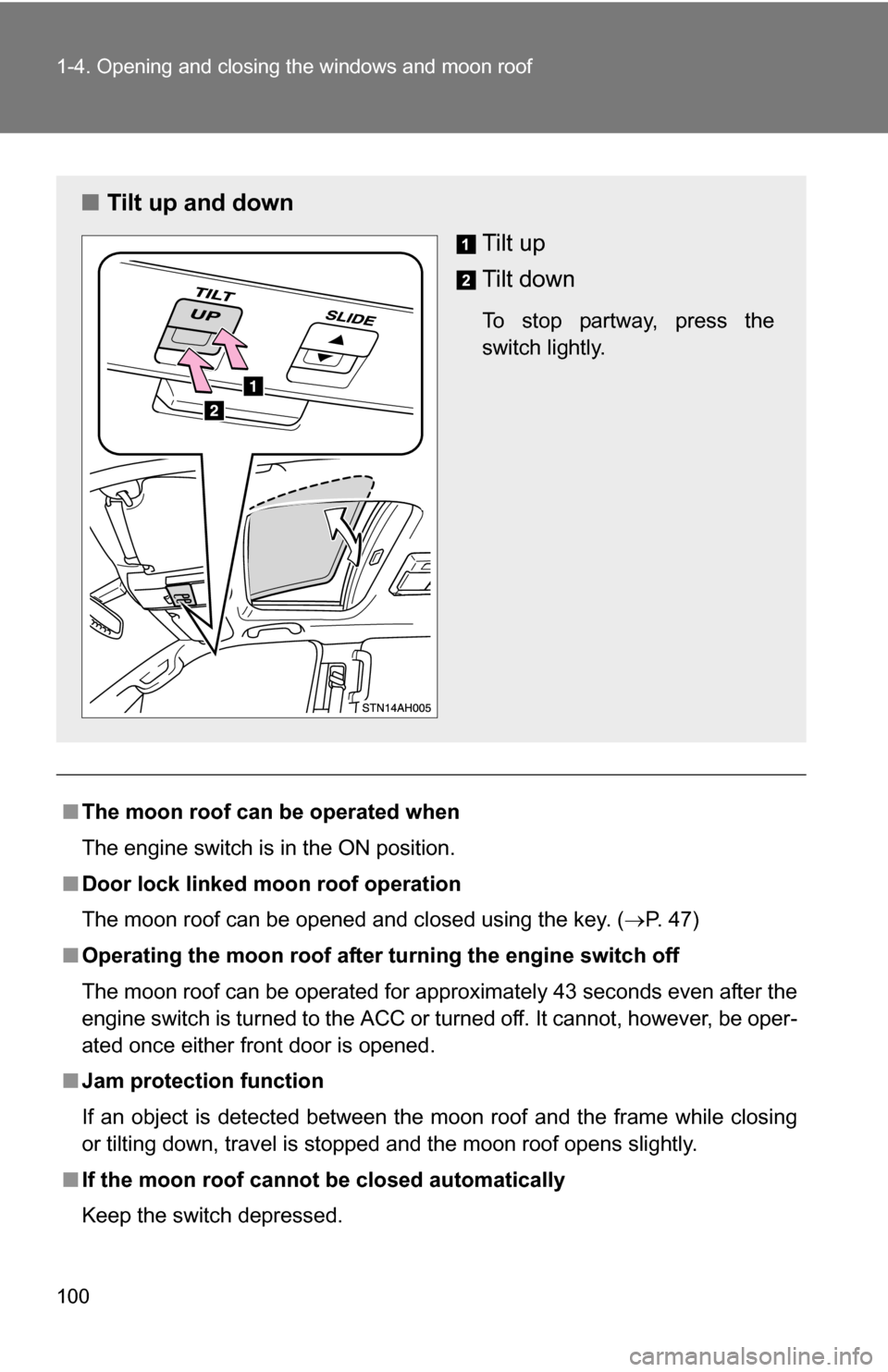
■ Tilt up and down
Tilt up
Tilt down
To stop partway, press the
switch lightly.
Page 101 of 672
101
1-4. Opening and closing the windows and moon roof
1
Before driving
■
Sunshade
The sunshade can be opened and closed manually. However, the sunshade
will open automatically when the moon roof is opened.
■ Moon roof open reminder function
An alarm will sound when the driver’s door is opened with the moon roof not
fully closed and the engine switch off.
■ When the battery is disconnected
The moon roof must be initialized in order to ensure proper operation.
Push and hold the switch toward the UP (tilt up) side or (sliding
close) side.
After the moon roof will tilt up and down, release the switch.
To ensure the initialization is complete, make sure automatic open-
ing and closing functions work properly.
■ Customization that can be co nfigured at Toyota dealer
Settings (e.g. moon roof) can be changed.
(Customizable features P. 633)
Page 103 of 672
103
1
Before driving
1-5. Refueling
Opening the fuel tank cap
Perform the following steps to open the fuel tank cap.
■Before refueling the vehicle
Turn the engine switch off and ensure that all the doors and win-
dows are closed.
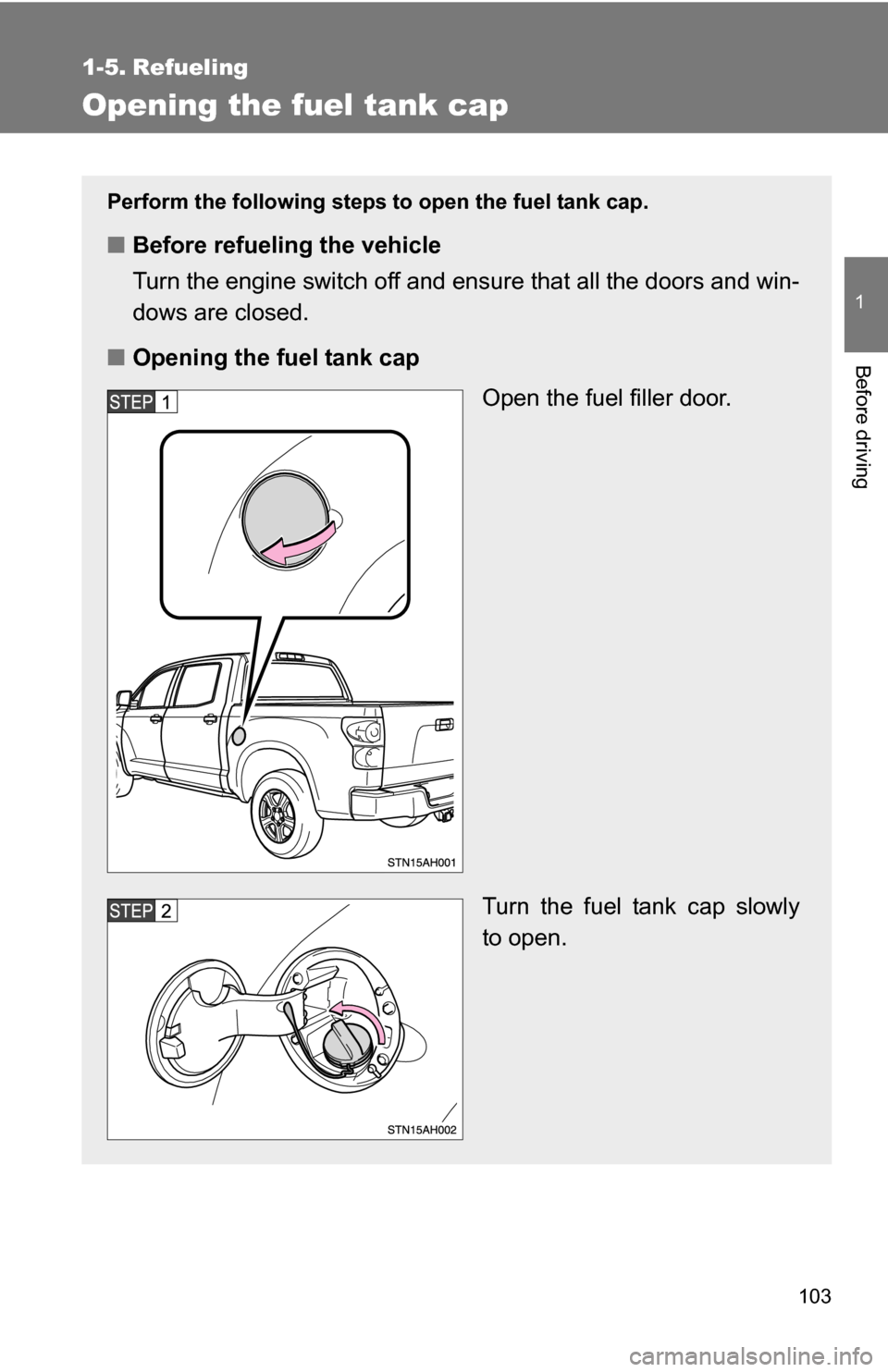
■ Opening the fuel tank cap
Open the fuel filler door.
Turn the fuel tank cap slowly
to open.
Page 104 of 672
104 1-5. Refueling
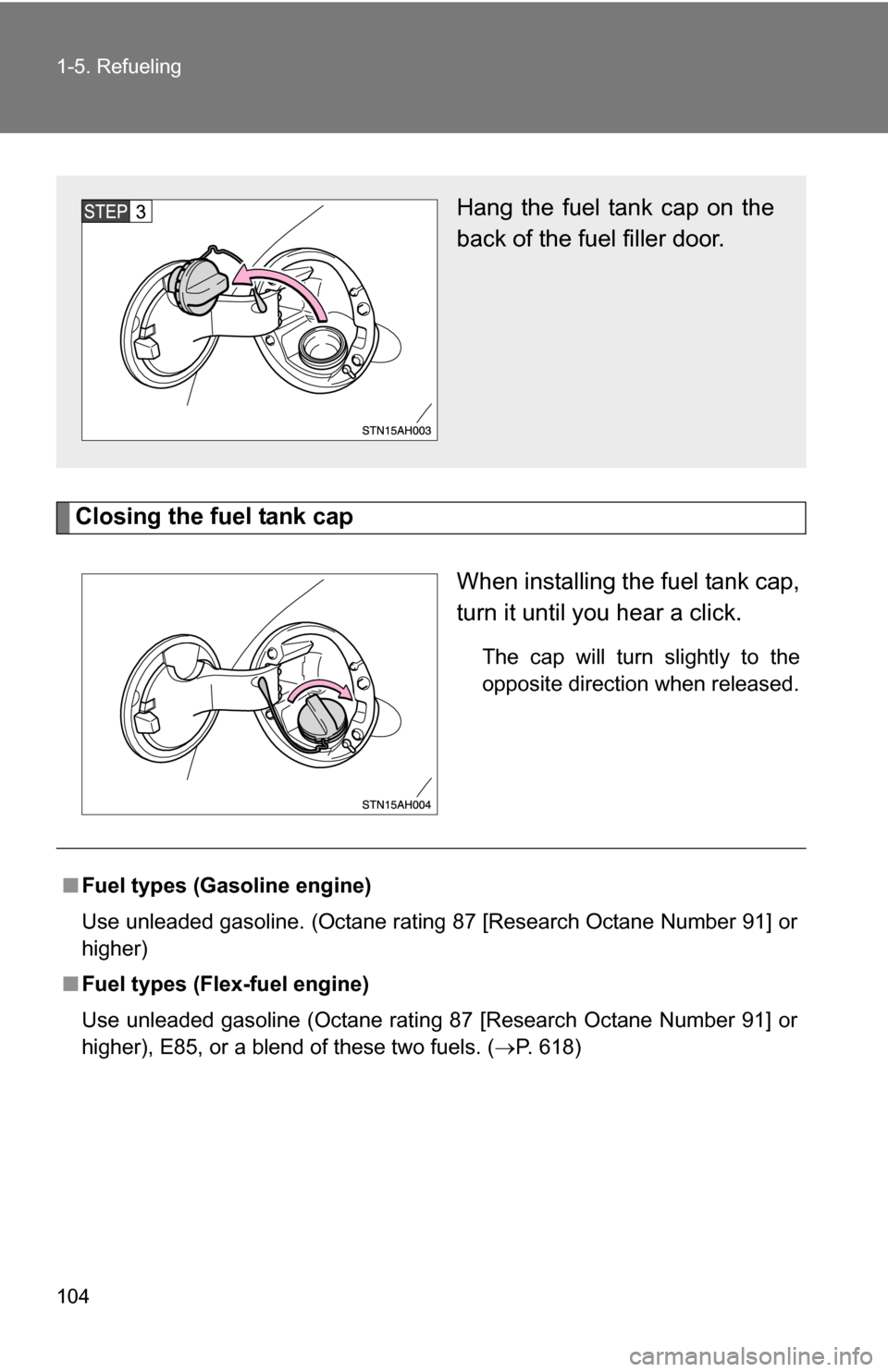
Closing the fuel tank capWhen installing the fuel tank cap,
turn it until you hear a click.
The cap will turn slightly to the
opposite direction when released.
Hang the fuel tank cap on the
back of the fuel filler door.
■Fuel types (Gasoline engine)
Use unleaded gasoline. (Octane rating 87 [Research Octane Number 91] or
higher)
■ Fuel types (Flex-fuel engine)
Use unleaded gasoline (Octane rating 87 [Research Octane Number 91] or
higher), E85, or a blend of these two fuels. ( P. 618)
Page 105 of 672
105
1-5. Refueling
1
Before driving
■
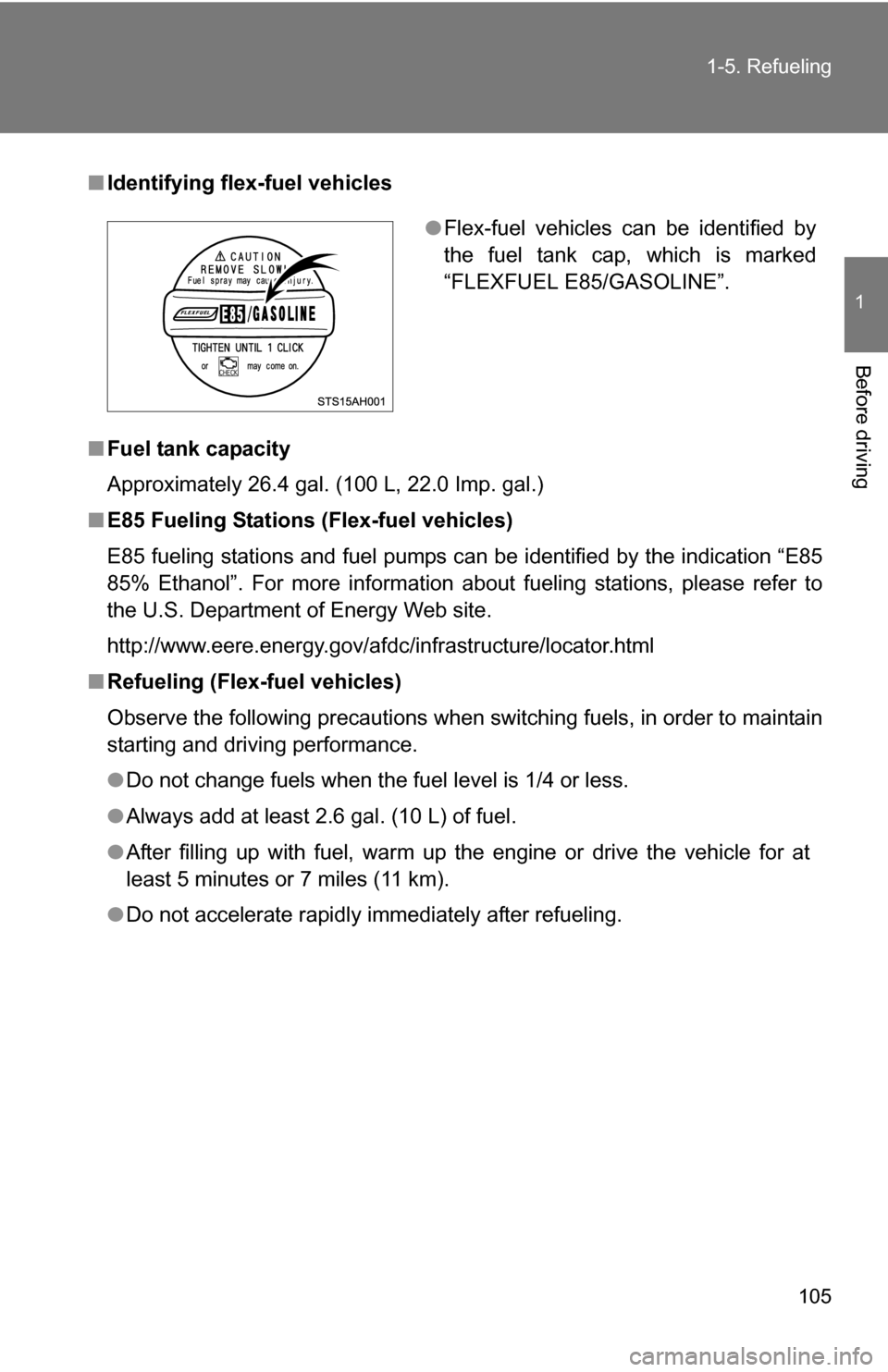
Identifying flex-fuel vehicles
■ Fuel tank capacity
Approximately 26.4 gal. (100 L, 22.0 Imp. gal.)
■ E85 Fueling Stations (Flex-fuel vehicles)
E85 fueling stations and fuel pumps can be identified by the indication “E85
85% Ethanol”. For more information about fueling stations, please refer to
the U.S. Department of Energy Web site.
http://www.eere.energy.gov/afdc/infrastructure/locator.html
■ Refueling (Flex-fuel vehicles)
Observe the following precautions when switching fuels, in order to maintain
starting and driving performance.
●Do not change fuels when the fuel level is 1/4 or less.
● Always add at least 2.6 gal. (10 L) of fuel.
● After filling up with fuel, warm up the engine or drive the vehicle for at
least 5 minutes or 7 miles (11 km).
● Do not accelerate rapidly immediately after refueling.
●Flex-fuel vehicles can be identified by
the fuel tank cap, which is marked
“FLEXFUEL E85/GASOLINE”.
Page 107 of 672
107
1-5. Refueling
1
Before driving
NOTICE
■
Refueling
Do not spill fuel during refueling.
Doing so may damage the vehicle, such as causing the exhaust systems to
operate abnormally or damaging fuel s ystem components or the vehicle’s
painted surface.
■ To prevent damage to the fuel filler door
Do not apply excessive force.
■ E85 fuel
E85 fuel can be used only in flex-fuel vehicles. Do not add E85 fuel to a gas-
oline-engine vehicle.
Filling a gasoline-engine vehicle with E85 will have a negative impact on
starting and driving performance and will cause damage to the fuel system
components.
Page 108 of 672
108
1-6. Theft deterrent system
Engine immobilizer system (if equipped)
■System maintenance
The vehicle has a maintenance-free type of engine immobilizer system.
■ Conditions that may cause the system to malfunction
●If the key is in contact with a metallic object
● If the key is in close proximity to or touching a key to the security system
(key with a built-in transponder chip) of another vehicle
■ Certifications for the en gine immobilizer system
For vehicles sold in U.S.A.
FCC ID: MOZRI-21BTY
This device complies with Part 15 of the FCC Rules. Operation is subject to
the following two conditions: (1) this device may not cause harmful interfer-
ence, and (2) this device must accept any interference received, including
interference that may cause undesired operation.
FCC WARNING:
Changes or modifications not expressly approved by the party responsible
for compliance could void the user’s authority to operate the equipment.
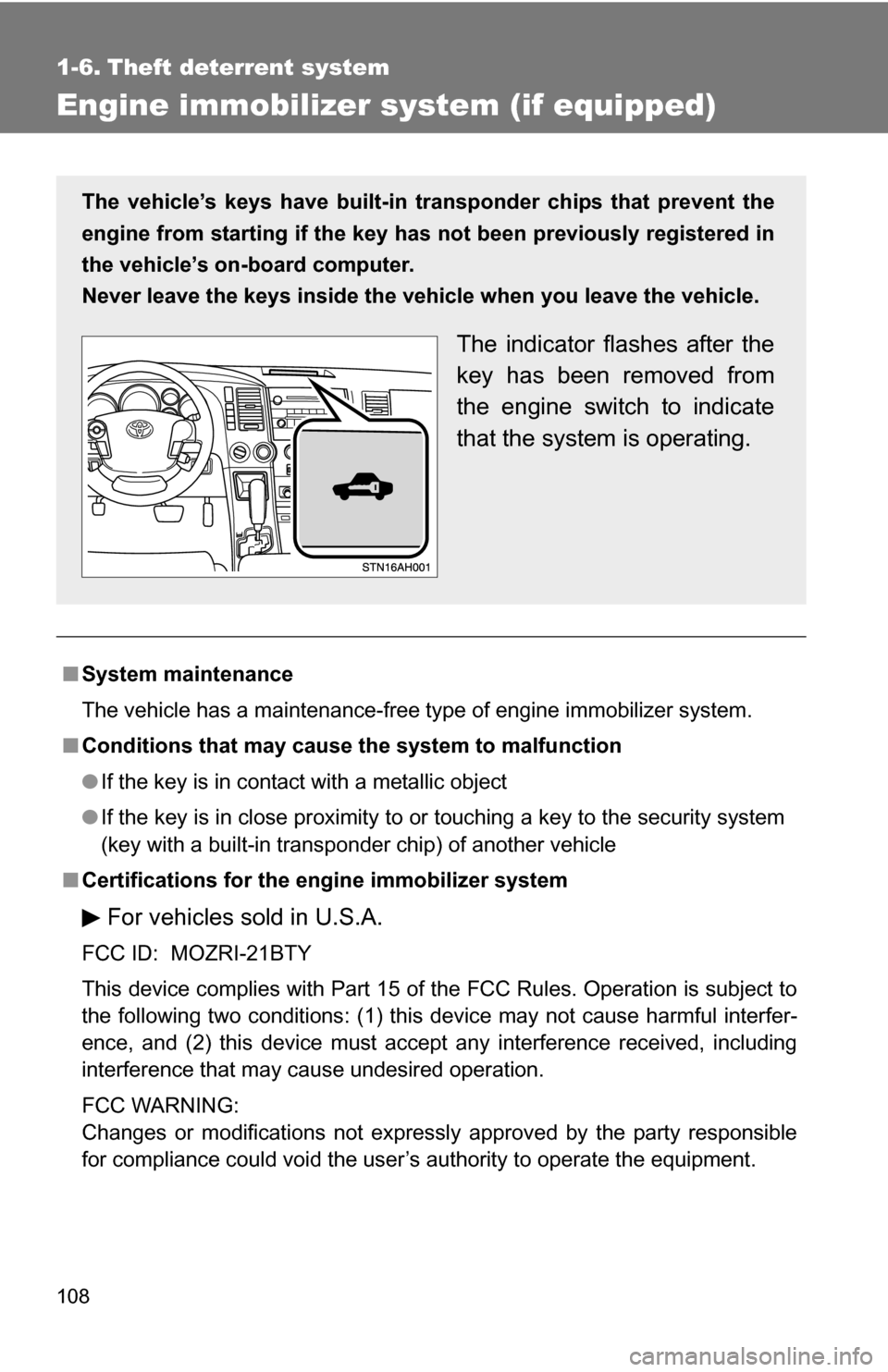
The vehicle’s keys have built-in tr ansponder chips that prevent the
engine from starting if the key has not been previously registered in
the vehicle’s on-board computer.
Never leave the keys inside the vehicle when you leave the vehicle.
The indicator flashes after the
key has been removed from
the engine switch to indicate
that the system is operating.
Page 109 of 672
109
1-6. Theft deterrent system
1
Before driving
For vehicles sold in Canada
This device complied with RSS-210 of Industry Canada.
Operation is subject to the following two conditions: (1) this device may not
cause interference, and (2) this device must accept any interference, includ-
ing interference that may cause undesired operation of the device.
NOTICE
■
To prevent damage to the key
Do not modify, remove or disable the engine immobilizer system. If any
unauthorized changes or modifications are made, the proper operation of
the system cannot be guaranteed.