Page 265 of 672
265
2-5. Driving information
2
When driving
●
Crosswinds and rough roads will adversely affect handling of your
vehicle and trailer, causing sway . Periodically check the rear to
prepare for being passed by large trucks or buses, which may
cause your vehicle and trailer to sway. If swaying occurs, firmly grip
the steering wheel, reduce speed immediately but gradually, and
steer straight ahead. Never increase speed. If you make no
extreme correction with the stee ring or brakes, your vehicle and
trailer will stabilize.
● Take care when passing other vehicles. Passing requires consider-
able distance. After passing a vehicle, do not forget the length of
your trailer, and be sure you hav e plenty of room before changing
lanes.
● In order to maintain engine braking efficiency when driving on a
long steep downgrade, do not use the transmission in D.
Transmission shift range position must be in 5 in the S mode (6-
speed models) or in 4 in the S mode (5-speed models).
● Due to the added load of the trailer, your vehicle’s engine may
overheat on hot days (at temperatures over 85°F [30°C]) when
driving up a long or steep grade. If the engine coolant temperature
gauge indicates overheating, immedi ately turn off the air condition-
ing (if in use), pull your vehicle off the road and stop in a safe spot.
( P. 585)
● Always place wheel blocks under both the vehicle and the trailer
wheels when parking. Apply the parking brake firmly, and put the
transmission in P. Avoid parking on a slope, but if unavoidable, do
so only after performing the following:
Apply the brakes and keep them applied.
Have someone place wheel blocks under both the vehicle and
trailer wheels.
When the wheel blocks are in pl ace, release the brakes slowly
until the blocks absorb the load.
Apply the parking brake firmly.
Page 267 of 672
267
2-5. Driving information
2
When driving
■
Before towing
Check that the following conditions are met:
●Ensure that your vehicle’s tires are properly inflated. ( P. 615)
● Trailer tires should be inflated according to the trailer manufacturer’s rec-
ommendation.
● All trailer lights work to be legal.
● All lights work each time you connect them.
● The trailer ball is set up at the proper height for the coupler on the t\
railer.
● The vehicle remains level when a loaded or unloaded trailer is hitched.
Do not drive if the vehicle is not level, and check for improper tongue
load, overloading, worn suspension, or other possible causes.
● The trailer cargo is securely loaded.
● The rear view mirrors conform to all applicable federal, state/provincial or
local regulations. If they do not, instal l rear view mirrors appropriate for
towing purposes.
● Depress TOW/HAUL button (if equipped)
■ Break-in schedule
If your vehicle is new or equipped with any new power train components
(such as an engine, transmission, differential and wheel bearing), Toyota
recommends that you do not tow a trailer until it has been driven for over 500
miles (800 km).
After the vehicle has been driven for over 500 miles (800 km), you can s\
tart
towing. However, drive the vehicle at a speed of less than 50 mph (80 km/h)
when towing a trailer for another 500 miles (800 km). In addition, avoid full
throttle acceleration.
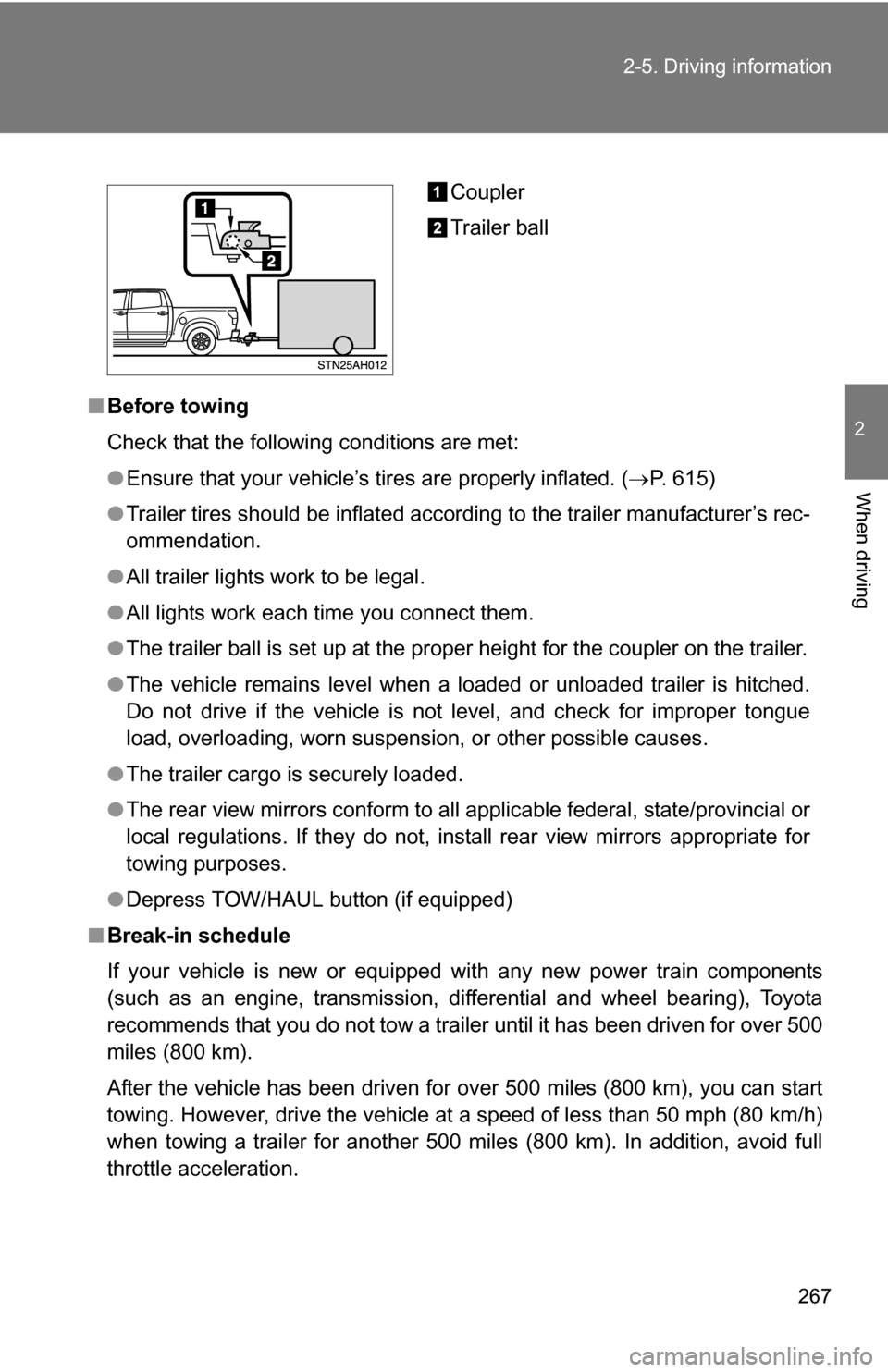
Coupler
Trailer ball
Page 332 of 672
332 3-3. Using the rear audio/video system
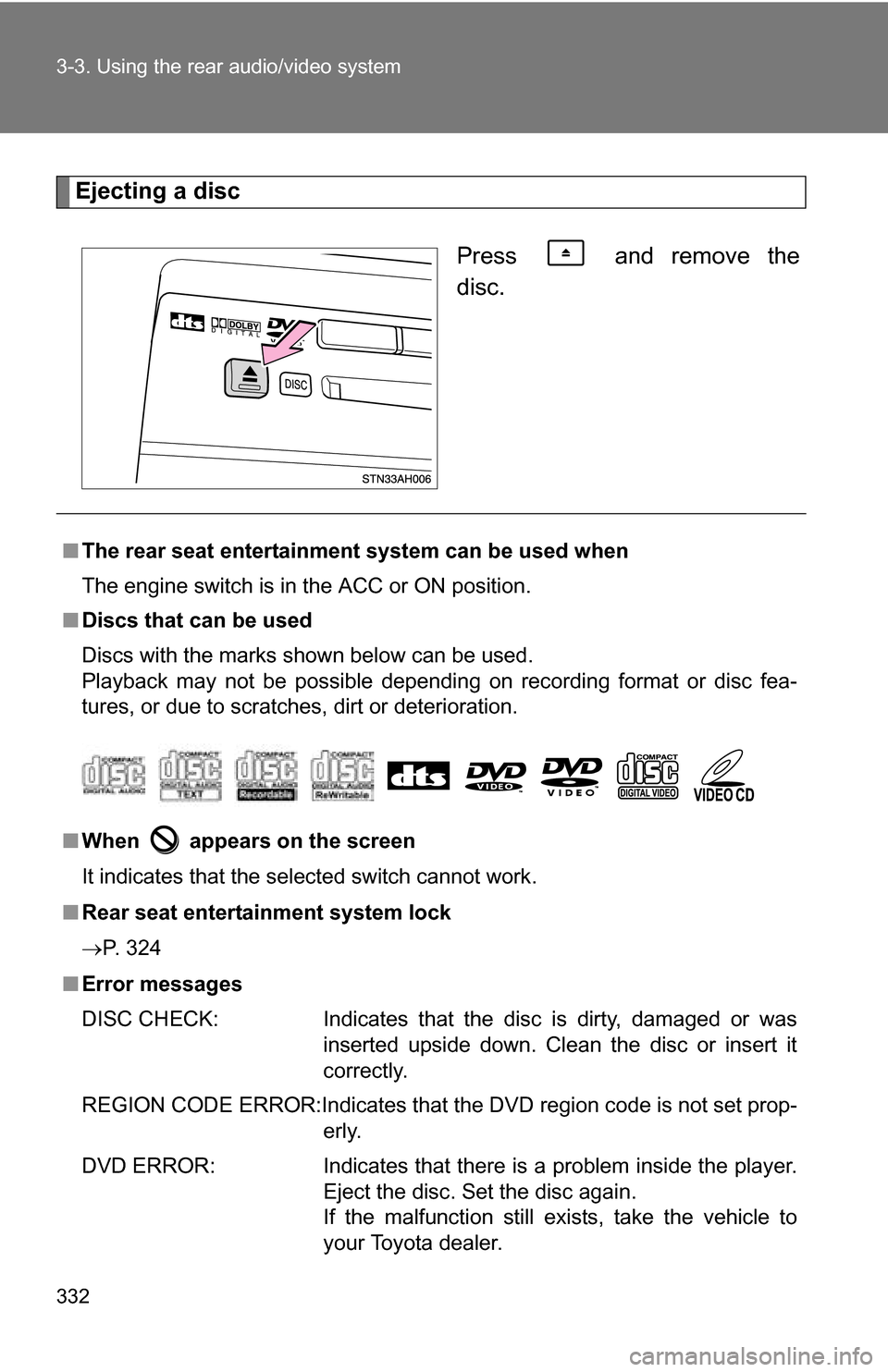
Ejecting a discPress and remove the
disc.
■The rear seat entertainmen t system can be used when
The engine switch is in the ACC or ON position.
■ Discs that can be used
Discs with the marks shown below can be used.
Playback may not be possible depending on recording format or disc fea-
tures, or due to scratches, dirt or deterioration.
■ When appears on the screen
It indicates that the selected switch cannot work.
■ Rear seat entertainment system lock
P. 324
■ Error messages
DISC CHECK: Indicates that the disc is dirty, damaged or was
inserted upside down. Clean the disc or insert it
correctly.
REGION CODE ERROR:Indicates that the DVD region code is not set prop- erly.
DVD ERROR: Indicates that there is a problem inside the player. Eject the disc. Set the disc again.
If the malfunction still exists, take the vehicle to
your Toyota dealer.
Page 459 of 672
Maintenance and care4
459
4-1. Maintenance and care ... 460Cleaning and protecting the vehicle exterior......... 460
Cleaning and protecting the vehicle interior.......... 462
4-2. Maintenance ................... 465 Maintenance requirements .................. 465
General maintenance....... 467
Emission inspection and maintenance (I/M)
programs........................ 470 4-3. Do-it-yourself
maintenance ................. 471
Do-it-yourself service precautions .................... 471
Hood ................................ 475
Engine compartment ........ 476
Tires ................................. 494
Tire inflation pressure ...... 501
Wheels ............................. 505
Air conditioning filter......... 507
Wireless remote control battery ............................ 510
Checking and replacing fuses .............................. 512
Light bulbs........................ 522
Page 467 of 672
467
4-2. Maintenance
4
Maintenance and care
General maintenance
Engine compartment
ItemsCheck points
Battery Maintenance-free. ( P. 489)
Brake fluid At the correct level? ( P. 486)
Engine coolant At the correct level? ( P. 484)
Engine oil At the correct level? ( P. 479)
Exhaust system No fumes or strange sounds?
Power steering fluid At the correct level? ( P. 488)
Radiator/condenser/hoses Not blocked with foreign matter?
(
P. 486)
Washer fluid At the correct level? ( P. 492)
Listed below are the general maintenance items that should be per-
formed at the intervals specified in the “Scheduled Maintenance
Guide” or “Owner’s Manual Supp lement”. It is recommended that
any problem you notice should be brought to the attention of your
Toyota dealer or qualified service shop for advice.
Page 469 of 672
469
4-2. Maintenance
4
Maintenance and care
Vehicle exterior
ItemsCheck points
Doors • Operate smoothly?
Engine hood • The lock system works properly?
Fluid leaks • Is there any leakage after park-
ing?
Tire • Inflation pressure is correct?
• Tire surfaces not worn or dam-
aged?
• Tires rotated according to the maintenance schedule?
• Wheel nuts are not loose?
CAUTION
■ If the engine is running
Turn the engine off and ensure that there is adequate ventilation before per-
forming maintenance checks.
Page 479 of 672
479
4-3. Do-it-yourself maintenance
4
Maintenance and care
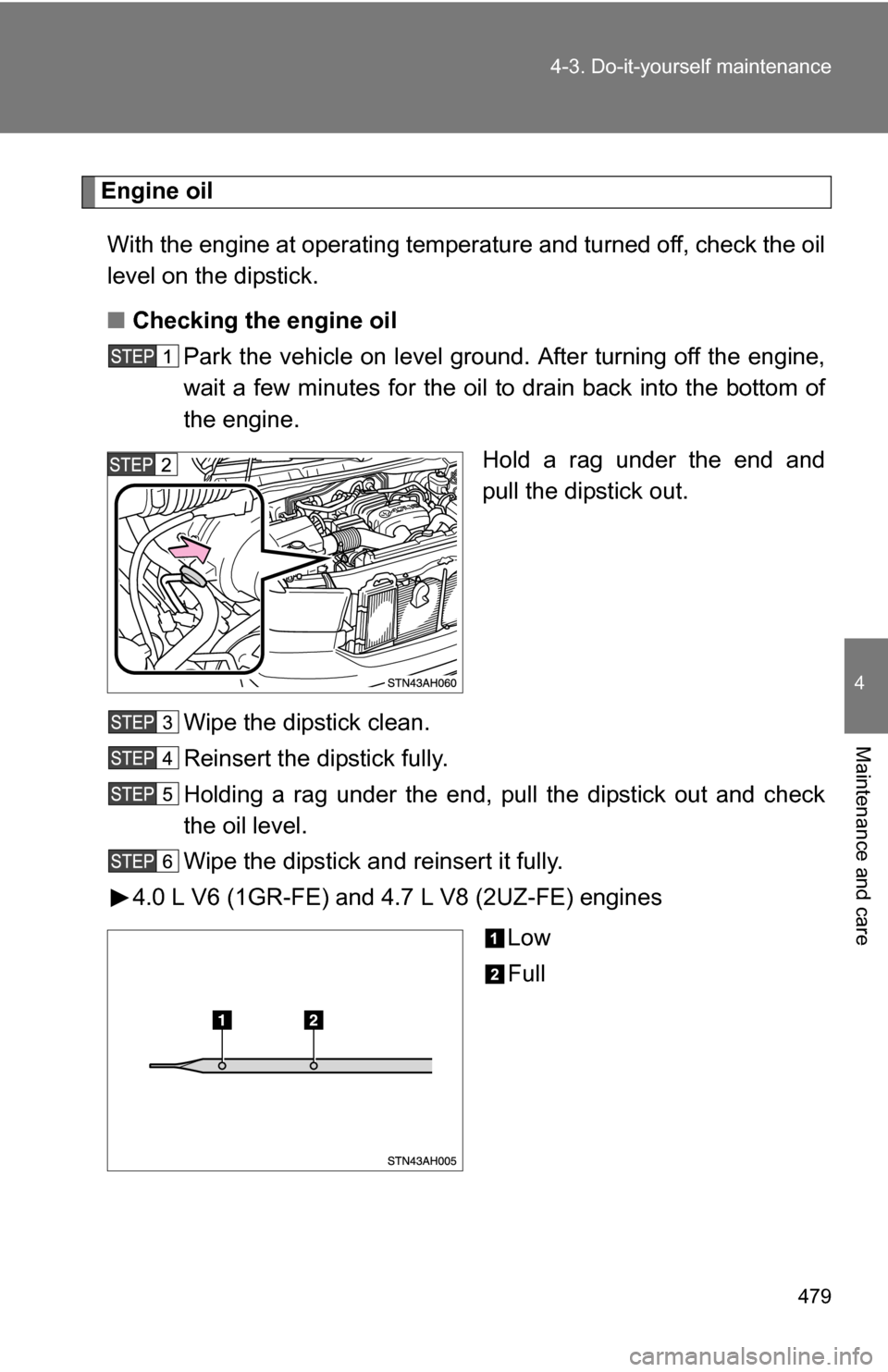
Engine oil
With the engine at operating temperature and turned off, check the oil
level on the dipstick.
■ Checking the engine oil
Park the vehicle on level gro und. After turning off the engine,
wait a few minutes for the oil to drain back into the bottom of
the engine.
Hold a rag under the end and
pull the dipstick out.
Wipe the dipstick clean.
Reinsert the dipstick fully.
Holding a rag under the end, pull the dipstick out and check
the oil level.
Wipe the dipstick and reinsert it fully.
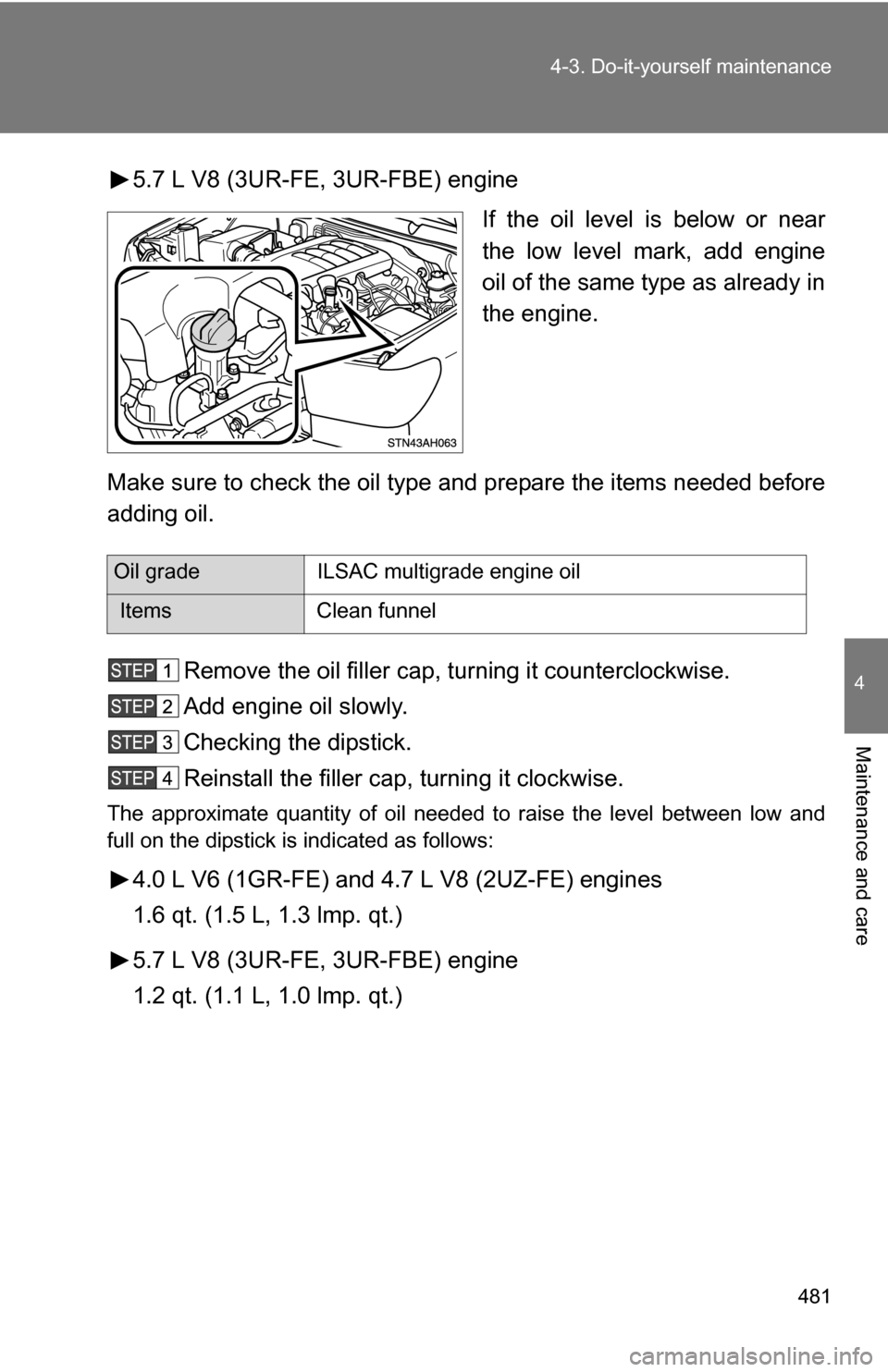
4.0 L V6 (1GR-FE) and 4.7 L V8 (2UZ-FE) engines
Low
Full
Page 481 of 672
481
4-3. Do-it-yourself maintenance
4
Maintenance and care
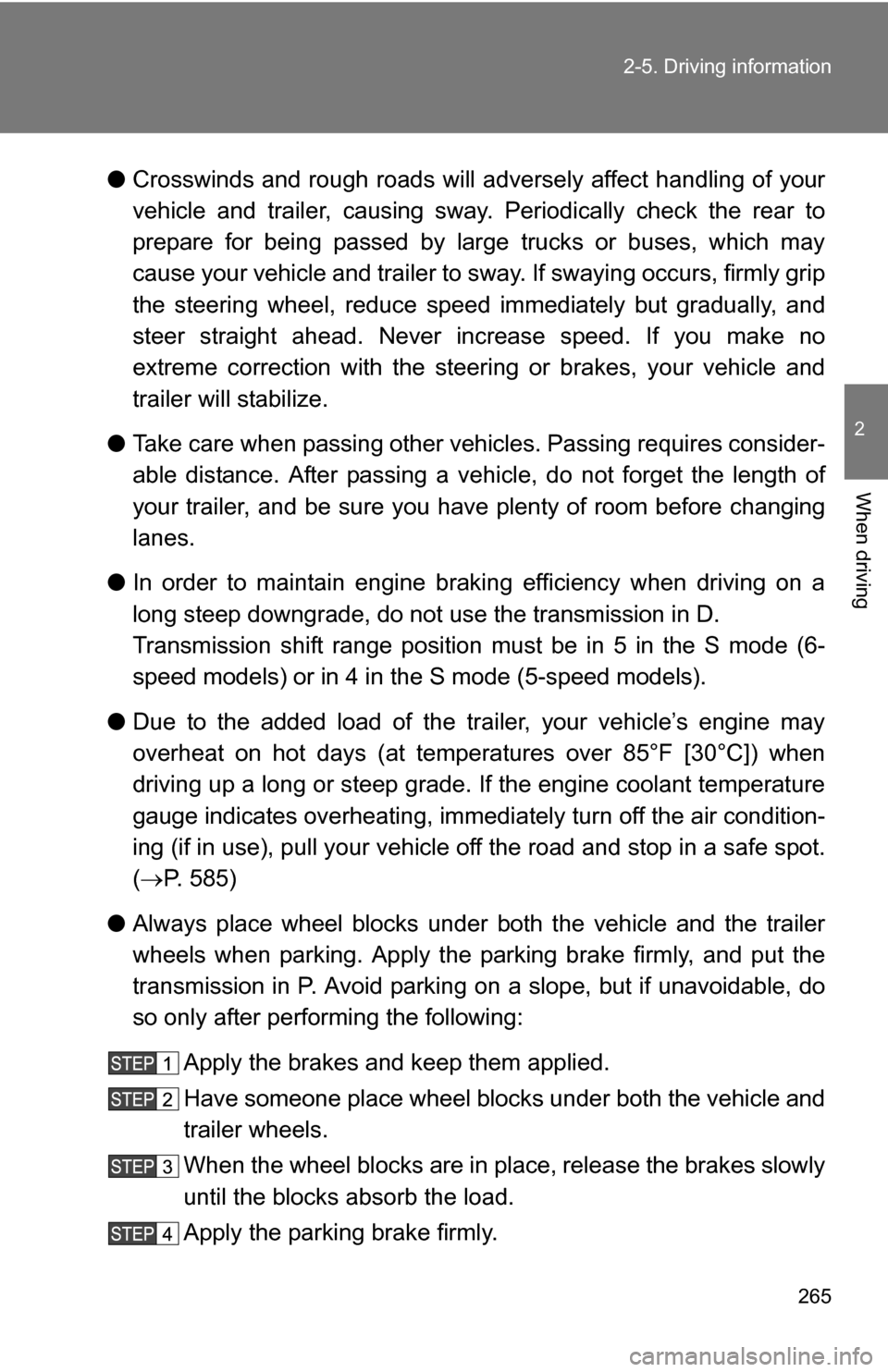
5.7 L V8 (3UR-FE, 3UR-FBE) engine
If the oil level is below or near
the low level mark, add engine
oil of the same type as already in
the engine.
Make sure to check the oil type and prepare the items needed before
adding oil. Remove the oil filler cap, turning it counterclockwise.
Add engine oil slowly.
Checking the dipstick.
Reinstall the filler cap, turning it clockwise.
The approximate quantity of oil needed to raise the level between low and
full on the dipstick is indicated as follows:
4.0 L V6 (1GR-FE) and 4.7 L V8 (2UZ-FE) engines
1.6 qt. (1.5 L, 1.3 lmp. qt.)
5.7 L V8 (3UR-FE, 3UR-FBE) engine
1.2 qt. (1.1 L, 1.0 lmp. qt.)
Oil grade ILSAC multigrade engine oil
ItemsClean funnel