Page 394 of 672
394 3-5. Using the interior lights
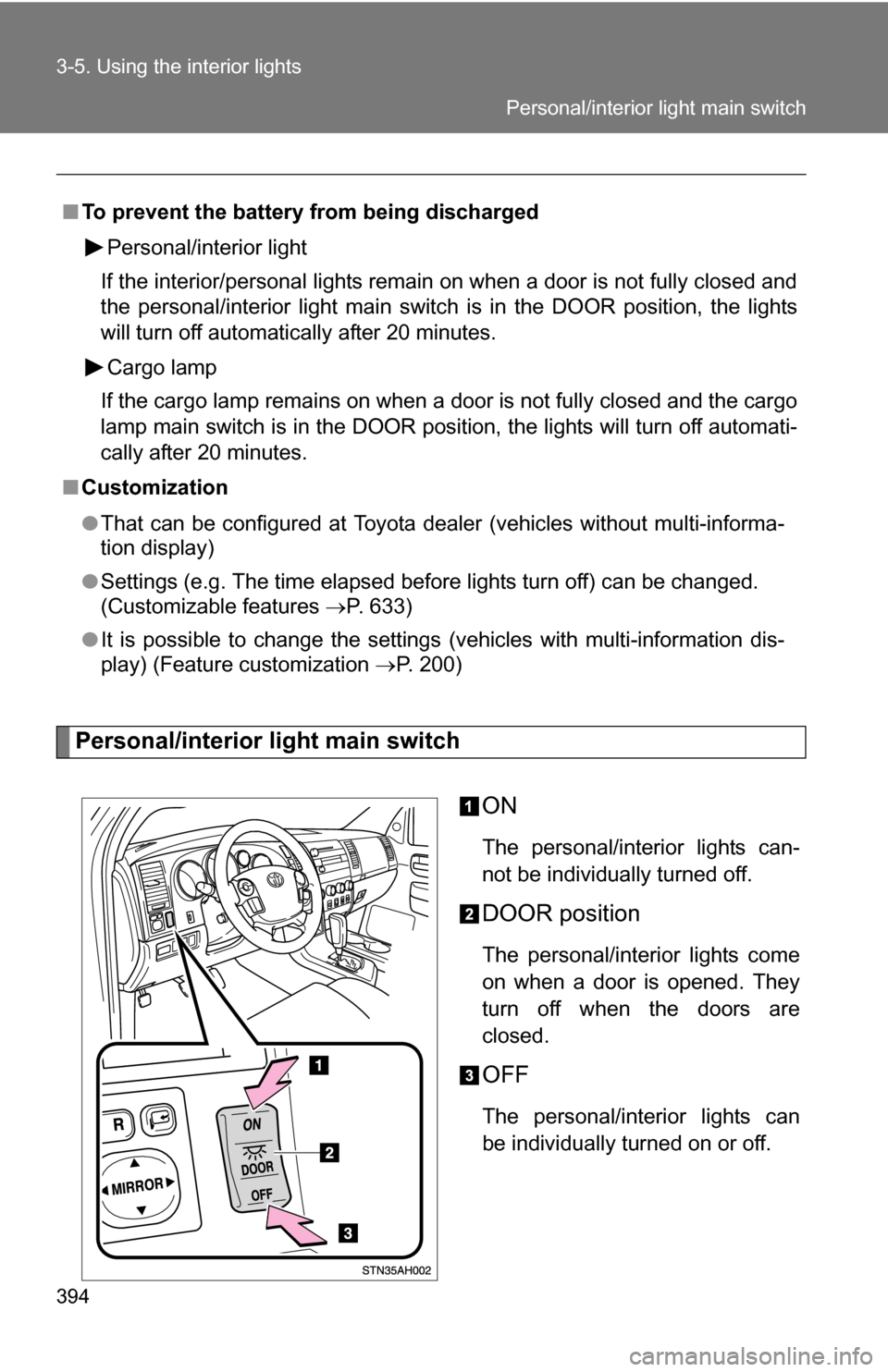
Personal/interior light main switchON
The personal/interior lights can-
not be individually turned off.
DOOR position
The personal/interior lights come
on when a door is opened. They
turn off when the doors are
closed.
OFF
The personal/interior lights can
be individually turned on or off.
■
To prevent the battery from being discharged
Personal/interior light
If the interior/personal lights remain on when a door is not fully closed and
the personal/interior light main switch is in the DOOR position, the lights
will turn off automatically after 20 minutes.
Cargo lamp
If the cargo lamp remains on when a door is not fully closed and the cargo
lamp main switch is in the DOOR position, the lights will turn off automati-
cally after 20 minutes.
■ Customization
●That can be configured at Toyota dealer (vehicles without multi-informa-
tion display)
● Settings (e.g. The time elapsed before lights turn off) can be changed.
(Customizable features P. 633)
● It is possible to change the settings (vehicles with multi-information dis-
play) (Feature customization P. 200)
Personal/interior light main switch
Page 395 of 672
395
3-5. Using the interior lights
3
Interior and exterior features
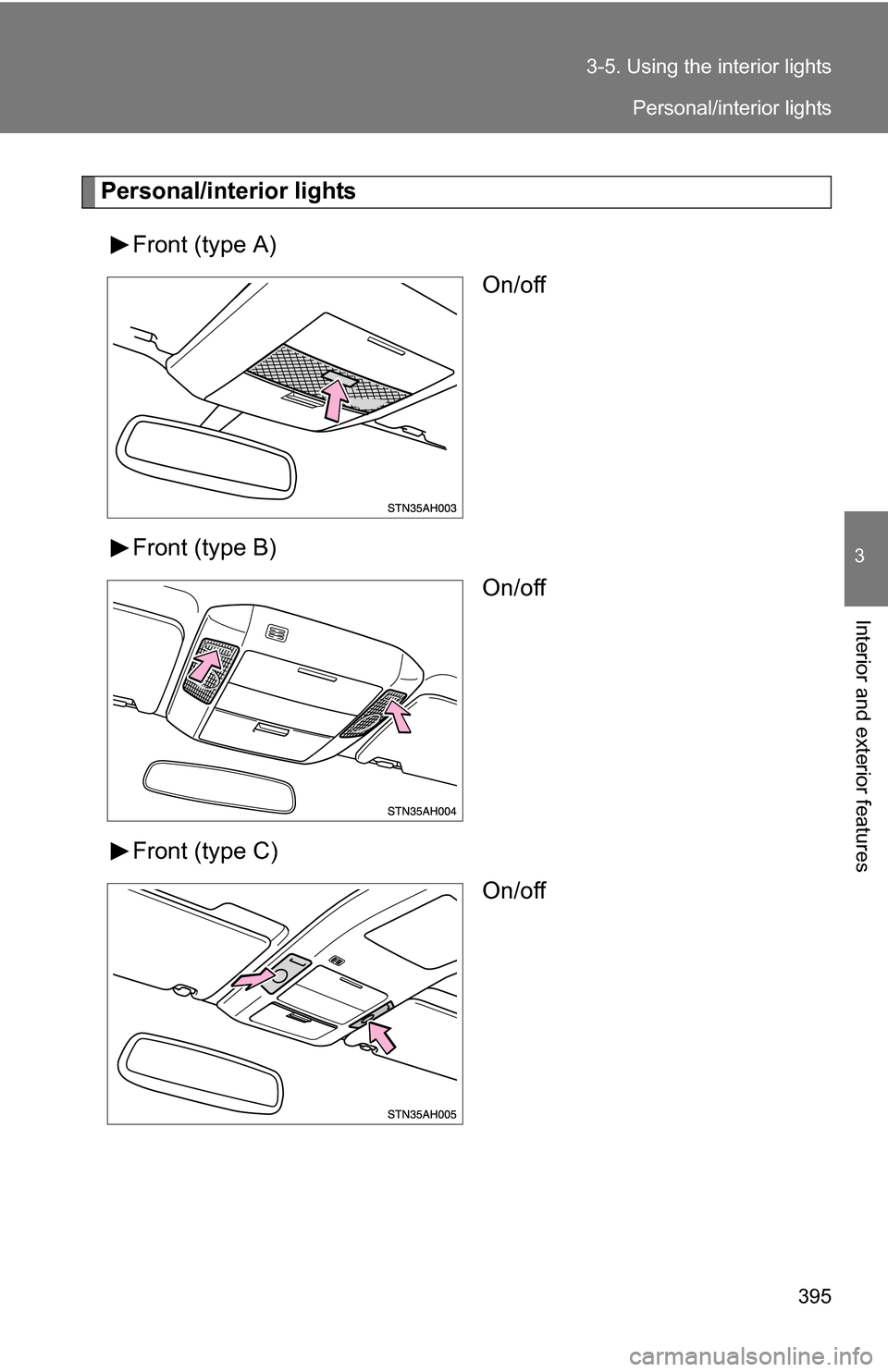
Personal/interior lights
Front (type A) On/off
Front (type B) On/off
Front (type C) On/off
Personal/interior lights
Page 396 of 672
396 3-5. Using the interior lights
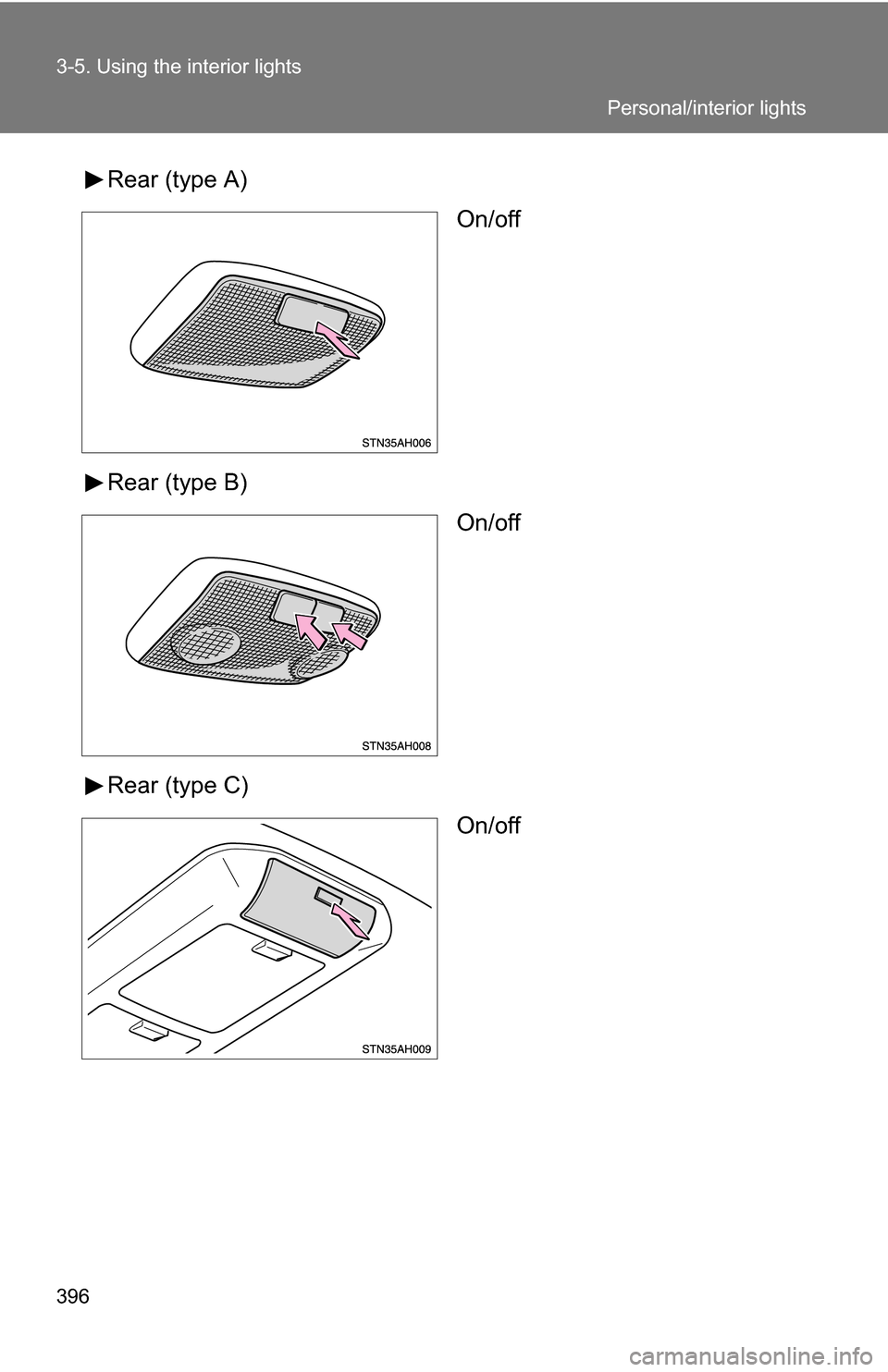
Rear (type A)On/off
Rear (type B) On/off
Rear (type C) On/off
Personal/interior lights
Page 397 of 672
397
3-5. Using the interior lights
3
Interior and exterior features
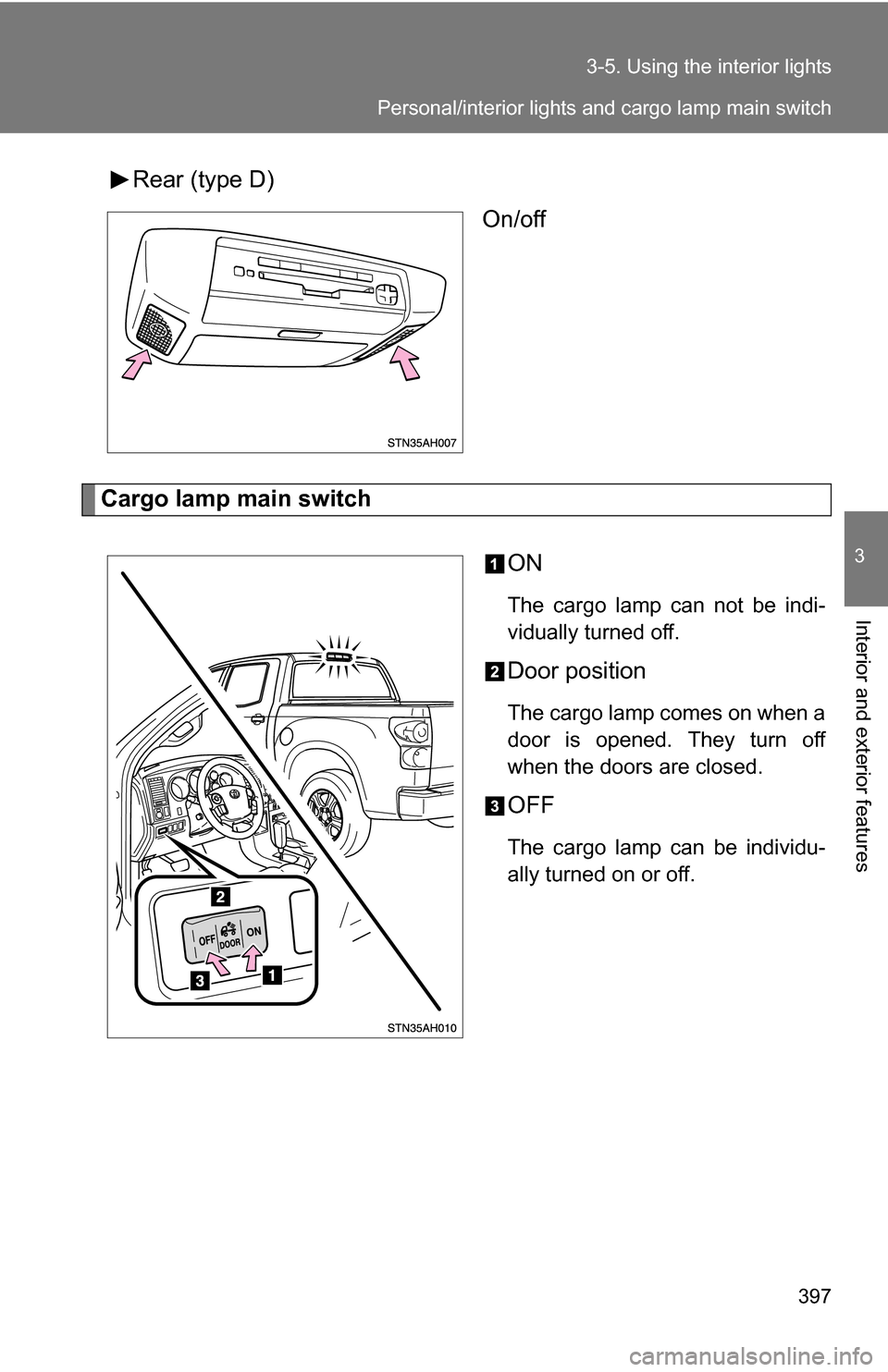
Rear (type D)
On/off
Cargo lamp main switch
ON
The cargo lamp can not be indi-
vidually turned off.
Door position
The cargo lamp comes on when a
door is opened. They turn off
when the doors are closed.
OFF
The cargo lamp can be individu-
ally turned on or off.
Personal/interior lights and cargo lamp main switch
Page 440 of 672
440 3-7. Other interior features
NOTICE
■To avoid damaging the power outlet and the plug
●Close the power outlet lid when not in use.
● Foreign objects or liquids that enter the power outlet may cause a short
circuit.
● Do not use plug adaptors to connect too many plugs to the power outlet.
● After inserting a plug, gently close the power outlet lid.
■ To prevent the fuse from being blown
Do not use a 115V AC appliance that requires more than 100 W.
If a 115V AC appliance that consumes more than 100 W is used, the protec-
tion circuit will cut the power supply.
■ Appliances that may not operate properly
The following 115V AC appliances may not operate even if their power con-
sumption is under 100 W.
●Appliances with high initial peak wattage
● Measuring devices that process precise data
● Other appliances that require an extremely stable power supply
■ To prevent the battery from being discharged
Turn off all the vehicle’s electronic equipment and accessories, such as the
headlights and air conditioning, when elec trical appliances that consume in
excess of 100W are used continuously for long periods of time.
■ To prevent any damage caused by heat
●Do not use any electrical appliances that give off intense heat such as
toasters, in any locations including the internal or external trim, seats and
deck.
● Do not use any electrical appliances, which are easily affected by vibration
or heat, inside the vehicle.
Vibration while driving, or the heat of the sun while parking, may result in
damage to those electrical appliances.
■ If any electrical appliances are to be used while driving
Securely fasten both the appliances and their cables to prevent them from
falling or getting caught any of the power train components.
Page 468 of 672
468 4-2. Maintenance
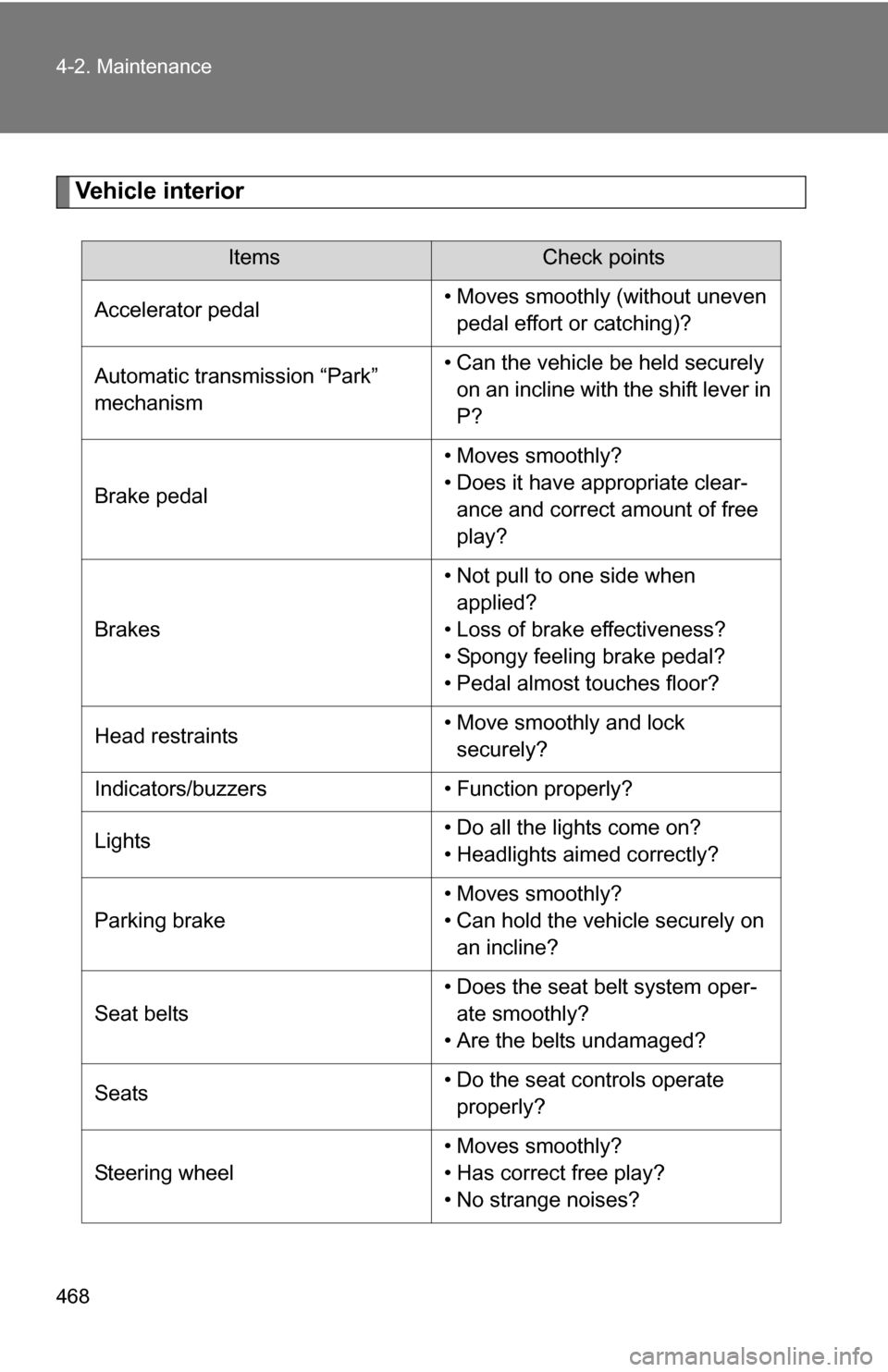
Vehicle interior
ItemsCheck points
Accelerator pedal • Moves smoothly (without uneven
pedal effort or catching)?
Automatic transmission “Park”
mechanism • Can the vehicle be held securely
on an incline with the shift lever in
P?
Brake pedal • Moves smoothly?
• Does it have appropriate clear-
ance and correct amount of free
play?
Brakes • Not pull to one side when
applied?
• Loss of brake effectiveness?
• Spongy feeling brake pedal?
• Pedal almost touches floor?
Head restraints • Move smoothly and lock
securely?
Indicators/buzzers • Function properly?
Lights • Do all the lights come on?
• Headlights aimed correctly?
Parking brake • Moves smoothly?
• Can hold the vehicle securely on
an incline?
Seat belts • Does the seat belt system oper-
ate smoothly?
• Are the belts undamaged?
Seats • Do the seat controls operate
properly?
Steering wheel • Moves smoothly?
• Has correct free play?
• No strange noises?
Page 517 of 672
517
4-3. Do-it-yourself maintenance
4
Maintenance and care
22 DOME
7.5 AInterior lights, personal lights, van-
ity lights, engine switch light, foot
light, door courtesy lights, acces-
sory meter
23 HEAD LH 15 ALeft-hand headlight
(high beam)
24 HEAD LL 15 ALeft-hand headlight
(low beam)
25 INJ 10 AMultiport fuel injection system/
sequential multiport fuel injection
system, ignition system
26 MET 7.5 A Gauges and meters
27 IGN 10 ASRS airbag system, multiport fuel
injection system/sequential multi-
port fuel injection system, engine
immobilizer system, cruise control
system
28 HEAD RH 15 ARight-hand headlight
(high beam)
29 HEAD RL 15 ARight-hand headlight
(low beam)
30 EFI NO.2 10 AMultiport fuel injection system/
sequential multiport fuel injection
system, leak detection pump
31 DEF I/UP 5 A No circuit
32 SPARE 5 A Spare fuse
33 SPARE 15 A Spare fuse
34 SPARE 30 A Spare fuse
35 DEFOG 40 A Back window defogger
36 SUB BATT 40 A Trailer towing
37 ABS1 50 AAnti-lock brake system, vehicle sta-
bility control system
FuseAmpereCircuit
Page 575 of 672
5
When trouble arises
575
5-2. Steps to take in an emergency
If the engine will not star t
If the engine still does not start after following the correct starting
procedure ( P. 177) or releasing the steering lock (P. 178), confirm
the following points.
■ The engine will not start even when the starter motor oper-
ates normally.
One of the following may be the cause of the problem.
●There may not be sufficient fuel in the vehicle’s tank.
Refuel the vehicle. (
P. 103)
Flex-fuel vehicles: The type of fuel may be different. When
refueling, add the same type of fuel, if available.
After adding a different type of fuel, the engine may run
roughly and driving performance may be reduced for a while
when the engine is first started. In this case, wait until the
engine runs normally.
● The engine may be flooded.
Try to restart the engine once more following correct starting
procedures.
● There may be a malfunction in the engine immobilizer system.
( P. 108)
■ The starter motor turns over slowly, the interior lights and
headlights are dim, or the horn does not sound or sounds at
a low volume.
One of the following may be the cause of the problem.
●The battery may be discharged. ( P. 581)
● The battery terminal connec tions may be loose or corroded.