Page 524 of 592
524 5-2. Steps to take in an emergency
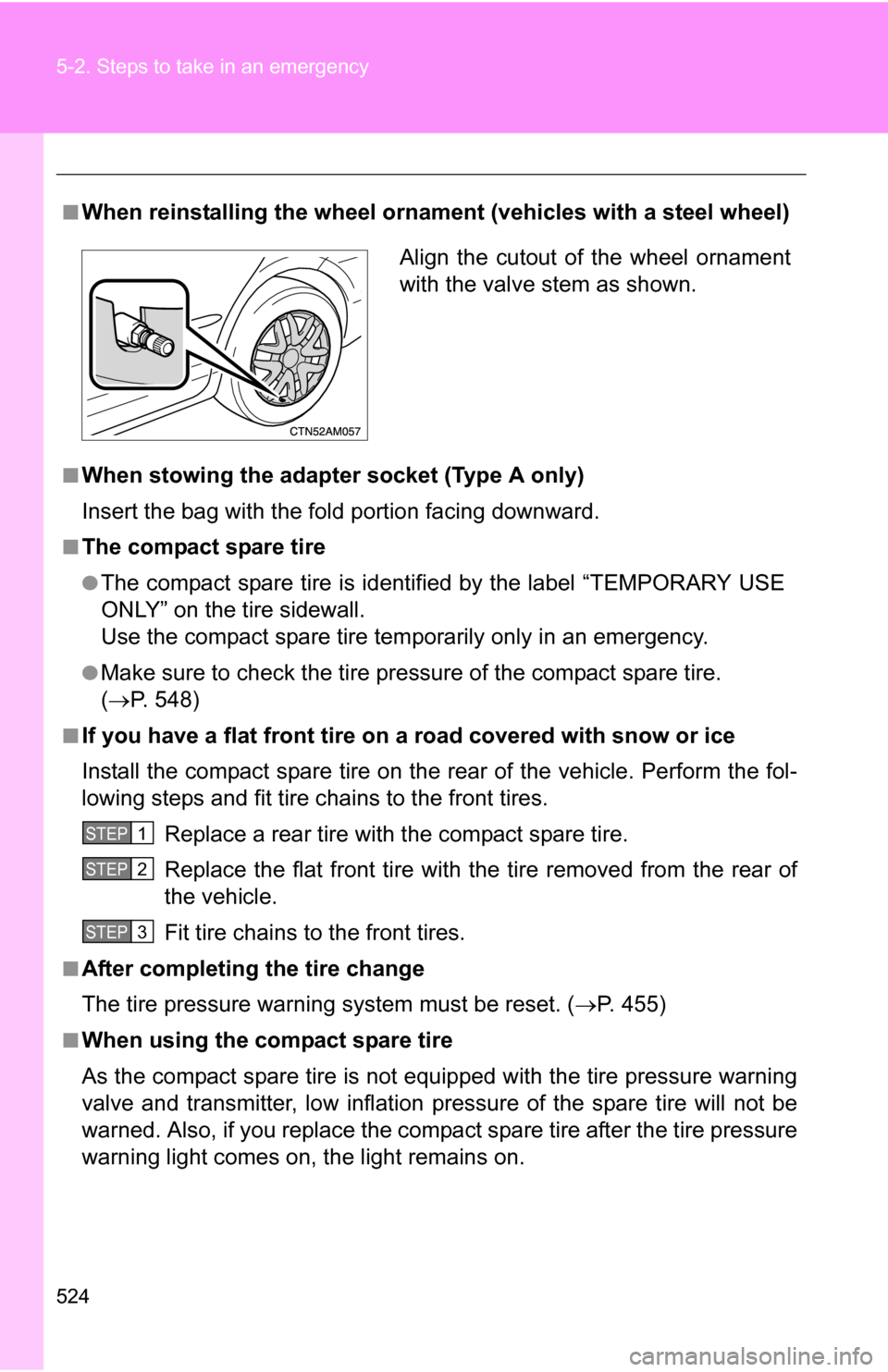
■When reinstalling the wheel ornament (vehicles with a steel wheel)
■When stowing the adapter socket (Type A only)
Insert the bag with the fold portion facing downward.
■The compact spare tire
●The compact spare tire is identified by the label “TEMPORARY USE
ONLY” on the tire sidewall.
Use the compact spare tire temporarily only in an emergency.
●Make sure to check the tire pressure of the compact spare tire.
( P. 548)
■If you have a flat front tire on a road covered with snow or ice
Install the compact spare tire on the rear of the vehicle. Perform the fol-
lowing steps and fit tire chains to the front tires.
Replace a rear tire with the compact spare tire.
Replace the flat front tire with the tire removed from the rear of
the vehicle.
Fit tire chains to the front tires.
■After completing the tire change
The tire pressure warnin g system must be reset. ( P. 455)
■When using the compact spare tire
As the compact spare tire is not equipped with the tire pressure warning
valve and transmitter, low inflation pressure of the spare tire will not be
warned. Also, if you replace the compac t spare tire after the tire pressure
warning light comes on, the light remains on.
Align the cutout of the wheel ornament
with the valve stem as shown.
STEP1
STEP2
STEP3
Page 528 of 592
528 5-2. Steps to take in an emergency
NOTICE
■When loosening or tightening the spare tire clamp bolt (type A
only)
Do not use an impact wrench. Use the adapter socket and jack handle.
■Do not drive the vehicle with a flat tire
Do not continue driving with a flat tire.
Driving even a short distance with a flat tire can damage the tire and the
wheel beyond repair.
■Be careful when driving over bumps with the compact spare tire
installed on the vehicle
The vehicle becomes lower when driving with the compact spare tire
compared to when drivin g with standard tires. Be careful when driving
over uneven road surfaces.
■Driving with tire chains and the compact spare tire
Do not fit tire chains to the compact spare tire.
Tire chains may damage the vehicle body and adversely affect driving
performance.
■When replacing the tires
When removing or fitting the wheels, tires or the tire pressure warning
valve and transmitter, contact your Toyota dealer as the tire pressure
warning valve and transmitter may be damaged if not handled correctly.
■To avoid damaging the tire pressure warning valves and transmit-
ters
Do not use liquid sealants on flat tires.
■After taking out or stowing the spare tire (type A only)
Make sure to secure the tire carrier by tightening the clamp bolt to pre-
vent the holding bracket from hitting the under body of the vehicle during
driving.
■Using the tire carrier
●As the tire carrier is designed for use with the compact spare tire, it
cannot be used with standard tires.
●If the spare tire is flat, do not use th e tire carrier, as the tire may not be
held securely.
Page 548 of 592
548 6-1. Specifications
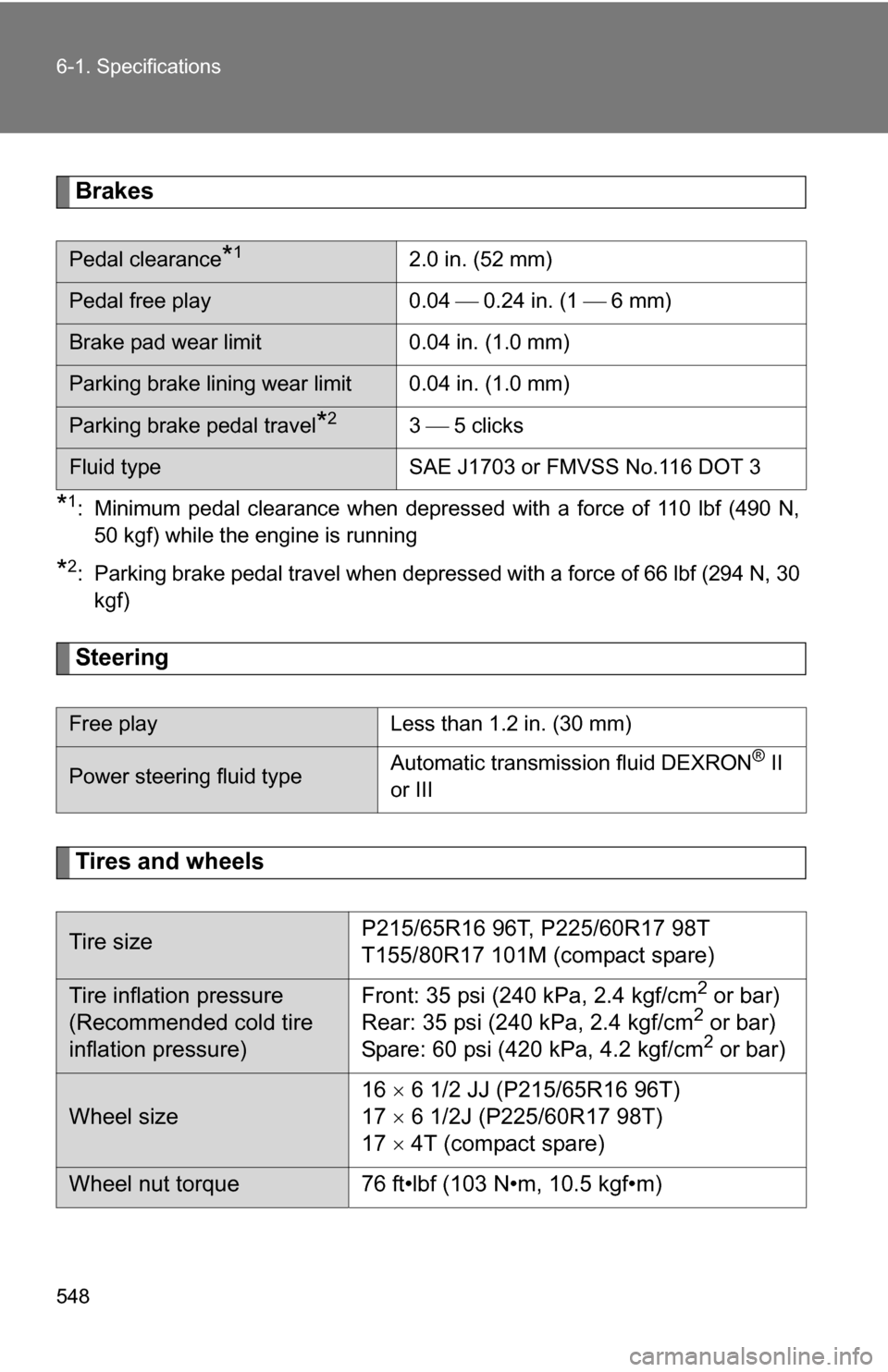
Brakes
*1: Minimum pedal clearance when depressed with a force of 110 lbf (490 N,50 kgf) while the engine is running
*2: Parking brake pedal travel when depressed with a force of 66 lbf (294 N, 30kgf)
Steering
Tires and wheels
Pedal clearance*12.0 in. (52 mm)
Pedal free play 0.04 0.24 in. (1 6 mm)
Brake pad wear limit 0.04 in. (1.0 mm)
Parking brake lining wear limit 0.04 in. (1.0 mm)
Parking brake pedal travel*23 5 clicks
Fluid type SAE J1703 or FMVSS No.116 DOT 3
Free playLess than 1.2 in. (30 mm)
Power steering fluid type Automatic transmission fluid DEXRON® II
or III
Tire size P215/65R16 96T, P225/60R17 98T
T155/80R17 101M (compact spare)
Tire inflation pressure
(Recommended cold tire
inflation pressure)Front: 35 psi (240 kPa, 2.4 kgf/cm2 or bar)
Rear: 35 psi (240 kPa, 2.4 kgf/cm2 or bar)
Spare: 60 psi (420 kPa, 4.2 kgf/cm2 or bar)
Wheel size 16
6 1/2 JJ (P215/65R16 96T)
17 6 1/2J (P225/60R17 98T)
17 4T (compact spare)
Wheel nut torque 76 ft•lbf (103 N•m, 10.5 kgf•m)
Page 554 of 592
554 6-1. Specifications
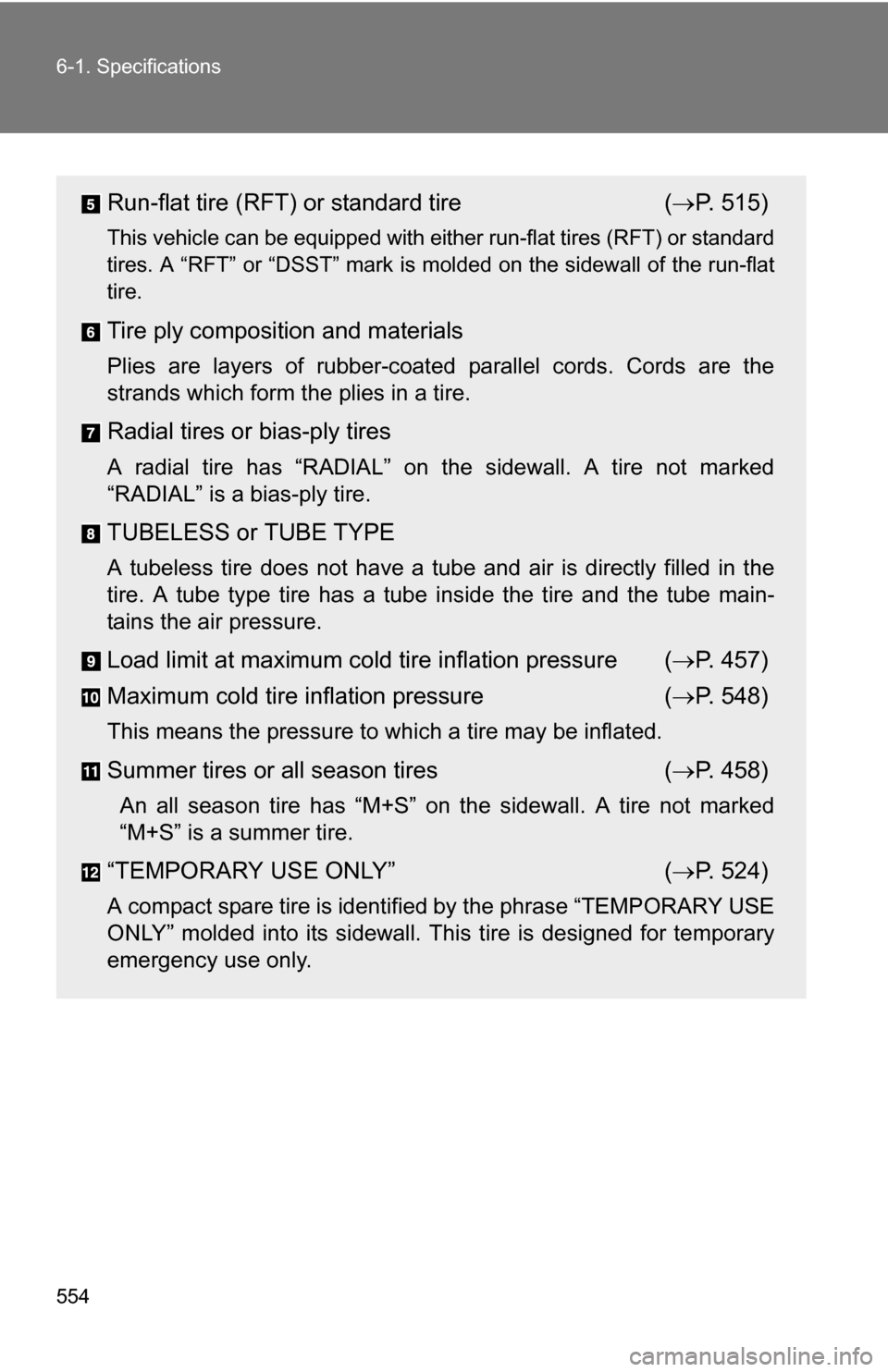
Run-flat tire (RFT) or standard tire( P. 515)
This vehicle can be equipped with either run-flat tires (RFT) or standard
tires. A “RFT” or “DSST” mark is molded on the sidewall of the run-flat
tire.
Tire ply composition and materials
Plies are layers of rubber-coated parallel cords. Cords are the
strands which form the plies in a tire.
Radial tires or bias-ply tires
A radial tire has “RADIAL” on the sidewall. A tire not marked
“RADIAL” is a bias-ply tire.
TUBELESS or TUBE TYPE
A tubeless tire does not have a tube and air is directly filled in the
tire. A tube type tire has a tube inside the tire and the tube main-
tains the air pressure.
Load limit at maximum cold tire inflation pressure ( P. 457)
Maximum cold tire in flation pressure ( P. 548)
This means the pressure to which a tire may be inflated.
Summer tires or all season tires ( P. 458)
An all season tire has “M+S” on the sidewall. A tire not marked
“M+S” is a summer tire.
“TEMPORARY USE ONLY” ( P. 524)
A compact spare tire is identified by the phrase “TEMPORARY USE
ONLY” molded into its sidewall. This tire is designed for temporary
emergency use only.
Page 555 of 592
555
6-1. Specifications
6
Vehicle specifications
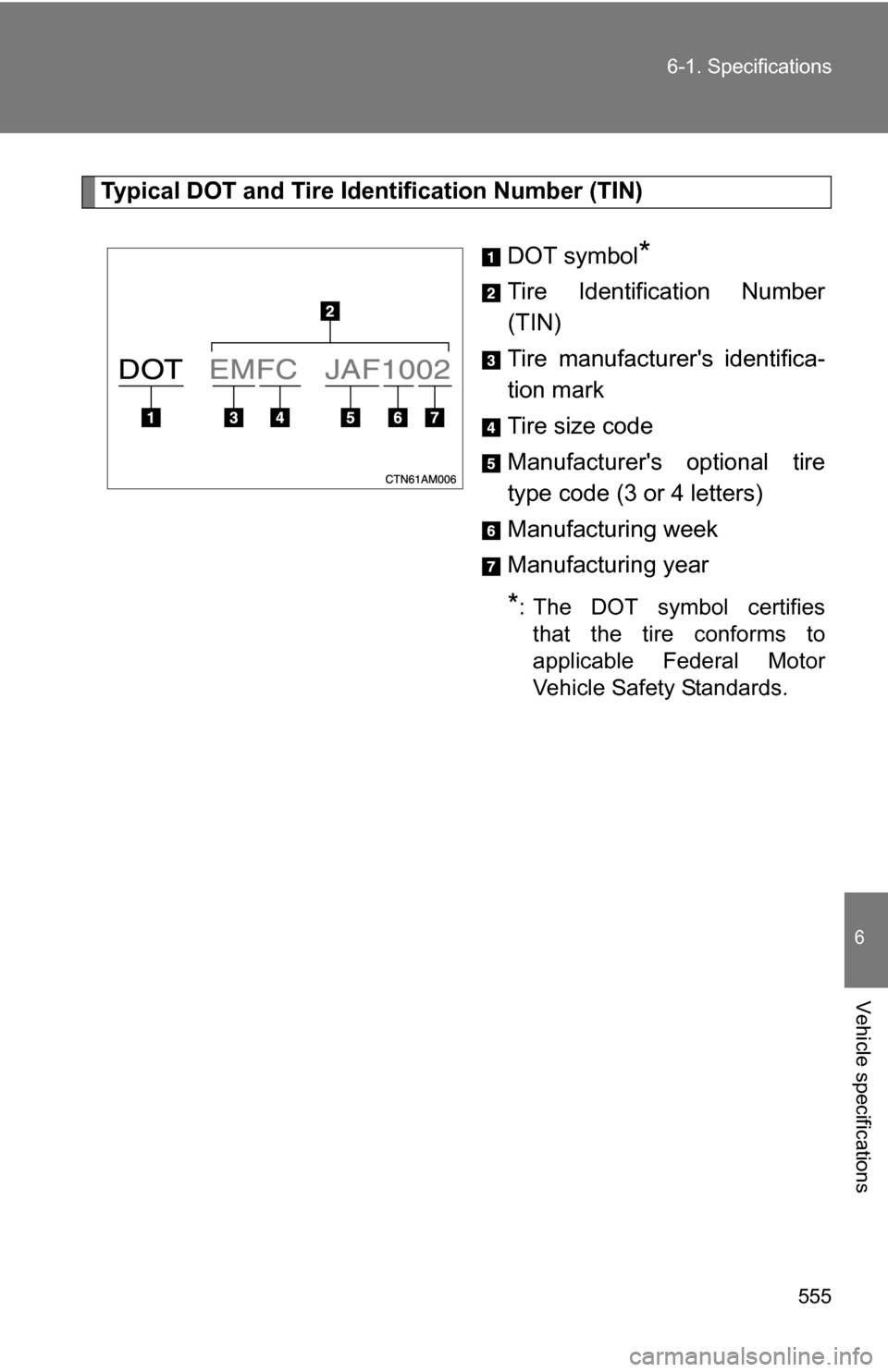
Typical DOT and Tire Identification Number (TIN)
DOT symbol
*
Tire Identification Number
(TIN)
Tire manufacturer's identifica-
tion mark
Tire size code
Manufacturer's optional tire
type code (3 or 4 letters)
Manufacturing week
Manufacturing year
*: The DOT symbol certifiesthat the tire conforms to
applicable Federal Motor
Vehicle Safety Standards.
Page 560 of 592
560 6-1. Specifications
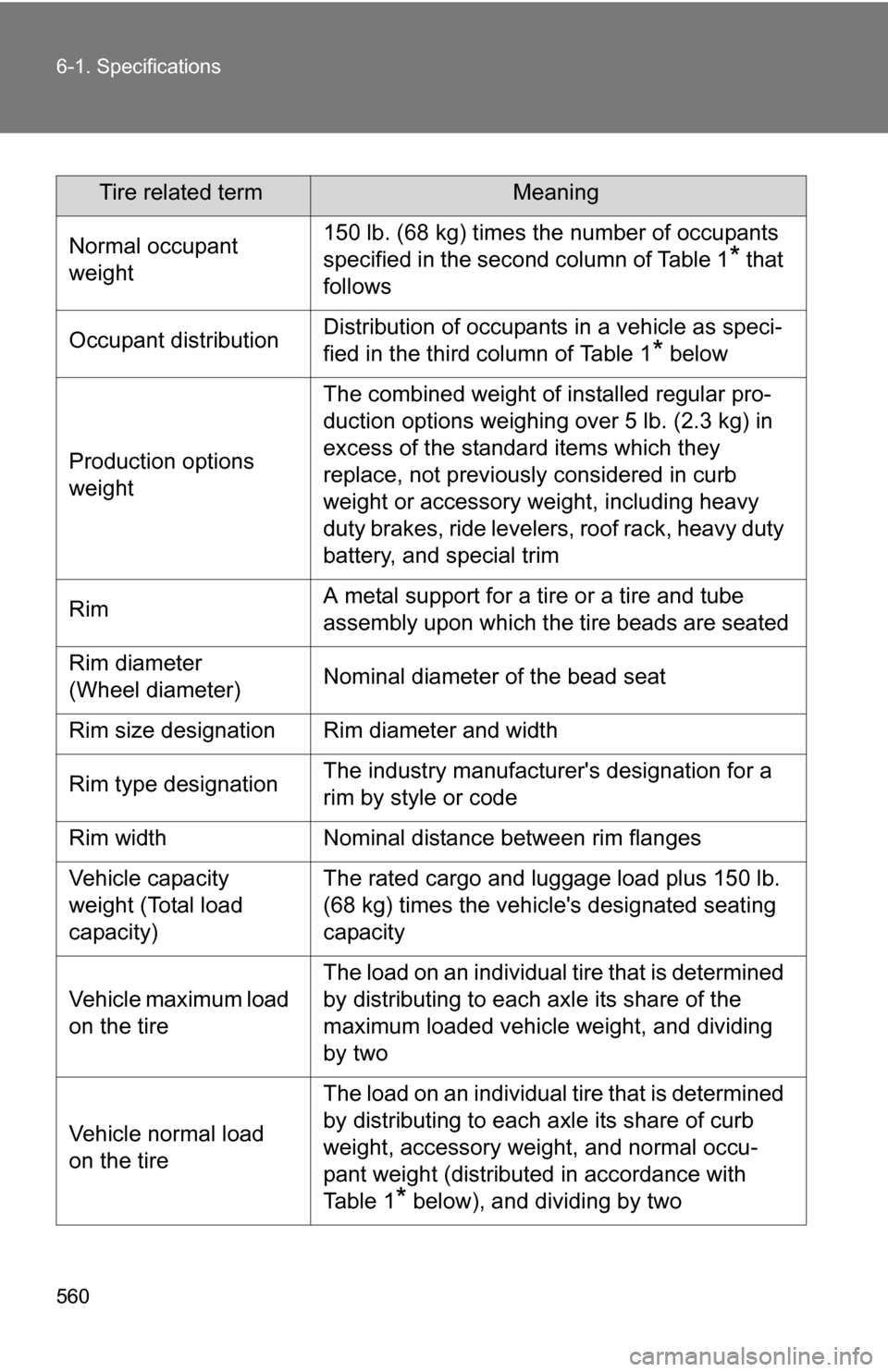
Tire related termMeaning
Normal occupant
weight 150 lb. (68 kg) times the number of occupants
specified in the second column of Table 1
* that
follows
Occupant distribution Distribution of occupants in a vehicle as speci-
fied in the third column of Table 1
* below
Production options
weight The combined weight of installed regular pro-
duction options weighing over 5 lb. (2.3 kg) in
excess of the standard items which they
replace, not previously considered in curb
weight or accessory weight, including heavy
duty brakes, ride levelers, roof rack, heavy duty
battery, and special trim
Rim A metal support for a tire or a tire and tube
assembly upon which the tire beads are seated
Rim diameter
(Wheel diameter) Nominal diameter of the bead seat
Rim size designation Rim diameter and width
Rim type designation The industry manufacturer's designation for a
rim by style or code
Rim width Nominal distance between rim flanges
Vehicle capacity
weight (Total load
capacity) The rated cargo and luggage load plus 150 lb.
(68 kg) times the vehicl
e's designated seating
capacity
Vehicle maximum load
on the tire The load on an individual tire that is determined
by distributing to each axle its share of the
maximum loaded vehicle weight, and dividing
by two
Vehicle normal load
on the tire The load on an individual tire that is determined
by distributing to each axle its share of curb
weight, accessory weight, and normal occu-
pant weight (distributed in accordance with
Ta b l e 1
* below), and dividing by two
Page 592 of 592
592
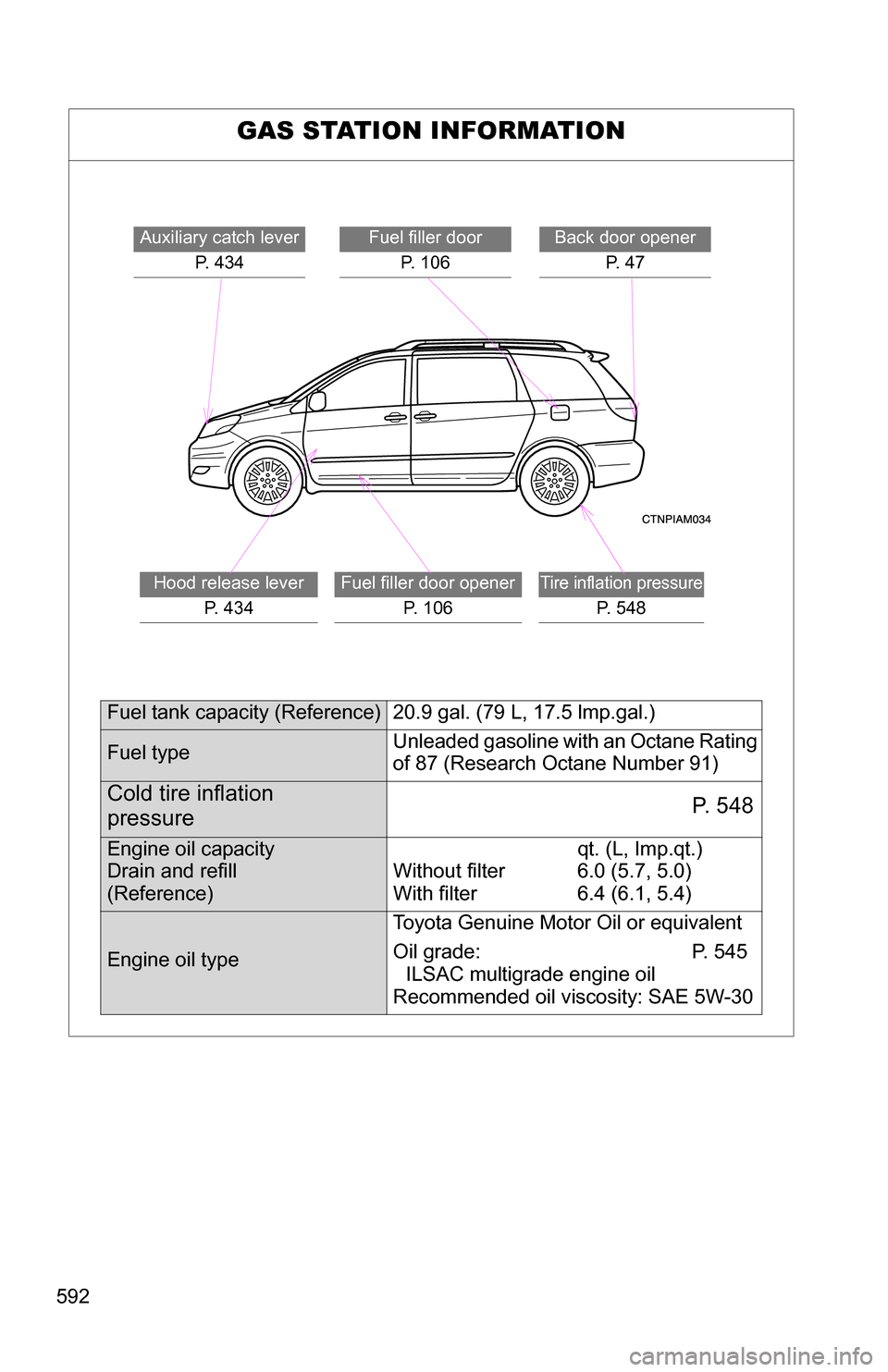
GAS STATION INFORMATION
Auxiliary catch leverP. 434Fuel filler doorP. 106
Hood release lever P. 4 3 4Fuel filler door opener P. 1 0 6Tire inflation pressure
P. 548
Back door openerP. 4 7
Fuel tank capacity (Reference) 20.9 gal. (79 L, 17.5 lmp.gal.)
Fuel type Unleaded gasoline with an Octane Rating
of 87 (Research Octane Number 91)
Cold tire inflation
pressure
P. 5 4 8
Engine oil capacity
Drain and refill
(Reference)qt. (L, Imp.qt.)
Without filter 6.0 (5.7, 5.0)
With filter 6.4 (6.1, 5.4)
Engine oil type Toyota Genuine Motor Oil or equivalent
Oil grade: P. 545
ILSAC multigrade engine oil
Recommended oil viscosity: SAE 5W-30