Page 2 of 612

TABLE OF CONTENTSIndex
2
1-1. Key information .................. 32Keys ..................................... 32
1-2. Opening, closing and locking the doors ............. 33
Wireless remote control ....... 33
Side doors ............................ 37
Back door ............................. 42
1-3. Adjustable components (seats, mirrors, steering
wheel) ................................ 47
Front seats ........................... 47
Rear seats ............................ 51
Driving position memory system ................................ 61
Head restraints ..................... 64
Seat belts ............................. 67
Steering wheel (manually adjustable type) .................. 77
Steering wheel (power-adjustable type)...... 78
Anti-glare inside rear view mirror .................................. 79
Outside rear view mirrors ..... 82
Roof luggage carrier............. 86
1-4. Opening and closing the windows and
moon roof ......................... 88
Power windows .................... 88
Power back window ............. 90
Moon roof ............................. 92 1-5. Refueling ............................. 95
Opening the fuel tank cap..... 95
1-6. Theft deterrent system ..... 100 Engine immobilizer system .............................. 100
Alarm .................................. 102
Theft prevention labels (U.S.A.)............................. 104
1-7. Safety information ............ 105 Correct driving posture ....... 105
SRS airbags ....................... 107
Front passenger occupant classification system ......... 120
Child restraint systems ....... 125
Installing child restraints ..... 129
2-1. Driving procedures........... 142 Driving the vehicle .............. 142
Engine (ignition) switch....... 151
Automatic
transmission........ 154
Turn signal lever ................. 158
Parking brake ..................... 159
Horn .................................... 160
2-2. Instrument cluster ............ 161 Gauges and meters ............ 161
Indicators and warning lights ................................. 166
Multi-information display ..... 171
Accessory meter ................. 177
1Before driving
2When driving
Page 10 of 612
10
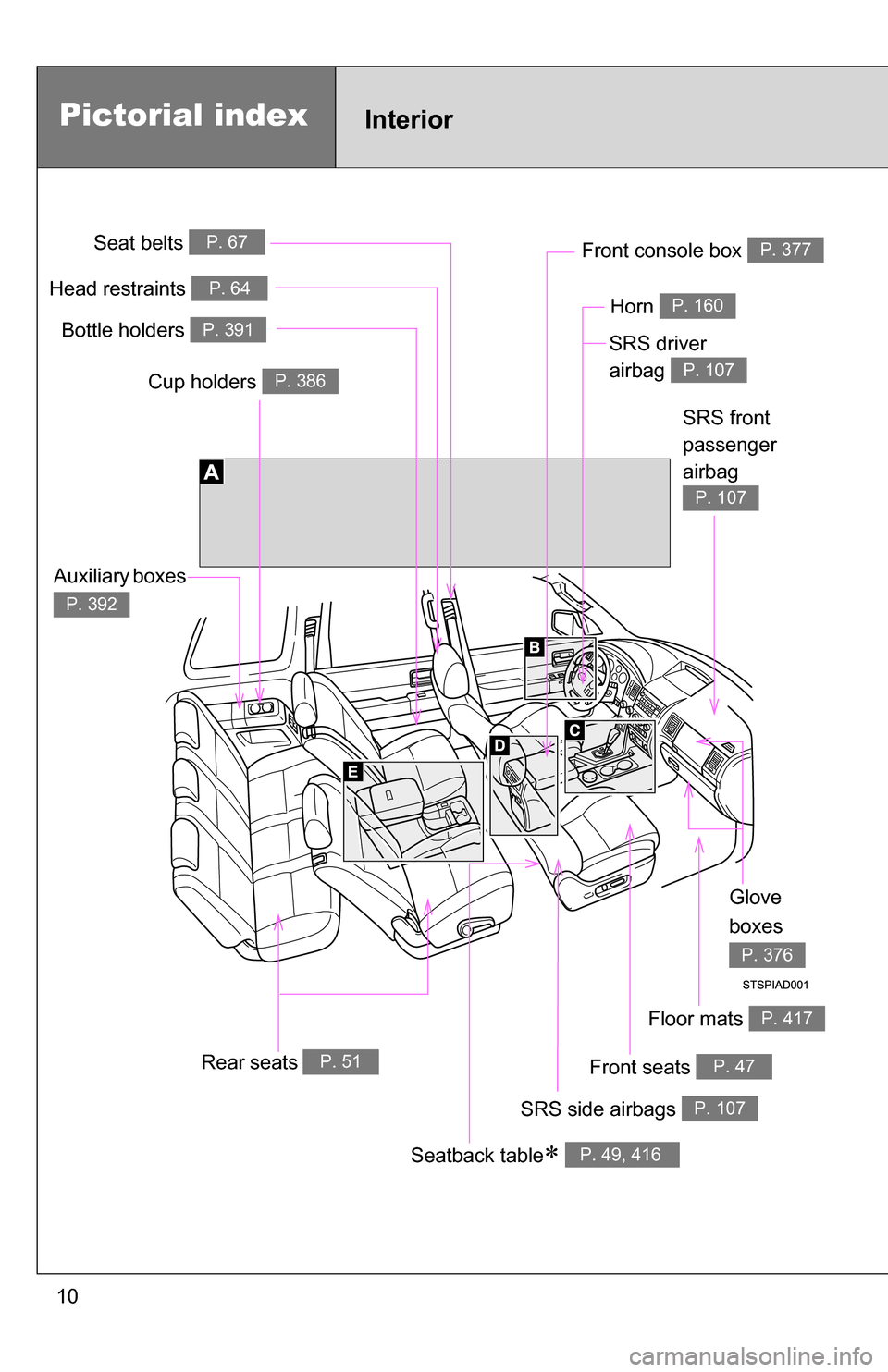
Pictorial indexInterior
Seat belts P. 67
SRS driver
airbag
P. 107
Head restraints P. 64
Bottle holders P. 391
SRS side airbags P. 107
Floor mats P. 417
SRS front
passenger
airbag
P. 107
Rear seats P. 51Front seats P. 47
Front console box P. 377
Seatback table P. 49, 416
Cup holders P. 386
Auxiliary boxes
P. 392
Glove
boxes
P. 376
Horn P. 160
Page 141 of 612

When driving2
141
2-1. Driving procedures ........ 142Driving the vehicle............ 142
Engine (ignition) switch .... 151
Automatic
transmission..... 154
Turn signal lever .............. 158
Parking brake ................... 159
Horn ................................. 160
2-2. Instrument cluster.......... 161 Gauges and meters ......... 161
Indicators and warning lights .............................. 166
Multi-information display............................ 171
Accessory meter .............. 177
2-3. Operating the lights and wipers ........................... 180
Headlight switch ............... 180
Fog light switch ................ 183
Windshield wipers and washer ........................... 184
Rear window wiper and washer ........................... 186
Headlight cleaner switch ............................. 187 2-4. Using other driving
systems ........................ 188
Cruise control ................... 188
Dynamic laser cruise control ............................ 191
Intuitive parking assist...... 202
Electronically modulated air suspension ................ 208
AVS (Adaptive Variable Suspension System) ...... 213
Four-wheel drive system ........................... 214
AUTO LSD system........... 219
Driving assist systems ..... 221
2-5. Driving information ........ 227 Off-road precautions ........ 227
Cargo and luggage .......... 232
Vehicle load limits ............ 236
Winter driving tips ............ 237
Trailer towing ................... 241
Dinghy towing .................. 257
Page 160 of 612
160
2-1. Driving procedures
Hor n
■After adjusting the steering wheel (veh icles with manual tilt and tele-
scopic steering)
Make sure that the steering wheel is securely locked.
The horn may not sound if the steering wheel is not securely locked.
( P. 77)
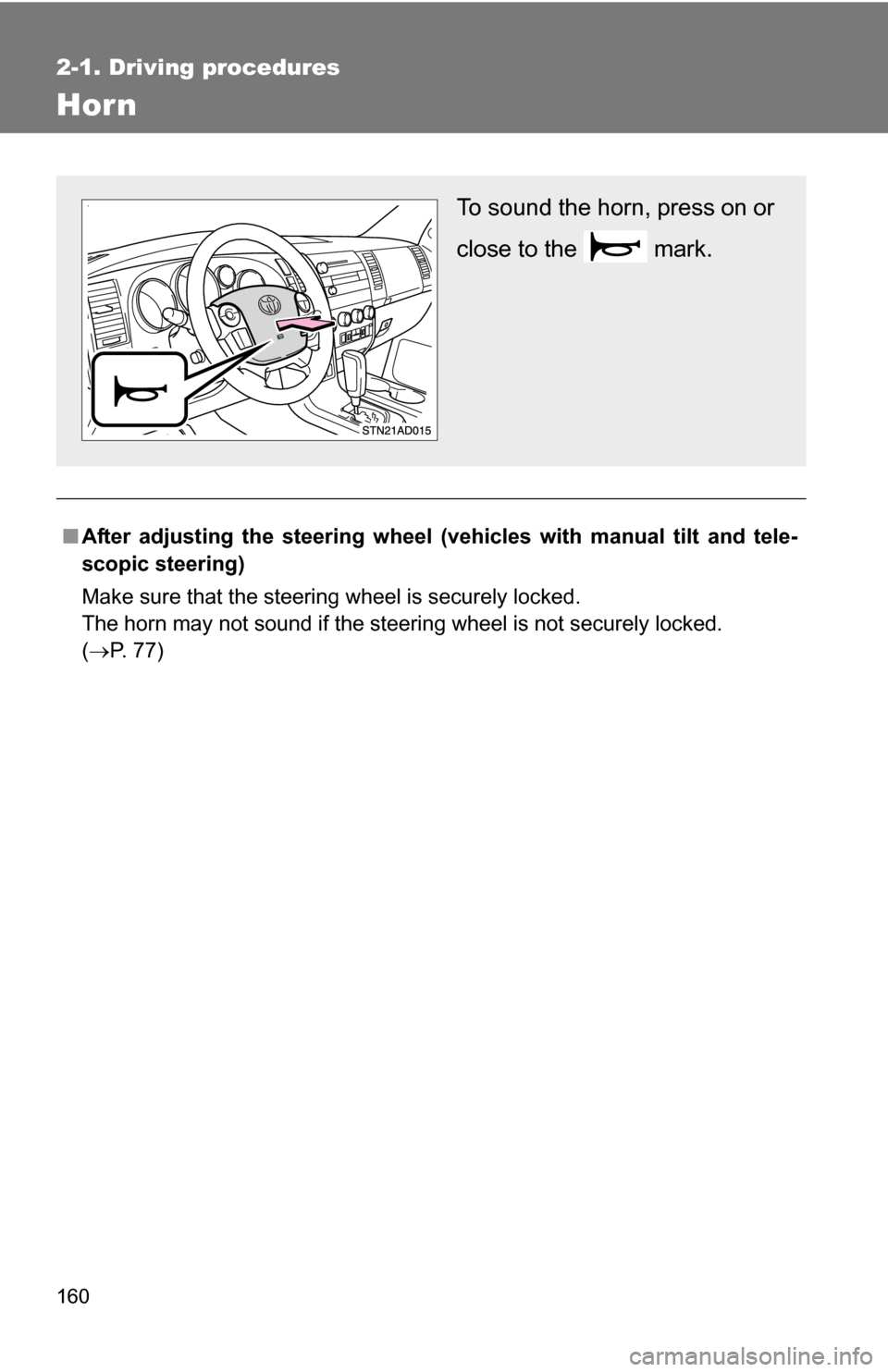
To sound the horn, press on or
close to the mark.
Page 206 of 612

206 2-4. Using other driving systems
■Sensor detection information
●Certain vehicle conditions and the surrounding environment may affect
the ability of a sensor to correctly detect an obstacle. Particular instances
where this may occur are listed below.
• There is dirt, snow or ice on a sensor.
• A sensor is frozen.
• A sensor is covered in any way.
• The vehicle is leaning considerably to one side.
• On an extremely bumpy road, on an incline, on gravel, or on grass.
• The vicinity of the vehicle is noisy due to vehicle horns, motorcycle
engines, air brakes of large vehicles, or other loud noises producing
ultrasonic waves.
• There is another vehicle equipped with parking assist sensors in the vicinity.
• A sensor is coated with a sheet of spray or heavy rain.
• The vehicle is equipped with a fender pole or radio antenna.
• A bumper or sensor receives a strong impact.
• The vehicle is approaching a tall or right-angled curb.
• In harsh sunlight or intense cold weather.
• The area directly under the bumpers is not detected. Objects lower than the sensors or thin stakes etc. may be detected ini-
tially, but as they draw closer, they may cease to be detected.
• A towing hitch is mounted to the vehicle.
• A non-genuine Toyota suspension (lowered suspension etc.) is installed.
• When attaching a two-way radio antenna.
• When a towing eyelet is mounted on your vehicle.
• When the bumper is damaged.
In addition to the examples above, there are instances in which, because of
their shapes, signs and other objects may be judged by a sensor to be closer
than they are.
● The shape of the obstacle may prevent a sensor from detecting it. Pay
particular attention to the following obstacles:
• Wires, fences, ropes, etc.
• Cotton, snow and other materials that absorb radio waves
• Sharply-angled objects
Page 487 of 612
487
4-3. Do-it-yourself maintenance
4
Maintenance and care
Fuse layout and amperage ratings
■ Engine compartment
FuseAmpereCircuit
1 A/F 15 A Multiport fuel injection system/
sequential multiport fuel injection
system
2 HORN 10 A Horn
3 EFI NO.1 25 A Multiport fuel injection system/
sequential multiport fuel injection
system
4 IG2 MAIN 30 A INJ, MET, IGN fuses
5 L2 RR2 SEAT 30 A Power third seat
6 L1 RR2 SEAT 30 A Power third seat
7 CDS FAN 25 A Electric cooling fans
8 DEICER 20 A Windshield wiper de-icer
9 TOW TAIL 30 A Trailer lights (tail lights)
10 R2 RR2 SEAT 30 A Power third seat 11 R1 RR2 SEAT 30 A Power third seat
12 POWER NO.4 25 A Power windows
Page 542 of 612
542
5-2. Steps to take in an emergency
If the engine will not star t
If the engine still does not start after following the correct starting
procedure ( P. 151) or releasing the steering lock (P. 152), confirm
the following points.
■ The engine will not start even when the starter motor oper-
ates normally.
One of the following may be the cause of the problem.
●There may not be sufficient fuel in the vehicle’s tank.
Refuel the vehicle. ( P. 9 5 )
Flex-fuel vehicles: The type of fuel may be different. When
refueling, add the same type of fuel, if available.
After adding a different type of fuel, the engine may run
roughly and driving performance may be reduced for a while
when the engine is first started. In this case, wait until the
engine runs normally.
● The engine may be flooded.
Try to restart the engine once more following correct starting
procedures.
● There may be a malfunction in the engine immobilizer system.
( P. 100)
■ The starter motor turns over slowly, the interior lights and
headlights are dim, or the horn does not sound or sounds at
a low volume.
One of the following may be the cause of the problem.
●The battery may be discharged. ( P. 546)
● The battery terminal connec tions may be loose or corroded.
Page 543 of 612
5
When trouble arises
543
5-2. Steps to take in an emergency
■
The starter motor does not turn over, the interior lights and
headlights do not turn on, or the horn does not sound.
One of the following may be the cause of the problem.
● One or both of the battery terminals may be disconnected.
● The battery may be discharged. ( P. 546)
Contact your Toyota dealer if the problem cannot be repaired, or if
repair procedures are unknown.