Page 331 of 516
Maintenance and care4
331
4-1. Maintenance and careCleaning and protecting the vehicle exterior ......... 332
Cleaning and protecting the vehicle interior .......... 335
4-2. Maintenance Maintenance requirements .................. 338
General maintenance....... 340
Emission inspection and maintenance (I/M)
programs........................ 343
4-3. Do-it-yourself maintenance Do-it-yourself service precautions .................... 344
Hood ................................ 348
Positioning a floor jack ..... 350
Engine compartment ........ 352
Tires ................................. 368
Tire inflation pressure ...... 375
Wheels ............................. 380
Air conditioning filter......... 382
Key battery ....................... 384
Checking and replacing fuses .............................. 388
Light bulbs........................ 400
Page 334 of 516
334 4-1. Maintenance and care
NOTICE
■To protect your vehicle’s painted surfaces
Do not use organic cleaners such as benzene or gasoline.
■ Cleaning the exterior lights
●Wash carefully. Do not use organic substances or scrub with a hard brush.
This may damage the surfaces of the lights.
● Do not apply wax on the surfaces of the lights.
Wax may cause damage to the lenses.
■ To prevent damage to the windshield wiper arms
When lifting the wiper arms away from the windshield, pull the driver side
wiper arm upward first, and repeat for the passenger side. When returning
the wipers to their original position, do so from the passenger side first.
Page 337 of 516

337
4-1. Maintenance and care
4
Maintenance and care
NOTICE
■
Cleaning detergents
Do not use organic substances such as benzene or gasoline, acidic or alka-
line solutions, dye, bleach or other detergent. Doing so may discolor the
vehicle interior or cause streaks or damage to painted surfaces.
■ Preventing damage to leather surfaces
Observe the following precautions to avoid damage to and deterioration o\
f
leather surfaces.
●Remove any dust or dirt on leather surfaces immediately.
● Do not expose the vehicle to direct sunlight for extended periods of time.
Park the vehicle in the shade, especially during summer.
● Do not place items made of vinyl, plastic, or that contain wax on the uphol-
stery, as they may stick to the leather surface if the vehicle interior heats
up significantly.
■ Water on the floor
Do not wash the vehicle floor with water.
Vehicle systems such as the audio system may be damaged if water comes
into contact with electrical components under the floor of the vehicle, and
may also cause the body to rust.
■ Cleaning the inside of the rear window
●Do not use glass cleaner to clean the rear window, as this may cause
damage to the rear window defogger heater wires. Use a cloth dampened
with lukewarm water to gently wipe the windows clean. Wipe the windows
in strokes running parallel to the heater wires.
● Be careful not to scratch or damage the heater wires.
Page 341 of 516
341
4-2. Maintenance
4
Maintenance and care
Vehicle interior
ItemsCheck points
Accelerator pedal • Moves smoothly (without uneven
pedal effort or catching)?
Automatic transmission “Park”
mechanism • Can the vehicle be held securely
on an incline with the shift lever in
P?
Brake pedal • Moves smoothly?
• Does it have appropriate clear-
ance and correct amount of free
play?
Brakes • Not pull to one side when
applied?
• Loss of brake effectiveness?
• Spongy feeling brake pedal?
• Pedal almost touches floor?
Head restraints • Move smoothly and lock
securely?
Indicators/buzzers • Function properly?
Lights • Do all the lights come on?
• Headlights aimed correctly?
Parking brake • Moves smoothly?
• Can hold the vehicle securely on
an incline?
Seat belts • Does the seat belt system oper-
ate smoothly?
• Are the belts undamaged?
Seats • Do the seat controls operate
properly?
Steering wheel • Moves smoothly?
• Has correct free play?
• No strange noises?
Page 345 of 516
345
4-3. Do-it-yourself maintenance
4
Maintenance and care
ItemsParts and tools
Fuses ( P. 388)• Fuse with same amperage rating
as original
Radiator and condenser (P. 361)
Tire inflation pressure (
P. 375) • Tire pressure gauge
• Compressed air source
Washer fluid
(P. 367) • Water washer fluid containing
antifreeze (for winter use)
• Funnel
Light bulb (P. 400) • Bulb with same number and watt-
age rating as original
• Flathead screwdriver
Page 348 of 516
348
4-3. Do-it-yourself maintenance
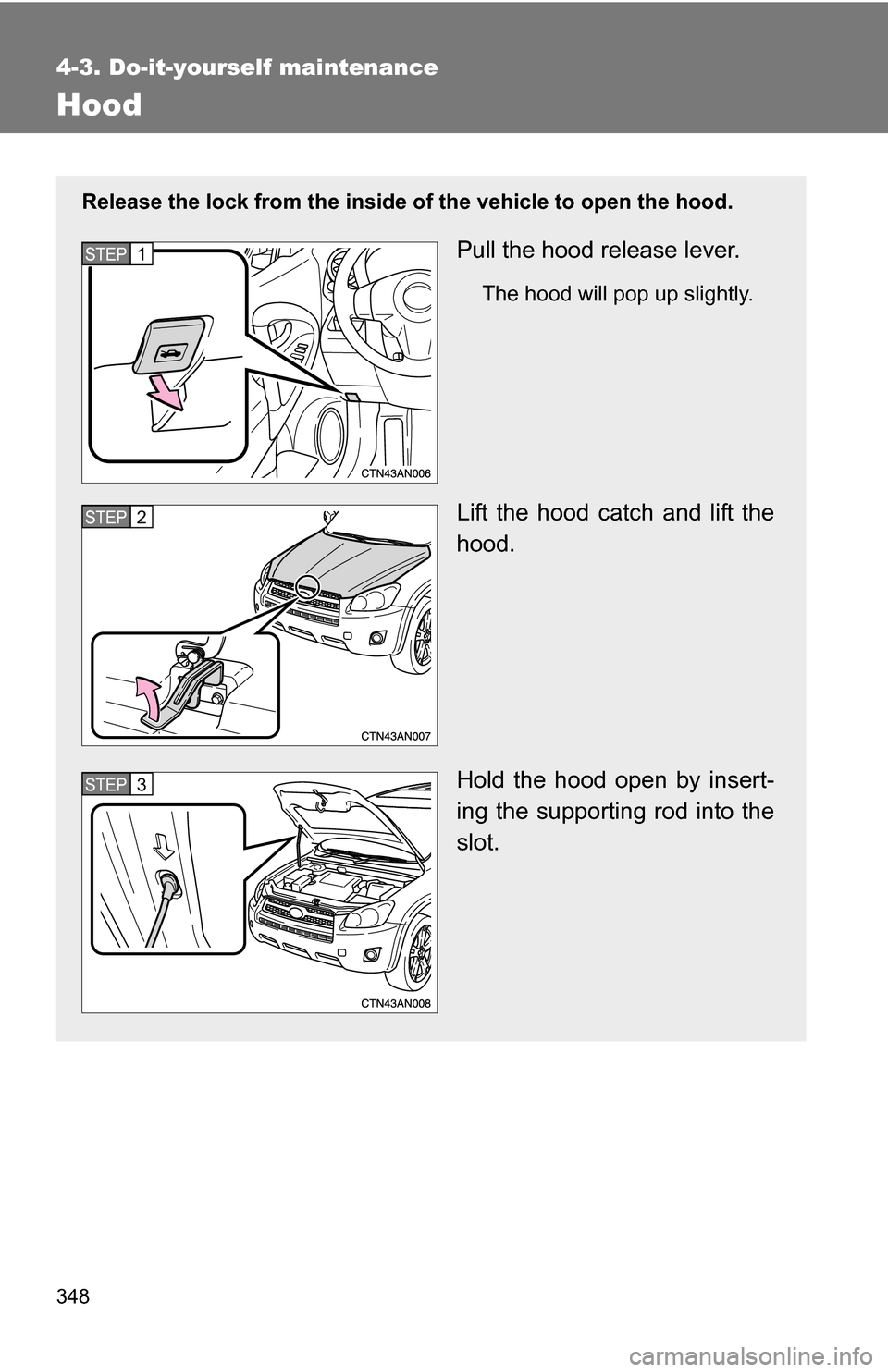
Hood
Release the lock from the inside of the vehicle to open the hood.
Pull the hood release lever.
The hood will pop up slightly.
Lift the hood catch and lift the
hood.
Hold the hood open by insert-
ing the supporting rod into the
slot.
STEP 1
STEP 2
STEP 3
Page 362 of 516
362 4-3. Do-it-yourself maintenance
■Adding fluid
Fluid type SAE J1703 or FMVSS No.116 DOT 3 brake fluid
Items Clean funnel
■ Brake fluid can absorb moisture from the air
Excess moisture in the fluid can cause a dangerous loss of braking effi-
ciency. Use only newly opened brake fluid.
CAUTION
■When filling the reservoir
Take care because brake fluid can harm your hands or eyes and damage
painted surfaces.
If fluid gets on your hands or in your eyes, flush the affected area with clean
water immediately.
If you still experience discomfort, see a doctor.
NOTICE
■If the fluid level is low or high
It is normal for the brake fluid level to go down slightly as the brake pads
wear or when the fluid level in the accumulator is high.
If the reservoir needs frequent refilling, it may indicate a serious pro\
blem.
Page 364 of 516
364 4-3. Do-it-yourself maintenance
Type BGreen: Good condition
Dark: Charging is necessary.
Have the vehicle inspected by
your Toyota dealer.
Clear or light yellow: Not
working properly. Have the
vehicle checked by your
Toyota dealer.
■Before recharging
When recharging, the battery produces hydrogen gas which is flammable
and explosive. Therefore, before recharging:
●If recharging with the battery installed on the vehicle, be sure to discon-
nect the ground cable.
● Make sure the power switch on the charger is off when connecting and
disconnecting the charger cables to the battery.
■ After recharging/reconnecting the battery (vehicles with smart key sys-
tem)
In some cases, the engine may not start. Follow the procedure below to ini-
tialize the system.
Shift the shift lever to P, and turn the “ENGINE START STOP”
switch OFF.
Open and close any of the doors.
Start the engine. (If the engine does not start first time, repeat the
procedure.)
STEP 1
STEP 2
STEP 3