Page 424 of 608
424
4-2. Maintenance
General maintenance
Engine compartment
ItemsCheck points
Battery Maintenance-free. ( →P. 449)
Brake fluid At the correct level? (→P. 448)
Engine coolant At the correct level? (→P. 445)
Engine oil At the correct level? (→P. 440)
Exhaust system No fumes or strange sounds?
Radiator/condenser/hoses Not blocked with foreign matter?
(
→P. 447)
Washer fluid At the correct level? (→P. 452)
Listed below are the general maintenance items that should be per-
formed at the intervals specified in the “Scheduled Maintenance
Guide” or “Owner’s Manual Supp lement”. It is recommended that
any problem you notice should be brought to the attention of your
Toyota dealer or qualifie d service shop for advice.
Page 428 of 608

428
4-3. Do-it-yourself maintenance
Do-it-yourself service precautions
If you perform maintenance yourself, be sure to follow the correct
procedures as given in these sections.
ItemsParts and tools
Battery condition ( →P. 449)•Warm water
• Baking soda
• Grease
• Conventional wrench
(for terminal clamp bolts)
Brake fluid level ( →P. 448)• FMVSS No.116 DOT 3 or SAE
J1703 brake fluid
• Rag or paper towel
• Funnel (used only for adding brake fluid)
Engine coolant level ( →P. 445)• “Toyota Super Long Life Coolant”
or similar high quality ethylene
glycol based non-silicate, non-
amine, non-nitrite and non-borate
coolant with long-life hybrid
organic acid technology.
For the U.S.A.:
“Toyota Super Long Life
Coolant” is pre-mixed with 50%
coolant and 50% deionized
water.
For Canada:
“Toyota Super Long Life
Coolant” is pre-mixed with 55%
coolant and 45% deionized
water.
• Funnel (used only for adding engine coolant)
Engine oil level (→P. 440) • “Toyota Genuine Motor Oil” or
equivalent
• Rag or paper towel, funnel (used only for adding oil)
Page 430 of 608
430 4-3. Do-it-yourself maintenance
CAUTION
The engine compartment contains many mechanisms and fluids that may
move suddenly, become hot, or become electrically energized. To avoid death
or serious injury observe the following precautions.
■When working on the engine compartment
●Keep hands, clothing, and tools away from the moving fan and engine
drive belt.
● Be careful not to touch the engine, radiator, exhaust manifold, etc. right
after driving as they may be hot. Oil and other fluids may also be hot.
● Do not leave anything that may burn easily, such as paper or rags, in the
engine compartment.
● Do not smoke, cause sparks or expose an open flame to fuel or the bat-
tery. Fuel and battery fumes are flammable.
● Be extremely cautious when working on the battery. It contains poisonous
and corrosive sulfuric acid.
● Take care because brake fluid can harm your hands or eyes and damage
painted surfaces.
If fluid gets on your hands or in your eyes, flush the affected area with
clean water immediately.
If you still experience discomfort, see a doctor.
● Do not touch the engine compartment when the electric cooling fan is
operating.
Vehicles without smart key system: The electric cooling fan may keep
rotating for about 3 minutes even after the engine switch is turned to the
“LOCK” position.
With the engine switch in the “ON” position, the electric cooling fan may
automatically start to run if the air conditioning is on and/or the coolant
temperature is high. Be sure the engine switch is in the “LOCK” position
when working near the electric cooling fan or radiator grille.
Vehicles with smart key system: The electric cooling fan may keep rotating
for about 3 minutes even after the “ENGINE START STOP” switch is OFF.
With the “ENGINE START STOP” switch in IGNITION ON mode, the elec-
tric cooling fan may automatically start to run if the air conditioning is on
and/or the coolant temperature is high. Be sure the “ENGINE START
STOP” switch is OFF when working near the electric cooling fan or radia-
tor grille.
Page 437 of 608
437
4-3. Do-it-yourself maintenance
4
Maintenance and care
Engine compartment
2.7 L 4-cylinder (1AR-FE) engine
Washer fluid tank (→P. 452)
Engine oil filler cap (→ P. 441)
Engine oil level dipstick (→ P. 440)
Engine coolant reservoir (→ P. 445)Battery ( →P. 449)
Brake fluid reservoir (→ P. 448)
Fuse boxes ( →P. 475)
Electric cooling fans
Condenser ( →P. 447)
Radiator ( →P. 447)
Page 438 of 608
438 4-3. Do-it-yourself maintenance
3.5 L V6 (2GR-FE) engine
Washer fluid tank (→P. 452)
Engine oil filler cap (→ P. 441)
Engine oil level dipstick (→ P. 440)
Engine coolant reservoir (→ P. 445)Battery ( →P. 449)
Brake fluid reservoir (→ P. 448)
Fuse boxes ( →P. 475)
Electric cooling fans
Condenser ( →P. 447)
Radiator ( →P. 447)
Page 440 of 608
440 4-3. Do-it-yourself maintenance
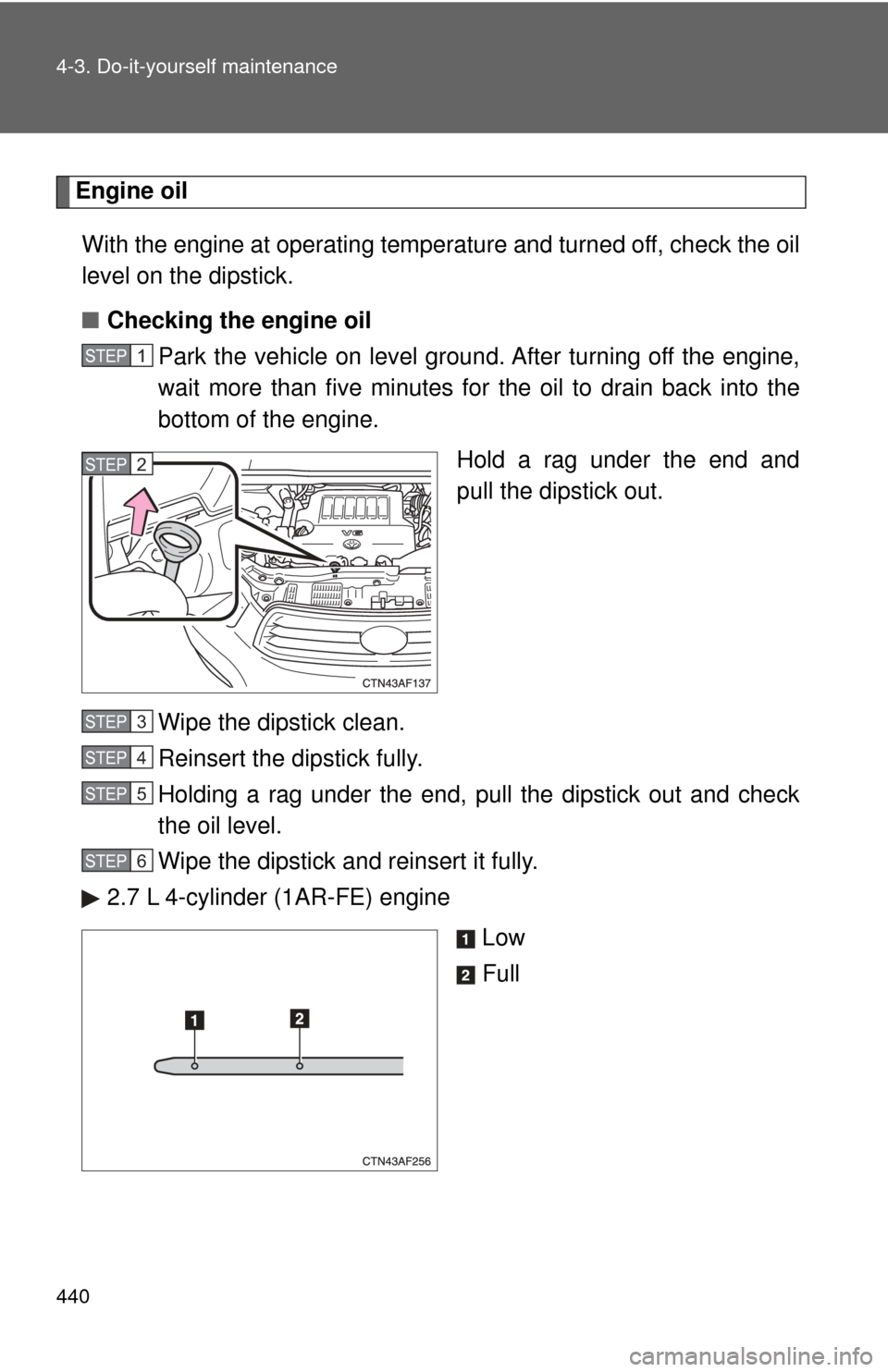
Engine oilWith the engine at operating temperature and turned off, check the oil
level on the dipstick.
■ Checking the engine oil
Park the vehicle on level ground. After turning off the engine,
wait more than five minutes for the oil to drain back into the
bottom of the engine.
Hold a rag under the end and
pull the dipstick out.
Wipe the dipstick clean.
Reinsert the dipstick fully.
Holding a rag under the end, pull the dipstick out and check
the oil level.
Wipe the dipstick and reinsert it fully.
2.7 L 4-cylinder (1AR-FE) engine
Low
Full
STEP1
STEP2
STEP3
STEP4
STEP5
STEP6
Page 441 of 608
441
4-3. Do-it-yourself maintenance
4
Maintenance and care
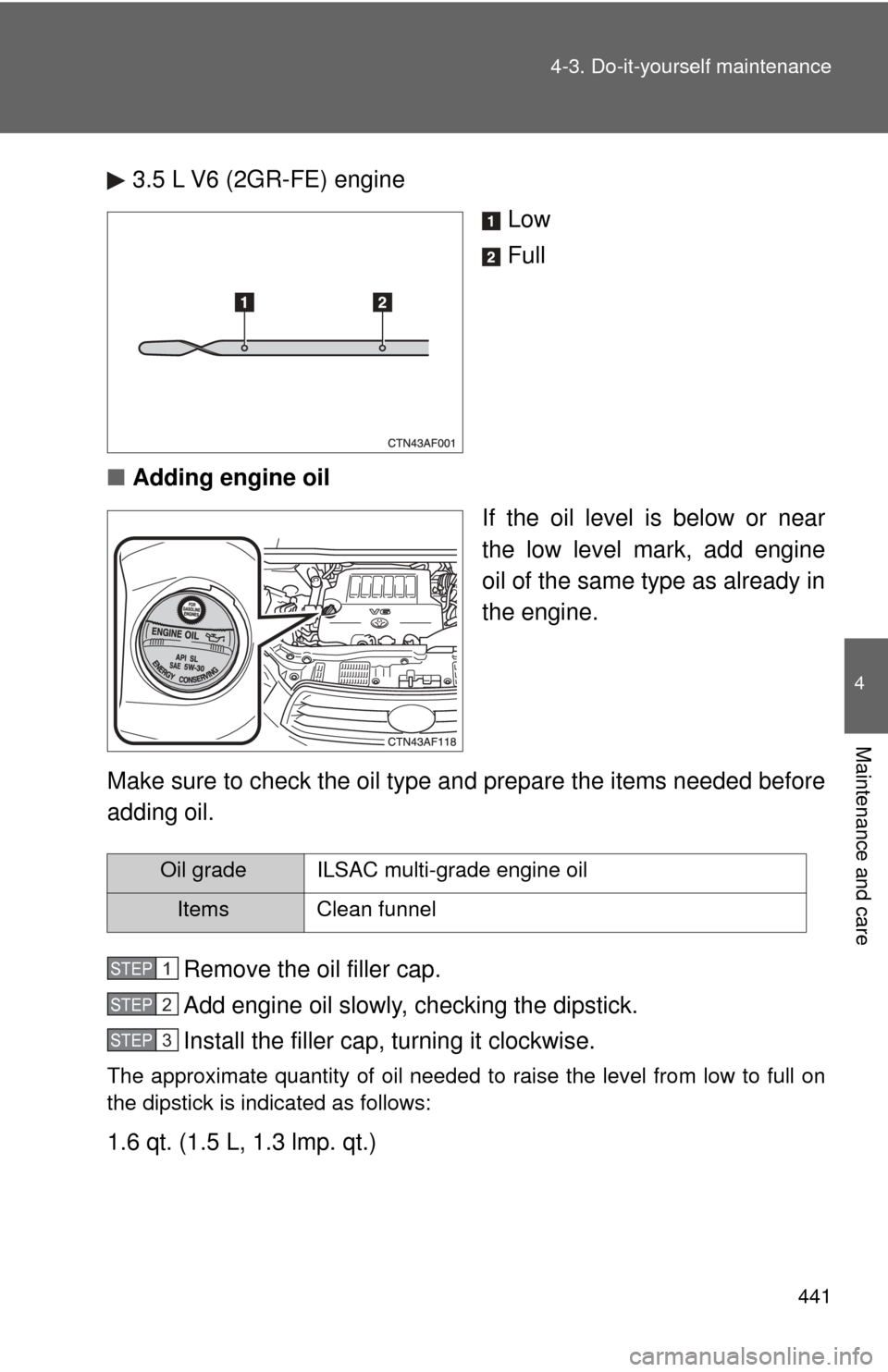
3.5 L V6 (2GR-FE) engine
Low
Full
■ Adding engine oil
If the oil level is below or near
the low level mark, add engine
oil of the same type as already in
the engine.
Make sure to check the oil type and prepare the items needed before
adding oil. Remove the oil filler cap.
Add engine oil slowly, checking the dipstick.
Install the filler cap, turning it clockwise.
The approximate quantity of oil needed to raise the level from low to full on
the dipstick is indicated as follows:
1.6 qt. (1.5 L, 1.3 lmp. qt.)
Oil grade ILSAC multi-grade engine oil
Items Clean funnel
STEP1
STEP2
STEP3
Page 442 of 608
442 4-3. Do-it-yourself maintenance
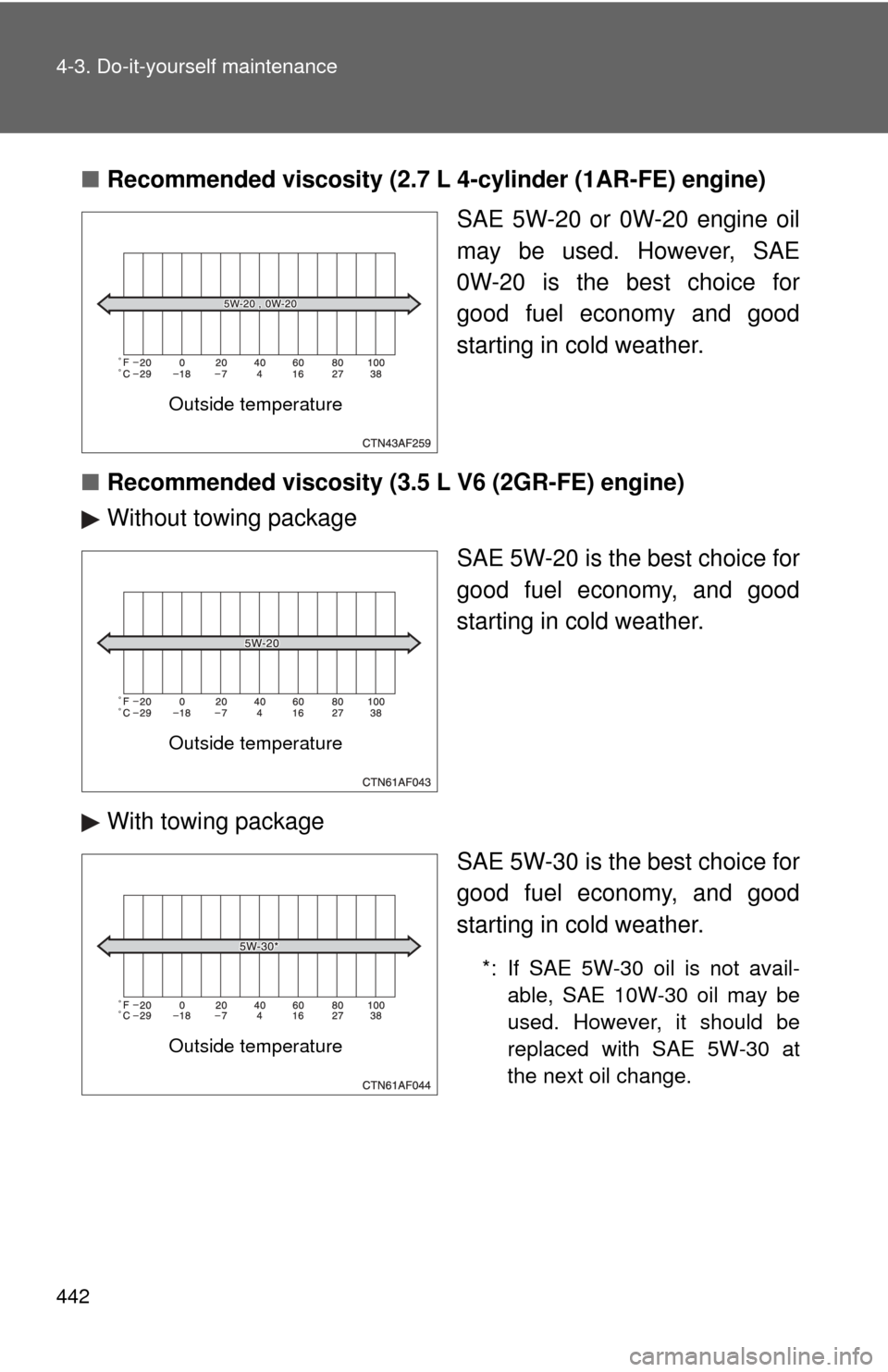
■Recommended viscosity (2.7 L 4-cylinder (1AR-FE) engine)
SAE 5W-20 or 0W-20 engine oil
may be used. However, SAE
0W-20 is the best choice for
good fuel economy and good
starting in cold weather.
■ Recommended viscosity (3.5 L V6 (2GR-FE) engine)
Without towing package
SAE 5W-20 is the best choice for
good fuel economy, and good
starting in cold weather.
With towing package SAE 5W-30 is the best choice for
good fuel economy, and good
starting in cold weather.
*: If SAE 5W-30 oil is not avail-able, SAE 10W-30 oil may be
used. However, it should be
replaced with SAE 5W-30 at
the next oil change.
Outside temperature
Outside temperature
Outside temperature