Page 539 of 608
5
When trouble arises
539
5-2. Steps to take in an emergency
If the electronic key does not operate properly (vehicles with smart key system)
Locking and unlocking the doors, and mechanical key linked functions
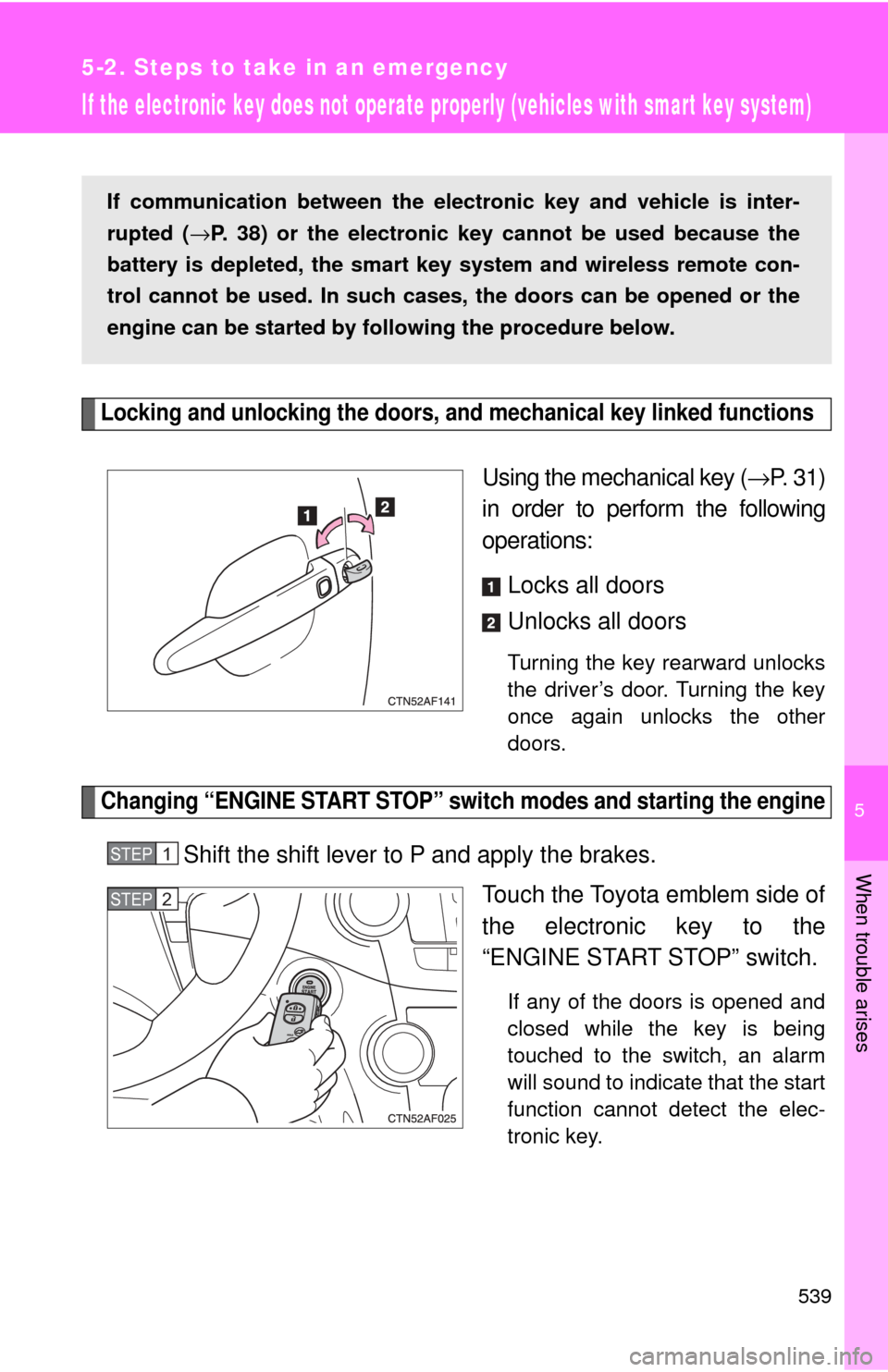
Using the mechanical key (→P. 31)
in order to perform the following
operations:
Locks all doors
Unlocks all doors
Turning the key rearward unlocks
the driver’s door. Turning the key
once again unlocks the other
doors.
Changing “ENGINE START STOP” switch modes and starting the engine
Shift the shift lever to P and apply the brakes. Touch the Toyota emblem side of
the electronic key to the
“ENGINE START STOP” switch.
If any of the doors is opened and
closed while the key is being
touched to the switch, an alarm
will sound to indicate that the start
function cannot detect the elec-
tronic key.
If communication between the electronic key and vehicle is inter-
rupted (→P. 38) or the electronic key cannot be used because the
battery is depleted, the smart key system and wireless remote con-
trol cannot be used. In such cases, the doors can be opened or the
engine can be started by following the procedure below.
STEP1
STEP2
Page 540 of 608
540 5-2. Steps to take in an emergency
To change “ENGINE START STOP” switch modes: Within 5
seconds of the buzzer sounding, release the brake pedal and
press the “ENGINE START STOP” switch. Modes can be
changed each time the sw itch is pressed. (→P. 174)
To start the engine: Press the “ENGINE START STOP” switch
within 5 seconds after the buzzer sounds, keeping the brake
pedal depressed.
In the event that the “ENGINE START STOP” switch still cannot be
operated, contact your Toyota dealer.
■ Stopping the engine
Shift the shift lever to P and press the “ENGINE START STOP” switch as
you normally do when stopping the engine.
■ Replacing the electronic key battery
As the above procedure is a temporary measure, it is recommended that the
electronic key battery be replaced immediately when the battery depletes.
(→P. 473)
STEP3
Page 541 of 608
5
When trouble arises
541
5-2. Steps to take in an emergency
If the battery is discharged
The following procedures may be used to start the engine if the vehi-
cle's battery is discharged.
You can call your Toyota dealer or qualified repair shop.
If you have a set of jumper (or boo ster) cables and a second vehi-
cle with a 12-volt battery, you can jump start your Toyota following
the steps below.
Connect the jumper cables.
2.7 L 4-cylinder (1AR-FE) engine
STEP1
Page 542 of 608
542 5-2. Steps to take in an emergency
3.5 L V6 (2GR-FE) engine
Positive (+) battery terminal on your vehicle
Positive (+) battery terminal on the second vehicle
Negative (-) battery terminal on the second vehicle
Connect the jumper cable to ground on your vehicle as shown in
the illustration.Start the engine of the second vehicle. Increase the engine
speed slightly and maintain at that level for approximately 5
minutes to recharge the battery of your vehicle.
Vehicles with smart key system:
Open and close any of the doors with the “ENGINE START
STOP” switch OFF.
STEP2
STEP3
Page 543 of 608

5
When trouble arises
543
5-2. Steps to take in an emergency
■
Starting the engine when the battery is discharged
The engine cannot be started by push-starting.
■ To prevent battery discharge
●Turn off the headlights and the audio system while the engine is turned
off.
● Turn off any unnecessary electrical components when the vehicle is run-
ning at a low speed for an extended period, such as in heavy traffic, etc.
■ When the battery is removed or discharge
●The power back door must be initialized ( →P. 75)
● The tire inflation pressure warning system must be initialized. ( →P. 455)
Vehicles without smart key system:
Maintain the engine speed of the second vehicle, and turn
the engine switch to the “ON” position, then start the vehi-
cle's engine.
Vehicles with smart key system:
Maintain the engine speed of the second vehicle, and turn
the “ENGINE START STOP” switch to IGNITION ON mode,
then start the vehicle's engine.
Once the vehicle’s engine has started, remove the jumper
cables in the exact reverse order in which they were con-
nected.
Once the engine starts, have th e vehicle checked at your Toyota
dealer as soon as possible.STEP4
STEP5
Page 545 of 608
5
When trouble arises
545
5-2. Steps to take in an emergency
If your vehicle overheats
If your engine overheats:
Stop the vehicle in a safe place and turn off the air condi-
tioning system.
Check to see if steam is coming out from under the hood.
If you see steam: Stop the engine. Carefully lift the hood after the steam
subsides and then restart the engine.
If you do not see steam: Leave the engine running and carefully lift the hood.
Remove the engine compartment cover. (
→P. 439)
Check to see if the cooling fan is operating.
If the fan is operating: Wait until the temperature of the engine (shown on the
instrument cluster) begins to fall and then stop the
engine.
If the fan is not operating: Stop the engine and call your Toyota dealer.
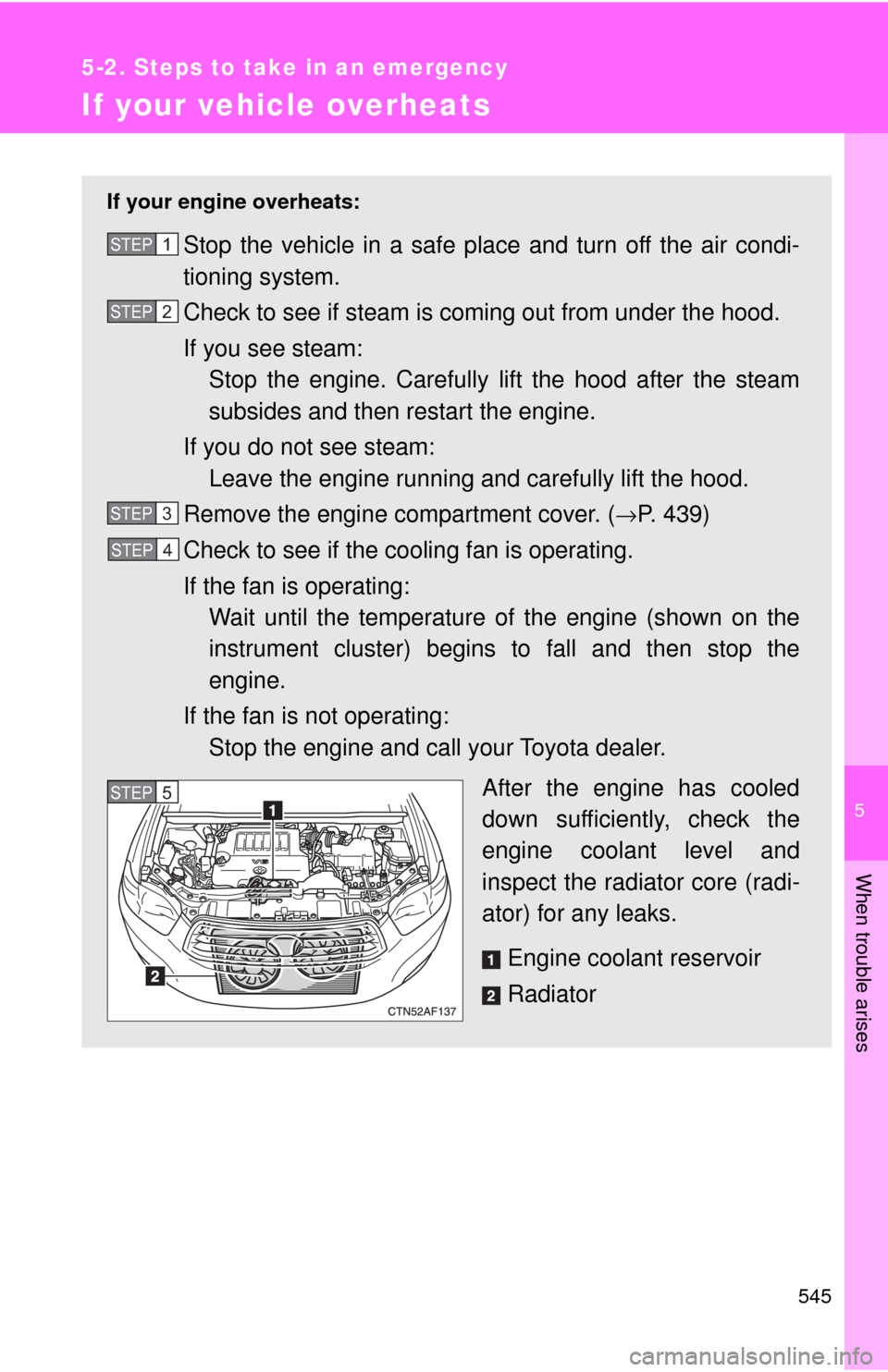
After the engine has cooled
down sufficiently, check the
engine coolant level and
inspect the radiator core (radi-
ator) for any leaks.
Engine coolant reservoir
Radiator
STEP1
STEP2
STEP3
STEP4
STEP5
Page 546 of 608
546 5-2. Steps to take in an emergency
■Overheating
If you observe the following, your vehicle may be overheating.
●The engine coolant temperature gauge enters the red zone or a loss of
power is experienced.
● Steam is coming from under the hood.
CAUTION
■To prevent an accident or injury when inspecting under the hood of
your vehicle
● If steam is seen coming from under the hood, do not open the hood until
the steam has subsided. The engine compartment may be very hot, caus-
ing serious injury such as burns.
● Keep hands and clothing away from the fan and other belts while the
engine is running.
● Do not loosen the coolant reservoir cap while the engine and radiator are
hot.
Serious injury, such as burns, may result from hot coolant and steam
released under pressure.
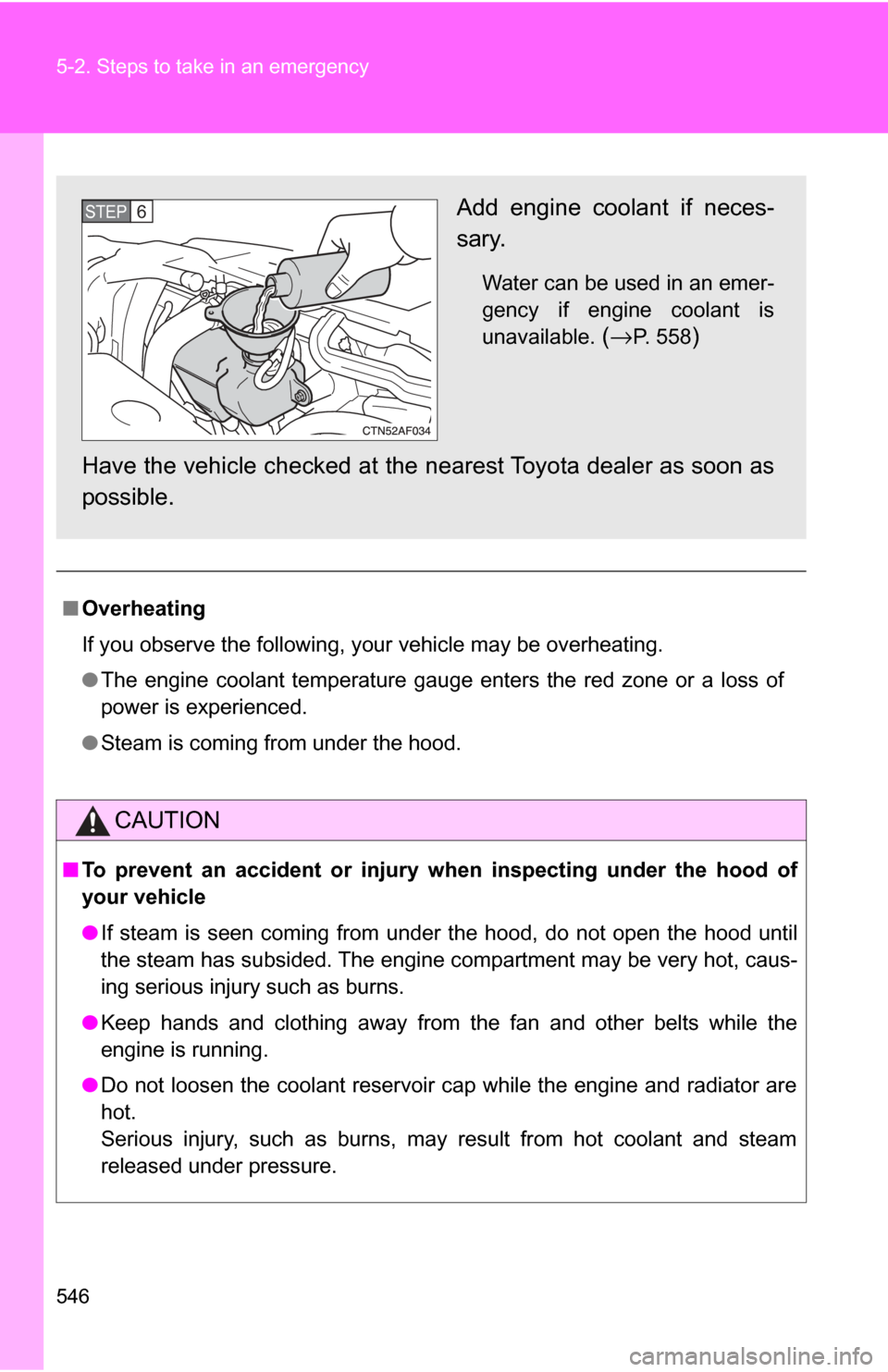
Add engine coolant if neces-
sary.
Water can be used in an emer-
gency if engine coolant is
unavailable.
(→P. 558)
Have the vehicle checked at the nearest Toyota dealer as soon as
possible.
STEP6
Page 547 of 608
5
When trouble arises
547
5-2. Steps to take in an emergency
NOTICE
■
When adding engine coolant
Wait until the engine has cooled down before adding engine coolant.
When adding coolant, do so slowly. Adding cool coolant to a hot engine too
quickly can cause damage to the engine.