Page 313 of 520
313
3-5. Using the
storage features
3
Interior features
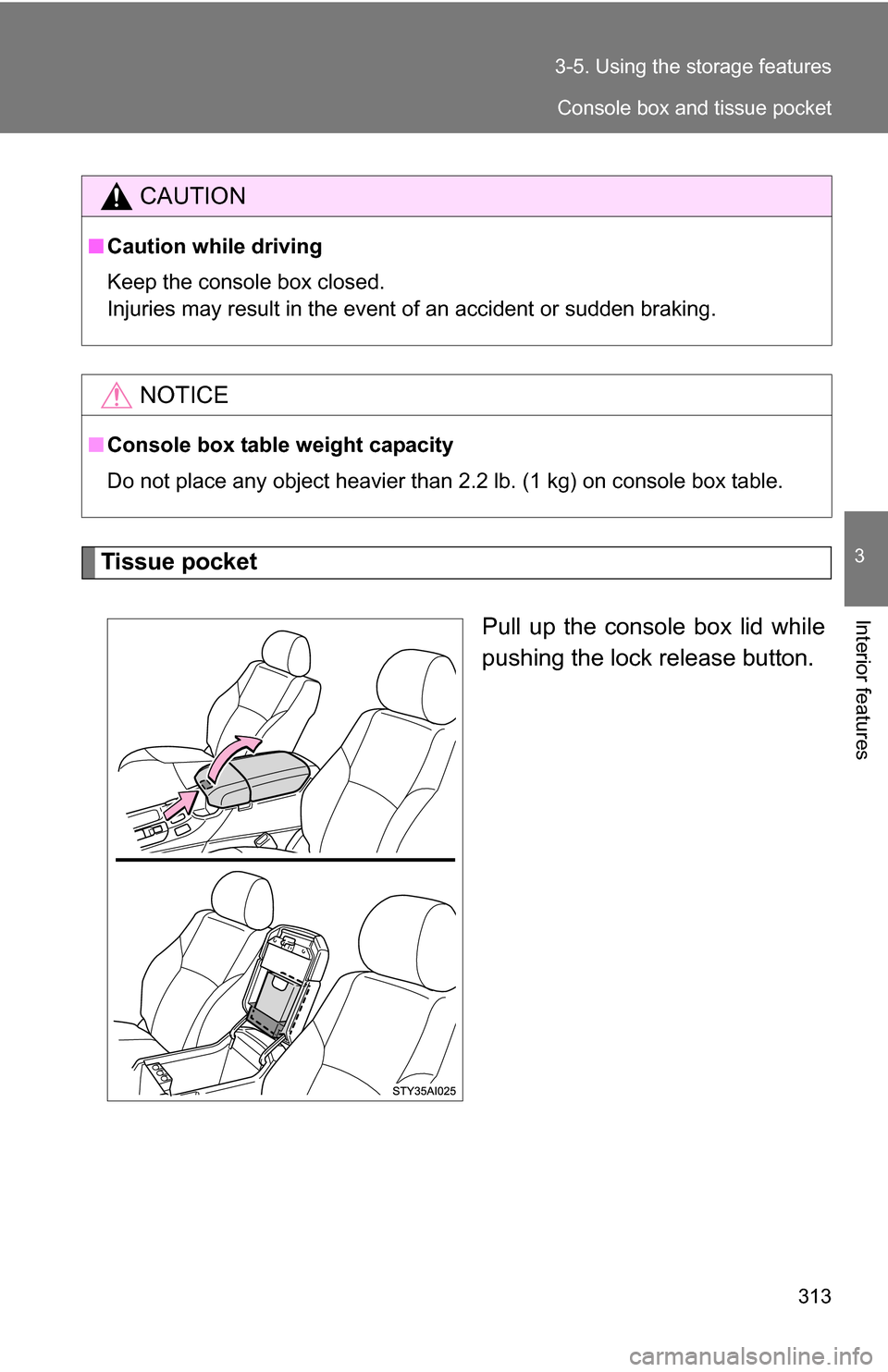
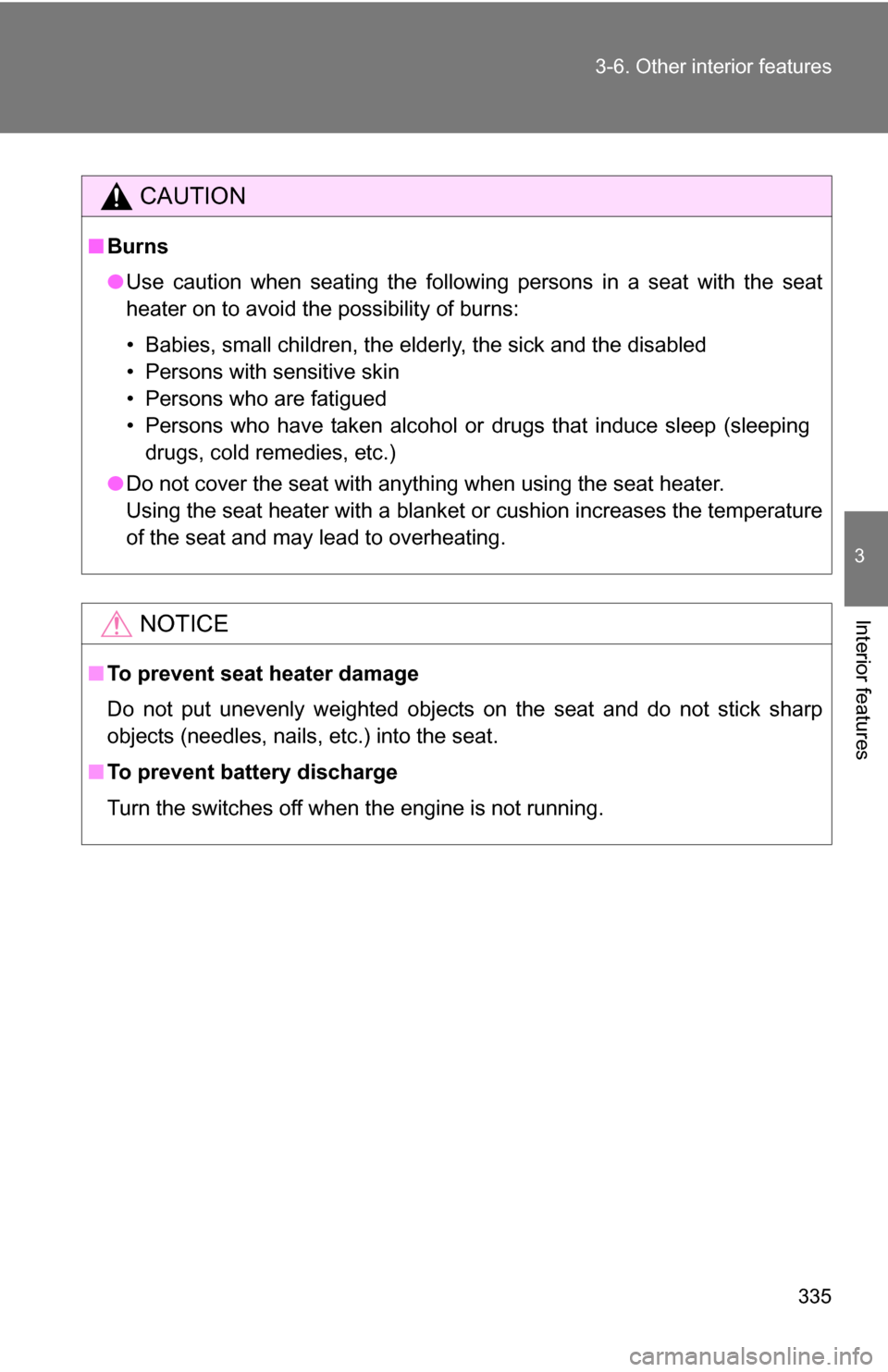
Tissue pocket
Pull up the console box lid while
pushing the lock release button.
CAUTION
■Caution while driving
Keep the console box closed.
Injuries may result in the event of an accident or sudden braking.
NOTICE
■Console box table weight capacity
Do not place any object heavier than 2.2 lb. (1 kg) on console box table.
Console box and tissue pocket
Page 335 of 520
335
3-6. Other interior features
3
Interior features
CAUTION
■
Burns
●Use caution when seating the following persons in a seat with the seat
heater on to avoid the possibility of burns:
• Babies, small children, the elderly, the sick and the disabled
• Persons with sensitive skin
• Persons who are fatigued
• Persons who have taken alcohol or drugs that induce sleep (sleeping
drugs, cold remedies, etc.)
● Do not cover the seat with anything when using the seat heater.
Using the seat heater with a blanket or cushion increases the temperature
of the seat and may lead to overheating.
NOTICE
■To prevent seat heater damage
Do not put unevenly weighted objects on the seat and do not stick sharp
objects (needles, nails, etc.) into the seat.
■ To prevent battery discharge
Turn the switches off when the engine is not running.
Page 344 of 520
344 3-6. Other interior features
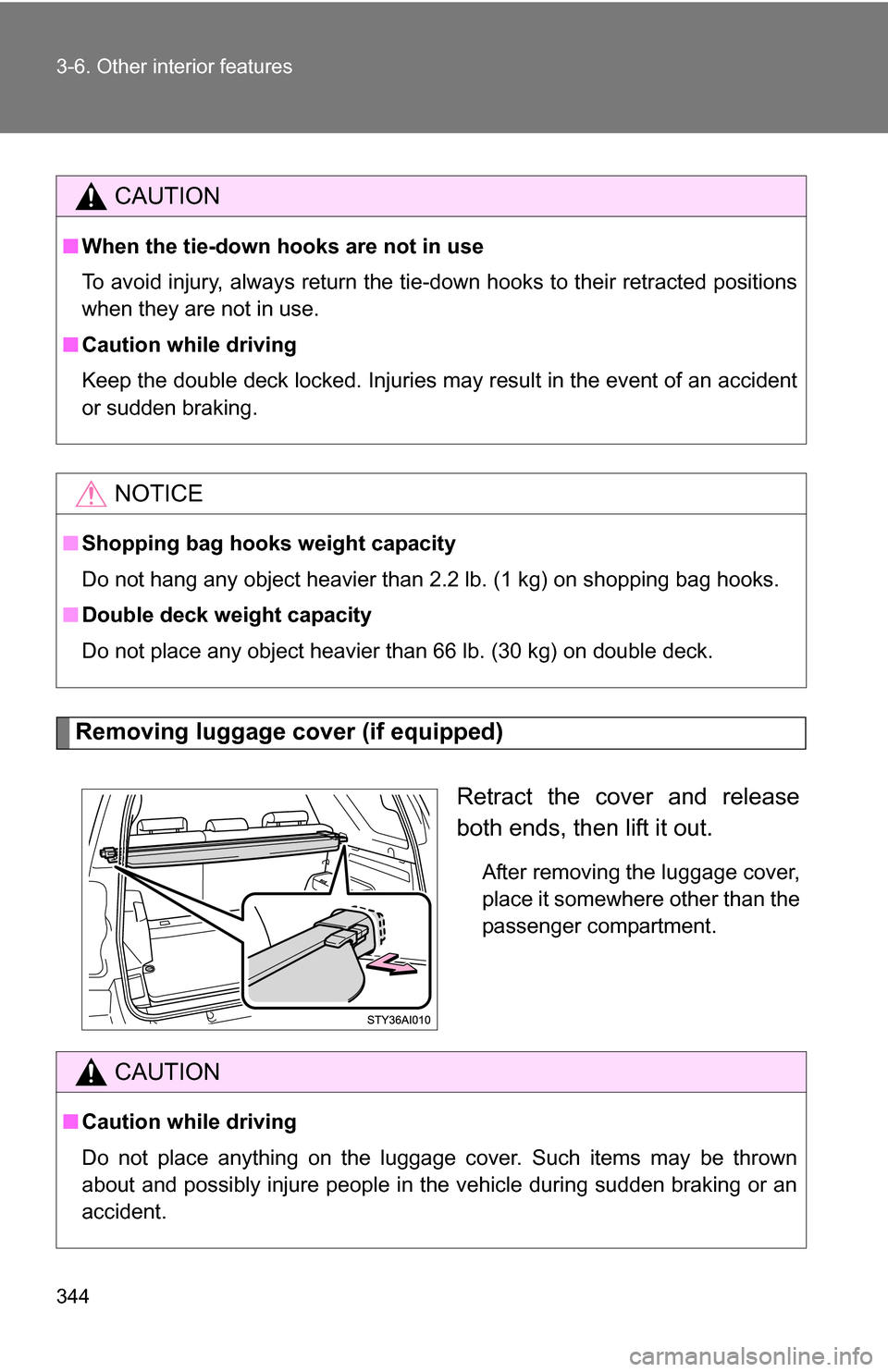
Removing luggage cover (if equipped)Retract the cover and release
both ends, then lift it out.
After removing the luggage cover,
place it somewhere other than the
passenger compartment.
CAUTION
■When the tie-down hooks are not in use
To avoid injury, always return the tie-down hooks to their retracted positions
when they are not in use.
■ Caution while driving
Keep the double deck locked. Injuries may result in the event of an accident
or sudden braking.
NOTICE
■Shopping bag hooks weight capacity
Do not hang any object heavier than 2.2 lb. (1 kg) on shopping bag hoo\
ks.
■ Double deck weight capacity
Do not place any object heavier than 66 lb. (30 kg) on double deck.
CAUTION
■Caution while driving
Do not place anything on the luggage cover. Such items may be thrown
about and possibly injure people in the vehicle during sudden braking or an
accident.
Page 391 of 520

391
4-3. Do-it-yourself maintenance
4
Maintenance and care
■If the tread wears down below 0.16 in. (4 mm) on snow tires
The effectiveness of snow tires is lost.
■Maximum load of tire
Check that the maximum load of the re
placed tire is greater than 1/2 of
the Gross Axle Weight Ratings (GAWR) of either the front axle or the
rear axle, whichever is greater.
As for the maximum load of the tire, see the load limit at maximum cold
tire inflation pressure mentioned on the sidewall of the tire, and as for the
Gross Axle Weight Ratings (GAWR) , see the Certification Label.
( P. 395, 471, 484).
■Tire types
1 Summer tires
Summer tires are high-speed performance tires best suited to highway
driving under dry conditions. Since summer tires do not have the same
traction performance as snow tire s, summer tires are inadequate for
driving on snow-covered or icy roads. For driving on snow-covered
roads or icy roads, the use of snow tires is recommended. When
installing snow tires, be sure to replace all four tires.
2 All season tires
All season tires are designed to provide better traction in snow and to
be adequate for driving in most winter conditions, as well as for use
year round. All season tires, however, do not have adequate traction
performance compared with snow tires in heavy or loose snow. Also,
all season tires fall short in acceleration and handling performance
compared with summer tires in highway driving.
3Snow tires For driving on snow-covered roads or icy roads, we recommend using
snow tires. If you need snow tires, select tires of the same size, con-
struction and load capacity as the or iginally installed tires. Since your
vehicle has radial tires as original equipment, make sure your snow
tires also have radial construction. Do not install studded tires without
first checking local regulations for possible restriction. Snow tires
should be installed on all wheels. ( P. 213)
Page 397 of 520
397
4-3. Do-it-yourself maintenance
4
Maintenance and care
●Do not bleed or reduce tire inflation pressure after driving. It is normal
for the tire inflation pressure to be higher after driving.
●Never exceed the vehicle capacity weight.
Passengers and luggage weight should be placed so that the vehicle
is balanced.
CAUTION
■Proper inflation is critical
to save tire performance
Keep your tires properly inflated.
Otherwise, the following conditions may occur and result in an accident
causing death or serious injury.
●Excessive wear
●Uneven wear
●Poor handling
●Possibility of blowouts resu lting from overheated tires
●Poor sealing of the tire bead
●Wheel deformation and/or tire separation
●A greater possibility of tire damage from road hazards
NOTICE
■When inspecting and adjusting tire inflation pressure
Be sure to reinstall the tire valve caps.
Without the valve caps, dirt or mo isture could get into the valve and
cause air leakage, which could result in an accident. If the caps have
been lost, replace them as soon as possible.
Page 398 of 520

398
4-3. Do-it-yourself maintenance
Wheels
■When replacing wheels
The wheels of your Toyota are equipped with tire pressure warning
valves and transmitters that allow the tire pressure warning system to
provide advanced warning in the event of a loss in tire inflation pressure.
Whenever wheels are replaced, the tire pressure warning valves and
transmitters must be installed. (P. 390)
If a wheel is bent, cracked or heavily corroded, it should be
replaced.
Otherwise, the tire may separate from the wheel or cause loss of
handling control.
■ Wheel selection
When replacing wheels, care should be taken to ensure that
they are equivalent to those removed in load capacity, diameter,
rim width, and offset.
Replacement wheels are available at your Toyota dealer.
Toyota does not recommend using:
●Wheels of different sizes or types
● Used wheels
● Bent wheels that have been straightened
■ Aluminum wheel precautions (if equipped)
●Use only Toyota wheel nuts and wrench designed for use with
your aluminum wheels.
● When rotating, repairing or changing your tires, check that the
wheel nuts are still tight after driving 1000 miles (1600 km).
● Be careful not to damage the aluminum wheels when using
tire chains.
● Use only Toyota genuine balance weights or equivalent and a
plastic or rubber hammer when balancing your wheels.
Page 441 of 520

5
When trouble arises
441
5-2. Steps to take in an emergency
■
Key reminder buzzer
The buzzer indicates that the key has not been removed (with the engine
switch in the ACC or LOCK position and the driver’s door opened).
■ If the malfunction indicator lamp comes on while driving
First check the following:
● Is your vehicle low on gas?
If it is, refuel the vehicle immediately.
● Is the fuel tank cap loose?
If it is, tighten it securely.
The light will go off after taking several driving trips.
If the light does not go off even after several trips, contact your Toyota dealer
as soon as possible.
■ Front passenger detection sensor and passenger seat belt reminder
If luggage or other load is placed on the front passenger seat, depending on
its weight, the reminder light to flash and buzzer to sound.
■
When the tire pressure warning light comes on
Check the tire inflation pressure and adjust to the appropriate level.
■The tire pressure warning light may turn on due to natural causes
The tire pressure warning light may turn on due to natural causes such
as natural air leaks or tire inflation pressure changes caused by temper-
ature. In this case, adjusting the ti re inflation pressure will turn off the
warning light (after a few minutes).
■When a tire is replaced with a spare tire
The spare tire is also equipped with the tire pressure warning valve and
transmitter. The tire pressure warning li ght will turn on if the tire inflation
pressure of the spare tire is low. If a tire goes flat, even though the flat
tire is replaced with the spare tire, the tire pressure warning light does
not turn off. Replace the spare tire with the repaired tire and adjust the
proper tire inflation pressure. The ti re pressure warning light will turn off
after a few minutes.
Page 470 of 520
470
6-1. Specifications
Maintenance data (fuel, oil level, etc.)
Dimensions and weight
1: Unladen vehicle2: 2WD models3: 4WD models4: With roof rails5: With rear spoiler6: With rear height control air suspension7: With 5 occupants8: With 7 occupants
Overall length189.2 in. (4805 mm)
Overall width75.2 in. (1910 mm)
Overall height1
71.7 in. (1820 mm)2 or 3,4
70.9 in. (1800 mm)2,3,5
69.1 in. (1755 mm)2,3
71.1 in. (1805 mm)2 or 3,4,6
70.3 in. (1785 mm)2 or 3,5,6
68.5 in. (1740 mm)2 or 3,6
Wheelbase109.8 in. (2790 mm)
Front tread 62.0 in. (1575 mm)
Rear tread62.0 in. (1575 mm)
Vehicle capacity weight
(Occupants + luggage) 950 lb. (431 kg)7
1050 lb. (477 kg)8
Towing capacity
(Trailer weight + cargo) For weight carrying hitch
5000 lb. (2268 kg)
For weight distributing hitch
(4.7 L V8 [2UZ-FE] engine only)
2WD models: 7300 lb. (3311kg)
4WD models: 7000 lb. (3175 kg)
Luggage compartment load
capacity
200 lb. (91 kg)7
0 lb. (0 kg)8