Page 186 of 520
186
2-4. Using other driving systems
Downhill Assist Control (if equipped)
The downhill assist control system helps to prevent excessive speed
on steep downhill descents.
■System operation
The system will operate when the vehicle is traveling under 15
mph (25 km/h) and the four-wheel drive control switch is in the
L4 position.
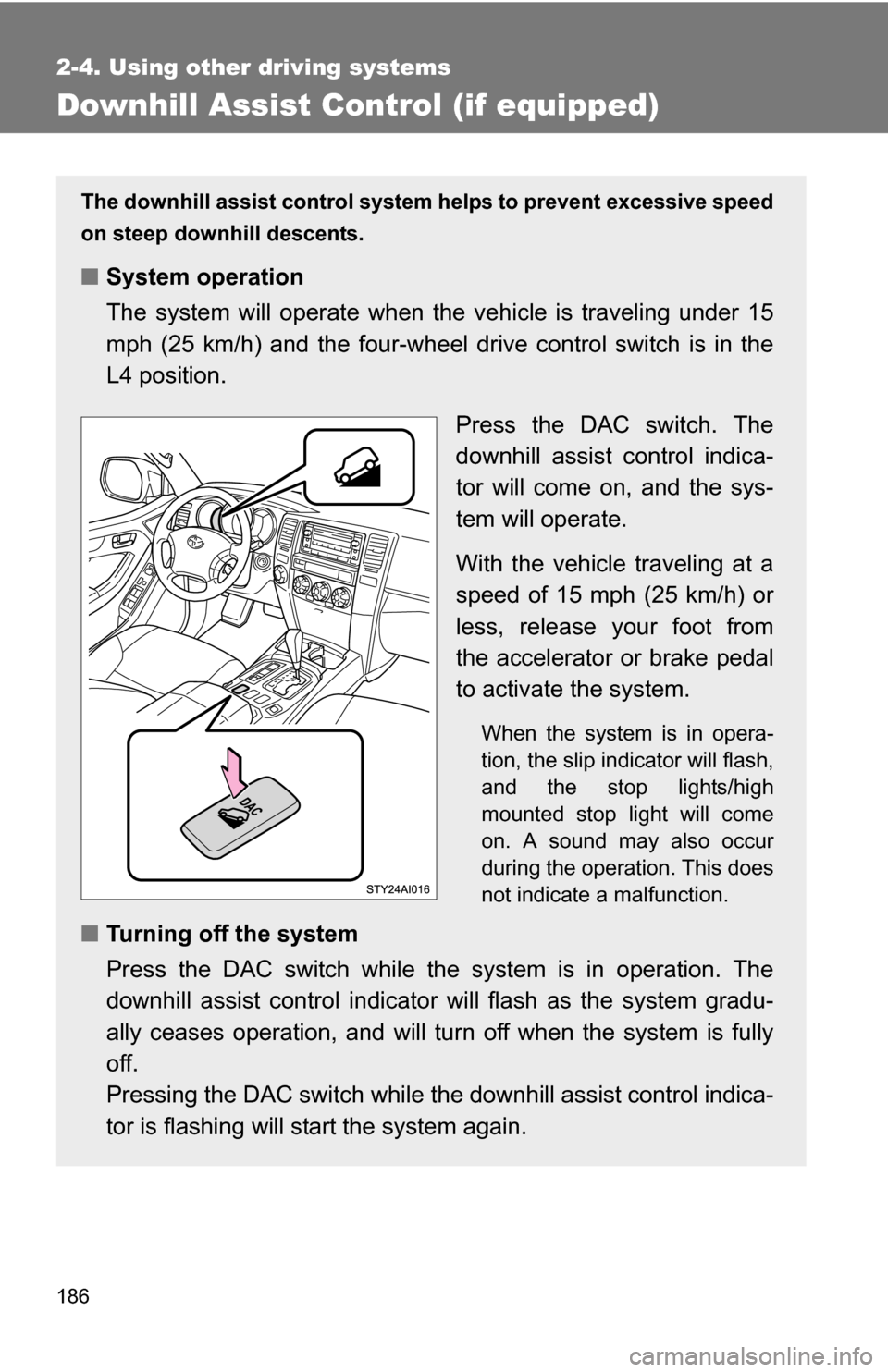
Press the DAC switch. The
downhill assist control indica-
tor will come on, and the sys-
tem will operate.
With the vehicle traveling at a
speed of 15 mph (25 km/h) or
less, release your foot from
the accelerator or brake pedal
to activate the system.
When the system is in opera-
tion, the slip indicator will flash,
and the stop lights/high
mounted stop light will come
on. A sound may also occur
during the operation. This does
not indicate a malfunction.
■Turning off the system
Press the DAC switch while the system is in operation. The
downhill assist control indicator will flash as the system gradu-
ally ceases operation, and will tu rn off when the system is fully
off.
Pressing the DAC switch while t he downhill assist control indica-
tor is flashing will st art the system again.
Page 196 of 520
196 2-4. Using other driving systems
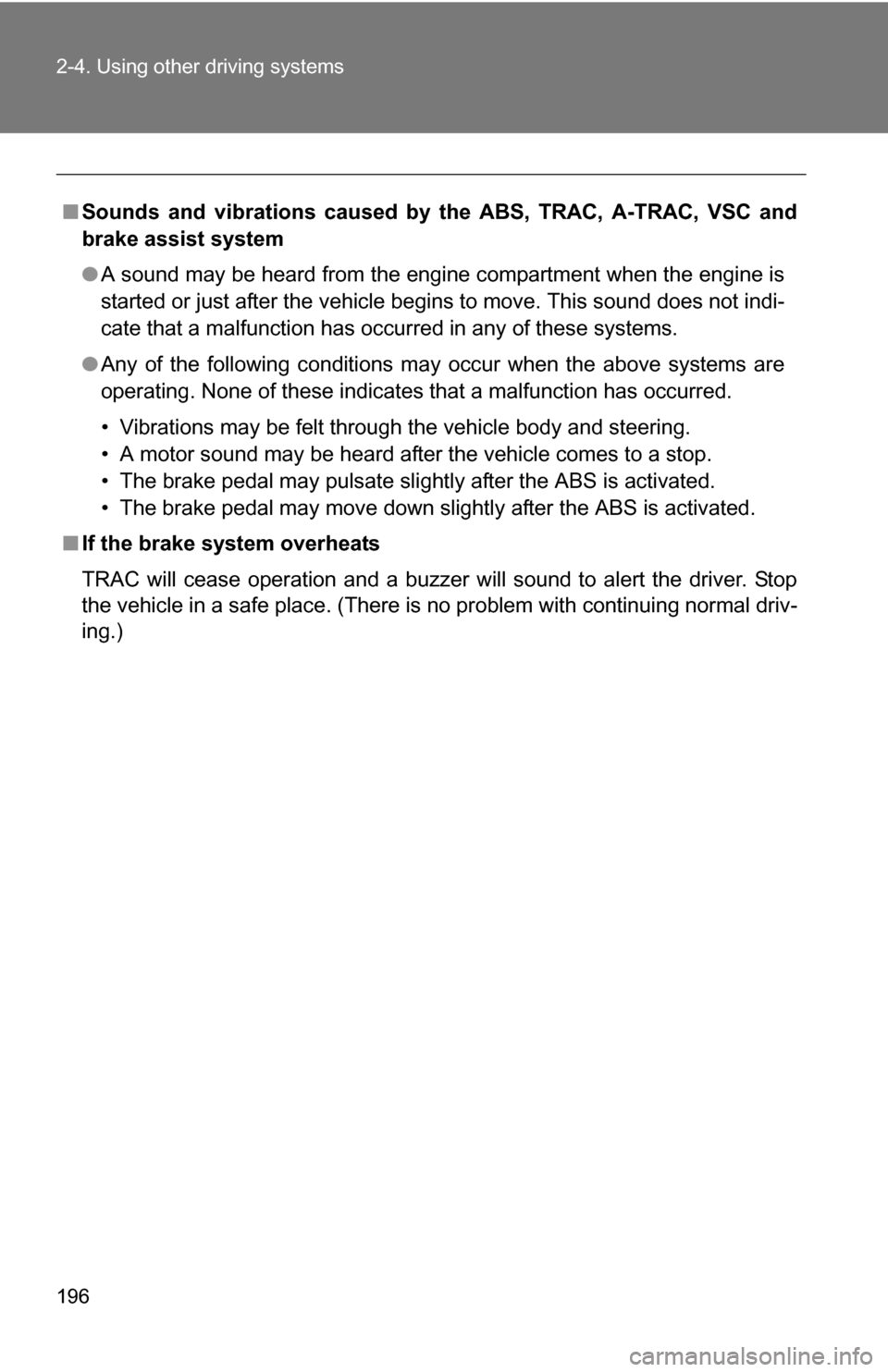
■Sounds and vibrations caused by the ABS, TRAC, A-TRAC, VSC and
brake assist system
● A sound may be heard from the engine compartment when the engine is
started or just after the vehicle begins to move. This sound does not indi-
cate that a malfunction has occurred in any of these systems.
● Any of the following conditions may occur when the above systems are
operating. None of these indicates that a malfunction has occurred.
• Vibrations may be felt through the vehicle body and steering.
• A motor sound may be heard after the vehicle comes to a stop.
• The brake pedal may pulsate slightly after the ABS is activated.
• The brake pedal may move down slightly after the ABS is activated.
■ If the brake system overheats
TRAC will cease operation and a buzzer will sound to alert the driver. Stop
the vehicle in a safe place. (There is no problem with continuing normal driv-
ing.)
Page 226 of 520
226 2-5. Driving information
CAUTION
■To avoid accident or injury
●Avoid holding the brake pedal down too long or applying the brakes too
frequently. This could cause the brakes to overheat and result in reduced
braking efficiency.
■ Hitches
●If you wish to install a trailer hitch, contact your Toyota dealer.
● Use only a hitch that conforms to the gross trailer weight requirement.
● Follow the directions supplied by the hitch manufacturer.
● Lubricate the hitch ball with a light coat of grease.
● Remove the trailer hitch whenever you are not towing a trailer. After
removing the hitch, seal any mounting hole in the vehicle body to prevent
entry of any substances into the vehicle.
■ When towing a trailer
●If the gross trailer weight exceeds 1000 lb. (453 kg), trailer brakes are
required. Toyota recommends trailers with brakes that conform to all appli-
cable federal and state/provincial regulations.
● Never tap into your vehicle’s hydraulic system, as this will lower the vehi-
cle’s braking effectiveness.
● Never tow a trailer without using a safety chain securely attached to both
the trailer and the vehicle. If damage occurs to the coupling unit or hitch
ball, there is danger of the trailer wandering into another lane.
Page 365 of 520
365
4-2. Maintenance
4
Maintenance and care
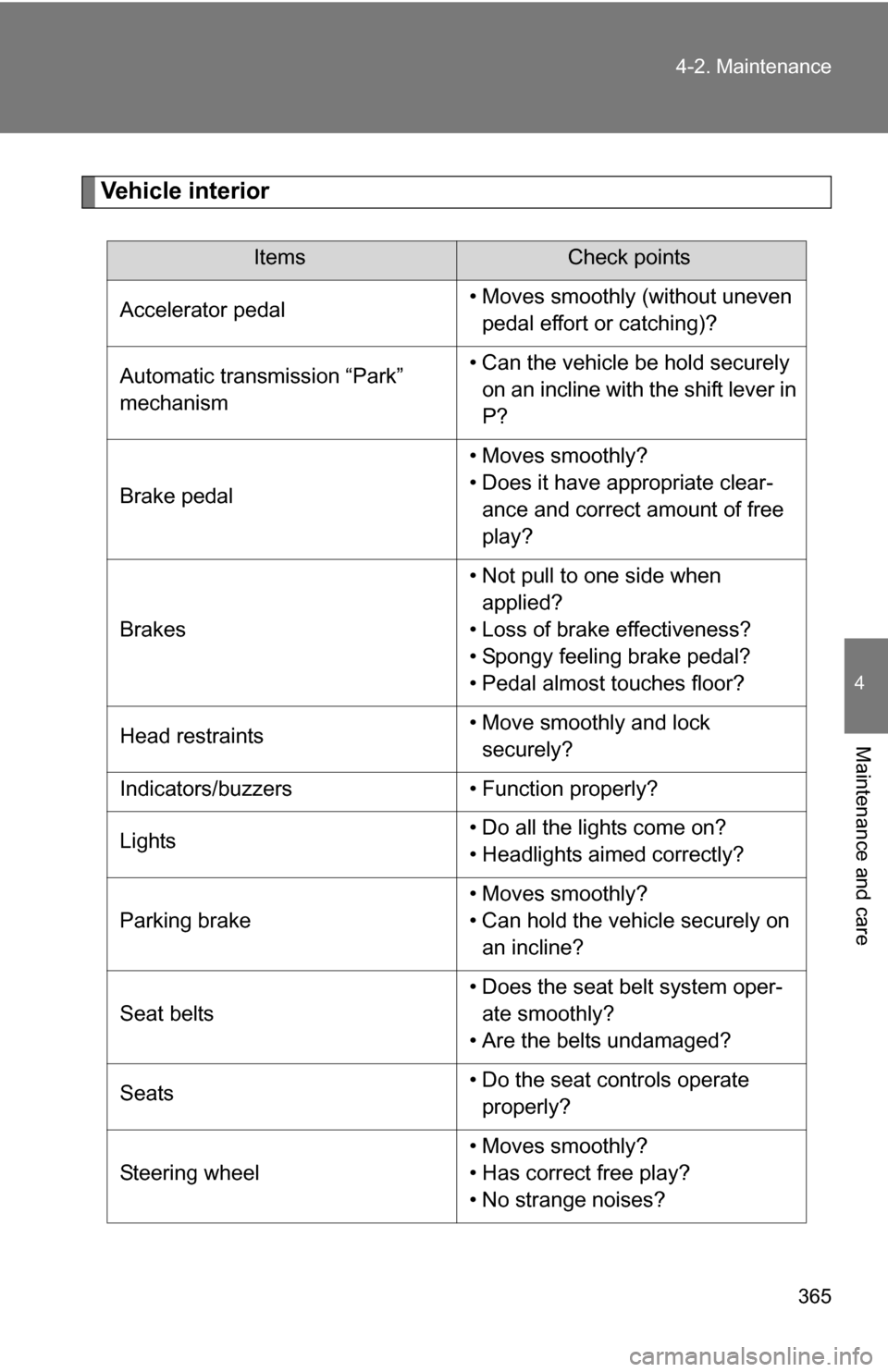
Vehicle interior
ItemsCheck points
Accelerator pedal • Moves smoothly (without uneven
pedal effort or catching)?
Automatic transmission “Park”
mechanism • Can the vehicle be hold securely
on an incline with the shift lever in
P?
Brake pedal • Moves smoothly?
• Does it have appropriate clear-
ance and correct amount of free
play?
Brakes • Not pull to one side when
applied?
• Loss of brake effectiveness?
• Spongy feeling brake pedal?
• Pedal almost touches floor?
Head restraints • Move smoothly and lock
securely?
Indicators/buzzers • Function properly?
Lights • Do all the lights come on?
• Headlights aimed correctly?
Parking brake • Moves smoothly?
• Can hold the vehicle securely on
an incline?
Seat belts • Does the seat belt system oper-
ate smoothly?
• Are the belts undamaged?
Seats • Do the seat controls operate
properly?
Steering wheel • Moves smoothly?
• Has correct free play?
• No strange noises?
Page 371 of 520
371
4-3. Do-it-yourself maintenance
4
Maintenance and care
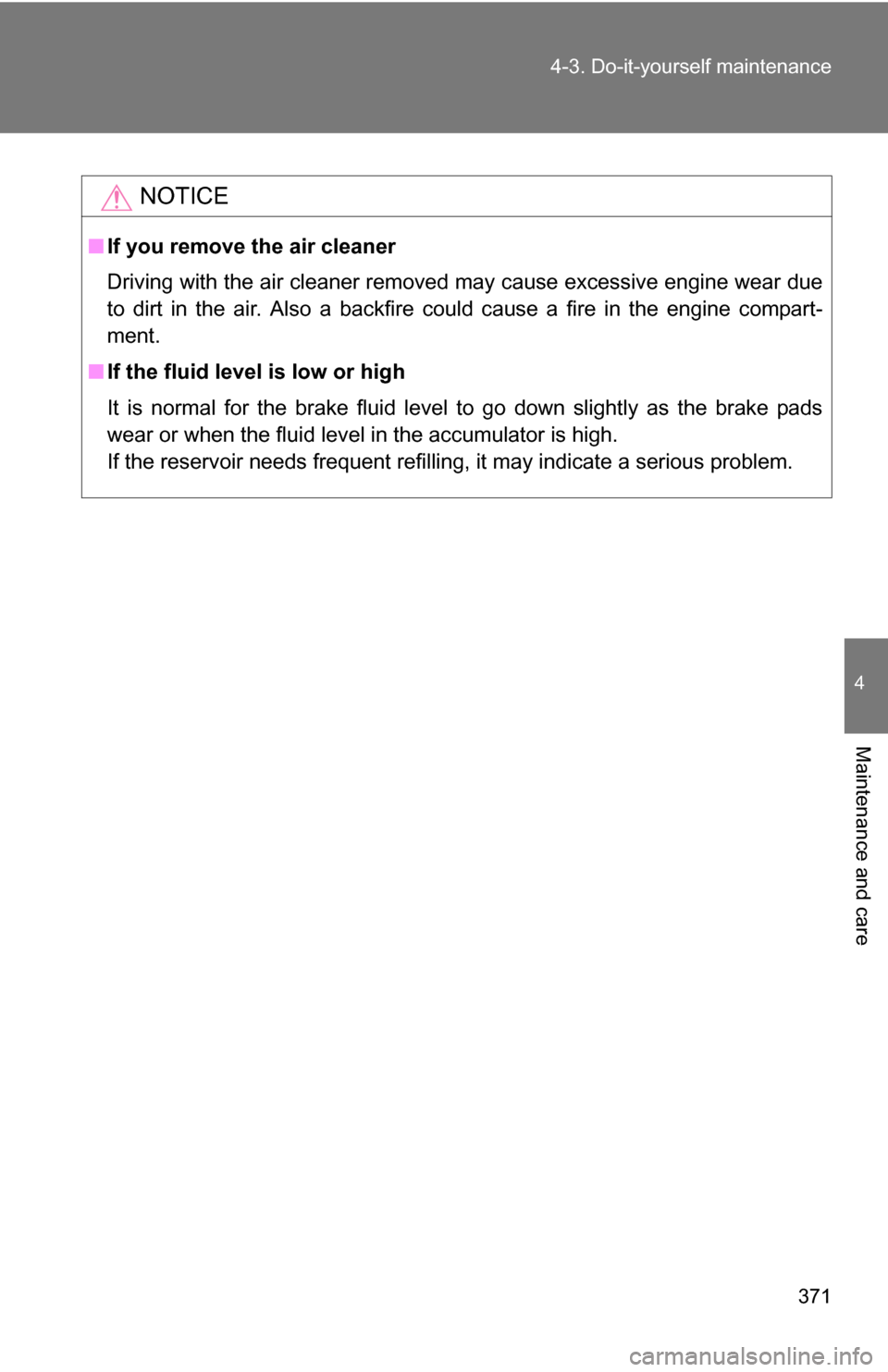
NOTICE
■
If you remove the air cleaner
Driving with the air cleaner removed may cause excessive engine wear due
to dirt in the air. Also a backfire could cause a fire in the engine compart-
ment.
■ If the fluid level is low or high
It is normal for the brake fluid level to go down slightly as the brake pads
wear or when the fluid level in the accumulator is high.
If the reservoir needs frequent refilling, it may indicate a serious pro\
blem.
Page 382 of 520

382 4-3. Do-it-yourself maintenance
■Adding fluid
Make sure to check the fluid type and prepare the necessary items.
Turn the engine switch off.
Depress the brake pedal 20 times or more.
Remove the reservoir cap.
Add newly opened brake fluid up to the MAX line.
.
Fluid type FMVSS No.116 DOT 3 or SAE J1703 brake fluid
ItemsRag or paper towel
■ Brake fluid can absorb moisture from the air
Excess moisture in the fluid can cause a dangerous loss of braking effi-
ciency. Use only newly opened brake fluid.
CAUTION
■When filling the reservoir
Take care because brake fluid can harm your hands or eyes and damage
painted surfaces.
If fluid gets on your hands or in your eyes, flush the affected area with clean
water immediately.
If you still experience discomfort, see a doctor.
NOTICE
■If the fluid level is low or high
It is normal for the brake fluid level to go down slightly as the brake pads
wear or when the fluid level in the accumulator is high.
If the reservoir needs frequent refilling, it may indicate a serious pro\
blem.
■ If you spill fluid
Be sure to wash it off with water to prevent damage to parts or paint.
Page 407 of 520
407
4-3. Do-it-yourself maintenance
4
Maintenance and care
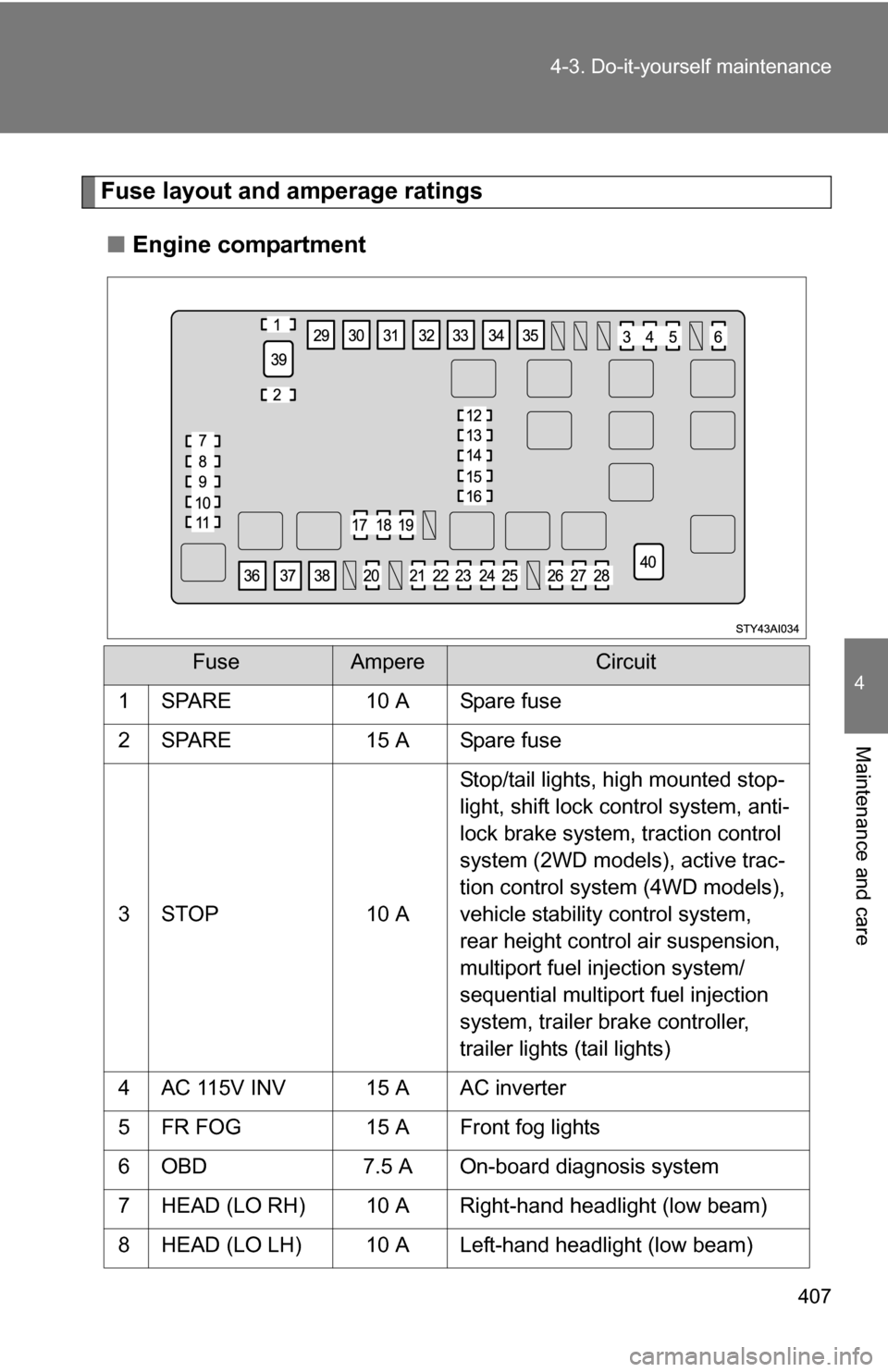
Fuse layout and amperage ratings
■ Engine compartment
FuseAmpereCircuit
1 SPARE 10 A Spare fuse
2 SPARE 15 A Spare fuse
3 STOP 10 A Stop/tail lights, high mounted stop-
light, shift lock control system, anti-
lock brake system, traction control
system (2WD models), active trac-
tion control system (4WD models),
vehicle stability control system,
rear height control air suspension,
multiport fuel injection system/
sequential multiport fuel injection
system, trailer brake controller,
trailer lights (tail lights)
4 AC 115V INV 15 A AC inverter
5 FR FOG 15 A Front fog lights
6 OBD 7.5 A On-board diagnosis system
7 HEAD (LO RH) 10 A Right-hand headlight (low beam)
8 HEAD (LO LH) 10 A Left-hand headlight (low beam)
Page 408 of 520

408 4-3. Do-it-yourself maintenance
9 HEAD (HI RH) 10 A Right-hand headlight (high beam)
10 HEAD (HI LH) 10 A Left-hand headlight (high beam)
11 EFI NO.2 10 A Multiport fuel injection system/
sequential multiport fuel injection
system
12 HEATER NO.2 7.5 A Air conditioning system
13 AIRSUS NO.2 10 A Rear height control air suspension
14 SEAT HEATER 25 A Seat heaters
15 DEFOG 30 A Back window defogger, multiport
fuel injection system/sequential
multiport fuel infection system
16 MIR HEATER 10 A Outside rear view mirror heater
17 DOME 10 A Interior light, personal lights, wire-
less remote control system, door
courtesy lights, gauge and meter,
vanity lights, instrument panel
lights, running board lights, multi-
plex communication system
18 RADIO NO.1 20 A Audio system, navigation system,
rear seat entertainment system
19 ECU-B 10 A Anti-lock brake system, traction
control system (2WD models),
active traction control system (4WD
models), vehicle stability control
system, air conditioning system,
multiplex communication system,
theft deterrent system, driving posi-
tion memory system, front passen-
ger occupant classification system
20 ALT-S 7.5 A Charging system
21 HORN 10 A Horns
22 A/F HEATER 15 A A/F sensor
FuseAmpereCircuit