Page 421 of 520
421
4-3. Do-it-yourself maintenance
4
Maintenance and care
■
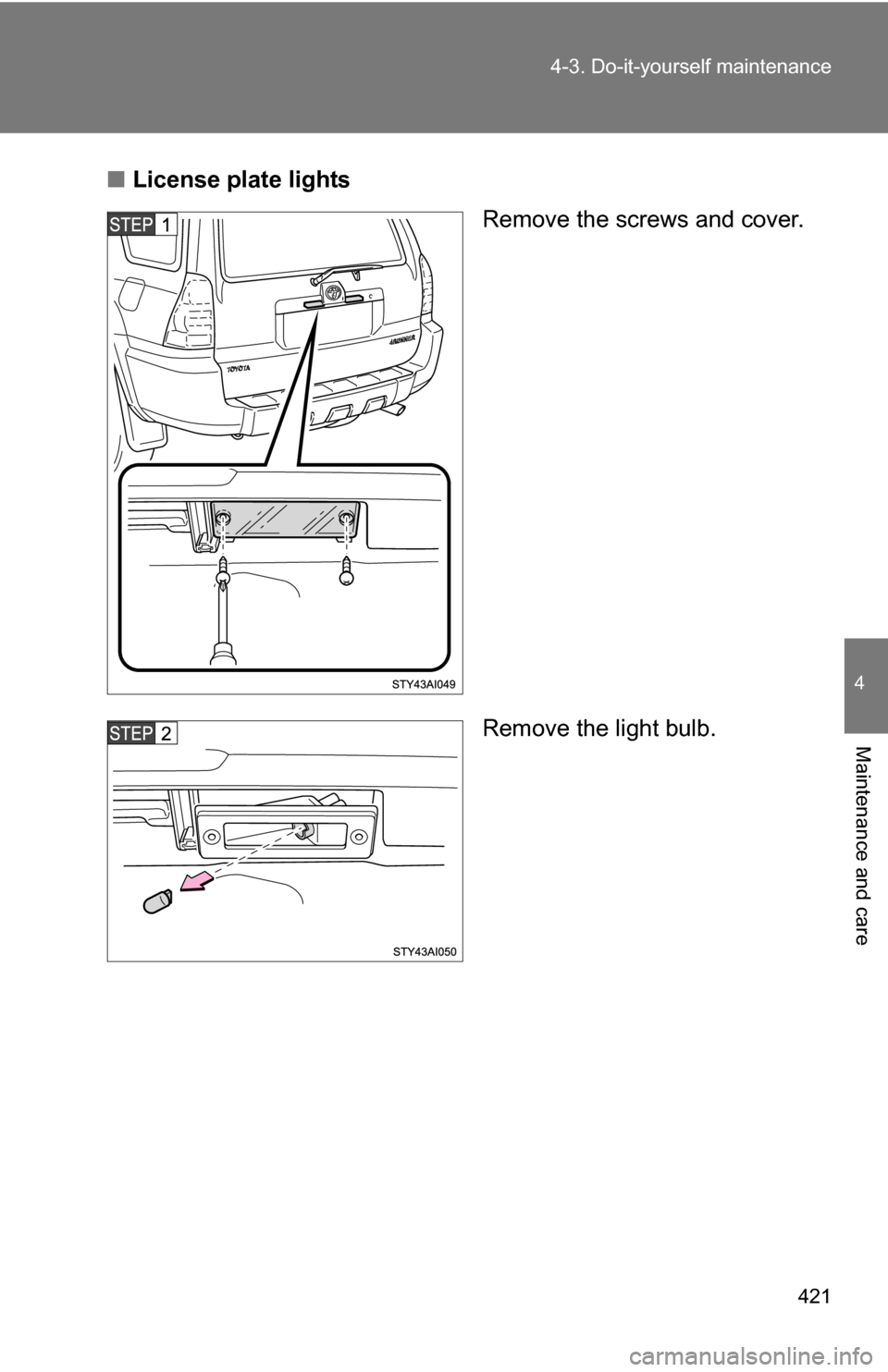
License plate lights
Remove the screws and cover.
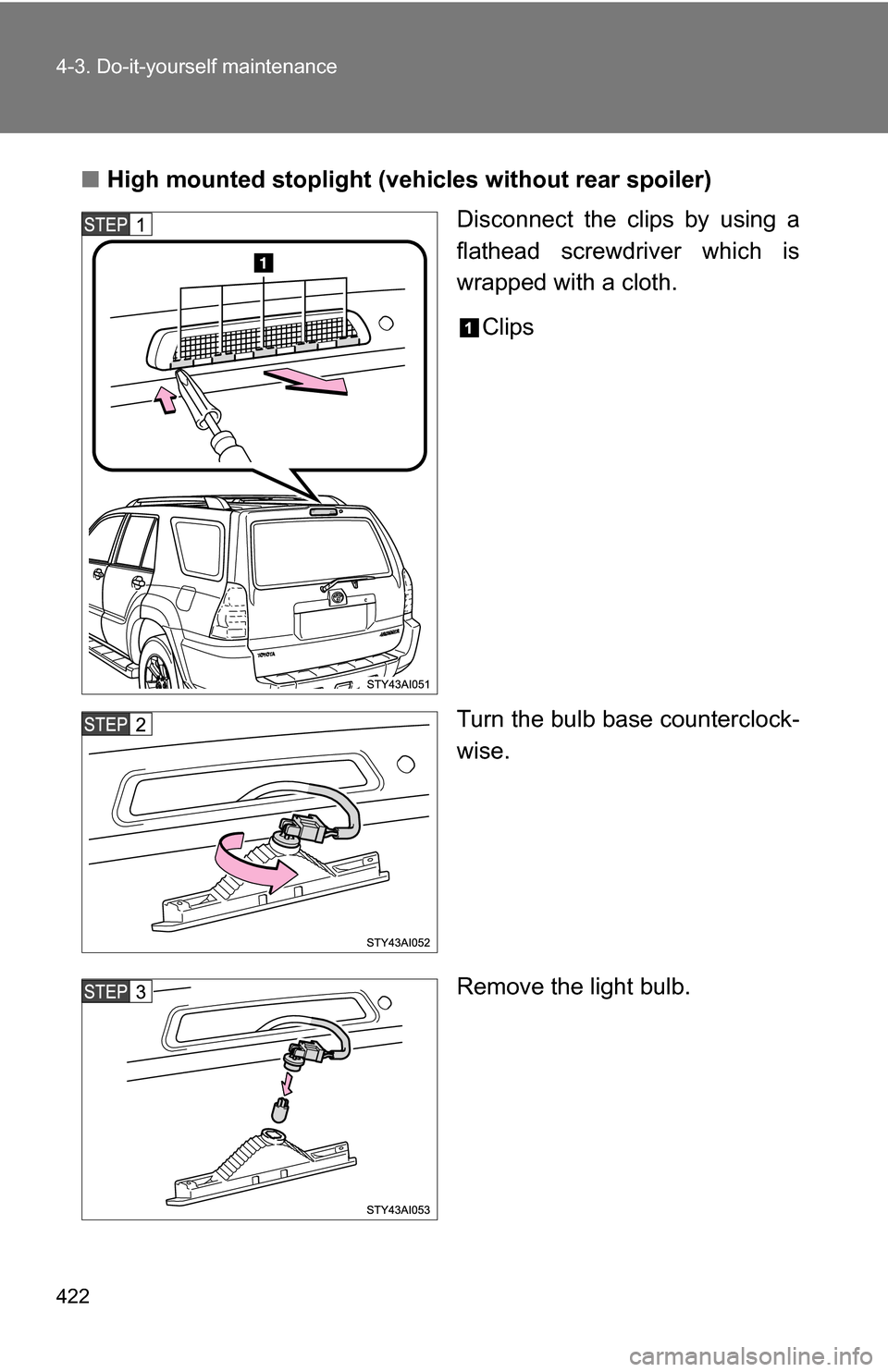
Remove the light bulb.
Page 422 of 520
422 4-3. Do-it-yourself maintenance
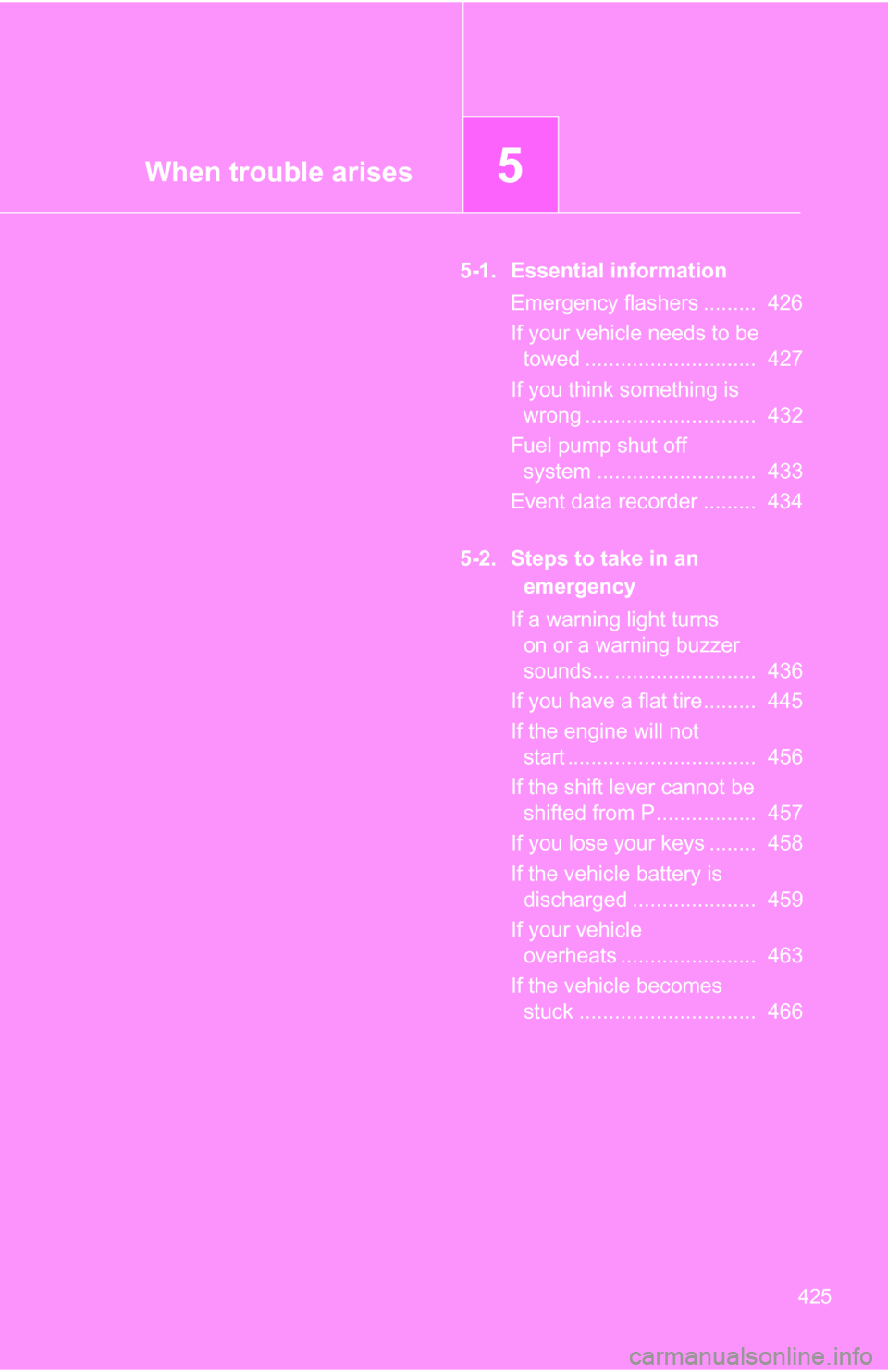
■High mounted stoplight (vehic les without rear spoiler)
Disconnect the clips by using a
flathead screwdriver which is
wrapped with a cloth.
Clips
Turn the bulb base counterclock-
wise.
Remove the light bulb.
Page 423 of 520
423
4-3. Do-it-yourself maintenance
4
Maintenance and care
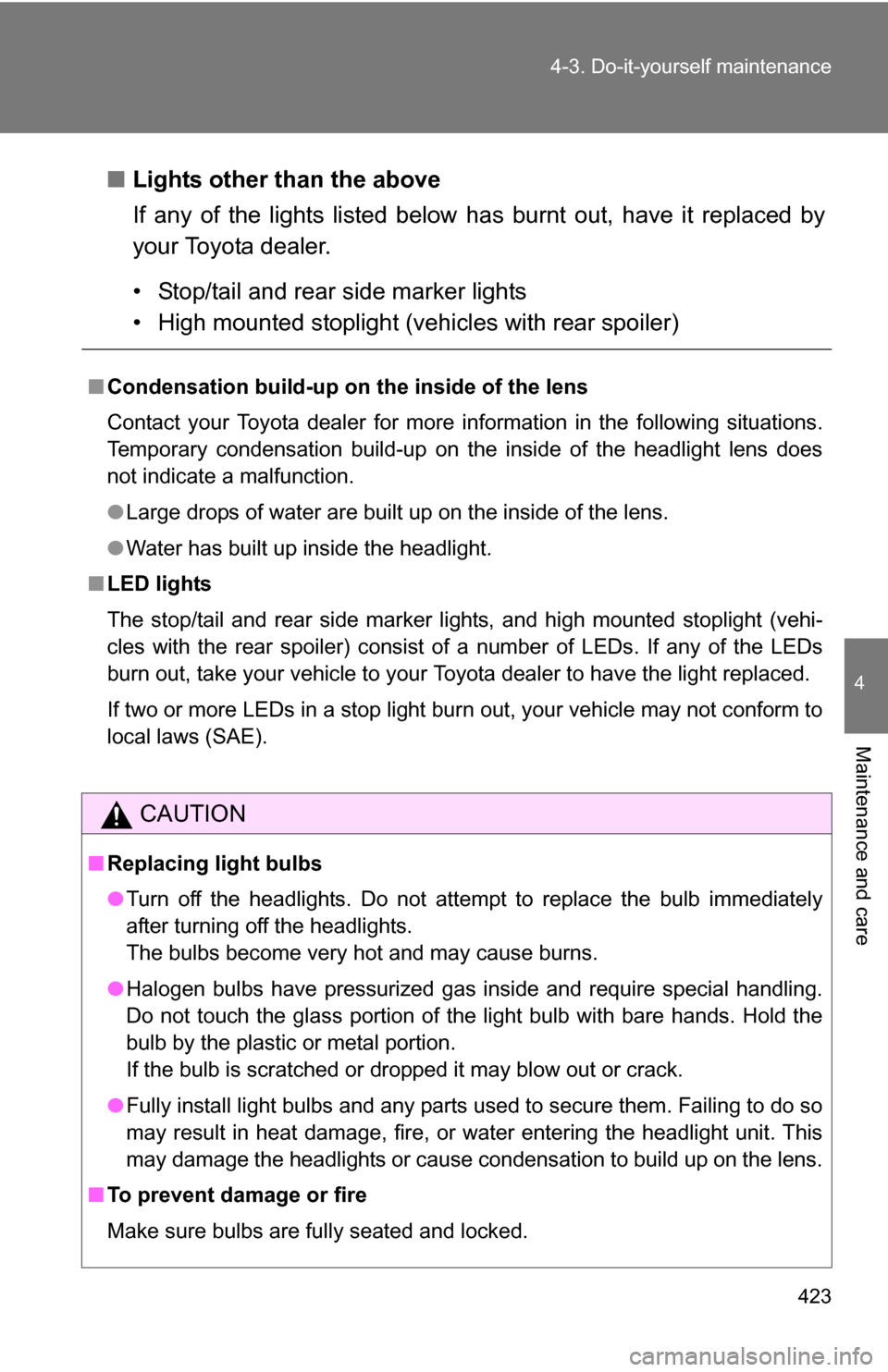
■
Lights other than the above
If any of the lights listed below has burnt out, have it replaced by
your Toyota dealer.
• Stop/tail and rear side marker lights
• High mounted stoplight (vehicles with rear spoiler)
■ Condensation build-up on th e inside of the lens
Contact your Toyota dealer for more information in the following situations.
Temporary condensation build-up on the inside of the headlight lens does
not indicate a malfunction.
● Large drops of water are built up on the inside of the lens.
● Water has built up inside the headlight.
■ LED lights
The stop/tail and rear side marker lights, and high mounted stoplight (vehi-
cles with the rear spoiler) consist of a number of LEDs. If any of the LEDs
burn out, take your vehicle to your Toyota dealer to have the light replaced.
If two or more LEDs in a stop light burn out, your vehicle may not conform to
local laws (SAE).
CAUTION
■Replacing light bulbs
●Turn off the headlights. Do not attempt to replace the bulb immediately
after turning off the headlights.
The bulbs become very hot and may cause burns.
● Halogen bulbs have pressurized gas inside and require special handling.
Do not touch the glass portion of the light bulb with bare hands. Hold the
bulb by the plastic or metal portion.
If the bulb is scratched or dropped it may blow out or crack.
● Fully install light bulbs and any parts used to secure them. Failing to do so
may result in heat damage, fire, or water entering the headlight unit. This
may damage the headlights or cause condensation to build up on the lens.
■ To prevent damage or fire
Make sure bulbs are fully seated and locked.
Page 425 of 520
When trouble arises5
425
5-1. Essential informationEmergency flashers ......... 426
If your vehicle needs to be towed ............................. 427
If you think something is wrong ............................. 432
Fuel pump shut off system ........................... 433
Event data recorder ......... 434
5-2. Steps to take in an emergency
If a warning light turns on or a warning buzzer
sounds... ........................ 436
If you have a flat tire......... 445
If the engine will not start ................................ 456
If the shift lever cannot be shifted from P................. 457
If you lose your keys ........ 458
If the vehicle battery is discharged ..................... 459
If your vehicle overheats ....................... 463
If the vehicle becomes stuck .............................. 466
Page 426 of 520
426
5-1. Essential information
Emergency flashers
NOTICE
■To prevent battery discharge
Do not leave the emergency flashers on longer than necessary when the
engine is not running.
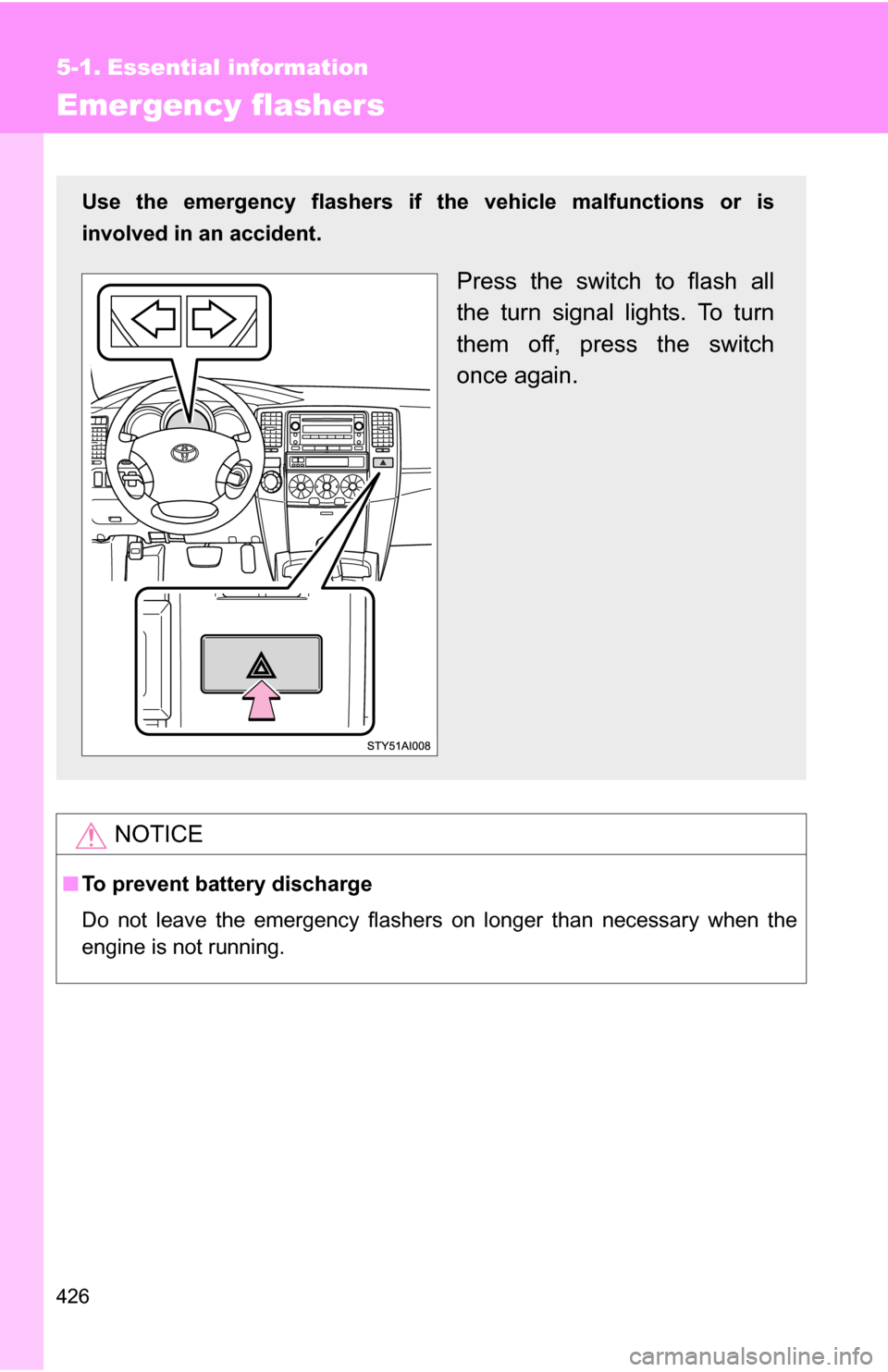
Use the emergency flashers if th e vehicle malfunctions or is
involved in an accident.
Press the switch to flash all
the turn signal lights. To turn
them off, press the switch
once again.
Page 436 of 520
436
5-2. Steps to take in an emergency
If a war ning light tur ns on or a war ning buzzer sounds...
Stop the vehicle immediately. Continuing to drive the vehicle may be dangerous.
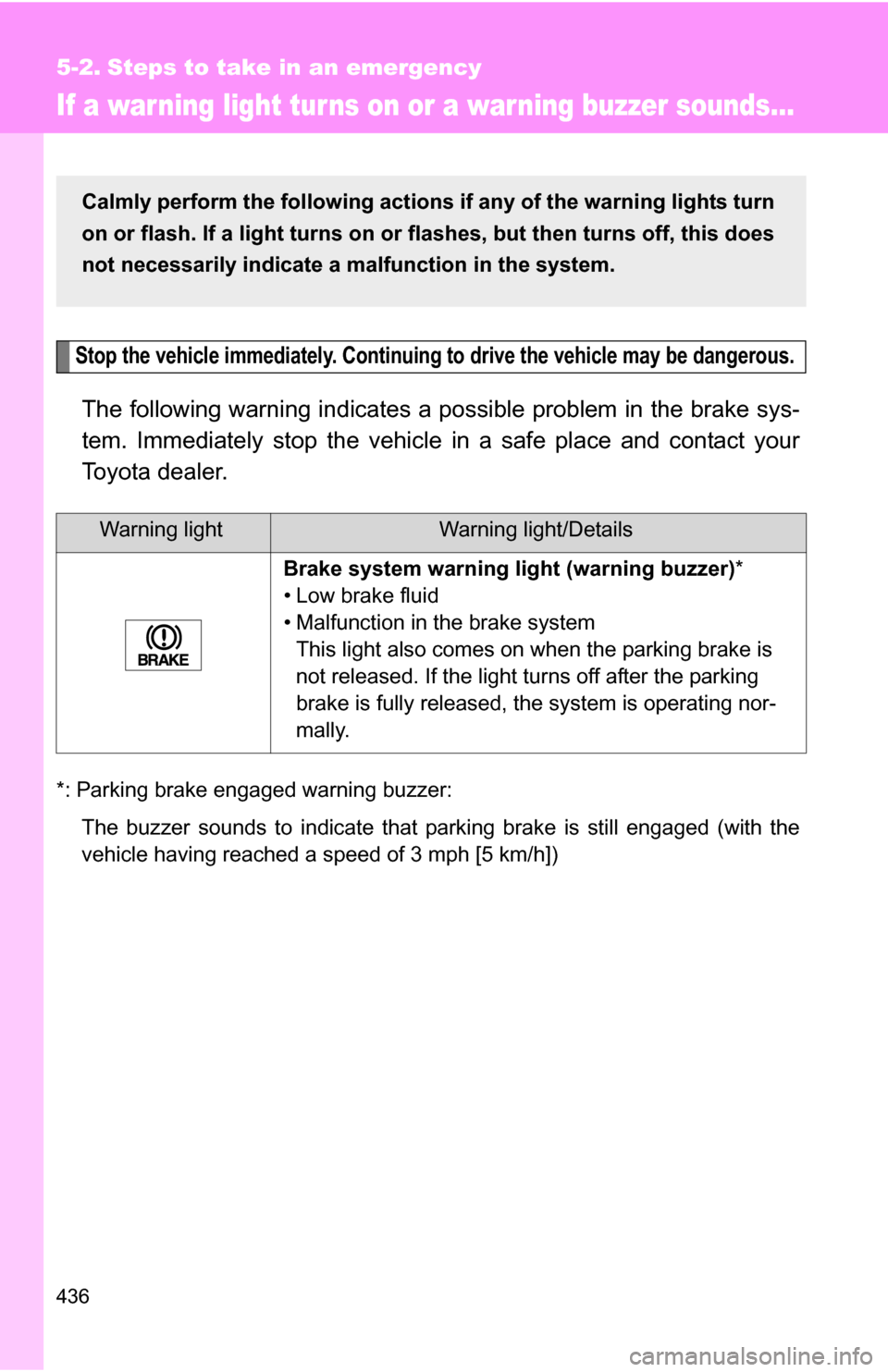
The following warning indicates a possible problem in the brake sys-
tem. Immediately stop the vehicle in a safe place and contact your
Toyota dealer.
*: Parking brake engaged warning buzzer:
The buzzer sounds to indicate that parking brake is still engaged (with the
vehicle having reached a speed of 3 mph [5 km/h])
Warning lightWarning light/Details
Brake system warning light (warning buzzer) *
• Low brake fluid
• Malfunction in the brake system This light also comes on when the parking brake is
not released. If the light turns off after the parking
brake is fully released, the system is operating nor-
mally.
Calmly perform the following actions if any of the warning lights turn
on or flash. If a light turns on or flashes, but then turns off, this does
not necessarily indicate a malfunction in the system.
Page 437 of 520

5
When trouble arises
437
5-2. Steps to take in an emergency
Stop the vehicle immediately.
The following warnings indicate the possibility of damage to the vehi-
cle that may lead to an accident. Immediately stop the vehicle in a
safe place and contact your Toyota dealer.
*: The light may come on when the oil level is extremely low. It is not designed to indicate low oil level, and the oil level must be checked using the engine
oil level dipstick.
Have the vehicle inspected immediately.
Failing to investigate the cause of the following warnings may lead to
the system operating abnormally and possibly cause an accident.
Have the vehicle inspected by your Toyota dealer immediately.
Warning lightWarning light/Details
Charging system warning light Indicates a malfunction in the vehicle’s charging sys-
tem.
Low engine oil pressure warning light Indicates that the engine oil pressure is too low*.
Warning lightWarning light/Details
Malfunction indicator lamp Indicates a malfunction in:
• The electronic engine control system;
• The electronic throttle control system;
• The electronic automatic transmission control sys-tem; or
• The emission control system.
SRS warning light Indicates a malfunction in:
• The SRS airbag system;
• The front passenger occupant classification system; or
• The seat belt pretensioner system.
Page 438 of 520
438 5-2. Steps to take in an emergency
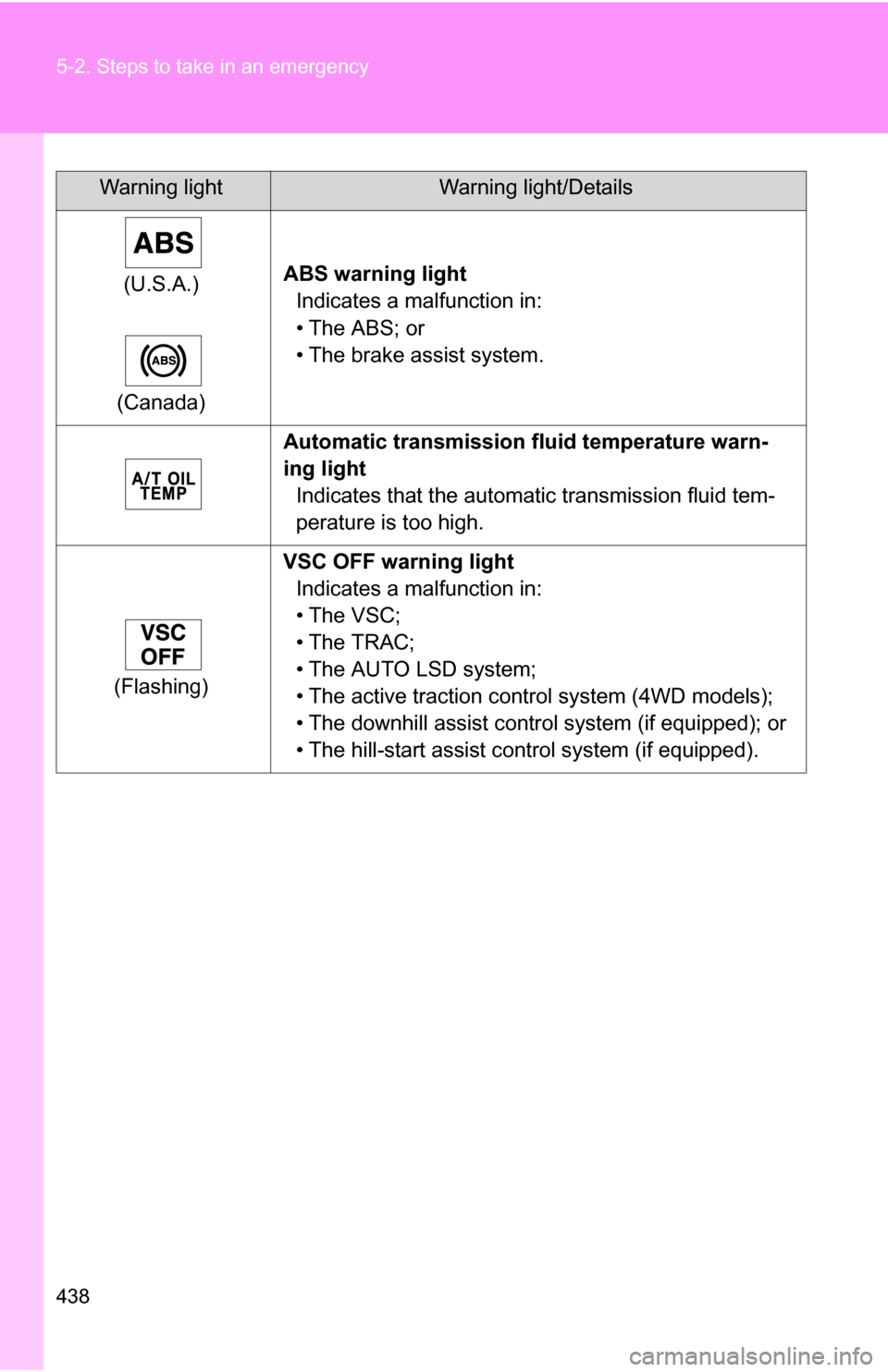
(U.S.A.)
(Canada) ABS warning light
Indicates a malfunction in:
• The ABS; or
• The brake assist system.
Automatic transmission fluid temperature warn-
ing light Indicates that the automatic transmission fluid tem-
perature is too high.
(Flashing) VSC OFF warning light
Indicates a malfunction in:
• The VSC;
• The TRAC;
• The AUTO LSD system;
• The active traction control system (4WD models);
• The downhill assist control system (if equipped); or
• The hill-start assist control system (if equipped).
Warning lightWarning light/Details