2009 SUBARU OUTBACK spare wheel
[x] Cancel search: spare wheelPage 335 of 447
9-10In case of emergency
cing speed. Then slowly pull off the
road to a safe place. Otherwise an
accident involving serious vehicle
damage and serious personal injury
could occur.
Check the pressure for all four tires
and adjust the pressure to the COLD
tire pressure shown on the vehicle
placard on the door pillar on thedriver’s side. If this light still illumi-
nates while driving after adjusting
the tire pressure, a tire may have
significant damage and a fast leak
that causes the tire to lose air
rapidly. If you have a flat tire, replace
it with a spare tire as soon aspossible.
When a spare tire is mounted or a
wheel rim is replaced without the
original pressure sensor/transmitter
being transferred, the low tire pres-
sure warning light will illuminate
steadily after blinking for approxi-
mately one minute. This indicates
the TPMS is unable to monitor all
four road wheels. Contact your
SUBARU dealer as soon as possible
for tire and sensor replacement and/
or system resetting.
Do not inject any tire liquid or
aerosol tire sealant into the tires,
as this may cause a malfunction of the tire pressure sensors.
If the light illuminates steadily after
blinking for approximately one min-
ute, promptly contact a SUBARU
dealer to have the system inspected.
Jump starting
WARNING
. Battery fluid is SULFURIC ACID.
Do not let it come in contact with
the eyes, skin, clothing or thevehicle.
If battery fluid gets on you,
thoroughly flush the exposed
area with water immediately. Get
medical help if the fluid has
entered your eyes.
If battery fluid is accidentally
swallowed, immediately drink a
large amount of milk or water,
and obtain immediate medicalhelp.
Keep everyone including chil-
dren away from the battery.
. The gas generated by a battery
explodes if a flame or spark is
brought near it. Do not smoke or
light a match while jump starting.
. Never attempt jump starting if the
discharged battery is frozen. It
could cause the battery to burst
or explode.
. Whenever working on or around
a battery, always wear suitable
Page 344 of 447

Station wagon:To take out the jack and
maintenance tools, open the center lid and
remove the bucket from the center of the
spare tire. Then, take the jack out of thebucket. & Jack handle
The jack handle is stowed on the back of
the floor cover of the trunk or on the back
of the center lid of the cargo area.Sedan: Open the floor cover and remove
the jack handle from the back of the floor
cover.
Station wagon: Open the center lid,
remove the left-hand part of the lid, and
take out the jack handle. For how to use the jack, refer to
“Flat
tires ”.
& Other maintenance tools
In addition to a jack and a jack handle, the
tool bucket on your vehicle contains the
following maintenance tools.
Screwdriver
Towing hook
Wheel nut wrench In case of emergency
9-19
Page 385 of 447
pressures in a warm garage, re-adjust the
tire pressures using the method described
above. Then, increase the vehicle speed
to at least 20 mph (32 km/h) and check to
see that the low tire pressure warning light
goes off a few minutes later. If the low tire
pressure warning light does not go off, the
tire pressure monitoring system may not
be functioning normally. In this event, go
to a SUBARU dealer to have the system
inspected as soon as possible.
While the vehicle is driven, friction be-
tween tires and the road surface causes
the tires to warm up. After illumination of
the low tire pressure warning light, any
increase in the tire pressures caused by
an increase in the outside air temperature
or by an increase in the temperature in the
tires can cause the low tire pressure
warning light to go off.
System resetting is necessary when the
wheels are changed (for example, a
switch to snow tires) and new TPMS
valves are installed on the newly fitted
wheels. Have this work performed by a
SUBARU dealer following wheel replace- ment.
It may not be possible to install TPMS
valves on certain wheels that are on the
market. Therefore, if you change the
wheels (for example, a switch to snowtires), use wheels that have the same part
number as the standard-equipment
wheels. Without four operational TPMS
valve/sensors on the wheels, the TPMS
will not fully function and the warning light
in the instrument panel will illuminate
steadily after blinking for approximately
one minute.
When a tire is replaced, adjustments are
necessary to ensure continued normal
operation of the tire pressure monitoring
system. As with wheel replacement, there-
fore, you should have the work performed
by a SUBARU dealer.
WARNING
If the low tire pressure warning light
does not illuminate briefly after the
ignition switch is turned ON or the
light illuminates steadily after blink-
ing for approximately one minute,
you should have your Tire Pressure
Monitoring System checked at a
SUBARU dealer as soon as possi-ble.
If this light illuminates while driving,
never brake suddenly and keep
driving straight ahead while gradu-
ally reducing speed. Then slowly
pull off the road to a safe place.
Otherwise an accident involving serious vehicle damage and serious
personal injury could occur.
If this light still illuminates while
driving after adjusting the tire pres-
sure, a tire may have significant
damage and a fast leak that causes
the tire to lose air rapidly. If you have
a flat tire, replace it with a spare tire
as soon as possible.
When a spare tire is mounted or a
wheel rim is replaced without the
original pressure sensor/transmitter
being transferred, the low tire pres-
sure warning light will illuminate
steadily after blinking for approxi-
mately one minute. This indicates
the TPMS is unable to monitor all
four road wheels. Contact your
SUBARU dealer as soon as possible
for tire and sensor replacement and/
or system resetting. If the light
illuminates steadily after blinking
for approximately one minute,
promptly contact a SUBARU dealer
to have the system inspected.
& Tire inspection
Check on a daily basis that the tires are
free from serious damage, nails, and
stones. At the same time, check the tires Maintenance and service
11-35
– CONTINUED –
Page 386 of 447
11-36Maintenance and service
for abnormal wear.
Contact your SUBARU dealer immedi-
ately if you find any problem. NOTE .When the wheels and tires strike
curbs or are subjected to harsh treat-
ment as when the vehicle is driven on a
rough surface, they can suffer damage
that cannot be seen with the naked eye.
This type of damage does not become
evident until time has passed. Try not
to drive over curbs, potholes or on
other rough surfaces. If doing so is
unavoidable, keep the vehicle ’s speed
down to a walking pace or less, and
approach the curbs as squarely as
possible. Also, make sure the tires are
not pressed against the curb when you
park the vehicle.. If you feel unusual vibration while
driving or find it difficult to steer the
vehicle in a straight line, one of the
tires and/or wheels may be damaged.
Drive slowly to the nearest authorized
SUBARU dealer and have the vehicleinspected.
& Tire pressures and wear
Maintaining the correct tire pressures
helps to maximize the tires ’service lives
and is essential for good running perfor- mance. Check and, if necessary, adjust
the pressure of each tire (including the
spare) at least once a month (for example,
during a fuel stop) and before any long
journey.
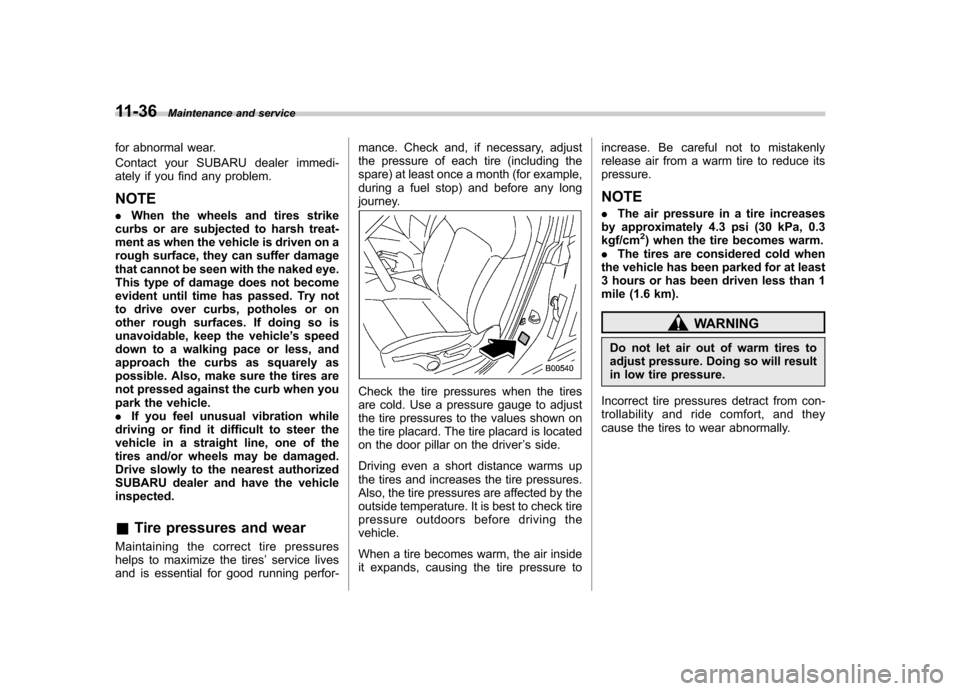
Check the tire pressures when the tires
are cold. Use a pressure gauge to adjust
the tire pressures to the values shown on
the tire placard. The tire placard is located
on the door pillar on the driver
’s side.
Driving even a short distance warms up
the tires and increases the tire pressures.
Also, the tire pressures are affected by the
outside temperature. It is best to check tire
pressure outdoors before driving thevehicle.
When a tire becomes warm, the air inside
it expands, causing the tire pressure to increase. Be careful not to mistakenly
release air from a warm tire to reduce itspressure.
NOTE . The air pressure in a tire increases
by approximately 4.3 psi (30 kPa, 0.3 kgf/cm
2) when the tire becomes warm.
. The tires are considered cold when
the vehicle has been parked for at least
3 hours or has been driven less than 1
mile (1.6 km).
WARNING
Do not let air out of warm tires to
adjust pressure. Doing so will result
in low tire pressure.
Incorrect tire pressures detract from con-
trollability and ride comfort, and they
cause the tires to wear abnormally.
Page 414 of 447

&Tires
Tire size P205/55R16
89H P225/60R16
97H P205/50R17
88V 215/45R17
91W P225/55R17
95V 215/45R18
89Y P215/45R18
89W
Wheel size 16 66.5JJ 17 67JJ 18 67JJ
Pressure Front 32 psi
(220 kPa,
2.2 kgf/cm
2) 32 psi
(220 kPa,
2.2 kgf/cm2) 33 psi
(230 kPa,
2.3 kgf/cm2) 35 psi
(240 kPa,
2.4 kgf/cm2) 32 psi
(220 kPa,
2.2 kgf/cm2) 33 psi
(230 kPa,
2.3 kgf/cm2)
Rear 30 psi
(210 kPa,
2.1 kgf/cm
2) 30 psi
(210 kPa,
2.1 kgf/cm2) 32 psi
(220 kPa,
2.2 kgf/cm2) 33 psi
(230 kPa,
2.3 kgf/cm2) 30 psi
(210 kPa,
2.1 kgf/cm2) 32 psi
(220 kPa,
2.2 kgf/cm2)
Rear at
trailer tow- ing –32 psi
(220 kPa,
2.2 kgf/cm
2) – 32 psi
(220 kPa,
2.2 kgf/cm2) –
Temporary
spare tire Size T135/80R16 T155/70D17 T135/80R16 T135/70D17*1
T135/80R16*2T155/70D17 T155/70D17
Pressure 60 psi (420 kPa, 4.2 kgf/cm
2)
*1: 2.5 GT Limited model
*2: 3.0 R model & Wheel alignment
Item Legacy OUTBACK
Sedan Station wagon Station wagon
Toe Front 0 in (0 mm)
Rear 0 in (0 mm)
Camber Front 0815 ’ 0840 ’
Rear 0840 ’ 0830 ’
0810 ’Specifications
12-5
Page 425 of 447

&Recommended tire inflation pressure
! Recommended cold tire inflation pressure
Recommended cold tire inflation pressure for your vehicle ’s tires is as follows,
Tire size P205/
55R16 89H P225/
60R16 97H P205/
50R17 88V 215/
45R17 91W P225/
55R17 95V 215/
45R18 89Y P215/
45R18 89W
Wheel size 16 66.5JJ 17 67JJ 18 67JJ
Pres- sure Front
32 psi
(220 kPa,
2.2 kgf/cm
2) 32 psi
(220 kPa,
2.2 kgf/cm2) 33 psi
(230 kPa,
2.3 kgf/cm2) 35 psi
(240 kPa,
2.4 kgf/cm2) 32 psi
(220 kPa,
2.2 kgf/cm2) 33 psi
(230 kPa,
2.3 kgf/cm2)
Rear 30 psi
(210 kPa,
2.1 kgf/cm
2) 30 psi
(210 kPa,
2.1 kgf/cm2) 32 psi
(220 kPa,
2.2 kgf/cm2) 33 psi
(230 kPa,
2.3 kgf/cm2) 30 psi
(210 kPa,
2.1 kgf/cm2) 32 psi
(220 kPa,
2.2 kgf/cm2)
Rear at trailertowing –32 psi
(220 kPa,
2.2 kgf/cm
2) –
32 psi
(220 kPa,
2.2 kgf/cm2) –
Tem-poraryspare tire Size
T135/
80R16 T155/
70D17 T135/
80R16 T135/
70D17
*1
T135/
80R16*2
T155/
70D17 T155/70D17
Pres- sure 60 psi (420 kPa, 4.2 kgf/cm
2)
*1: 2.5 GT Limited model
*2: 3.0 R model Consumer information and Reporting safety defects
13-5
– CONTINUED –
Page 443 of 447

Speedometer....................................................... 3-6, 3-24
SPORT mode indicator light ........................................ 3-38
SRS
Curtain airbag ........................................................ 1-56
Frontal airbag ........................................................ 1-45
Side airbag ........................................................... 1-56
SRS airbag (Supplemental Restraint System airbag) ... 4, 1-40
SRS airbag system Monitors. ............................................................... 1-63
Servicing ............................................................... 1-65
Warning light ......................................................... 3-30
Starting the engine ....................................................... 7-9
State emission testing (U.S. only) .................................. 7-7
Steering wheel Power ................................................................... 7-34
Tilt/telescopic ......................................................... 3-59
Stopping the engine ................................................... 7-11
Storage compartment ................................................... 6-5
Stowage boxes .......................................................... 6-17
Sun shade ........................................................ 2-30, 2-31
Sun visors ................................................................... 6-4
Supplemental Restraint System airbag (SRS) ... ............. 1-40
Synthetic leather upholstery ........................................ 10-5
T
Tachometer ......................................................... 3-6, 3-26
Temperature gauge ...................................... 3-7, 3-12, 3-27
Temperature warning light AT OIL TEMP ........................................................ 3-33
Temporary spare tire .................................................... 9-2
Tether (child restraint system) .............................. 1-35, 1-38 Tie-down hooks
.......................................................... 9-14
Tire
Chains .................................................................. 8-13
Inspection ............................................................ 11-35
Pressures and wear .............................................. 11-36
Replacement. ....................................................... 11-39
Rotation .............................................................. 11-39
Types .................................................................. 11-33
Tire pressure monitoring system (TPMS) ......................................... 3-33, 7-43, 9-9, 11-34
Tires ......................................................................... 12-5
Tires and wheels ...................................................... 11-33
Top tether anchorages ........................................ 1-35, 1-38
Towing ...................................................................... 9-13
All wheels on the ground ......................................... 9-17
Flat-bed truck ......................................................... 9-16
Tie-down hooks ...................................................... 9-14
Weight .................................................................. 8-22
Traction Control system OFF indicator light .................................................. 3-37
Trailer Connecting ............................................................ 8-20
Hitch ..................................................................... 8-19
Hitches .................................................................. 8-25
Towing .................................................................. 8-21
Towing tips ............................................................ 8-27
Trip meter .................................................................. 3-25
Trunk lid .................................................................... 2-24
Release handle ...................................................... 2-25
Trunk light ............................................................... 11-59 Index
14-9
Page 447 of 447

&Cold tire pressure:
Tire size P205/55R16
89H P225/60R16
97H P205/50R17
88V 215/45R17
91W P225/55R17
95V 215/45R18
89Y P215/45R18
89W
Wheel size 16 66.5JJ 17 67JJ 18 67JJ
Pressure Front 32 psi (220
kPa, 2.2 kgf/
cm
2) 32 psi (220
kPa, 2.2 kgf/
cm2) 33 psi (230
kPa, 2.3 kgf/
cm2) 35 psi (240
kPa, 2.4 kgf/
cm2) 32 psi (220
kPa, 2.2 kgf/
cm2) 33 psi (230 kPa,
2.3 kgf/cm2)
Rear 30 psi (210
kPa, 2.1 kgf/
cm
2) 30 psi (210
kPa, 2.1 kgf/
cm2) 32 psi (220
kPa, 2.2 kgf/
cm2) 33 psi (230
kPa, 2.3 kgf/
cm2) 30 psi (210
kPa, 2.1 kgf/
cm2) 32 psi (220 kPa,
2.2 kgf/cm2)
Rear at
trailer tow- ing –
32 psi (220
kPa, 2.2 kgf/ cm
2) –
32 psi (220
kPa, 2.2 kgf/
cm2) –
Temporary
spare tire Size T135/80R16 T155/70D17 T135/80R16 T135/70D17
*1
T135/80R16*2T155/70D17 T155/70D17
Pressure 60 psi (420 kPa, 4.2 kgf/cm
2)
*1: 2.5 GT Limited model
*2: 3.0 R model