2009 SUBARU OUTBACK seats
[x] Cancel search: seatsPage 92 of 447
1-66Seat, seatbelt and SRS airbags
&Precautions against vehicle modification
WARNING
To avoid accidental activation of the
system or rendering the system
inoperative, which may result in
serious injury, no modifications
should be made to any components
or wiring of the SRS airbag system.
This includes following modifica- tions: . Installation of custom steering
wheels
. Attachment of additional trim
materials to the dashboard
. Installation of custom seats
. Replacement of seat fabric or
leather
. Installation of additional fabric or
leather on the front seat
. Attachment of a hands-free mi-
crophone or any other accessory
to a front pillar, a center pillar, a
rear pillar, the windshield, a side
window, an assist grip, or any
other cabin surface that would be
near a deploying SRS curtainairbag. .
Installation of additional electri-
cal/electronic equipment such as
a mobile two-way radio on or
near the SRS airbag system
components and/or wiring is not
advisable. This could interfere
with proper operation of the
SRS airbag system.
CAUTION
Do not perform any of the following
modifications. Such modifications
can interfere with proper operation
of the SRS airbag system. . Attachment of any equipment
(bush bar, bullbar, winches, snow
plow, skid/sump plate, etc.) other
than genuine SUBARU acces-
sory parts.
. Modification of the suspension
system or front end structure.
. Installation of a tire of different
size and construction from the
tires specified on the vehicle
placard attached to the driver ’s
door pillar or specified for indivi-
dual vehicle models in this Own-er ’s Manual.
. Attachment of any equipment
(side steps or side sill protectors, etc.) other than genuine SUBARU
accessory parts to the side body.
Always consult your SUBARU dealer if
you want to install any accessory parts on
your vehicle.
Page 153 of 447
3-30Instruments and controls
The warning light(s) for unfastened
seatbelt(s) will alternate between
steady illumination and flashing at
15-second intervals. The chime will
not sound. –At speeds higher than approxi-
mately 9 mph (15 km/h)
The warning light(s) for unfastened
seatbelt(s) will alternate between
flashing and steady illumination at
15-second intervals and the chime
will sound while the warning light(s)
is/are flashing.
. It is possible to cancel the warning
operation that follows the 6-second
warning after turning ON the ignition
switch. When the ignition switch is
turned ON next time, however, the
complete sequence of the warning
operation resumes. For further details
about canceling the warning operation,
please contact your SUBARU dealer.
If there is no passenger on the front passenger ’s seat, the seatbelt warning
device for the front passenger ’s seat will
be deactivated. The front passenger ’s
occupant detection system monitors
whether or not there is a passenger on
the front passenger ’s seat. Observe the
following precautions. Failure to do so
may prevent the device from functioning
correctly or cause the device to fail. .
Do not install any accessory such as a
table or TV onto the seatback. . Do not store a heavy load in the
seatback pocket.. Do not allow the rear seat occupant to
place his/her hands or legs on the front passenger ’s seatback, or allow him/her to
pull the seatback. . Do not use front seats with their back-
ward-forward position and seatback not
being locked into place securely. If any of
them are not locked securely, adjust them
again. For adjusting procedure, refer tothe “Manual seat ”in the front seats section
in chapter 1 in this Owner ’s Manual.
(Models equipped with manual seats only)
If the seatbelt warning device for the front passenger ’s seat does not function cor-
rectly (e.g., it is activated even when the
front passenger ’s seat is empty or it is
deactivated even when the front passen-
ger has not fastened his/her seatbelt),
take the following actions. . Ensure that no article is placed on the
seat other than a child restraint system
and its child occupant. . Ensure that there is no article left in the
seatback pocket.. Ensure that the backward-forward po-
sition and seatback of front passenger ’s
seat are locked into place securely by moving the seat back and forth. (Models
equipped with manual seats only)
If still the seatbelt warning device for front passenger
’s seat does not function cor-
rectly after taking relevant corrective ac-
tions described above, immediately con-
tact your SUBARU dealer for an inspec-tion.
& SRS airbag system
warning light
When the ignition switch is turned to the “ON ”position, the SRS airbag system
warning light will illuminate for approxi-
mately 6 seconds and go out. This shows
the SRS frontal airbag and SRS side
airbag and SRS curtain airbag and seat-
belt pretensioners are in normal operation.
WARNING
If the warning light exhibits any of
the following conditions, there may
be a malfunction in the seatbelt
pretensioners and/or SRS airbag
system. Immediately take your vehi-
cle to your nearest SUBARU dealer
to have the system checked. Unless
checked and properly repaired, the
seatbelt pretensioners and/or SRS
airbags will operate improperly (e.g.
Page 182 of 447
Tilt/telescopic steering wheel
WARNING
. Do not adjust the steering wheel
tilt/telescopic position while driv-
ing. This may cause loss of
vehicle control and result in
personal injury.
. If the lever cannot be raised to
the fixed position, adjust the
steering wheel again. It is dan-
gerous to drive without locking
the steering wheel. This may
cause loss of vehicle control
and result in personal injury.
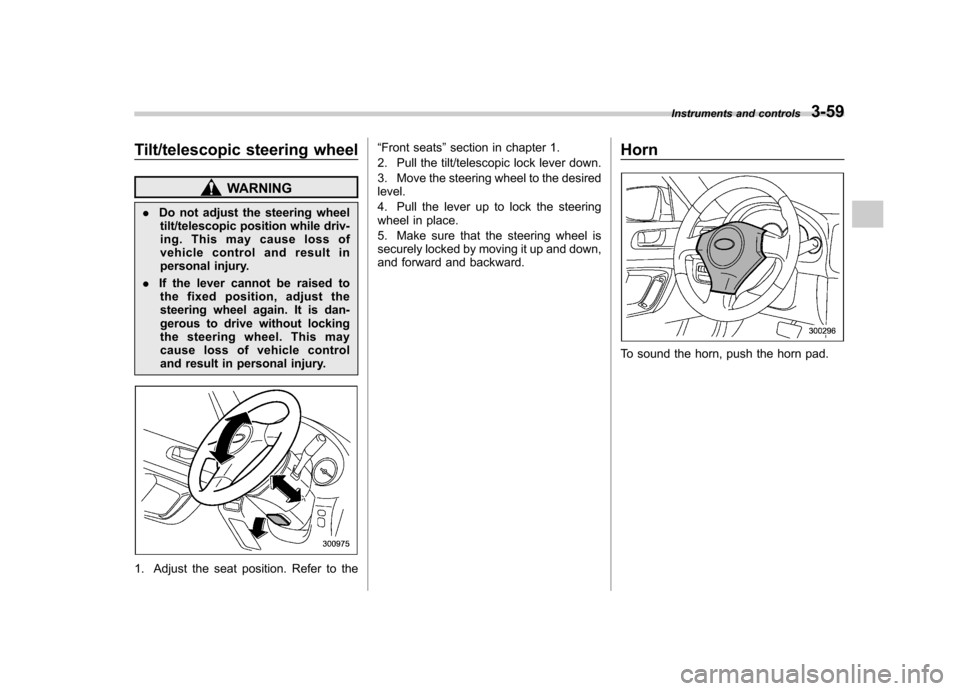
1. Adjust the seat position. Refer to the “
Front seats ”section in chapter 1.
2. Pull the tilt/telescopic lock lever down.
3. Move the steering wheel to the desired level.
4. Pull the lever up to lock the steering
wheel in place.
5. Make sure that the steering wheel is
securely locked by moving it up and down,
and forward and backward. Horn
To sound the horn, push the horn pad.Instruments and controls
3-59
Page 349 of 447

Cleaning the interior
Use a soft, damp cloth to clean the climate
control panel, audio equipment, instru-
ment panel, center console, combination
meter panel, and switches. (Do not use
organic solvents.) &Seat fabric
Remove loose dirt, dust or debris with a
vacuum cleaner. If the dirt is caked on the
fabric or hard to remove with a vacuum
cleaner, use a soft blush then vacuum it.
Wipe the fabric surface with a tightly
wrung cloth and dry the seat fabric
thoroughly. If the fabric is still dirty, wipe
using a solution of mild soap and luke-
warm water then dry thoroughly.
If the stain does not come out, try a
commercially-available fabric cleaner. Use
the cleaner on a hidden place and make
sure it does not affect the fabric adversely.
Use the cleaner according to its instruc-tions. NOTE
When cleaning the seat, do not use
benzine, paint thinner, or any similarmaterials. &
Leather seat materials
The leather used by SUBARU is a high
quality natural product which will retain its
distinctive appearance and feel for many
years with proper care.
Allowing dust or road dirt to build up on the
surface can cause the material to become
brittle and to wear prematurely. Regular
cleaning with a soft, moist, natural fiber
cloth should be performed monthly, taking
care not to soak the leather or allow water
to penetrate the stitched seams.
A mild detergent suitable for cleaning
woolen fabrics may be used to remove
difficult dirt spots, rubbing with a soft, dry
cloth afterwards to restore the luster. If
your SUBARU is to be parked for a long
time in bright sunlight, it is recommended
that the seats and headrests be covered,
or the windows shaded, to prevent fading
or shrinkage.
Minor surface blemishes or bald patches
may be treated with a commercial leather
spray lacquer. You will discover that each
leather seat section will develop soft folds
or wrinkles, which is characteristic of
genuine leather. & Synthetic leather upholstery
The synthetic leather material used on the
SUBARU may be cleaned using mild soap or detergent and water, after first vacuum-
ing or brushing away loose dirt. Allow the
soap to soak in for a few minutes and wipe
off with a clean, damp cloth. Commercial
foam-type cleaners suitable for synthetic
leather materials may be used when
necessary. NOTE
Strong cleaning agents such as sol-
vents, paint thinners, window cleaner
or gasoline must never be used on
leather or synthetic interior materials. &
Climate control panel, audio
panel, instrument panel,
console panel, switches,
combination meter, and other
plastic surface
Use a soft, damp cloth to clean the climate
control panel, audio equipment, instru-
ment panel, center console, combination
meter panel, and switches. NOTE
Do not use organic solvents such as
paint thinners or gasoline, or strong
cleaning agents that contain thosesolvents. Appearance care
10-5
– CONTINUED –
Page 427 of 447

whitewall, bears white lettering
or bears manufacturer, brand,
and/or model name molding that
is higher or deeper than the
same molding on the other side-
wall of the tire, or (2)The outward facing sidewall
of an asymmetrical tire that has
a particular side that must al-
ways face outward when mount-
ing on a vehicle.
. Accessory weight
The combined weight (in excess of
those standard items which may be
replaced) of floor mats, leather
seats and cross bars to the extent
that these items are available as
factory-installed equipment
(whether installed or not). . Curb weight
The weight of a motor vehicle with
standard equipment including the
maximum capacity of fuel, oil, and
coolant and air conditioning. . Maximum loaded vehicle weight
The sum of curb weight, accessory
weight, vehicle capacity weight and production options weight.
. Normal occupant weight
150 lbs (68 kg) times the number of
occupants (3 occupants). . Occupant distribution
Distribution of occupants in a vehi-
cle, 2 in front, 1 in rear seat.. Production options weight
The combined weight of those
installed regular production options
weighing over 5.1 lbs (2.3 kg) in
excess of those standards items
which they replace, not previously
considered in curb weight or acces-
sory weight. . Vehicle capacity weight
The total weight of cargo, luggage
and occupants that can be added to
the vehicle. . Vehicle maximum load on a tire
Load on an individual tire that is
determined by distributing to each
axle its share of the maximum
loaded vehicle weight and dividing
by two. . Vehicle normal load on a tire
Load on an individual tire that is determined by distributing to each
axle its share of the curb weight,
accessory weight, and normal oc-
cupant weight and dividing by two. &
Tire care –maintenance and
safety practices
. Check on a daily basis that the
tires are free from serious damage,
nails, and stones. At the same time,
check the tires for abnormal wear.. Inspect the tire tread regularly
and replace the tires before their
tread wear indicators become visi-
ble. When a tire ’s tread wear
indicator becomes visible, the tire
is worn beyond the acceptable limit
and must be replaced immediately.
With a tire in this condition, driving
at even low speeds in wet weather
can cause the vehicle to hydro-
plane. Possible resulting loss of
vehicle control can lead to anaccident. . To maximize the life of each tire
and ensure that the tires wear
uniformly, it is best to rotate the
Consumer information and Reporting safety defects
13-7
– CONTINUED –
Page 438 of 447

14-4Index
Disarming the alarm system ........................................ 2-19
Disc brake pad wear warning indicators ........................ 7-35
Dome light ........................................................ 6-2, 11-57
Door Locks ..................................................................... 2-5
Open warning light ................................................. 3-36
Step light ............................................................. 11-58
Drive belts. ............................................................... 11-20
Driving
All-Wheel Drive warning light ................................... 3-36
Car phone/cell phone .................................................. 7
Drinking ..................................................................... 6
Drugs ........................................................................ 6
Foreign countries ..................................................... 8-5
Pets .......................................................................... 7
Snowy and icy roads ................................................ 8-9
Tips....................................... 7-16, 7-18, 7-23, 7-29, 8-5
Tired or sleepy. ........................................................... 6
E
ECO gauge ................................................................. 3-8
Electrical system ........................................................ 12-3
Electronic Brake Force Distribution (EBD) system ........................................................... 3-35, 7-37
Emergency Locking Retractor (ELR) ............................. 1-15
Engine
Compartment overview ........................................... 11-6
Coolant ................................................................ 11-14
Exhaust gas (carbon monoxide) ............................. 5, 8-3
Hood .................................................................... 11-4
Oil........................................................................ 11-9 Overheating
........................................................... 9-13
Starting .................................................................. 7-9
Stopping ................................................................ 7-11
Exterior care .............................................................. 10-2
F
Flat tires ..................................................................... 9-4
Floor mat ................................................................... 6-13
Fluid level Automatic transmission ......................................... 11-22
Brake .................................................................. 11-28
Clutch ................................................................. 11-29
Power steering ..................................................... 11-27
Fog light Bulb .................................................................... 11-53
Indicator light ......................................................... 3-40
Switch ................................................................... 3-49
Front Differential gear oil ................................................ 11-24
Fog light (bulb) ..................................................... 11-53
Seatbelt pretensioners ............................................ 1-24
Seats ..................................................................... 1-2
Side marker light .................................................. 11-53
Turn signal/Parking and front side marker light ......... 11-53
Front fog light ............................................................. 3-49
Indicator light ......................................................... 3-40
Front seats
Forward and backward adjustment ... ................... 1-3, 1-4
Reclining .......................................................... 1-3, 1-4
Seat height adjustment (driver ’s seat) ........................ 1-4
Front side marker ..................................................... 11-53
Page 441 of 447

N
New vehicle break-in driving.......................................... 8-2
OOdometer .................................................................. 3-25
Odometer/Trip meter .................................................. 3-10
Off road driving ............................................................ 8-6
Oil filter .................................................................... 11-10
Oil level Engine .................................................................. 11-9
Front differential gear ............................................ 11-24
Manual transmission .............................................. 11-21
Rear differential .................................................... 11-25
Oil pressure warning light ............................................ 3-32
Outside mirrors .......................................................... 3-57
Outside temperature indicator ...................................... 3-42
Overhead console ........................................................ 6-7
Overheating engine .................................................... 9-13
PParking Brake ................................................................... 7-45
Brake stroke ......................................................... 11-33
Light switch ........................................................... 3-48
Tips...................................................................... 7-45
Parking your vehicle ................................................... 7-44
Periodic inspections ..................................................... 8-4
Petrol fuel ................................................................... 7-3
Pocket ........................................................................ 6-8
Power
Door locking switch .................................................. 2-7 Seat
....................................................................... 1-4
Steering ................................................................ 7-34
Steering fluid ........................................................ 11-27
Windows ............................................................... 2-21
Precautions against vehicle modification ................ 1-27, 1-66
Preparing to drive ........................................................ 7-8
Printed antenna ........................................................... 5-2
RRear Combination lights ................................................ 11-53
Gate ............................................................. 2-27, 9-18
Seats ..................................................................... 1-9
Viscous limited slip differential .................................. 7-33
Rear differential Gear oil ............................................................... 11-25
Rear seat
Folding down .......................................................... 1-9
Rear turn signal ........................................................ 11-53
Rear window
Defogger button ..................................................... 3-54
Wiper and washer switch ......................................... 3-53
Wiper blades ........................................................ 11-44
Recommended
Automatic transmission fluid ................................... 11-23
Brake fluid ........................................................... 11-29
Clutch fluid .......................................................... 11-30
OIL grade and viscosity ..................... 11-12, 11-13, 11-22, 11-25, 11-27
Power steering fluid .............................................. 11-28
Spark plugs ......................................................... 11-20 Index
14-7