2009 SUBARU OUTBACK ABS
[x] Cancel search: ABSPage 324 of 447
8-28Driving tips
! Before starting out on a trip
. Check that the vehicle and vehicle-to-
hitch mounting are in good condition. If
any problems are apparent, do not tow the
trailer. . Check that the vehicle sits horizontally
with the trailer attached. If the vehicle is
tipped sharply up at the front and down at
the rear, check the total trailer weight,
GVW, GAWs and tongue load again, then
confirm that the load and its distribution
are acceptable. . Check that the tire pressures are
correct.. Check that the vehicle and trailer are
connected properly. Confirm that
–the trailer tongue is connected
properly to the hitch ball. – the trailer lights connector is con-
nected properly and trailer ’s brake
lights illuminate when the vehicle ’s
brake pedal is pressed, and that the trailer ’s turn signal lights flash when
the vehicle ’s turn signal lever is oper-
ated. – the safety chains are connected
properly.– all cargo in the trailer is secured
safety in position.– the side mirrors provide a good
rearward field of view without a sig- nificant blind spot.
. Sufficient time should be taken to learn
the “feel ”of the vehicle/trailer combination
before starting out on a trip. In an area free
of traffic, practice turning, stopping and
backing up. ! Driving with a trailer
. You should allow for considerably more
stopping distance when towing a trailer.
Avoid sudden braking because it may
result in skidding or jackknifing and loss ofcontrol. . Avoid abrupt starts and sudden accel-
erations. If your vehicle has a manual
transmission, always start out in first gear
and release the clutch at moderate enginerevolution. . Avoid uneven steering, sharp turns and
rapid lane changes.. Slow down before turning. Make a
longer than normal turning radius because
the trailer wheels will be closer than the
vehicle wheels to the inside of the turn. In
a tight turn, the trailer could hit yourvehicle. . Crosswinds will adversely affect the
handling of your vehicle and trailer, caus-
ing sway. Crosswinds can be due to
weather conditions or the passing of large
trucks or buses. If swaying occurs, firmly
grip the steering wheel and slow down immediately but gradually. .
When passing other vehicles, consid-
erable distance is required because of the
added weight and length caused by
attaching the trailer to your vehicle.
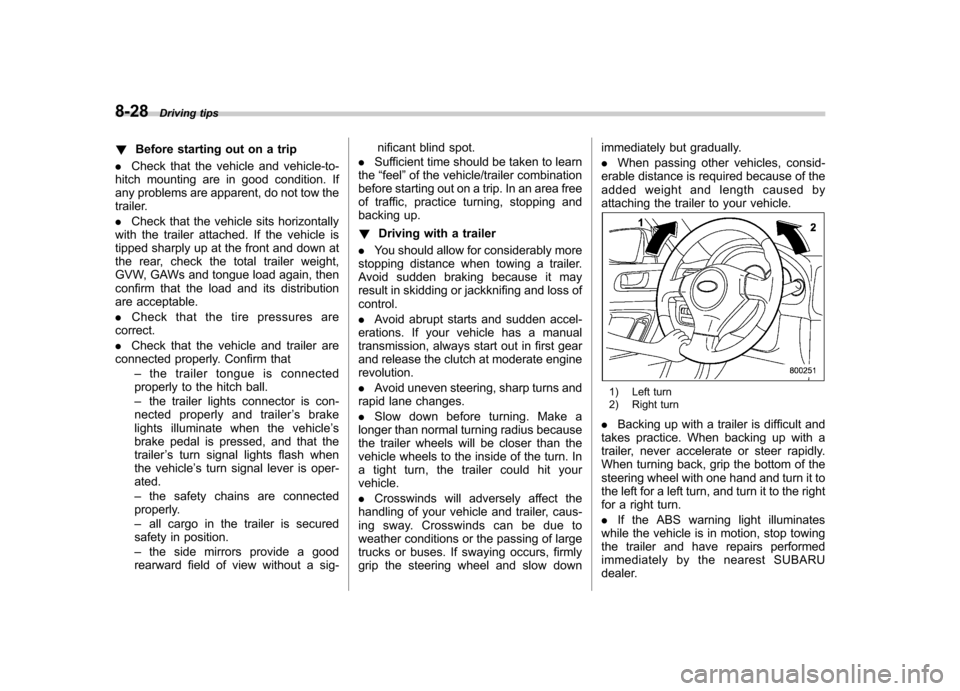
1) Left turn
2) Right turn
. Backing up with a trailer is difficult and
takes practice. When backing up with a
trailer, never accelerate or steer rapidly.
When turning back, grip the bottom of the
steering wheel with one hand and turn it to
the left for a left turn, and turn it to the right
for a right turn. . If the ABS warning light illuminates
while the vehicle is in motion, stop towing
the trailer and have repairs performed
immediately by the nearest SUBARU
dealer.
Page 325 of 447

!Driving on grades
. Before going down a steep hill, slow
down and shift into lower gear (if neces-
sary, use 1st gear) in order to utilize the
engine braking effect and prevent over-
heating of your vehicle ’s brakes. Do not
make sudden downshifts. . When driving uphill in hot weather, the
air conditioner may turn off automatically
to protect the engine from overheating. . When driving uphill in hot weather, pay
attention to the water temperature gauge
pointer (for all vehicles) and AT OIL TEMP
warning light (for AT models) since the
engine and transmission are relatively
prone to overheating under these condi-
tions. If the water temperature gauge
pointer approaches the OVERHEAT zone
or the AT OIL TEMP warning light illumi-
nates, immediately switch off the air
conditioner and stop the vehicle at the
nearest safe place. Refer to the “Engine
overheating ”section in chapter 9, and
“ Warning and indicator lights ”section in
chapter 3. NOTE
With AT models, the temperature of
engine coolant is less likely to rise to
the OVERHEAT zone in the “D ” posi-
tion than in the manual mode position. . If your vehicle has an automatic trans- mission, avoid using the accelerator pedal
to stay stationary on an uphill slope
instead of using the parking brake or foot
brake. That may cause the transmission
fluid to overheat. !
Parking on a grade
Always block the wheels under both
vehicle and trailer when parking. Apply
the parking brake firmly. You should not
park on a hill or slope. But if parking on a
hill or slope cannot be avoided, you
should take the following steps:
1. Apply the brakes and hold the pedal down.
2. Have someone place wheel blocks
under both the vehicle and trailer wheels.
3. When the wheel blocks are in place,
release the regular brakes slowly until the
blocks absorb the load.
4. Apply the regular brakes and then
apply the parking brake; slowly release
the regular brakes.
5. Shift into 1st or reverse gear (manual
transmission) or “P ” (automatic transmis-
sion) and shut off the engine. Driving tips
8-29
Page 366 of 447
11-16Maintenance and service
2. Place a proper container under the
drain plug and loosen the drain plug.
3. Loosen the radiator cap to drain the
coolant from the radiator. Then drain the
coolant from the reserve tank. Tighten the
drain plug securely.
NOTE (turbo model only)
The cap (without tabs) on top of the
radiator does not need to be removed.
To add coolant, remove the cap (with
tabs) on the coolant tank on top of theengine.
4. Install the under cover.
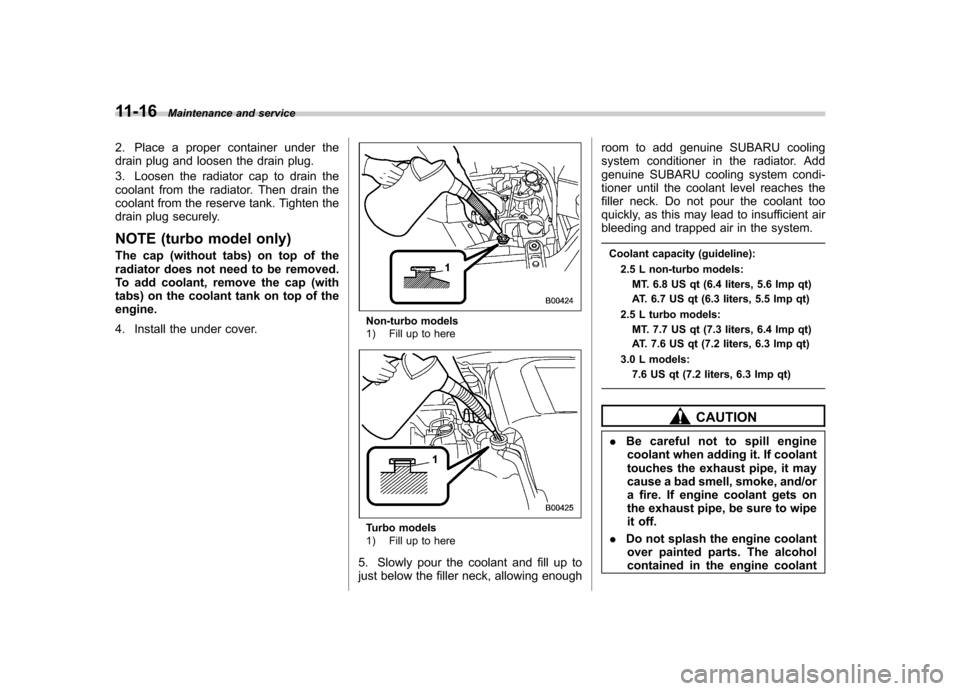
Non-turbo models
1) Fill up to here
Turbo models
1) Fill up to here
5. Slowly pour the coolant and fill up to
just below the filler neck, allowing enough room to add genuine SUBARU cooling
system conditioner in the radiator. Add
genuine SUBARU cooling system condi-
tioner until the coolant level reaches the
filler neck. Do not pour the coolant too
quickly, as this may lead to insufficient air
bleeding and trapped air in the system.
Coolant capacity (guideline): 2.5 L non-turbo models:MT. 6.8 US qt (6.4 liters, 5.6 Imp qt)
AT. 6.7 US qt (6.3 liters, 5.5 Imp qt)
2.5 L turbo models: MT. 7.7 US qt (7.3 liters, 6.4 Imp qt)
AT. 7.6 US qt (7.2 liters, 6.3 Imp qt)
3.0 L models: 7.6 US qt (7.2 liters, 6.3 Imp qt)
CAUTION
. Be careful not to spill engine
coolant when adding it. If coolant
touches the exhaust pipe, it may
cause a bad smell, smoke, and/or
a fire. If engine coolant gets on
the exhaust pipe, be sure to wipe
it off.
. Do not splash the engine coolant
over painted parts. The alcohol
contained in the engine coolant
Page 378 of 447
11-28Maintenance and service
.Be careful not to spill power
steering fluid when adding it. If
power steering fluid touches the
exhaust pipe, it may cause a bad
smell, smoke, and/or a fire. If
power steering fluid gets on the
exhaust pipe, be sure to wipe itoff.
The power steering fluid expands greatly
as its temperature rises; the fluid level
differs according to fluid temperature.
Therefore, the reservoir tank has two
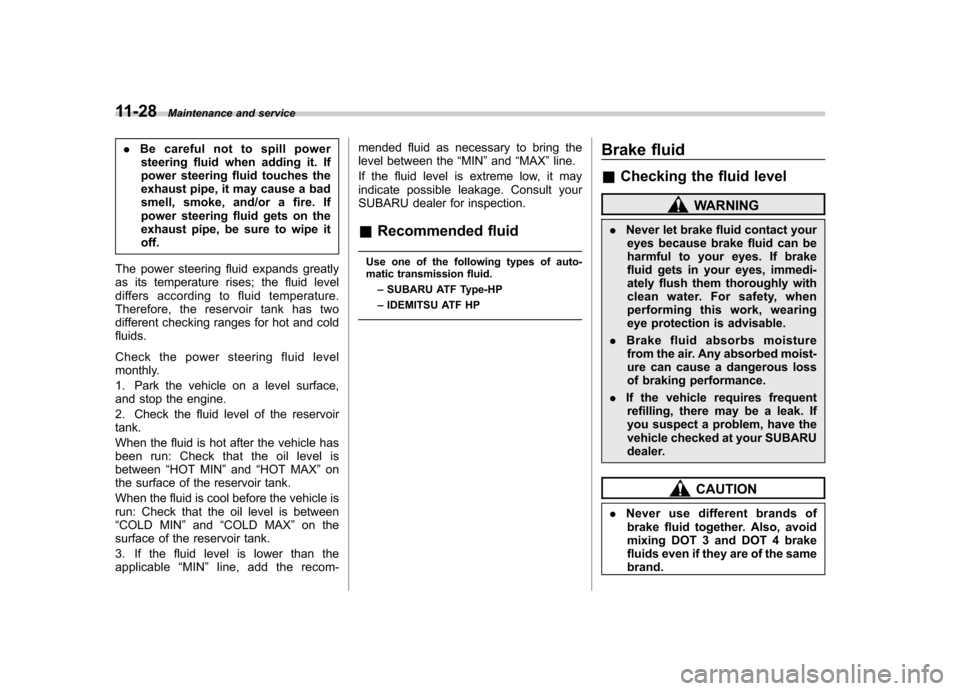
different checking ranges for hot and coldfluids.
Check the power steering fluid level
monthly.
1. Park the vehicle on a level surface,
and stop the engine.
2. Check the fluid level of the reservoir tank.
When the fluid is hot after the vehicle has
been run: Check that the oil level isbetween “HOT MIN ”and “HOT MAX ”on
the surface of the reservoir tank.
When the fluid is cool before the vehicle is
run: Check that the oil level is between“ COLD MIN ”and “COLD MAX ”on the
surface of the reservoir tank.
3. If the fluid level is lower than the
applicable “MIN ”line, add the recom- mended fluid as necessary to bring the
level between the
“MIN ”and “MAX ”line.
If the fluid level is extreme low, it may
indicate possible leakage. Consult your
SUBARU dealer for inspection.
& Recommended fluid
Use one of the following types of auto-
matic transmission fluid. –SUBARU ATF Type-HP
– IDEMITSU ATF HP Brake fluid &
Checking the fluid level
WARNING
. Never let brake fluid contact your
eyes because brake fluid can be
harmful to your eyes. If brake
fluid gets in your eyes, immedi-
ately flush them thoroughly with
clean water. For safety, when
performing this work, wearing
eye protection is advisable.
. Brake fluid absorbs moisture
from the air. Any absorbed moist-
ure can cause a dangerous loss
of braking performance.
. If the vehicle requires frequent
refilling, there may be a leak. If
you suspect a problem, have the
vehicle checked at your SUBARU
dealer.
CAUTION
. Never use different brands of
brake fluid together. Also, avoid
mixing DOT 3 and DOT 4 brake
fluids even if they are of the samebrand.
Page 379 of 447
.When adding brake fluid, be care-
ful not to allow any dirt into the
reservoir.
. Never splash the brake fluid over
painted surfaces or rubber parts.
Alcohol contained in the brake
fluid may damage them.
. Be careful not to spill brake fluid
when adding it. If brake fluid
touches the exhaust pipe, it may
cause a bad smell, smoke, and/or
a fire. If brake fluid gets on the
exhaust pipe, be sure to wipe itoff.
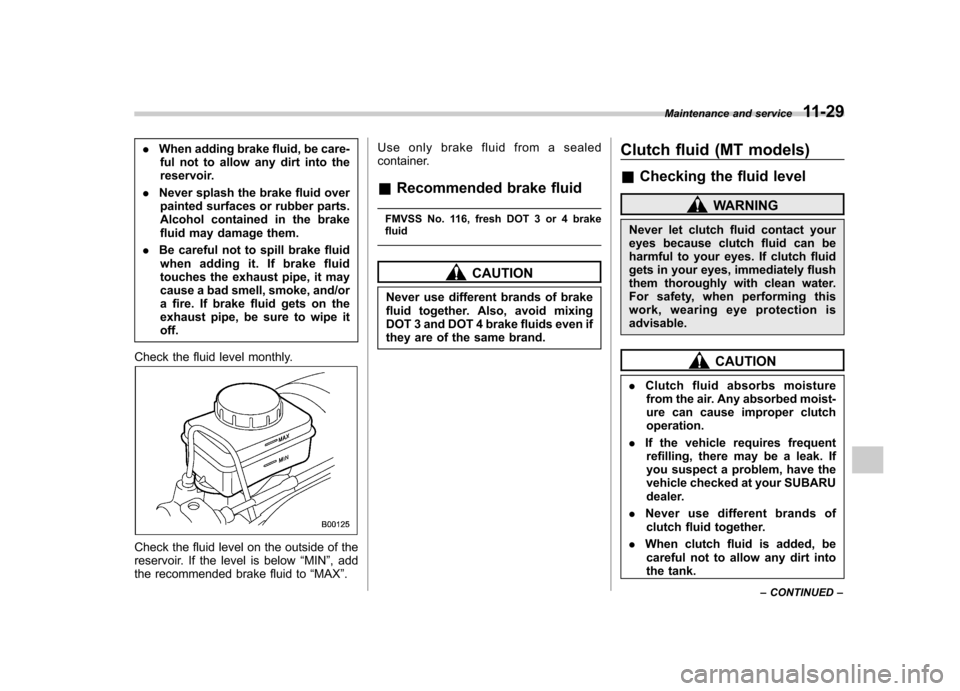
Check the fluid level monthly.
Check the fluid level on the outside of the
reservoir. If the level is below “MIN ”, add
the recommended brake fluid to “MAX ”. Use only brake fluid from a sealed
container.
& Recommended brake fluid
FMVSS No. 116, fresh DOT 3 or 4 brake fluid
CAUTION
Never use different brands of brake
fluid together. Also, avoid mixing
DOT 3 and DOT 4 brake fluids even if
they are of the same brand. Clutch fluid (MT models) &
Checking the fluid level
WARNING
Never let clutch fluid contact your
eyes because clutch fluid can be
harmful to your eyes. If clutch fluid
gets in your eyes, immediately flush
them thoroughly with clean water.
For safety, when performing this
work, wearing eye protection isadvisable.
CAUTION
. Clutch fluid absorbs moisture
from the air. Any absorbed moist-
ure can cause improper clutchoperation.
. If the vehicle requires frequent
refilling, there may be a leak. If
you suspect a problem, have the
vehicle checked at your SUBARU
dealer.
. Never use different brands of
clutch fluid together.
. When clutch fluid is added, be
careful not to allow any dirt into
the tank. Maintenance and service
11-29
– CONTINUED –
Page 416 of 447

Fuse
panel Fuse
rating Circuit
13 20A .Cargo socket
14 15A .Position light
. Tail light
. Rear combination light
15 Empty
16 10A .Illumination
17 15A .Seat heaters
18 10A .Back-up light
19 7.5A .Headlight right side re-
lay
20 10A .Cigarette lighter socket
21 7.5A .Starter relay
22 15A .Air conditioner
. Rear window defogger
relay coil
23 15A .Rear wiper
. Rear window washer
24 15A .Audio unit
. Clock
25 15A .SRS airbag system
26 7.5A .Power window relay
27 15A .Blower fan Fuse
panel Fuse
rating Circuit
28 15A .Blower fan
29 15A .Fog light
30 30A .Front wiper
. Front wiper washer
31 7.5A .Auto air conditioner unit
. Integrated unit
32 7.5A .Headlight left side relay
33 7.5A .ABS/Vehicle dynamics
control unit Specifications
12-7
– CONTINUED –
Page 417 of 447
12-8Specifications
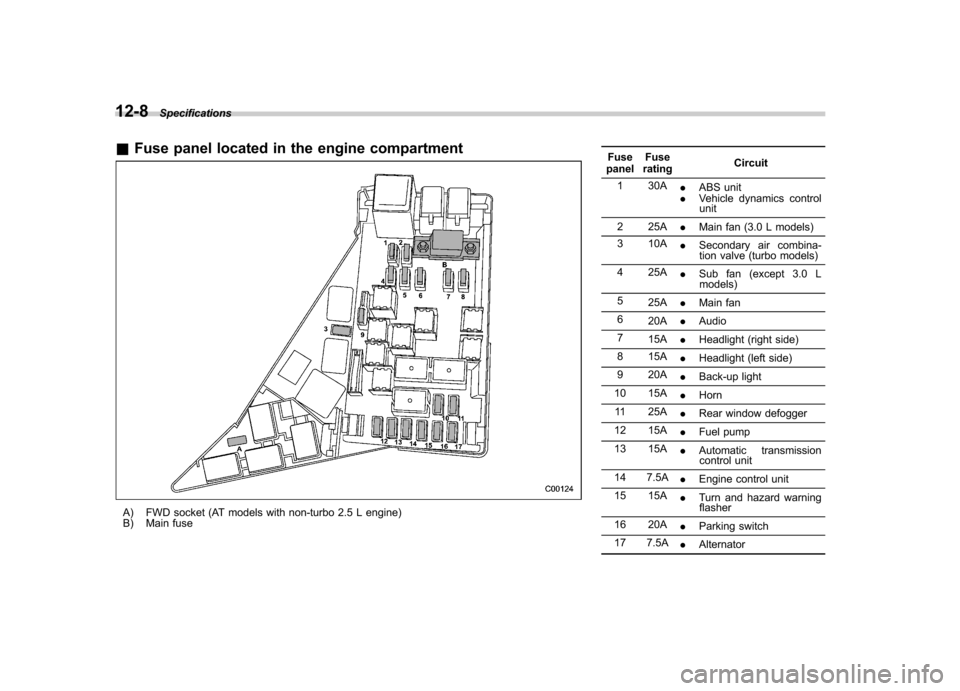
&Fuse panel located in the engine compartment
A) FWD socket (AT models with non-turbo 2.5 L engine)
B) Main fuse Fuse
panel Fuse
rating Circuit
1 30A .ABS unit
. Vehicle dynamics control
unit
2 25A .Main fan (3.0 L models)
3 10A .Secondary air combina-
tion valve (turbo models)
4 25A .Sub fan (except 3.0 L
models)
5 25A .Main fan
6 20A .Audio
7 15A .Headlight (right side)
8 15A .Headlight (left side)
9 20A .Back-up light
10 15A .Horn
11 25A .Rear window defogger
12 15A .Fuel pump
13 15A .Automatic transmission
control unit
14 7.5A .Engine control unit
15 15A .Turn and hazard warning
flasher
16 20A .Parking switch
17 7.5A .Alternator
Page 436 of 447
14-2Index
A
ABS (Anti-lock Brake System) ..................................... 7-35
Warning light ................................................. 3-34, 7-36
Accessories ....................................................... 5-4, 11-49
Accessory power outlet ................................................. 6-9
Active head restraint ..................................................... 1-7
Air cleaner element ................................................... 11-17
Air conditioner ............................................................. 4-7
Air filtration system ..................................................... 4-13
Air flow selection .......................................................... 4-2
Alarm system ............................................................ 2-16
All-Wheel Drive warning light ....................................... 3-36
Aluminum wheel cleaning ............................................ 10-3
Aluminum wheels ...................................................... 11-40
Antenna system ........................................................... 5-2
Anti-lock Brake System (ABS) ..................................... 7-35
Arming the system ..................................................... 2-17
Armrest ..................................................................... 1-12
Ashtray ..................................................................... 6-11
AT OIL TEMP warning light ......................................... 3-33
Audio control button ................................................... 5-26
Audio set .................................................................... 5-5
Auto-dimming mirror/compass ...................................... 3-56
Automatic climate control system ................................... 4-7
Automatic transmission 4-speed ................................................................ 7-18
5-speed ................................................................ 7-24
Capacities ............................................................. 12-4
Fluid .................................................................... 11-22
Manual mode ................................................ 7-21, 7-27
Selector lever ................................................ 7-19, 7-25 Shift lock release
............................................ 7-24, 7-30
SPORT mode ........................................................ 7-23
Temperature warning light (AT OIL TEMP) ................. 3-33
Automatic/Emergency Locking Retractor (A/ELR) ........... 1-15
AUX unit operation ..................................................... 5-25
BBattery .................................................................... 11-46
Jump starting ......................................................... 9-10
Replacement (remote keyless entry system) .............. 2-11
Booster seat .............................................................. 1-34
Brake Booster ....................................................... 7-34, 11-30
Fluid ................................................................... 11-28
Pad and lining ...................................................... 11-32
Parking ....................................................... 7-45, 11-33
Pedal .................................................................. 11-31
System .................................................................. 7-34
Brake pedal Free play ............................................................. 11-31
Reserve distance .................................................. 11-31
Brake system ............................................................. 7-34
Warning light .......................................................... 3-35
Braking ..................................................................... 7-34
Tips ...................................................................... 7-34
Breaking-in of new brake pads and linings ................... 11-32
Bulb Chart .................................................................... 12-9
Replacing ............................................................ 11-50