2009 SUBARU FORESTER Vehicle dynamics control off
[x] Cancel search: Vehicle dynamics control offPage 237 of 384
7-28Starting and operating
a malfunction of the Vehicle Dynamics
Control system; if either should occur,
have an authorized SUBARU dealer carry
out an inspection of that system at the first
available opportunity. . The indicator light does not illuminate
when the ignition switch is turned to the
ON position. . The indicator light does not turn off
approximately 2 seconds after the ignition
switch has been turned to the ON position. ! Vehicle Dynamics Control warning
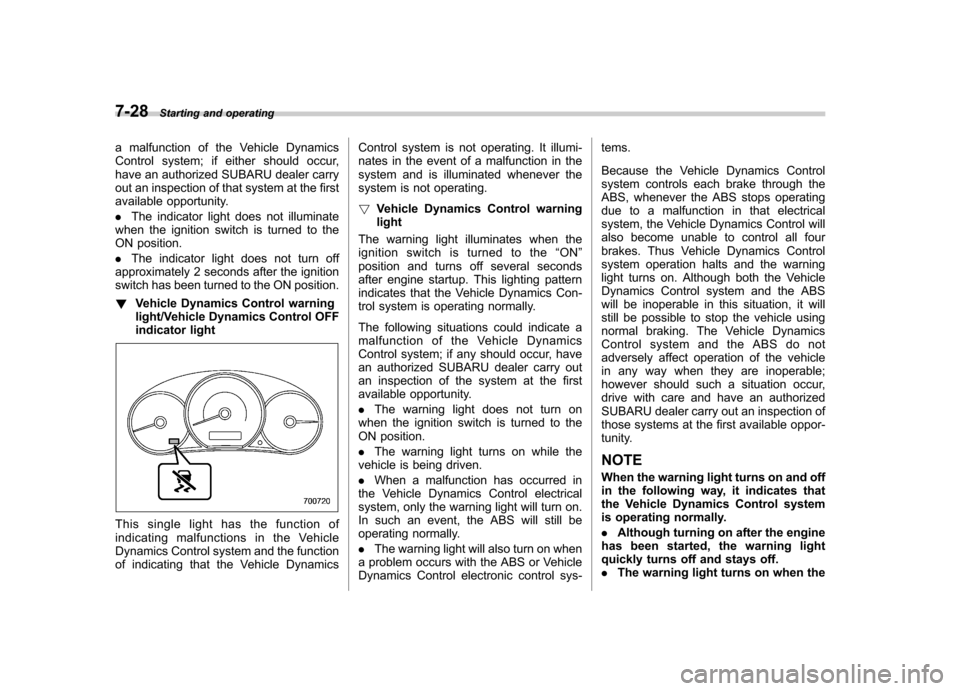
light/Vehicle Dynamics Control OFF
indicator light
This single light has the function of
indicating malfunctions in the Vehicle
Dynamics Control system and the function
of indicating that the Vehicle Dynamics Control system is not operating. It illumi-
nates in the event of a malfunction in the
system and is illuminated whenever the
system is not operating. !
Vehicle Dynamics Control warning light
The warning light illuminates when the
ignition switch is turned to the “ON ”
position and turns off several seconds
after engine startup. This lighting pattern
indicates that the Vehicle Dynamics Con-
trol system is operating normally.
The following situations could indicate a
malfunction of the Vehicle Dynamics
Control system; if any should occur, have
an authorized SUBARU dealer carry out
an inspection of the system at the first
available opportunity. . The warning light does not turn on
when the ignition switch is turned to the
ON position. . The warning light turns on while the
vehicle is being driven.. When a malfunction has occurred in
the Vehicle Dynamics Control electrical
system, only the warning light will turn on.
In such an event, the ABS will still be
operating normally. . The warning light will also turn on when
a problem occurs with the ABS or Vehicle
Dynamics Control electronic control sys- tems.
Because the Vehicle Dynamics Control
system controls each brake through the
ABS, whenever the ABS stops operating
due to a malfunction in that electrical
system, the Vehicle Dynamics Control will
also become unable to control all four
brakes. Thus Vehicle Dynamics Control
system operation halts and the warning
light turns on. Although both the Vehicle
Dynamics Control system and the ABS
will be inoperable in this situation, it will
still be possible to stop the vehicle using
normal braking. The Vehicle Dynamics
Control system and the ABS do not
adversely affect operation of the vehicle
in any way when they are inoperable;
however should such a situation occur,
drive with care and have an authorized
SUBARU dealer carry out an inspection of
those systems at the first available oppor-
tunity.
NOTE
When the warning light turns on and off
in the following way, it indicates that
the Vehicle Dynamics Control system
is operating normally. . Although turning on after the engine
has been started, the warning light
quickly turns off and stays off.. The warning light turns on when the
Page 238 of 384
vehicle is being driven; it then turns off
and stays off. !Vehicle Dynamics Control OFF in-
dicator light
This light illuminates to indicate that the
Vehicle Dynamics Control system is in
non-operation mode. This does not con-
stitute failure of the Vehicle Dynamics
Control system. NOTE . The indicator light may stay on for a
while after the engine has been started,
especially in cold weather. This occurs
because the engine has not yet
warmed up and is completely normal.
The light will turn off when the engine
has reached a suitable operating tem-perature.. When an engine problem occurs
and the CHECK ENGINE warning light/
malfunction indicator lamp turns on,
the indicator light will also illuminate.
The following two situations could indicate
malfunction of the Vehicle Dynamics
Control system; if either should occur,
have an authorized SUBARU dealer carry
out an inspection of that system at the first
available opportunity. . The indicator light does not turn on
when the ignition switch is turned to the ON position..
The indicator light fails to turn off after
the engine is started, even when several
minutes have passed to allow the engine
to heat up sufficiently.
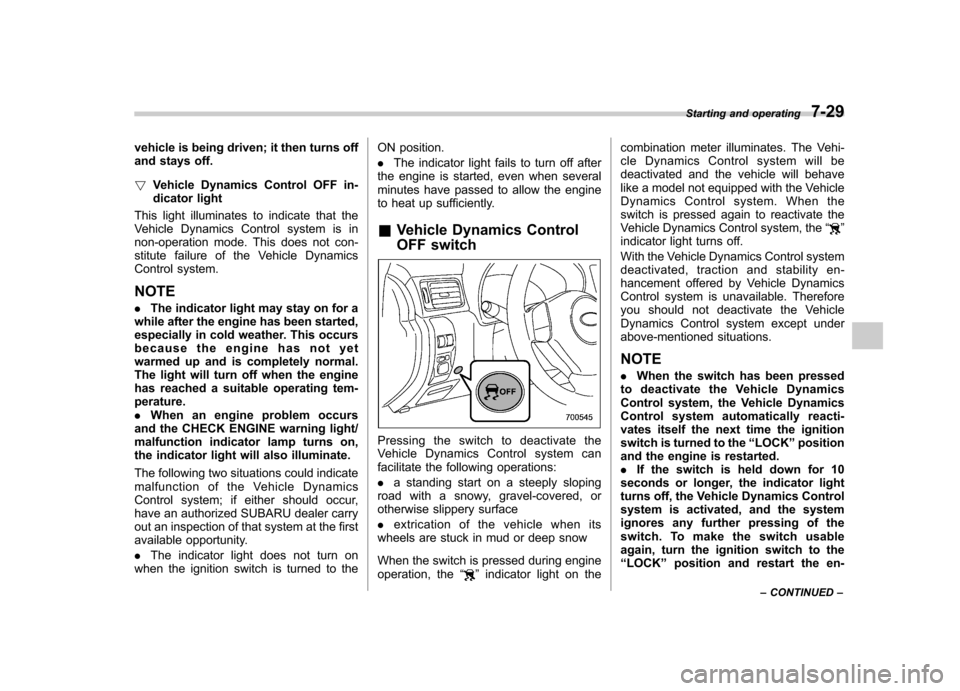
& Vehicle Dynamics Control
OFF switch
Pressing the switch to deactivate the
Vehicle Dynamics Control system can
facilitate the following operations: .a standing start on a steeply sloping
road with a snowy, gravel-covered, or
otherwise slippery surface . extrication of the vehicle when its
wheels are stuck in mud or deep snow
When the switch is pressed during engine
operation, the “
”indicator light on the combination meter illuminates. The Vehi-
cle Dynamics Control system will be
deactivated and the vehicle will behave
like a model not equipped with the Vehicle
Dynamics Control system. When the
switch is pressed again to reactivate the
Vehicle Dynamics Control system, the
“
”
indicator light turns off.
With the Vehicle Dynamics Control system
deactivated, traction and stability en-
hancement offered by Vehicle Dynamics
Control system is unavailable. Therefore
you should not deactivate the Vehicle
Dynamics Control system except under
above-mentioned situations.
NOTE . When the switch has been pressed
to deactivate the Vehicle Dynamics
Control system, the Vehicle Dynamics
Control system automatically reacti-
vates itself the next time the ignition
switch is turned to the “LOCK ”position
and the engine is restarted.. If the switch is held down for 10
seconds or longer, the indicator light
turns off, the Vehicle Dynamics Control
system is activated, and the system
ignores any further pressing of the
switch. To make the switch usable
again, turn the ignition switch to the“ LOCK ”position and restart the en-Starting and operating
7-29
– CONTINUED –
Page 239 of 384
7-30Starting and operating
gine. .Whentheswitchispressedto
deactivate the Vehicle Dynamics Con-
trol system, the vehicle ’s running per-
formance is comparable with that of a
vehicle that does not have a Vehicle
Dynamics Control system. Do not de-
activate the Vehicle Dynamics Control
system except when absolutely neces-
sary. Tire pressure monitoring
system (TPMS) (U.S.-spec.models)
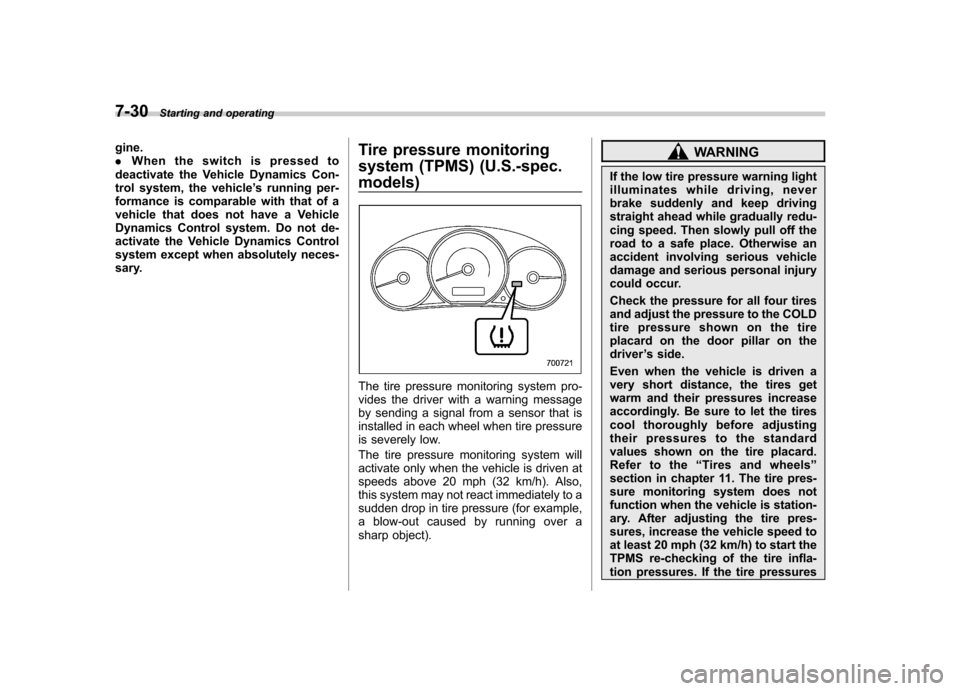
The tire pressure monitoring system pro-
vides the driver with a warning message
by sending a signal from a sensor that is
installed in each wheel when tire pressure
is severely low.
The tire pressure monitoring system will
activate only when the vehicle is driven at
speeds above 20 mph (32 km/h). Also,
this system may not react immediately to a
sudden drop in tire pressure (for example,
a blow-out caused by running over a
sharp object).
WARNING
If the low tire pressure warning light
illuminates while driving, never
brake suddenly and keep driving
straight ahead while gradually redu-
cing speed. Then slowly pull off the
road to a safe place. Otherwise an
accident involving serious vehicle
damage and serious personal injury
could occur.
Check the pressure for all four tires
and adjust the pressure to the COLD
tire pressure shown on the tire
placard on the door pillar on thedriver ’s side.
Even when the vehicle is driven a
very short distance, the tires get
warm and their pressures increase
accordingly. Be sure to let the tires
cool thoroughly before adjusting
their pressures to the standard
values shown on the tire placard.
Refer to the “Tires and wheels ”
section in chapter 11. The tire pres-
sure monitoring system does not
function when the vehicle is station-
ary. After adjusting the tire pres-
sures, increase the vehicle speed to
at least 20 mph (32 km/h) to start the
TPMS re-checking of the tire infla-
tion pressures. If the tire pressures
Page 256 of 384
winter driving, stop when and where it is
safe to do so and check under the fenders
periodically. !Parking in cold weather
Do not use the parking brake when
parking for long periods in cold weather
since it could freeze in that position.
Instead, observe the following.
1. Place the shift lever in “1 ” or “R ” for
manual transmission vehicles, and in “P ”
for automatic transmission vehicles.
2. Use tire stops under the tires to
prevent the vehicle from moving.
When the vehicle is parked in snow or
when it snows, raise the wiper blades off
the glass to prevent damage to them.
When the vehicle has been left parked
after use on roads heavily covered with
snow, or has been left parked during a
snowstorm, icing may develop on the
brake system, which could cause poor
braking action. Check for snow or ice
buildup on the suspension, disc brakes
and brake hoses underneath the vehicle.
If there is caked snow or ice, remove it,
being careful not to damage the disc
brakes and brake hoses and ABS har-ness.WARNING
Snow can trap dangerous exhaust
gases under your vehicle. Keep
snow clear of the exhaust pipe and
from around your vehicle if you park
the vehicle in snow with the enginerunning.
! Refueling in cold weather
To help prevent moisture from forming in
the fuel system and the risk of its freezing,
use of an antifreeze additive in the fuel
tank is recommended during cold weather.
Use only additives that are specifically
designed for this purpose. When an
antifreeze additive is used, its effect lasts
longer if the tank is refilled whenever the
fuel level reaches half empty.
If your SUBARU is not going to be used
for an extended period, it is best to have
the fuel tank filled to capacity. & Driving on snowy and icy roads
To prevent skidding and slipping, avoid
sudden braking, abrupt acceleration, high-
speed driving, and sharp turning when
driving on snowy or icy roads.
Always maintain ample distance between
your vehicle and the vehicle ahead of you to avoid the need for sudden braking.
To supplement the foot brake, use the
engine brake effectively to control the
vehicle speed. (Shift into a lower gear
when necessary.)
Avoid shifting down abruptly. Such beha-
vior can cause the wheels to lock, possibly
leading to loss of vehicle control.
An anti-lock brake system (ABS) en-
hances your vehicle
’s braking perfor-
manceonsnowyandicyroads.For
information on braking on slippery sur-
faces, refer to the “ABS (Anti-lock Brake
System) ”and “Vehicle Dynamics Control
system ”sections in chapter 7.
WARNING
Do not use the cruise control on
slippery roads such as snowy or icy
roads. This may cause loss of
vehicle control. Driving tips
8-9
– CONTINUED –
Page 376 of 384

Fuel........................................................................... 7-2
Economy hints ......................................................... 8-2
Filler lid and cap ...................................................... 7-3
Gauge .................................................................... 3-8
Requirements .......................................................... 7-2
Fuses ...................................................................... 11-44
Fuses and circuits ...................................................... 12-6
G
GAWR (Gross Axle Weight Rating) .............................. 8-13
Glove box ................................................................... 6-5
GVWR (Gross Vehicle Weight Rating) .......................... 8-13
H
Hazard warning flasher ........................................... 3-5, 9-2
Head restraint adjustment
Front seat ............................................................... 1-5
Rearseat ................................................................. 1-7
Headlight
Beam lever ........................................................... 3-26
Flasher ................................................................. 3-25
Indicator light ......................................................... 3-21
Headlights ........................................................ 3-24, 11-47
Heater operation (manual climate control system) ............ 4-5
High beam indicator light ............................................ 3-20
High/low beam change (dimmer) .................................. 3-25
Hill start assist (MT vehicles) .............................. 7-33, 11-29
Hill start assist warning light ................................ 3-17, 7-34
Horn ......................................................................... 3-38
Hose and connections ............................................... 11-12 I
Ignition switch
............................................................. 3-3
Light ...................................................................... 3-5
Illuminated entry .......................................................... 2-9
Illumination brightness control ...................................... 3-26
Immobilizer ................................................................. 2-2
Indicator light (security indicator light) ................. 2-3, 3-19
Indicator light Coolant temperature low .......................................... 3-13
Cruise control ................................................ 3-20, 7-37
Cruise control set ........................................... 3-21, 7-38
Front fog light ......................................................... 3-21
Headlight ............................................................... 3-21
High beam ............................................................. 3-20
Immobilizer ............................................................. 2-3
Security .......................................................... 2-3, 3-19
Selector lever/Gear position ..................................... 3-20
SPORT mode ........................................................ 3-20
Traction control system OFF .................................... 3-18
Turn signal ............................................................ 3-20
Vehicle Dynamics Control OFF ......................... 3-19, 7-28
Vehicle Dynamics Control operation .................. 3-18, 7-27
Information display ...................................................... 3-22
Inside mirror .............................................................. 3-33
Interior lights ............................................................... 6-2
J
Jack handle ............................................................... 9-17
Jump starting .............................................................. 9-9 Index
14-5
Page 380 of 384

TireChains .................................................................. 8-11
Inspection ............................................................ 11-33
Pressures and wear .............................................. 11-33
Replacement ........................................................ 11-37
Rotation ............................................................... 11-36
Types .................................................................. 11-31
Tire pressure monitoring system (TPMS) .......................................... 3-14, 7-30, 9-8, 11-31
Tires ......................................................................... 12-5
Tires and wheels. ...................................................... 11-31
Top tether anchorages ........................................ 1-29, 1-32
Towing ...................................................................... 9-12
All wheels on the ground ........................................ 9-15
Flat-bed truck ........................................................ 9-15
Tie-down hooks ..................................................... 9-12
Weight.................................................................. 8-16
Traction Control system OFF indicator light .................................................. 3-18
Trailer
Connecting ............................................................ 8-14
Hitch .................................................................... 8-14
Hitches ................................................................. 8-19
Towing .................................................................. 8-16
Towing tips ............................................................ 8-21
Turn signal Indicator lights ....................................................... 3-20
Lever .................................................................... 3-26 U
Under-floor storage compartment
.................................. 6-14
V
Valet mode ................................................................ 2-16
Vanity mirror ............................................................... 6-4
Vehicle Capacity weight ...................................................... 8-12
Identification ........................................................ 12-10
Symbols .................................................................... 3
Vehicle Dynamics Control
OFF indicator light .................................................. 7-28
OFF switch ............................................................ 7-29
Operation indicator light ................................... 3-18, 7-27
System .................................................................. 7-26
Warning light .................................................. 3-18, 7-28
Ventilator .................................................................... 4-2
W
Warning and indicator lights .......................................... 3-9
Warning light
ABS.............................................................. 3-15, 7-23
All-Wheel Drive ...................................................... 3-17
Anti-lock Brake System ........................................... 3-15
AT OIL TEMP ......................................................... 3-14
Brake system ......................................................... 3-16
Charge .................................................................. 3-13
CHECK ENGINE .................................................... 3-12
Coolant temperature high ........................................ 3-13
Door open ............................................................. 3-17
Hill start assist ............................................... 3-17, 7-33 Index
14-9