2009 SKODA SUPERB ABS
[x] Cancel search: ABSPage 200 of 294

Intelligent Technology
199
Using the system
Safety
Driving Tips
General Maintenance
Breakdown assistance
Technical Data
Tyre inflation pressu
re-control system*
The tyre inflation pressure-control system compares with the aid of the ABS sensors the speed and also the rolling circumference
of the individual wheels. If the rolling
circumference of a wheel is changed, the warning light°
lights up in the instru-
ment cluster
⇒page 39. The rolling circumference of the tyre can change if:
•
the tyre inflation pressure is too low,
•
the structure of the tyre is damaged,
•
the vehicle is loaded on one side,
•
the wheels of an axle are loaded heavily (e.g. when towing a trailer or when
driving uphill or downhill),•
snow chains are mounted,
•
the temporary spare wheel is mounted,
•
one wheel per axle was changed.
Basic setting of tyre inflation pressure-control system After changing the tyre inflation pressures or after changing one or several wheels, a basic setting of the system must be carried out as follows.•
Inflate all tyres to the specified inflation pressure
⇒page 235.
•
Switch on the ignition.
•
Press button
⇒fig. 192
for more than 2 seconds. While pressing the
button, the warning light
lights up. At the same time the memory of the system
is erased and the new calibration is star
ted, which is confirmed with an audible
signal and then the warning light
goes out.
•
If the warning light
does not go out after the basic setting, there is a fault in
the system. Have the vehicle inspected by your nearest specialist garage. Warning light
lights up
If the tyre inflation pressure of at least on
e wheel is insufficiently inflated in compar-
ison to the stored basic value, the warning light
⇒
lights up.
Warning light
flashes
If the warning light flashes, there is a system fault. Have the vehicle inspected by your nearest specialist garage.
WARNING
•
When the warning light
lights up, immediately reduce the speed and
avoid sudden steering and brake mano
euvres. Please stop the vehicle
without delay at the nearest possible stop and inspect the tyres and their inflation pressures.•
The driver is responsible for the correc
t tyre inflation pressures. For this
reason, the tyre inflation pressures must be checked regularly.•
Under certain circumstances (e.g. sporty style of driving, wintry or
unpaved roads) the warning light
can be delayed or does not light up at
all.•
The tyre inflation pressure-control system does not take away the
responsability from the driver for the correct tyre inflation pressure.
Note
The tyre inflation pressure-control system:•
does not replace the regular tyre inflatio
n pressure control, because the system
cannot detect an even pressure loss,•
cannot warn in case of very rapid tyre inflation pressure loss, e.g. in case of
sudden tyre damage. In this
case carefully bring the vehi
cle to a standstill without
sudden steering movements and without sharp braking.
Fig. 192 Button for setting the tyre inflation pressure control value
s2dk.1.book Page 199 Wednesday, April 8, 2009 12:23 PM
Page 218 of 294

Taking care of your vehicle and cleaning the vehicle
217
Using the system
Safety
Driving Tips
General Maintenance
Breakdown assistance
Technical Data
Severe soiling – Clean severely soiled areas with
a cloth dipped in a mild soapy solu-
tion (2 spoonfuls of natural
soap to 1 litre of water).
– Ensure that the leather is not soaked through at any point and that no
water gets into the stitching of the seams.
– Dry off the leather with a soft, dry cloth. Removing stains – Remove fresh stains which are
water-based
(e.g. coffee, tea, juices,
blood etc.) with an absorbent cloth or household paper or use the cleaner from the care set for a
stain which has already dried in.
– Remove fresh stains on a
fat base
(e.g. butter, mayonnaise, chocolate
etc.) with an absorbent cloth or household cleaning paper or with the cleaner from the care set if the stain has not yet penetrated into the surface.
– Use a grease dissolver for
grease stains which have dried in
.
–Eliminate
special stains
(e.g. ball-point pens, felt pen, nail varnish,
dispersion paint, shoe cream etc.) with a special stain remover suit-able for leather.
Leather care – Treat the leather every six months with the leather care product avail-
able from an authorised Škoda Service Partner.
– Apply only a small amount of the care product. – Dry the leather off with a soft clothIt is best to consult an authorised Škod
a Service Partner if you have any questions
regarding cleaning and care of the
leather interior in your vehicle.
Caution
•
You must on no account treat the leathe
r with solvents (e.g. gasoline, turpen-
tine), floor wax, shoe cream or such like.•
Avoid leaving your vehicle for lengthy pe
riods in bright sunlight in order to
avoid bleaching the leather. If you leave yo
ur vehicle parked in the open for lengthy
periods, protect the leather from the direct
rays of the sun by covering it over.
•
Sharp-edged objects on items of clothing such as zip fasteners, rivets, sharp-
edged belts may leave permanent scratches or signs of rubbing on the surface.
Note
•
Use a care cream with light blocker and impregnation effect regularly and each
time after cleaning the leather. The cream no
urishes the leather, allows it to breathe
and keeps it supple and also provides moisture. It also creates surface protection.•
Clean the leather every 2 to 3 months, remove fresh soiling each time this
occurs.•
Remove fresh stains such as those from
ball-point pens, ink, lipstick, shoe
cream etc., as quickly as possible.•
Care also for the leather dye. Refreshen
areas which have lost their colour with
a special coloured leather cream as required.•
The leather is a natural material with specific properties. During the use of the
vehicle, minor optical change
s can occur on the leather parts of the covers (e. g
wrinkles or creases as a result of the stress of the covers).Seat belts– Keep the seat belts clean! – Wash seat belts which have become
soiled using a mild soapy solu-
tion.
– Inspect the seat belts regularly to
ensure they are in good condition.
Belt webbing which has become severely so
iled may prevent the inertia reel from
reeling up the belt properly.
s2dk.1.book Page 217 Wednesday, April 8, 2009 12:23 PM
Page 224 of 294

Inspecting and replenishing
223
Using the system
Safety
Driving Tips
General Maintenance
Breakdown assistance
Technical Data
WARNING
•
Never open the bonnet if you see that steam or coolant is flowing out of
the engine compartment - risk of scaldi
ng! Wait long enough until the steam
or coolant has stopped escaping.•
For safety reasons, the bonnet must always be properly closed when
driving. One should therefore check that
the lock has in fact engaged prop-
erly after closing the bonnet.•
Stop your vehicle immediately while driv
ing if you notice that the lock is
not properly engaged and close the bonne
t properly - risk of an accident!
Caution
Ensure that the arms of the windscreen
wipers are correctly
in place against the
windscreen before opening the bonnet otherwise damage could occur to the paintwork.Working in the engine compartment Particular care is required when carrying out any work in the engine compartment!There is a risk of injuries, scalding,
accidents and fire when working in the
engine compartment, e.g. inspecting and replenishing oil and other fluids. For this reason, it is essential to comply with the warning instructions stated below and with the general applicable
rules of safety. The engine compart-
ment of your car is a hazardous area
⇒
.
WARNING
•
Never open the bonnet if you see that steam or coolant is flowing out of
the engine compartment - risk of scaldi
ng! Wait long enough until the steam
or coolant has stopped escaping.•
Switch off the engine and pull out the ignition key.
•
Apply the handbrake firmly.
•
If your vehicle is fitted with a ma
nual gearbox, move the gearshift lever
into Neutral, or if it is fitted with
automatic gearbox, move the selector lever
into position P.•
Allow the engine to cool down.
•
Keep children clear of the engine compartment.
•
Never spill oil and other fluids over the hot engine. Such fluids (e.g. the
antifreeze contained in the coolant) may ignite!•
Avoid short circuits in the electrical system - particularly on the battery.
•
Never place your hand into the radiator fan as long as the engine is still
warm. The fan might suddenly start running!•
Never open the cap of the coolant expa
nsion bottle as long
as the engine
is still warm. The cooling system is pressurized!•
Cover over the cap of the coolant expansion reservoir with a large cloth
when opening it as protection for your
face, hands and arms from hot steam
or hot coolant.•
Do not let objects, such as e.g cleani
ng cloth or tools lie in the engine
compartment.•
If you wish to work under the vehicle, you must secure the vehicle from
rolling away and support it with suitable supporting blocks: the car jack is not sufficient for this - risk of injury!•
In cases where it be necessary to carry out inspection work when the
engine is running there is an additional risk from rotating parts (e.g. the V- ribbed belt, alternator, radiator fan) and from the high-voltage ignition system. Please observe in addition the following.
− Never touch the electrical cabl
es of the ignition system.
− Absolutely avoid any jewellery, loose items of clothing or long hair from getting into the rotating parts of the engine - Hazard! Therefore remove any jewellery beforehand, tie up your hair and wear tight fitting clothing.
•
Please also comply with the warnin
g instructions stated below when
carrying out any essential work on th
e fuel system or on the electrical
system.
WARNING (continued)
s2dk.1.book Page 223 Wednesday, April 8, 2009 12:23 PM
Page 230 of 294
Inspecting and replenishing
229
Using the system
Safety
Driving Tips
General Maintenance
Breakdown assistance
Technical Data
The brake fluid reservoir is located on
the left of the engine compartment.
The brake fluid reservoir on right-hand
steering models is positioned on
the other side of the engine compartment. – Switch the engine off. – Open the bonnet
⇒
page 223, “Working in the engine compartment”.
– Inspect the brake fluid level in the reservoir
⇒
page 228, fig. 205
. The
level must be between the “MIN” and “MAX” markings.
A slight drop in the fluid level results when driving due to normal wear-and-tear and automatic adjustment of the br
ake pads, and is perfectly normal.
There may be an indication of a leak in the brake system, however, if the fluid level drops significantly within a short time or if it drops below the “MIN” marking. A situ- ation where the brake fluid level is too low is indicated by the warning light
lighting up in the instrument cluster
⇒page 41. In this case
stop immediately and
do not drive any further! Obtain professional assistance.
WARNING
•
Read and observe the warning notes
⇒page 223 before working in the
engine compartment.•
If the fluid level has dropped below the MIN marking, do not drive any
further - risk of accident! Obtain professional assistance.Replacing brake fluidBrake fluid absorbs moisture. This causes the fluid to absorb moisture from the surrounding air over a period of time. Excessive water in the brake fluid may be the cause of corrosion in the brake system. Th
e water content also lowers the boiling
point of the brake fluid.
This is why brake fluid mu
st be replaced every two
years. One may only use new genuine brake fluid
from Škoda Auto. The specification for
the brake fluid is “FMVSS 116 DOT 4”.
We recommend that you have th
e brake fluid replaced by an
authorised Škoda
Service Partner
as part of an Inspection Service.
WARNING
•
Using old brake fluid can result in seve
re stress on the brakes because of
the formation of vapour bubbles in th
e brake system. This greatly impairs
the braking efficiency and thus al
so the safety of your vehicle.
•
Brake fluid is toxic! It must therefor
e be kept safely in closed original
containers and well away from children and unauthorized persons.
Caution
Brake fluid damages the paintwork of the vehicle.
For the sake of the environment
In view of the problems involved with prop
er disposal of brak
e fluid, the special
tools and the professional knowledge required, you should have the brake fluid replaced by authorised Škoda Service Partners.BatteryWorking on the battery
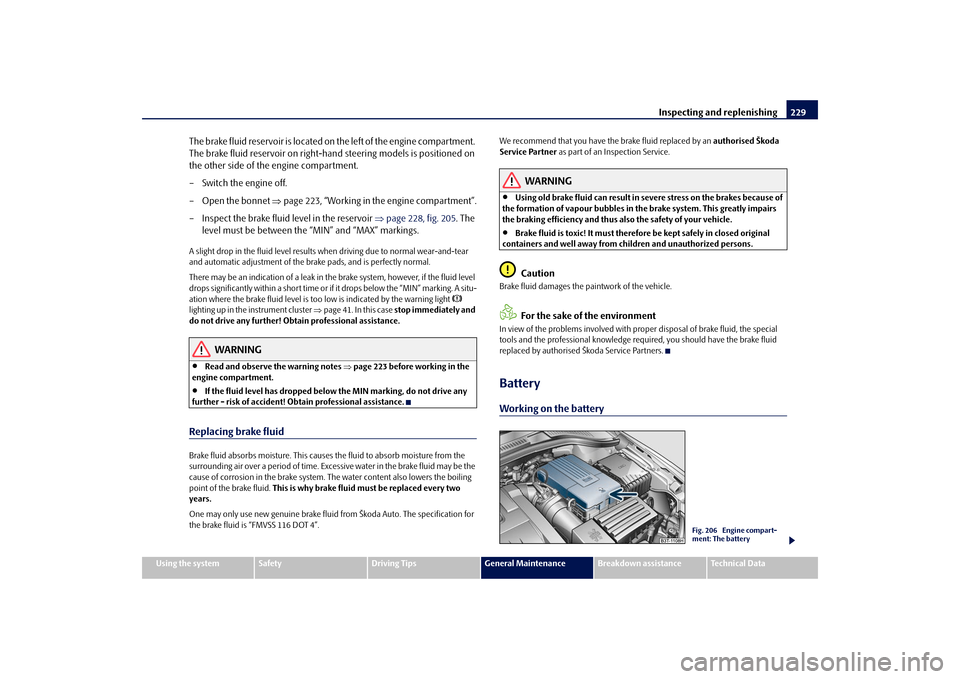
Fig. 206 Engine compart- ment: The battery
s2dk.1.book Page 229 Wednesday, April 8, 2009 12:23 PM
Page 258 of 294

Fuses and light bulbs
257
Using the system
Safety
Driving Tips
General Maintenance
Breakdown assistance
Technical Data
Fuse cover in engine compartment The fuse box in the engine comp
artment exists in two different
versions. You can determine which version your vehicle is fitted with after removing the fuse cover at the location of the fuses.On some vehicles, the battery cover
must be removed before removing
the fuse cover
⇒
page 229.
Removing fuse cover – Move the circlips
⇒
fig. 229
as far as the stop, the symbol
appears behind the circlip and remove the cover.
Installing fuse cover – Position the fuse cover on the fuse box and push the circlips as far
as the stop - the symbol
is visible behind the circlip.
Caution
•
When unlocking and locking the fuse cover,
it must be pressed on the sides to
the box, otherwise damage can
occur to the locking mechanism.
•
Carefully position the fuse cover in th
e engine compartment. If the cover was
not correctly positioned, water can get into
the fuses and this results in a damage
to the vehicle!
Fuse assignment in engine compartment - version 1Certain electrical components are only standard on certain vehicle model versions or only suppliable as optional
equipment for certain models.
Fig. 229 Fuse cover in engine compartment
AA
AA
No.
Power consumer
Amperes
F1
Front right main headlight, right rear light unit
30
F2
Valves for ABS
20
F3
Not assigned
F4
Not assigned
F5
Horn
15
F6
Not assigned
F7
Not assigned
F8
Not assigned
F9
Valves
10
F10
Not assigned
F11
Lambda probe
10
Fig. 230 Schematic repre-sentation of fuse box in engine compartment - version 1
s2dk.1.book Page 257 Wednesday, April 8, 2009 12:23 PM
Page 259 of 294

Fuses and light bulbs
258
F12
Lambda probe
10
F13
Control unit for automatic gearbox
15
F14
Not assigned
F15
Coolant pump
10
F16
Not assigned
F17
Instrument cluster, windshield
wiper lever and turn sig-
nal light lever
5
F18
Audio amplifier (sound system)
30
F19
Radio
15
F20
Phone
5
F21
Not assigned
F22
Not assigned
F23
Engine control unit
10
F24
Control unit for CAN databus
5
F25
Not assigned
F26
Not assigned
F27
Valve for fuel dosing
15
F28
Engine control unit
15/25
F29
Main relay
5
F30
Control unit for auxiliary heating
20
F31
Front window wiper
30
F32
Not assigned
F33
Not assigned
F34
Not assigned
F35
Not assigned
No.
Power consumer
Amperes
F36
Not assigned
F37
Not assigned
F38
Radiator fan, valves
10
F39
Not assigned
F40
Not assigned
F41
Not assigned
F42
Not assigned
F43
Ignition
30
F44
Not assigned
F45
Not assigned
F46
Not assigned
F47
Front left main headlight, left rear light unit
30
F48
Pump for ABS
40
F49
Power supply for terminal 15 (ignition on)
50
F50
Not assigned
F51
Not assigned
F52
Power supply relay - terminal X
a)
40
F53
Accessory equipment
50
F54
Not assigned
a)In order not to drain the battery unnecessarily when starting the engine, the electrical com- ponents of this terminal are automatically switched off.No.
Power consumer
Amperes
s2dk.1.book Page 258 Wednesday, April 8, 2009 12:23 PM
Page 260 of 294

Fuses and light bulbs
259
Using the system
Safety
Driving Tips
General Maintenance
Breakdown assistance
Technical Data
Fuse assignment in engine compartment - version 2Certain electrical components are only standard on certain vehicle model versions or only suppliable as optional equipment for certain models.No.
Power consumer
Amperes
F1
Not assigned
F2
Control unit for automatic gearbox DQ200
30
F3
Measuring circuit
5
F4
Va lve s for AB S
30/20
F5
Control unit for automatic gearbox DQ250
15
F6
Instrument cluster, windshield
wiper lever and turn sig-
nal light lever
5
F7
Power supply for terminal 15 (ignition on)
40
F8
Radio
15
F9
Phone
5
F10
Engine control unit, Main relay
5/10
Fig. 231 Schematic repre- sentation of fuse box in engine compartment - version 2
F11
Control unit for auxiliary heating
20
F12
Control unit for CAN databus
5
F13
Engine control unit
15/20/30
F14
Ignition
20
F15
Lambda probe (petrol engine) Glow plug system relay and
fuel pump (diesel engine)
10 5
F16
Front right main headlight, right rear light unit
30
F17
Horn
15
F18
Audio amplifier (sound system)
30
F19
Front window wiper
30
F20
Valve for fuel dosing water pump
2010
F21
Lambda probe
10/15
F22
Not assigned
F23
Relay ValvesHigh pressure pump
51015
F24
Fa n
10
F25
Pump for ABS
30/40
F26
Left main headlight
30
F27
Control unit for glow plug system
50
F28
Windscreen heater
50
F29
Accessory equipment
50
F30
Power supply relay - terminal X
a)
50
a)In order not to drain the battery unnecessarily
when starting the engine, the electrical com-
ponents of this terminal are automatically switched off.No.
Power consumer
Amperes
s2dk.1.book Page 259 Wednesday, April 8, 2009 12:23 PM
Page 261 of 294

Fuses and light bulbs
260
Fuse assignment in the dash panelCertain electrical components are only st
andard on certain vehicle model versions
or only suppliable as optional
equipment for certain models.
No.
Power consumer
Amperes
1
Diagnostic socket, engine control unit, fuel pump relay, fuel pump control unit
7,5
2
Control unit for ABS, ESP, switch for tyre air pressure control, brake sensor
5
3
Switch and control unit for airbag
5
4
WIV, parking light, dimming mirrors, pressure sensor, telephone preinstallation
5
5
Control unit for headlamp beam adjustment and head- light swivel, control unit for parking aid, control unit for park assist
5
6
Instrument cluster, control
unit for electromechanical
power steering, Haldex, selector lever lock, power sup- ply for data bus
5
Fig. 232 Schematic repre- sentation of the fuse carrier in the dash panel
7
Valve heating, air mass meter
10
8
Control unit for trailer detection
5
9
Relay for auxiliary heating
5
10
Adaptive left main headlight
10
11
Adaptive right main headlight
10
12
Central locking of the front doors
10
13
Diagnostic socket, light switch, rain sensor, clock
7,5
14
Central locking system and bonnet lid
15
15
Central control unit - interior lights
7,5
16
Air conditioning system
7,5
17
Central locking system of the rear doors
10
18
Not assigned
19
Not assigned
20
Not assigned
21
Not assigned
22
Air blower for Climatronic
40
23
Front power window
30
24
Selector lever lock
5
25
Rear wind
ow heater
relay for auxiliary heating and ventilation
2530
26
Power socket in the luggage compartment
25
27
Fuel pump relay, Fuel pump relay, control unit for fuel pump, injection valves
1520
28
Not assigned
29
Preparation for the aftermarket radio
5
No.
Power consumer
Amperes
s2dk.1.book Page 260 Wednesday, April 8, 2009 12:23 PM